














Binance, HTX or Bybit for crypto futures in Pakistan?
Binance is the first candidate to examine if you want a crypto futures account connected to a Pakistani rupee starting budget. The reason is specific: PVARA names it among the exchanges granted preliminary NOCs, while Binance documents both a PKR-facing purchase market and its international futures products. That combination gives it a stronger Pakistan-specific starting case than a platform supported only by a generic list of accepted countries.
That is a conditional recommendation for an eligible account, not a claim that Binance holds a confirmed Pakistani retail derivatives licence. Before depositing for futures, check the service available to your verified residence and the permission covering it. The 2026 rules now make that distinction meaningful rather than a small-print formality.
HTX also has a documented NOC and merits consideration if the exact contract you want is available on acceptable terms. Bybit is useful as a product and fee comparison, but we did not establish equivalent Pakistan-specific authorisation in the official material reviewed. An exchange's international app being accessible does not make all three choices equal locally.
| Exchange | Reason to consider it | What must not be assumed |
|---|---|---|
| Binance | PVARA-named NOC, PKR-facing payment market and documented crypto futures | NOC status is not proof of full retail derivatives approval |
| HTX | Also named by PVARA for an NOC; documents USDT perpetual products | The same preliminary status does not establish identical markets, costs or customer permissions |
| Bybit | A clear international perpetual fee schedule for comparison | Absence from its restricted-country list is not a Pakistani derivatives licence |
For a new account, Binance therefore has the most coherent starting case in this shortlist. For someone already trading an eligible contract elsewhere, that is not automatically a reason to move. Compare the actual market, the total cost of moving collateral and your own product approval before changing a working setup.
USDT futures, Bitcoin collateral or spot: which one do you need?
For someone measuring a budget in rupees, a USDT-margined BTC perpetual is usually the easiest leveraged product to understand. You follow Bitcoin's price, while margin and trading profit or loss are expressed in USDT. It is still a token balance, not money insured in a Pakistani bank.
Buying BTC on the spot market does something different: you own the purchased Bitcoin rather than a leveraged contract tracking its price. A spot purchase does not become a futures position because the app also has a Futures tab. Move between those products deliberately rather than selecting whichever Buy button appears first.
Why coin collateral changes a losing trade
With a coin-margined product, the crypto used to support the trade can change in value as well. A Bitcoin holder might deliberately want that arrangement. A newcomer whose spending budget is PKR may find it harder to track because both the trade and the collateral's fiat value can move.
That is not an automatic argument against coin-margined contracts. It is a reason to choose them for an actual purpose, such as a position built around an existing Bitcoin holding, instead of because their advertised leverage looks larger. Read the settlement asset on the contract before moving collateral.
Bitcoin and Ether before a long list of altcoins?
A platform with hundreds of symbols is not necessarily better for the one market you want. Check the bid and ask for your intended order size, not only a token's daily percentage change. The gap between the quoted price and your expected fill can matter more on a thin contract than the published trading fee.
For an altcoin position, also check contract notices. HTX's June 2026 announcement, for example, removed several USDT perpetuals and described how remaining positions would be settled. That is a concrete reminder that a spot listing or a past futures review does not guarantee a contract is still tradable. A delisting can affect your exit even when you did not intend to close that day.
Binance, HTX and Bybit: which futures fees are lower?
The published standard references reviewed show Binance USDⓈ-M fees of 0.02% maker and 0.05% taker, compared with Bybit's 0.02% maker and 0.055% taker for its standard perpetual/futures tier. HTX's Group 1 USDT-margined schedule shows 0.02% maker and 0.06% taker at Prime 0 before token deductions. Actual account rates, regional terms, promotions and VIP tiers take precedence. We are comparing ordinary reference rates, not advertising a guaranteed personal discount.
For a 5,000 USDT position entered and exited at the same value using taker orders, those references produce 5 USDT in trading commissions on Binance and 5.50 USDT on Bybit. HTX comes to 6 USDT on the same basis. The gap from Binance is 0.50 USDT for Bybit and 1 USDT for HTX. It is real, but too small to justify overlooking a worse entry price, a transfer cost or uncertain product permission.
| Standard reference | Entry taker fee | Exit taker fee | Combined |
|---|---|---|---|
| Binance at 0.05% | 2.50 USDT | 2.50 USDT | 5.00 USDT |
| Bybit at 0.055% | 2.75 USDT | 2.75 USDT | 5.50 USDT |
| HTX Prime 0 Group 1 at 0.06% | 3.00 USDT | 3.00 USDT | 6.00 USDT |
These calculations exclude funding, slippage, collateral conversion and withdrawals. They also assume the same position value on exit for a clean comparison. In a real trade, the price and therefore the fee base can change. A maker order may cost less, but there is no guarantee it fills at the time or price you need.
When the order can change
Those rates favour Binance for standard taker trades, but not every user has the standard rate. HTX publishes separate contract groups, Prime tiers and an optional token deduction; Bybit also adjusts fees by tier. Compare like with like. A discounted coin-margined rate is not the fee for the USDT product in this example, and acquiring a separate token just for a deduction adds its own price exposure.
Funding can overtake the commission difference
Perpetuals can involve payments between long and short position holders. The displayed rate and timing vary by contract and can change. A positive rate normally means longs pay shorts; a negative rate reverses the direction. This is not a fixed income stream for choosing the other side, because the market can move against that position.
At a hypothetical 0.01% payment on a 5,000 USDT position, one funding event costs 0.50 USDT to the paying side. At 0.03%, it costs 1.50 USDT. That single event can exceed the commission difference in the table. Check the next event and the rate history for the contract rather than multiplying a single snapshot into a promised monthly cost.
How much leverage should you compare: 10x, 50x or 100x?
Do not rank exchanges by their biggest advertised multiplier. A platform maximum can apply only to selected contracts and small positions; the limit shown to a new or differently verified account may be lower. Pakistan's activity rules require leverage and exposure controls rather than providing a universal retail entitlement to 100x or 200x.
The number to understand first is the position size. If you allocate 50 USDT to a 10x position, you control roughly 500 USDT of exposure before costs and platform requirements. A 2% adverse move represents about 10 USDT on that position. That is already one-fifth of the initial 50 USDT, even though Bitcoin itself moved only 2%.
Why a high profit percentage can mislead
A return shown against margin can look much larger than the return against the whole account. If a position makes 10 USDT using 50 USDT of margin, that is 20% of that margin before costs. If the total account holds 200 USDT, it is 5% of the account. Neither number establishes what you would receive after converting back to PKR.
This distinction helps when reading a signal group's screenshots. A large green percentage without the position size, entry and exit, costs and losing trades does not show a repeatable result. Increasing leverage changes how dramatic the margin percentage looks; it does not improve the underlying price move.
Isolated or cross margin?
Isolated margin assigns collateral to a particular position; cross margin uses a shared eligible balance across positions. The details, including automatic additions and what balances are included, depend on the account settings. Do not assume a label means the rest of the account is protected if an auto-add feature or other positions change the calculation.
For learning a single contract, being able to identify exactly which balance supports it is more useful than opening several trades at once. A successful demo exercise should include reducing and closing the position and cancelling leftover orders, not just opening a long and watching the profit field move.
Buying USDT with PKR: compare the amount you actually receive
For a rupee-funded trader, the first cost is often paid before the futures account has any position. Your bank balance is in PKR; a USDT-margined contract needs the supported token balance. A favourable commission cannot recover money lost to an unnecessarily expensive conversion.
Compare offers for your real budget, not the lowest number visible anywhere on the page. A merchant advertising a low PKR price may have a minimum above your budget, a maximum below it or a payment method you cannot use. The relevant figure is how much usable USDT the complete transaction delivers.
What a PKR 60,000 budget buys
Assume a budget of PKR 60,000. At a hypothetical price of PKR 300 per USDT, that buys 200 USDT. At PKR 306, the same budget buys about 196.08 USDT. You start the second account almost 3.92 USDT behind before trading. These are illustrative prices, not an exchange-rate forecast or an offer available today.
Now compare that gap with the exchange commission. A 2,000 USDT order charged at 0.05% costs 1 USDT on entry. Saving a fraction of that commission while accepting a much worse PKR quote is not a cheaper overall setup. Compare the purchase quote and trading commission together before funding.
Keep the selling side in view as well. The price at which someone will buy your USDT can differ from the price at which they sell it to you. If buying and immediately selling would reduce your PKR balance, that difference is a real cost even when the screen advertises zero platform fees.
Easypaisa, JazzCash and bank transfers
A payment-method label on a P2P marketplace means a counterparty may use that method. It is not proof of a partnership between the wallet or bank and the exchange. Binance publishes an Easypaisa P2P page; the payment methods and executable offers available to a particular account still need checking. Do not assume a JazzCash or bank option shown in somebody else's tutorial is available to you on the same terms.
An amount acceptable to an exchange can also exceed a payment account's own limit. Check the permitted transfer amount before creating the order. Using a relative's account to make up the difference introduces an identity mismatch rather than solving the payment problem.
Why P2P escrow does not protect every part of a PKR payment
In a P2P trade, the exchange coordinates the token side while money moves through a separate payment system. That separation is easy to overlook. Even when the tokens are held for an order, the platform does not control every bank review, payment dispute or reversal affecting the rupees.

Binance's transaction rules require matching verified names, reject third-party payments and direct users to keep transactions on the platform. That rules out a seller asking you to send money to an unrelated account while promising to sort it out in a messaging app. A slightly better price does not compensate for losing the connection between the order and the person receiving the money.
For a purchase, preserve the order and payment reference if payment succeeds but tokens do not arrive; use the order's dispute process. For a sale, a buyer's screenshot is not confirmation that your own account received the correct payment. Check your payment provider directly before releasing the tokens.
What if a bank asks about a transfer?
Explain the real transaction and provide the relevant records. Do not call a crypto sale a salary, family remittance or unrelated invoice to make it look easier to process. A false description can make a review harder and disconnect the payment from the evidence you later need.
The useful record is compact: the counterparty shown in the order, the order ID, the amount and time, and the corresponding bank or wallet reference. For a sale of trading proceeds, retain the exchange statement too. None of this guarantees a bank's decision, but it gives the bank an identifiable transaction rather than a story supported only by chat screenshots.
Stops, liquidations and getting out of a trade
A liquidation is the exchange forcing a position to reduce or close when the supporting margin no longer meets its requirements. It is not a normal withdrawal, and a stop order is not a guarantee that liquidation can never occur. The exact threshold depends on the account, position and maintenance requirement.
Binance's explanation distinguishes the last traded price from the mark price used for liquidation. If you watch one but set a stop using the other, a fast move can behave differently from your expectation. Inspect the stop's trigger setting and the position's liquidation reference together.
For a long position, a stop-market order normally aims to sell when its trigger is reached. It prioritises execution rather than a guaranteed price. A stop-limit order adds a price condition and may fail to fill if the market moves past it. That trade-off is worth understanding before increasing the position size.
Closing half is not the same as withdrawing half
Suppose an account has one 1,000 USDT position and you close 50% of it. The remaining 500 USDT exposure still moves with the market. The released margin and realised result may become available, but the remaining trade can require collateral. Read the withdrawable balance rather than taking half of the original deposit as a promise.
Also inspect pending orders after changing the position. A take-profit designed for the original size may need adjustment. Use a close-position or reduce-only instruction where appropriate, so that an attempted exit does not open a new position in the opposite direction. Practising this on a demo account is more informative than following a screenshot of someone else's settings.
Withdrawing futures profits to a Pakistani bank or wallet
First close the part of the position you want to cash out. Then check that the resulting funds are available for transfer from the derivatives wallet. A favourable unrealised result is not a completed sale, and an internal wallet transfer is not a PKR payment.
If the account offers a permitted direct withdrawal, read the provider, currency, beneficiary and final amount before confirming. If you instead sell USDT through P2P, you are accepting a buyer's payment through the selected method. Those are different transactions even if both eventually increase your bank balance.
A profitable USDT result can become a smaller PKR result
Assume you bought 200 USDT for PKR 60,000 and finished with 210 USDT after all trading costs. That is a 5% increase in tokens. Selling at a hypothetical PKR 290 per USDT gives PKR 60,900 before any cash-out charges, just 1.5% above the original rupee spending. The trading result and the rupee conversion both contribute to the final outcome.
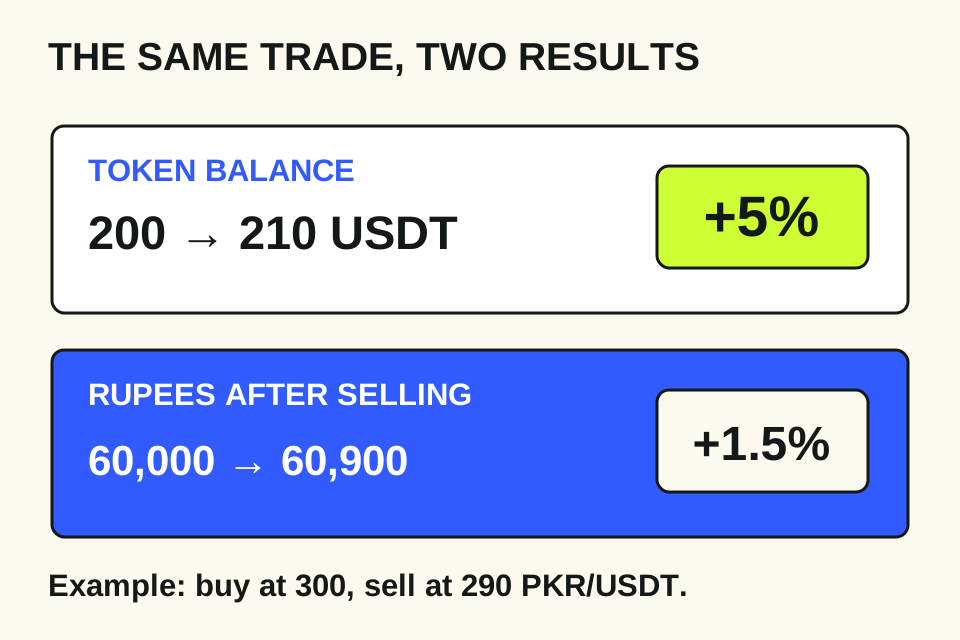
That does not mean every trader should repeatedly sell into PKR. If your next trade uses USDT, repeated buying and selling adds costs. But money needed for rent, expenses or a planned purchase should be evaluated as the rupees actually available, not the exchange's profit percentage.
What proof should you keep?
Keep the original purchase amount, the trade history showing realised results, the withdrawal or transfer ID and the final sale/payment record. Together they distinguish a return of your own capital from a trading gain. A screenshot of a futures balance cannot establish that by itself.
If a withdrawal is held for review, use the provider's official support process and obtain the stated reason. Do not send another payment to a supposed agent who promises to unlock it. Separately, a bank review must be answered through the bank; closing an exchange support ticket does not automatically resolve a payment-provider restriction.
Is crypto futures trading legal in Pakistan in 2026?
Pakistan has moved beyond the old argument that crypto is either completely banned or completely unregulated. PVARA now publishes a licensing framework and final August 2026 regulations. Those rules cover different activities, including derivatives. The useful question is which business is authorised to provide which service to which customer.
What a Binance or HTX NOC means
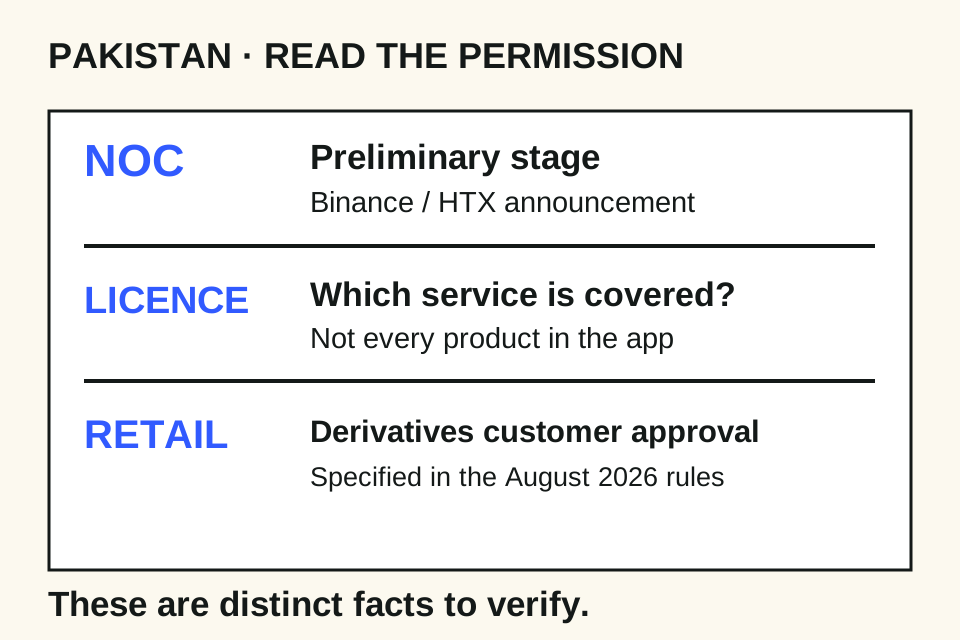
An NOC is a preliminary regulatory step. PVARA announced NOCs for Binance and HTX on 12 December 2025. Its licensing process still distinguishes that stage from a full licence. Binance's own announcement describes its progress towards a local structure and full permission; it should not be rewritten as proof that every product is already locally approved.
For futures, the activity-specific regulation goes further: a provider needs the derivatives category and explicit approval for the customer classes it serves, such as retail customers. This matters because permission to exchange or hold coins is not automatically permission to offer leveraged Bitcoin positions to ordinary users.
What happened to the September deadline?
PVARA's notice gave existing transitional providers a 5 September 2026 application deadline. This review is dated after that deadline. It would be wrong to describe it as a future event or to conclude that all existing apps automatically became prohibited on that day.
The final Services Regulations allow certain existing providers that submitted complete, timely NOC applications to continue existing services while a decision is pending, subject to conditions and directions. That is a transitional arrangement, not unrestricted permission to launch anything or onboard anyone. Legacy approvals are also addressed in the rules.
The consequence is practical: an existing account, a preliminary approval and a fully authorised new retail futures service can have different positions. If a provider relies on transition, it should be able to explain the basis and scope applicable to the service offered to you. An influencer's registration screenshot does not settle that question.
Was the old SBP instruction a blanket ban?
In May 2025, the central bank clarified that its 2018 advice to regulated institutions reflected the absence of a framework, rather than a declaration that virtual assets were illegal throughout Pakistan. Its 2026 banking circular then replaced the earlier instruction. An article relying only on the 2018 text is not describing the present framework.
What the new SBP banking rules change for deposits and withdrawals
The SBP circular allows a bank to open accounts for PVARA-licensed providers after checking the licence and relevant controls. Where client-money accounts are used, the circular specifies PKR accounts separated from the provider's own funds. It also says these accounts are non-remunerative and cannot accept cash deposits or cash withdrawals.
For the reader, this points towards a more identifiable banking relationship with a licensed provider. It is not permission to hand cash to an unofficial local agent or a promise that your preferred exchange already has such a client-money account. The actual licensed entity and the beneficiary named in the deposit instructions matter.
NOC holders receive narrower treatment: accounts for completing licensing formalities, with virtual-asset transactional activity dependent on obtaining the licence. This is the important difference behind headlines saying that banks can now serve crypto businesses. The headline alone does not prove that a particular NOC holder can offer you direct PKR deposit and withdrawal today.
Does this remove P2P from the equation?
Only when a genuinely available, permitted direct service replaces the transaction you need. A future bank integration or a regulatory announcement does not make a current P2P order a bank deposit into the exchange. Compare the service displayed to your verified account, including who receives your payment and who sends money back.
For larger sums, this distinction can outweigh a small difference in price. Receiving funds from an identifiable provider account and receiving transfers from individual marketplace counterparties are different experiences for your bank records. We have not tested a live direct PKR withdrawal for Binance or HTX and do not present one as verified here.
The circular also keeps other applicable foreign-exchange rules in place. A new crypto framework does not mean every outward card payment or foreign-currency transfer must be accepted. If a bank declines a method, select a genuinely supported method rather than disguising the payment purpose.
Karachi, Lahore, Islamabad and Pakistanis living abroad
The PVARA and SBP materials used here operate at the national level. We did not identify a separate city permission that makes the same offshore futures account approved in Karachi but prohibited in Lahore or Islamabad. The same national licensing framework is the starting point in each city.
What can vary locally is practical: your own bank or wallet account, the documents it holds, the size of a permitted payment and the service available to the exchange account. Those differences can change a funding choice without changing which regulator oversees the virtual-asset provider.
Pakistani passport, different country of residence
If you live in the UAE, Saudi Arabia, the UK or another country, start with that residence when checking product eligibility. A Pakistani passport does not automatically place your account under the same service terms as a resident in Pakistan. Some destinations restrict retail derivatives even when buying crypto is allowed.
Do not keep an old address to retain a preferred product. Ask the exchange how a move affects open positions and withdrawals before changing residence details or opening a replacement account. The relevant question is what the actual customer is permitted to use, not which country's page has the most attractive ranking.
Are DEX perpetuals a shortcut around the local rules?
No. A wallet interface changes custody and how you interact with the service; it does not make Pakistani law irrelevant. It can also add blockchain fees, network-specific collateral and smart-contract exposure. A trader comfortable with those differences may compare a legally available product, but the absence of a conventional signup form is not proof of unrestricted access.
For a newcomer whose aim is a PKR-funded Bitcoin position, a DEX also does not solve the bank exit on its own. It should be considered for a particular trading or custody need, not placed above the documented exchange candidates simply because it asks for fewer details at the first screen.
Other questions Pakistani futures traders ask
Is there a fixed minimum PKR amount to start?
There is no single minimum across a rupee purchase, an internal transfer and a futures contract. A P2P seller can impose an order minimum, while the contract has its own minimum position and margin requirements. A small budget that clears the purchase minimum may still leave too little usable balance after costs. Check the full transaction rather than treating a tiny advertised futures minimum as the total cash needed.
Does a PVARA licence make leveraged trading halal?
Regulatory permission and a religious assessment are different questions. A licence does not certify a contract as Shariah-compliant. Anyone needing that assessment should have the actual contract, financing and funding arrangements reviewed by a qualified adviser. A broad label attached to Bitcoin or to the exchange does not settle every futures product it offers.
What tax percentage should I deduct?
This review does not establish a universal Pakistani crypto-futures tax percentage. Do not import a neighbouring country's rate or treat an unverified social post as an FBR rule. Keep a record of capital introduced, realised results, fees and PKR conversions, then establish the treatment for your own circumstances. A regulatory NOC is neither a tax exemption nor proof that an exchange has settled your tax obligations.
Should I trust a local signal seller's preferred exchange?
Look at the actual decision being justified. Does the recommendation identify an available contract, relevant cost or usable payment method, or only a signup reward and a large profit screenshot? A signal seller can benefit from activity even when the follower loses. A useful exchange comparison should still make sense without assuming the advertised trades will succeed.
What would make us change the shortlist?
A verified retail derivatives permission, a tested direct PKR deposit and withdrawal service, or a meaningful difference in the costs of the selected contract could change this order. Those would improve the product the reader can actually use. A new sponsorship, a bigger leverage banner or an application announcement alone would not establish the same advantage.