Where you live changes the answer
For a mainland resident looking for a Bitcoin or Ethereum perpetual account, we do not recommend an exchange. The 2026 national rules maintain the prohibition on virtual-currency business and address overseas providers serving domestic users. A ranking of offshore referral links would give the wrong answer to that search.
The regional sections below cover Hong Kong, Macau and Taipei. Their local account rules differ from the mainland position; the Hong Kong and Taiwan guides now provide the fuller exchange comparisons.
| Where the account holder lives | What this review establishes | What not to assume |
|---|---|---|
| Mainland China | No recommended resident crypto-futures account | An overseas app is a legal exception |
| Hong Kong | Licensed spot market; a professional-investor perpetual framework | Every retail account can trade perps |
| Macau | Restrictive financial-services position; no local retail-perps route established | Hong Kong permissions apply next door |
| Taipei (Taiwan account rules) | Local TWD crypto services and a new law with commencement pending | VASP registration is a futures licence |
Is crypto futures trading allowed in mainland China?
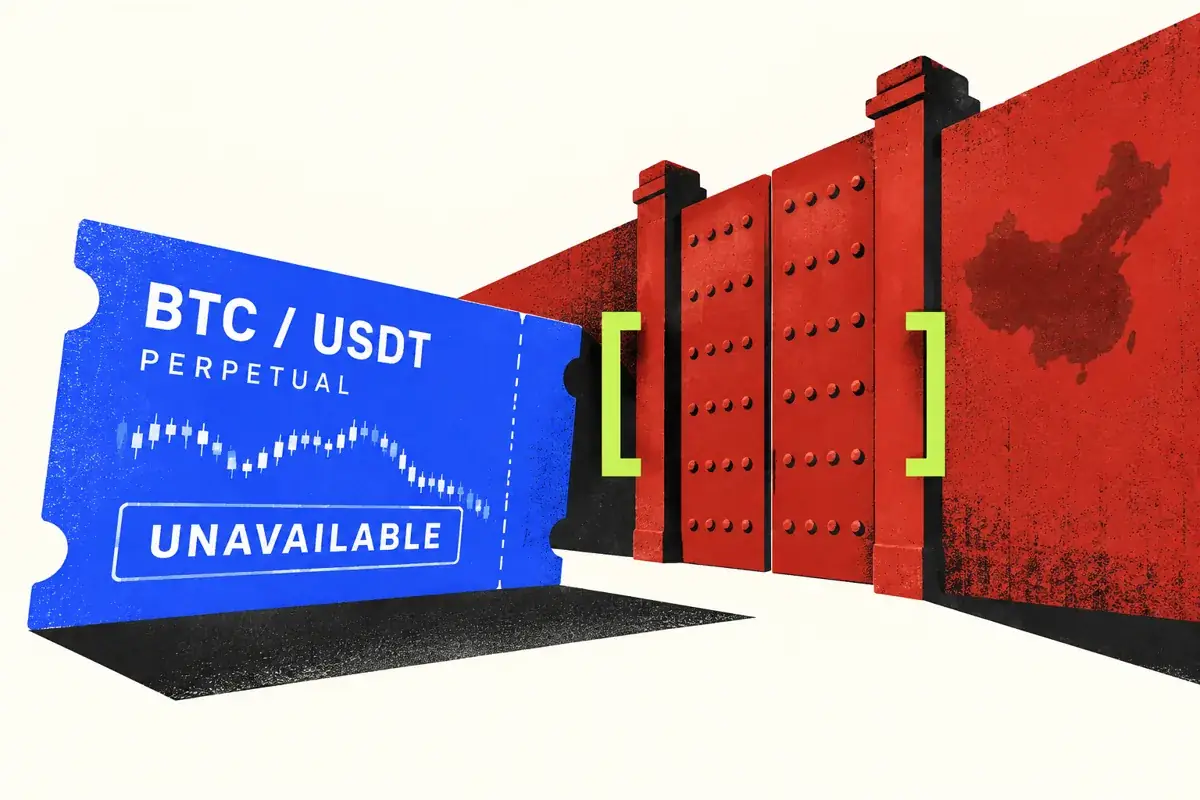
The notice issued by eight authorities on 6 February 2026 replaces the 2021 notice commonly quoted in older exchange guides. It treats the specified virtual-currency businesses, including exchange and related financial-product activity, as prohibited illegal financial activities. It also restricts the financial and payment services supporting them.
For the reader choosing a platform, the answer is therefore direct: an account advertised as offshore is not a supported retail futures route from the mainland. We leave the commercial shortlist empty here. That is a decision based on the applicable rule, not an unfinished comparison or a failure to find enough exchange names.
Did China reopen crypto in 2026?
No. The accompanying PBOC–CSRC explanation says the prohibitive policy continues. It also addresses newer subjects such as tokenised real-world assets and stablecoins. References to authorised financial infrastructure in that discussion should not be reinterpreted as general permission to open a BTC perpetual account.
This matters when a headline uses a broad phrase such as digital assets. A project involving a tokenised financial claim is not automatically the same product as a retail leveraged bet on Bitcoin. Read what activity was authorised and for whom before drawing a trading conclusion.
Do Shenzhen, Hainan or another special zone change this?
We found no exception in the reviewed national framework that creates a general retail crypto-perpetual route merely because someone is in Shenzhen, Hainan or another mainland development zone. The official explanation assigns local implementation responsibilities across provincial authorities. A technology pilot or a special economic label is not enough to establish an exemption.
What if you already own crypto or have an account?
Do not collapse three different questions into one: owning a balance, providing a crypto financial service, and using assets linked to unlawful activity. A restriction on a business is not proof that every individual holding a private key commits the same offence. Equally, a discussion of property rights does not establish permission to open a leveraged trade.
The mainland notice says investments that violate public order can produce invalid civil transactions, with resulting losses borne by the participants. A court recognising that an asset has value is consequently not a guarantee that a speculative trading agreement will be enforced as you expect. The facts of a dispute still matter.
If you need records or access to old funds
Use the provider’s official account process to request statements, trade history and instructions for the existing balance. Explain your actual residence and ask separately about closing positions and withdrawing assets. Those tasks are different from asking to open new exposure. We cannot promise that an account under review will have an immediate withdrawal window.
Why a P2P payment can become a different problem
The Supreme People’s Court’s money-laundering interpretation addresses virtual-asset transfers used to conceal the origin or nature of criminal proceeds. That is not a statement that every crypto transfer is money laundering. It does explain why a seemingly ordinary payment can trigger questions when the other side’s funds are connected to a crime.
Hong Kong: a separate crypto market
Hong Kong has SFC-licensed platforms such as HashKey and OSL. Its February 2026 perpetual-contract framework concerns professional investors; it is not a general opening of retail perpetuals. Local spot access and approval for a leveraged product remain separate decisions.
HashKey’s account-opening requirements also distinguish genuine overseas residence from a visit by a mainland resident. The dedicated Hong Kong guide compares the local products, professional-investor conditions, HKD funding and international exchanges’ restrictions.
Read the Hong Kong crypto leverage guideTaipei: TWD funding and crypto leverage
Taipei residents use Taiwan’s financial rules and local New Taiwan dollar services. MAX provides a documented TWD spot entry and exit; the international derivatives account is a separate choice. An AML registration for a local exchange does not license every futures product.
The FSC record dates the Virtual Asset Service Act to 22 July 2026, with commencement to be set separately. The Taiwan guide examines the current framework, compares Kraken, Bitget and Bybit under their published location policies, and explains the cost of moving between TWD and trading collateral.
Taiwan crypto leverage: exchanges, TWD and local rulesDoes Macau offer the same crypto access as Hong Kong?
No. Macau has its own monetary authority and financial-services rules. AMCM’s published position describes Bitcoin as a virtual commodity rather than legal tender and says banks and payment institutions must not directly or indirectly provide the specified virtual-currency financial services. Its later warning also addresses unauthorised crypto-related financial business.
The important trading conclusion is that a Hong Kong platform licence is not evidence of a locally authorised Macau futures service. Geographic proximity does not turn the two markets into a single account territory. We have not established a local retail crypto-perpetual route to recommend in Macau.
Did the September 2026 court decision open crypto trading?
The Macau final court’s 4 September 2026 news concerns a trademark appeal. The decision partly allowed registration for services outside the disputed crypto scope while maintaining the refusal concerning the virtual-currency services at issue. It was not the launch of a crypto exchange licensing regime.
That is a useful example of why the detail behind a headline matters. A business winning part of a branding dispute does not mean a resident can open a leveraged trading account with it. A trademark identifies a brand; it does not replace financial permission.
What about the digital pataca?
Macau’s 2026 policy address discusses developing the digital pataca. A digital version of local money is a payment project, not a licence for Bitcoin perps. Do not interpret a government digital-currency announcement as approval for a private token platform offering leverage.
For a Macau resident with an existing overseas account, the unresolved questions are the provider’s actual residence conditions and the applicable local rules. An accepted Hong Kong dollar transfer or a working mobile app does not settle either one. We therefore keep this section informational rather than supplying a signup link.
Is the digital yuan the same as USDT?
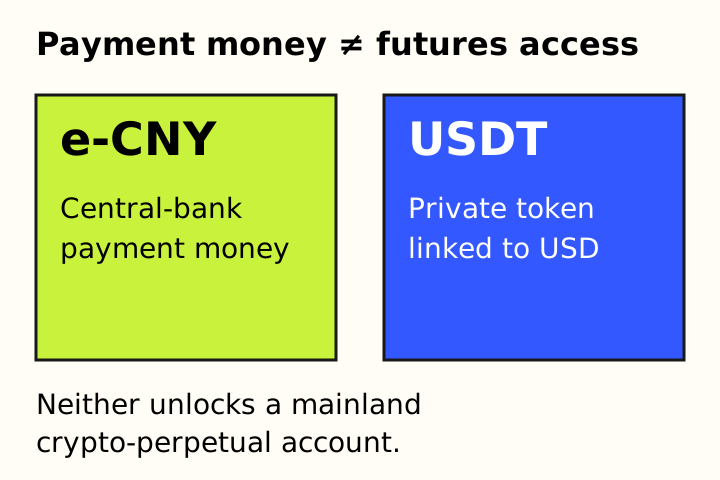
No. The e-CNY payment pilot described by HKMA lets eligible Hong Kong users open wallets for retail payments, including a top-up connection through the Faster Payment System. It is a public-money payment arrangement, not a stablecoin futures account.
USDT, a crypto exchange’s internal dollar balance and e-CNY should not be treated as three labels for the same money. A payment wallet being available does not tell you where a BTC contract is traded or which asset can back its losses. The first question is what the service lets you do, not whether its interface shows a digital balance.
The same caution applies to mainland discussion of renminbi-linked stablecoins and real-world-asset tokens. The 2026 official explanation addresses issuance and controlled activities; it does not establish a general retail leverage channel. We mention these developments because they are often presented as evidence of a reopening, not because they replace the subject of crypto futures.
What changes if you genuinely move?
A real move can change the service for which you are eligible. A visit, a different phone number or a connection routed through another place does not establish the same thing. Keep the account’s residence information accurate and let the provider assess the documents rather than selecting whichever location displays the most products.
For example, HashKey’s documented distinction between a mainland passport and eligible long-term residence can matter to someone who actually relocates. It is not an instruction for a mainland resident to present a tourist stay as a new home. The receiving platform still decides the account category and the available product.
Before moving an existing leveraged account
Ask what happens to open positions after the residence change, not only whether a new registration is possible. A service may allow an orderly exit while preventing new trades, or require an account transfer to a different entity. Obtain instructions for your actual account before a deadline forces a rushed decision.