















Binance or idax for crypto futures in Mongolia?
Binance makes the stronger starting point for a Mongolian trader seeking international crypto futures: it now documents both buying and selling supported stablecoins with tugriks. That is a useful advantage over an exchange that offers a contract but leaves you to find a separate MNT conversion service. Check that the futures product is enabled for your verified account before paying in.
The local challenger is idax Mongolia. Its help centre describes a futures wallet, leveraged orders and trading fees, while the Financial Regulatory Commission’s first-quarter 2026 report identifies the Mongolian company behind the service. That gives a reader something more concrete than an international exchange merely omitting Mongolia from a blocked-country list.
Choose between these two on the trade you intend to make. Frequent trading makes commission and execution quality important. A preference for a locally identifiable business makes idax worth examining even when its published commission is higher. Neither preference proves that one venue will give you the best fill on every BTC or altcoin order.
| Option | Where it fits | What to confirm first |
|---|---|---|
| Binance | International futures plus documented MNT buy and sell facilities | Futures approval and the bank method offered to your account |
| idax Mongolia | A local company with a published leveraged-trading workflow | The exact contract, live order book and available leverage |
| X-Meta | Buying supported coins with tugriks without a leveraged position | Spot price and withdrawal route; not a futures substitute |
The broader catalogue remains below for readers with a particular platform in mind. This shortlist is deliberately more selective: access to an exchange, access to its derivatives and a useful way to move tugriks are three different benefits. We have not performed live funded trades or timed withdrawals on these accounts.
Can you buy crypto directly with Mongolian tugriks?
Binance’s MNT purchase guide, published in June 2026, describes a bank-payment option inside the app. It names USDT, USDC, USD1 and U as supported purchases. That is more specific than saying the exchange accepts Mongolian money: the documented purchase is a stablecoin purchase, not a direct order for every asset or futures contract on the platform.
The practical benefit is that you can inspect a conversion quote before deciding whether to trade. For a BTC/USDT perpetual, USDT is the straightforward asset to investigate first. Buying a different supported stablecoin can add a conversion if the intended contract does not accept it as margin. Four buying choices do not mean four interchangeable futures balances.
Complete identity checks and look at the supported bank options in your own account. The guide allows additional verification, so do not send a bank payment using instructions copied from another customer’s screenshot. Review the amount of stablecoin you will receive, not just the tugrik amount leaving your bank.
Most completed purchases are described as quick, but Binance allows up to one business day for some reviews. If the deposit is still processing, a price move in Bitcoin does not mean your intended futures trade was opened. A purchase order and a leveraged trading order are separate records.
The three letters that can send you to the wrong market
In a Mongolian bank payment, MNT means tugriks. In a crypto market such as MNT/USDT, MNT can mean the Mantle token. Buying Mantle does not turn your account into a tugrik balance, and shorting Mantle is not a bet against Mongolia’s currency.
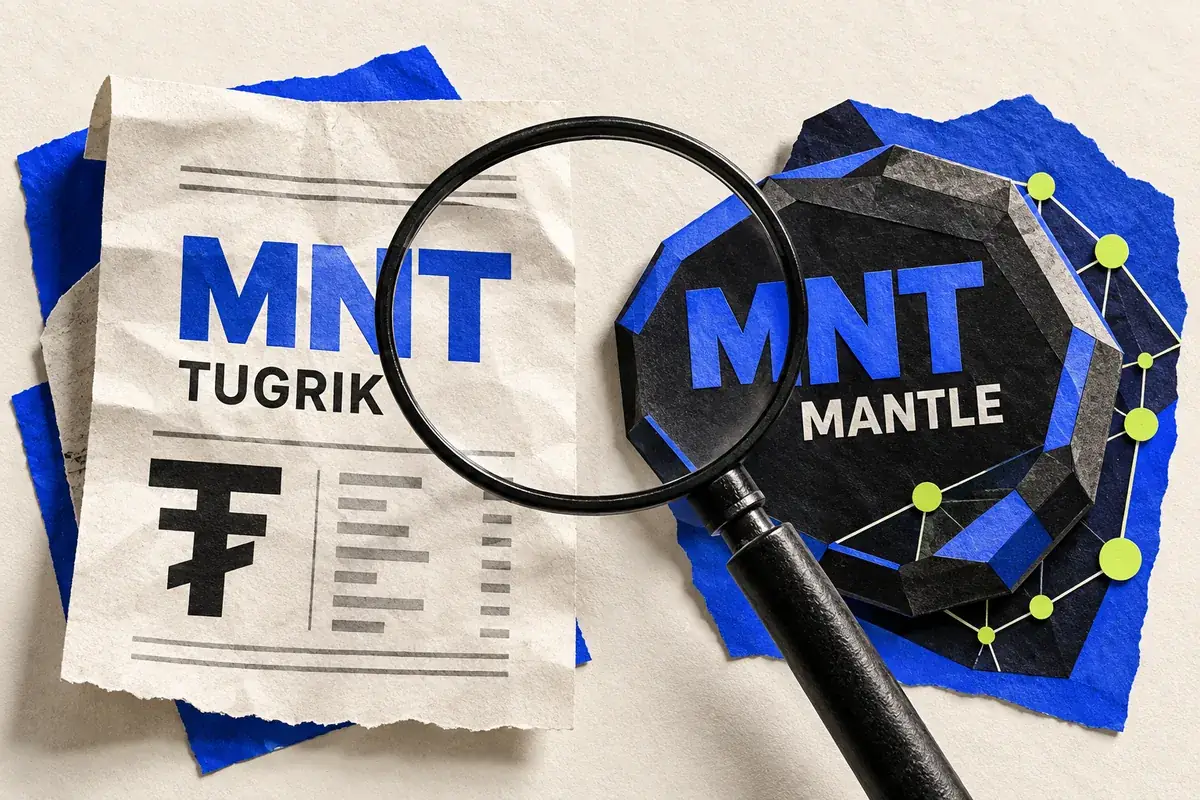
This matters when searching an exchange app. Use its local-currency payment area for a tugrik purchase; read the asset name when opening a trading pair. A search result containing “MNT futures” may be about the token rather than futures access in Mongolia.
What does idax offer beyond a local bank connection?
idax’s futures guide describes USDT-margined and coin-margined products, a leverage selector and transfers from the fiat or spot wallet into a separate futures wallet. In plain English, the money you deposited is not automatically the money backing an open position. The futures screen must show usable margin before an order can draw on it.
Its local status can make the business easier to identify. The FRC report lists Idax LLC, registration number 6803016, and the idax.exchange domain. That exact pairing matters more than a familiar exchange name in an advertisement. We use this Mongolian service in the comparison, rather than assuming every similarly named platform belongs to the same business.
Local registration has limits. Mongolia’s virtual-asset law explicitly says registration does not guarantee the asset or make the state responsible for customers’ losses. A futures contract can therefore be offered by an identifiable local provider and still expose you to liquidation, custody problems and poor execution.
When would paying more for idax make sense?
If local account administration is your deciding factor, investigate idax before rejecting it on fees alone. Its published terms give you a Mongolian contractual relationship to examine. Ask how your exact withdrawal and complaint would be handled, rather than paying extra solely because the homepage is in Mongolian.
If you mainly want frequent BTC perpetual trades and already meet Binance’s account requirements, the lower published base commission favours checking Binance first. That conclusion is about commission; it is not a claim that we measured better liquidity or customer support. Compare the live order preview on the same trade size before choosing.
X-Meta serves a different use case. Its site advertises MNT purchases and sales for spot crypto. That can suit someone buying coins to hold, but a spot purchase does not provide the long and short leveraged exposure that this guide is primarily about.
How much do Binance and idax futures cost?
The reviewed idax schedule lists a 0.05% maker fee and a 0.1% taker fee for futures. Binance’s published regular-user USDT futures reference lists 0.02% and 0.05%, respectively, before any BNB discount. The rate shown for your actual account and contract takes precedence; regional schedules, promotions and account tiers can differ.
“Maker” means your order waits in the book and adds an offer for somebody else to trade against. “Taker” means it trades against an existing offer. A limit order is not automatically a maker order: if it matches immediately, it can be charged as taker.
Here is a like-for-like calculation using 2,000 USDT of exposure at entry and exit. The position value is held unchanged to isolate commission. It is an example, not a quote for a future trade or a prediction of profit.
| Execution | Binance reference | idax published rate |
|---|---|---|
| Maker entry and taker exit | 0.40 + 1.00 = 1.40 USDT | 1.00 + 2.00 = 3.00 USDT |
| Taker entry and taker exit | 1.00 + 1.00 = 2.00 USDT | 2.00 + 2.00 = 4.00 USDT |
The comparison favours Binance’s reference tariff. But it does not mean that changing platforms saves the same amount on every trade. The actual exit value can change, and commission is only one part of the result. A worse fill can cost more than the commission difference, particularly on a thinly traded altcoin.
Why a small balance can make the fee feel larger
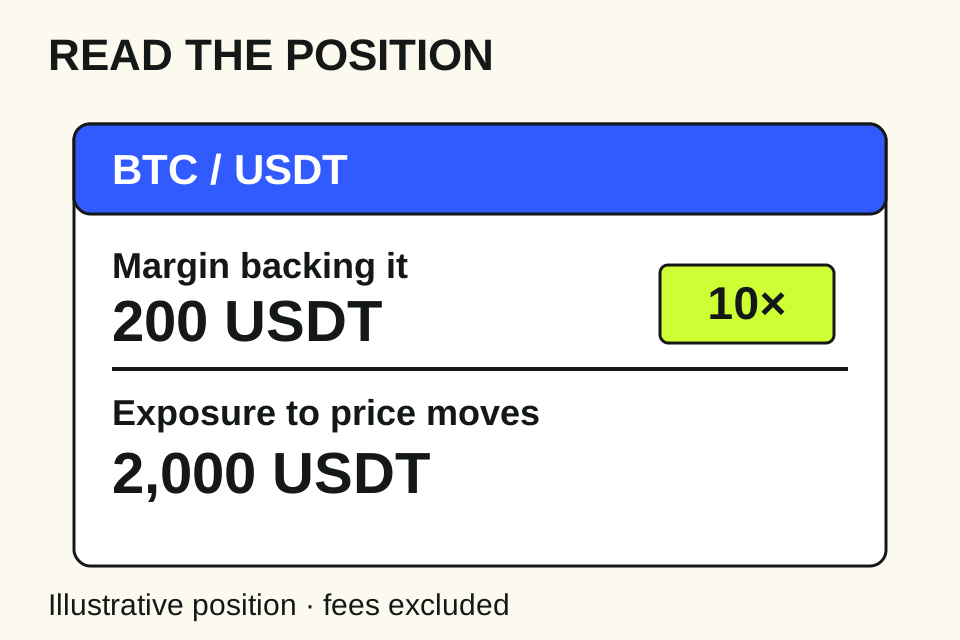
If 200 USDT backs a 2,000 USDT position, a 2 USDT round-trip commission equals 1% of that margin. The exchange did not charge a 1% trading rate; the position was ten times the margin. This is why comparing fees as a percentage of the deposit can be misleading when the two examples use different leverage.
Funding is separate. idax describes periodic payments between long and short holders. A displayed positive rate normally means longs pay shorts, and a negative rate reverses the direction. An illustrative 0.01% payment on 2,000 USDT is 0.20 USDT for that settlement. It is not a fixed Mongolian tax or a guaranteed daily charge.
For a quick trade, the entry and exit prices may dominate. For a position held through several funding settlements, the running payments deserve more attention. Check the rate and next settlement for the actual contract instead of multiplying one observed rate into a promised monthly cost.
Which margin balance should you use for Bitcoin leverage?
A USDT-margined BTC contract is usually easier to read when your starting question is, “How much stablecoin have I gained or lost?” A coin-margined contract adds another moving part: the asset backing the position can change in value while the trade is open. Neither choice removes the conversion back to tugriks when you eventually spend the money locally.
This is a practical reason to avoid selecting a contract solely because it displays the largest leverage number. Begin with the asset you can fund and withdraw, then compare the available BTC or ETH contract. A higher maximum multiplier does not make a mismatched collateral asset a better fit.
The idax guide shows a leverage selector but does not establish one dependable maximum for every contract. We therefore do not label idax “100×” or “200×” from an unsourced comparison chart. On either exchange, the limit can depend on the selected market, position size and account. Your own order screen supplies the usable figure.
A simple position check before you confirm
Read the order as two amounts: what backs it and what moves with the coin price. If your 200 USDT backs 2,000 USDT of exposure, a 1% adverse price move is roughly a 20 USDT loss before costs. That is already 10% of the starting margin. The liquidation point depends on the exchange’s maintenance requirements and price calculation, so it should not be guessed by dividing one by the multiplier.
Also distinguish closing a position from placing a second trade in the other direction. Use the platform’s actual close-position controls and review the remaining position afterwards. The goal is to end exposure; an unexpected second position is not the same outcome.
Can you sell the proceeds back into tugriks?
Binance’s separate MNT selling guide describes selling supported stablecoins to a selected bank account. It asks for the receiving account details, including the account name, bank and IBAN. This provides a documented exit to investigate alongside the purchase method, instead of assuming a successful deposit guarantees a matching withdrawal.
Before relying on it, inspect the selling quote and the account requirements. Binance describes many payments as quick but allows up to one business day for bank processing or checks. Treat an uncompleted bank payment as pending, not as spendable money merely because the crypto sale appears in your history.
The tugrik result can differ from the result displayed in USDT. Your trading profit, conversion quote and any separate withdrawal charge all affect what reaches the bank. Use the actual buy and sell receipts when reviewing performance. A profitable position in stablecoin terms does not guarantee the same percentage increase in local spending power.
For idax, deposits and withdrawals have separate fee rules. Its schedule lists zero operator deposit fees, while blockchain withdrawal charges vary by asset and network. A bank or conversion charge can still sit outside the exchange’s deposit tariff. Request the current withdrawal quote for the route you intend to use rather than treating “free deposit” as “free round trip.”
Keep enough balance outside an open position for any intended transfer. Funds supporting a live trade may not all be withdrawable. Closing the position changes that calculation; moving margin out while the trade remains open can leave it more vulnerable to liquidation.
Why old Mongolia P2P tutorials can be misleading
Two different developments are easy to mix up. The APG’s 2025 Mongolia follow-up report already described work with Binance that removed the option to register as a merchant for the MNT pair. Binance’s June 2026 help pages, meanwhile, explain customer purchases and sales using MNT. The newer customer guide should not be read as a reopening of unrestricted merchant registration.
If you simply want to fund an eligible account, follow the customer service actually displayed to you. If you want to run a business exchanging tugriks for other people’s crypto, that is a separate activity with different obligations. Instructions for one role are not evidence that the other role is available.
This distinction also changes how to read an old exchange review. A five-year-old list of Mongolian payment apps, or a screenshot showing an individual’s P2P advert, may say little about the current payment process. Prefer the provider’s current purchase and sale instructions over a copied list of local payment logos.
Does location within Mongolia change the choice?
The reviewed sources do not establish separate futures permission for Ulaanbaatar and the aimags. The FRC’s first-quarter report does show that registered providers are concentrated in the capital, but that is a description of company locations, not a rule that only capital-city residents can use crypto services.
For a customer outside Ulaanbaatar, the useful questions are whether identity checks can be completed, whether the listed bank method serves their account and whether support can resolve a transfer remotely. Those details can affect usability without requiring an invented regional ranking.
Mongolian citizens living abroad need a different country check. idax’s terms address customers’ obligations where they live, and international exchanges also assess actual residence. A Mongolian passport or tugrik bank account does not automatically make the Mongolia product terms apply when your account is established elsewhere.
For this reason, use the country guide for your real residence when assessing product eligibility, then return to the MNT payment information only if that payment method is permitted for your account. The payment currency and the country governing access need not be the same.