








Which crypto exchange makes sense for a Russian resident?
Bybit is the strongest starting point in this shortlist for an eligible Russian resident trading major crypto perpetuals. Its published service policy does not exclude Russia as a whole. The important exceptions concern named territories, sanctioned persons and payment services. This recommendation assumes truthful verification and a funding arrangement permitted under the current Russian framework; the trading website alone cannot establish either.
OKX is a useful alternative for a trader who already has supported crypto collateral. Its restriction for Russia specifically names fiat-payment services. That makes it a different proposition from an exchange promising a convenient RUB deposit. MEXC remains relevant for individual altcoin contracts, but its Russia-specific list of restricted pairs makes it a weaker default for somebody who wants broad freedom to open new altcoin positions.
| Exchange | Why consider it? | What changes the answer? |
|---|---|---|
| Bybit | Crypto perpetuals with no published whole-Russia service exclusion | Named regional exclusions, sanctions screening and restricted fiat services |
| OKX | An alternative for eligible accounts with crypto collateral | Russian fiat-payment services are restricted |
| MEXC | A secondary venue for a particular supported futures pair | A May 2026 notice prevents new positions in selected contracts for Russian users |
| Kraken Derivatives | Not a Russian-resident recommendation | Russia appears on its derivatives exclusion list |
The order is based on the usefulness of the available product and the clarity of its conditions. It is not a claim that the highest advertised leverage is the best deal. For example, somebody trading an affected MEXC contract has a concrete reason to choose another eligible venue; somebody already funded on OKX may have little reason to move just to follow the first name in a ranking.
MEXC has a contract restriction, not a blanket futures shutdown
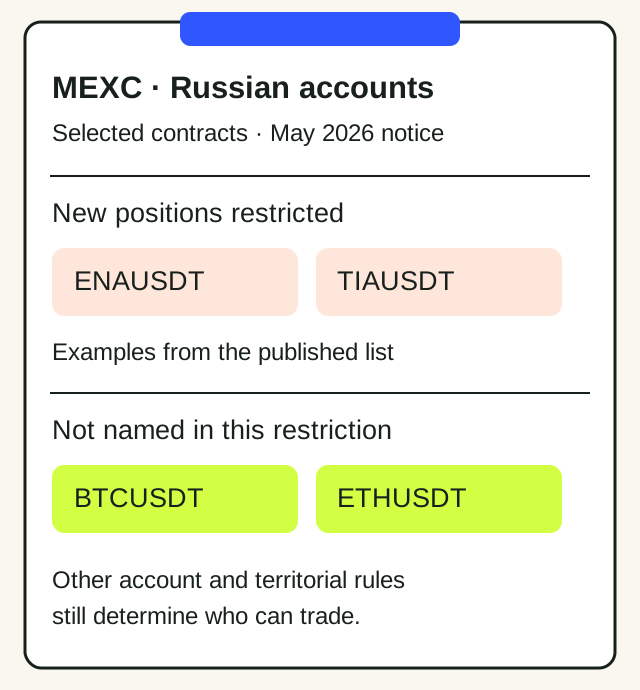
This is an important correction to broad statements that Russian users cannot trade futures on MEXC. Its May 15, 2026 notice says that, from May 18, users in Russia, Ukraine, Armenia and Belarus cannot open new positions in a specified set of pairs. Examples include ENAUSDT, TIAUSDT, FETUSDT, PENDLEUSDT and ALGOUSDT. BTCUSDT and ETHUSDT are not on that published list.
The notice expressly allows trading in other futures pairs. It also distinguishes opening a new position from managing an existing one: closing trades and adjustments to existing positions remain possible under the notice. An order that reduces an old position therefore does not demonstrate permission to open a new one in the same market.
For an altcoin trader, this changes how to compare venues. Start with the actual symbol you trade, not the exchange’s total coin count. If your strategy needs both opening and adding to a position, a market that only permits you to reduce an existing exposure is not a substitute. Likewise, seeing a chart or a public order book is not enough: public market data can remain visible when account permissions differ.
A sensible MEXC use case is a specific contract that remains available and offers execution you prefer. It is a poor choice to make a deposit first and only then discover that the intended pair is covered by the regional notice. Our shortlist consequently places it behind the more straightforward major-market candidates, without describing its entire futures business as closed to Russians.
What changed in Russia’s crypto rules in September 2026?
Russia now has a newer framework than the old shorthand “crypto is unregulated.” The Bank of Russia identifies Federal Law 282-FZ of August 4, 2026 and its September 1 effective date. Its explanation of the framework distinguishes domestic intermediaries from transactions abroad. A provider accepting an account does not remove these resident obligations.
For the domestic system, the central bank describes testing and an annual purchase limit of 300,000 rubles per intermediary for non-qualified investors buying the permitted liquid cryptocurrencies. Qualified investors also face a test but are described as having wider purchase access. That is a purchase framework, not a published universal leverage cap for every international BTC perpetual.
The part that matters most when choosing an offshore crypto exchange is funding. The central bank says residents’ crypto transactions abroad use foreign bank accounts, while crypto purchased in Russia can be transferred abroad through regulated intermediaries. It also describes notification of crypto held abroad. An old RUB-to-exchange tutorial cannot simply be assumed to satisfy this newer framework.
What this means for a trader choosing Bybit or OKX
Treat the exchange comparison as a product shortlist after establishing a permitted way to fund and use the account. If your entire plan depends on a domestic bank transfer to an anonymous seller, the shortlist has not solved that legal and banking issue. If you already have a legitimate foreign banking arrangement, keep the account and transfer records that connect it to your exchange funds. Do not substitute another person’s bank account for your own documented arrangement.
There is a separate July 2026 central-bank announcement about margin trading through brokers. Its own text calls the relevant ordinance a draft published for assessment. That announcement is not evidence that every retail customer has been given a new national entitlement to 50x, 100x or 200x crypto leverage. We do not use it to manufacture a leverage limit or to overrule an exchange’s product terms.
RUB deposits, crypto funding and getting money back
Bybit’s September 2026 fiat table makes a narrower statement than “Russian bank cards work.” For its general fiat services, the Russian entry allows only RUB transactions. Other rows separately restrict Russia for EUR SEPA and USD SWIFT services. An approved trading account therefore should not be read as permission to use every currency shown elsewhere on the website.
OKX gives a different answer: its risk disclosure restricts fiat-payment services for Russia. That is why our OKX recommendation is for the eligible crypto-funded account, not an advertised RUB cash-in service. Even then, the Russian funding rules discussed above still apply. Availability on the receiving exchange and permission for the money movement are two separate questions.
Compare the amount that reaches collateral
For a hypothetical 100,000-ruble budget, suppose a permitted funding method would credit 1,050 USDT and another would credit 1,020 USDT after conversion and transfer charges. Those are illustrative quotes, not current RUB exchange rates. The difference is 30 USDT before a single futures trade. A slightly cheaper execution commission cannot automatically recover that initial cost.
Ask the same question in reverse before assuming a profitable position is easy to cash out. A 1,100-USDT futures balance is not a promise of any particular number of rubles in a Russian bank account. The withdrawal network, receiving service, conversion quote and bank acceptance can all change the amount. A deposit method also need not have an identical withdrawal method.
When receiving crypto from another account, retain the transaction reference and the source-of-funds record. In this market, a clean explanation of how funds were obtained is useful when a transfer is reviewed. Avoid spending the entire available budget on collateral if the intended exit still requires a network fee or conversion charge in a different asset. This is especially relevant when the balance is profitable on screen but the withdrawal asset differs from the settlement asset.
How much leverage and what fees can Russian traders expect?
There is no single “Russian account leverage” number established by these providers. The allowed size depends on the contract, its risk tier and the account’s permissions. Bybit has published changes to selected BTC and ETH risk limits during 2026; its support material also uses a BTCUSDT example with a 150x maximum at the smallest risk tier. Neither statement promises 150x on every coin or on a large position.
For somebody choosing a platform for BTC or ETH, the useful number is the maximum at the position size they intend to trade. A headline maximum on a small BTC position says little about an altcoin trade or an account that already has several open orders. Read the actual order panel and applicable risk tier together. Our Finder’s model is an estimate based on the available contract data, not an override of those account controls.
| Venue and schedule | Maker | Taker | Illustrative 10,000-USDT taker order |
|---|---|---|---|
| Bybit standard non-VIP derivatives | 0.020% | 0.055% | 5.50 USDT for one fill |
| OKX published regular futures tier | 0.020% | 0.050% | 5.00 USDT for one fill |
At the quoted rates, a 10,000-USDT market entry and equal-value exit cost 11 USDT on Bybit or 10 USDT on OKX. Funding, slippage, conversion and withdrawals are extra. Regional schedules, VIP tiers and promotions can change the account’s rate.
The one-USDT difference in that round-trip example is useful perspective for Russian traders weighing a fresh transfer against using an existing account. It may matter across many trades; it is easily outweighed by a worse RUB conversion on a single funding transaction. A limit order is not automatically cheaper either: if it immediately takes liquidity, the taker rate can apply. Compare actual fills rather than the label on the order button.
Keep the ruble payout tied to the permitted payment method
A RUB quote is useful only when the payout can reach the trader’s own permitted receiving account. The sanctions and payment restrictions discussed above can remove a bank or method without changing the contract’s USDT result.
Keep the actual ruble funding debit and payout receipt alongside the exchange ledger. Do not use a quote from an unavailable payment method to label a different exchange cheaper, or confuse the futures profit with the proceeds from a separate token sale.
Crimea, Donetsk and Luhansk: which recommendations stop applying?
The international shortlist above is not a recommendation for residents of every territory discussed on this page. Crimea, Donetsk and Luhansk are expressly excluded in the relevant Bybit, OKX and MEXC documents. For a resident in those locations, changing the preferred exchange within this three-platform shortlist does not solve the account-access problem.
These are provider restrictions attached to location and compliance, not a judgement about readers living there. A person can have a valid passport and still fail the geographical condition. The same is true when an exchange continues to publish a Russian-language interface or a public BTC price for visitors from many countries.
| Location | Bybit | OKX | MEXC |
|---|---|---|---|
| Crimea | Named exclusion | Named exclusion | Named exclusion |
| Donetsk and Luhansk | Named exclusions | Named exclusions | Named exclusions |
| Sevastopol | Named separately | Crimea restriction requires attention to the actual location | Named separately |
| Kherson and Zaporizhzhia | Do not infer approval from an abbreviated list | Individual sanctions and location screening still apply | Named exclusions |
A particular issue in Bybit’s wording: Rostov
The current Bybit page also names “Rostov” in its list. Its surrounding geographic wording is imprecise; we are not adopting that wording as a geographic description. We are treating the named exclusion as a real published account restriction. A Rostov resident should not rely on this page’s Bybit recommendation while that entry remains in force.
An existing customer receiving a restriction notice needs the account’s instructions for managing positions and permitted withdrawals, rather than a fresh-account referral. A withdrawal may have a different review process from opening another trade. Changing an address field, using another person’s documents or disguising a location does not establish eligibility and can make an existing balance harder to recover.
For these excluded areas, we do not replace the unavailable partners with a speculative “no-KYC” exchange. A replacement would require its own current terms, actual territorial acceptance and a permitted funding arrangement. The useful answer here is specific: the three international providers assessed in this shortlist do not supply a normal recommendation for Crimea, Donetsk or Luhansk residents.
Kaliningrad and Russian citizens living abroad
Kaliningrad is a different case from the expressly named excluded territories. The three provider documents reviewed do not list it as a separate territorial exclusion. The normal Russian-resident assessment therefore applies, including sanctions checks and the funding constraints. Its proximity to Poland and Lithuania does not make a Kaliningrad address eligible for their European exchange products.
A Polish bank account alone would not turn somebody still resident in Kaliningrad into a Polish-resident derivatives client. Conversely, a Russian citizen who has genuinely moved to Poland should not be treated as if citizenship automatically proves continued residence in Russia. Identity, present residence, the provider’s own policy and the applicable sanctions exception all have to be read accurately.
Living in the EU, EEA or Switzerland
The European Commission’s March 2026 sanctions guidance describes exemptions under Article 5b(3), including qualifying temporary or permanent residence permits in the EU, EEA or Switzerland. This matters because the broader restriction can otherwise concern Russian nationality as well as residence. A qualifying permit can change that analysis; a holiday booking or a short visit is not the same evidence.
The exemption does not require every exchange to accept the applicant or override an individual asset freeze. It means a Russian passport is not, by itself, the complete answer for a documented resident covered by the exemption. Submit the identity and residence documents together, use the correct country product, and obtain approval under that entity’s requirements. Do not assume a global Bybit account and Bybit EU have interchangeable futures offerings.
Moving to another non-EU country
A move to Georgia, Armenia or Kazakhstan also requires a new country-specific review. These destinations have different exchange entities, fiat services and product conditions; “outside Russia” is not a single permission category. In particular, MEXC’s contract notice covers Armenia as well as Russia. Moving there does not remove the named-pair restriction simply because the residence country changes.
For an existing open position, ask for the migration treatment before changing the account’s entity. The relevant question is whether that contract and collateral balance can remain open under the new account, not whether the new country has a generally positive reputation for crypto. Keep the old and new residence dates with the trading exports so the account history remains understandable.
What does Moscow Exchange actually offer for crypto leverage?
There is now a concrete domestic alternative for eligible qualified investors. MOEX announced the September 22, 2026 launch of automatically renewed one-day contracts on its Bitcoin, Ether, Solana, Ripple and Tron indices. The symbols include BTCUSDF and ETHUSDF. They are crypto-linked derivatives, not an ordinary spot Bitcoin purchase.
The exchange says these contracts are restricted to qualified investors. Prices are quoted in US dollars while settlement is in Russian rubles. This is useful for a reader who wants local market infrastructure and ruble settlement, but it is not interchangeable with transferring USDT into an international perpetual account. The broker providing access also has to support the contract and approve the client.
We place this option after the international crypto-exchange comparison because it answers a different need. A qualified reader already using the domestic market may find it the simpler operational choice. A reader without that status should not be sent to a product they cannot trade, or told that buying a crypto-linked fund automatically gives the same leveraged exposure.

The relevant leverage is driven by the contract’s required collateral and the broker’s terms. An international “150x” advertisement cannot be pasted onto BTCUSDF. For qualified investors prioritising ruble settlement, that domestic structure can matter more than the international exchange's headline multiplier.
Russian tax: separate coin sales, futures and mining
The Federal Tax Service distinguishes digital-currency disposals from mining income. Its guidance gives a 13% rate on the relevant disposal-income band up to 2.4 million rubles and 15% on the excess. Mining falls under a different progressive framework. A futures trader should therefore avoid borrowing a headline mining-tax rate simply because both activities involve crypto.
FNS guidance also identifies securities and derivatives among income categories using a special two-tier 13%/15% scale. The important unresolved step for a particular international product is its Russian tax classification: a USDT-settled perpetual is not made identical to selling a Bitcoin merely because both balances appear in one exchange account. The legal contract, settlement asset and treatment of expenses determine the correct calculation.
As a rate illustration, an applicable taxable base of 3 million rubles would produce 312,000 rubles on the first 2.4 million and 90,000 on the remaining 600,000: 402,000 in total. That is an example for a base to which this two-tier scale applies. It does not establish that every account profit belongs to that base, that all losses are deductible, or that a non-resident uses the same rules.
The record that makes a futures return understandable
Keep the executed trades, realised contract gains and losses, funding payments, commissions and transfers of collateral separately. Add the ruble valuations used for reporting and the acquisition record for any coin later sold. Otherwise the same transfer can be mistaken for fresh income, or a later disposal can lose its documented acquisition cost.
For a trader receiving USDT profit and subsequently converting it into rubles, retain both events rather than only the final bank credit. The exchange’s profit summary and the bank statement describe different parts of that history. This is the useful preparation before determining the treatment of the particular offshore contract; it is more reliable than applying 13% to every withdrawal.