






Which crypto futures exchange makes sense in Belarus?
Bybit is the international candidate in this review for someone whose verified residence and funding arrangements permit its service. Dzengi and FREE2EX deserve a separate comparison for people living in Belarus: they offer locally operated leveraged trading, with Belarusian payment options. They are not simply smaller copies of a global perpetuals exchange. The products, cost of entering with rubles and treatment of customers living abroad can lead to a different choice.
The most useful starting question is where your trading money already sits. If it is Belarusian rubles in a local bank, a cheap global futures commission does not solve the cash-to-crypto step. If you already hold crypto lawfully, the comparison changes. If you have moved abroad, your present residence may matter more than your Belarusian passport. Those are three different situations, not three reasons to recommend the same exchange automatically.
| Situation | Candidate to examine | What decides the choice |
|---|---|---|
| Eligible international crypto-funded account | Bybit | Actual derivatives approval, lawful funding and account-specific fees |
| Belarus resident wanting BTC or ETH leverage with local funding | Dzengi | Selected-pair commission, bank funding and position financing |
| Belarus resident comparing a second local leveraged platform | FREE2EX | Margin-account product, higher base commission and actual instrument conditions |
| Belarusian living in Russia | FREE2EX or an eligible international provider | Dzengi excludes Russian residents, even when they are Belarusian citizens |
Our lead is not a claim that every Belarusian can open the same Bybit account or that foreign derivatives receive blanket approval under Belarusian law. It is the platform to investigate for international crypto futures where the customer's situation permits it. For a resident starting with BYN, the local comparison below is more immediately useful than a long list of offshore logos.
Bybit perpetuals, Dzengi leverage and FREE2EX: what are you actually trading?
Bybit: a crypto contract, with different settlement choices
Bybit offers USDT-settled, USDC-settled and inverse derivatives. For a beginner who already has stablecoins, a linear contract is easier to follow: the gain or loss is settled in the contract's stated currency rather than requiring a growing Bitcoin balance to back a losing Bitcoin trade. That does not remove liquidation risk; it makes the unit used to measure the result less confusing.
Choose the particular market before choosing the leverage slider. BTCUSDT perpetuals, an inverse Bitcoin contract and a dated future are not interchangeable. A perpetual has recurring funding, while a dated contract has an expiry. An expiry can be useful when you want a position for a defined period; it also means you cannot assume it will stay open indefinitely. Bybit's international product guide is the relevant starting point, rather than a spot-buying tutorial.
Dzengi: focus on the crypto instrument, not the wider catalogue
Dzengi's leverage offering includes price exposure through tokenized instruments. The useful question for this article is whether its BTC or ETH market gives you the position you want at a sensible total cost. A platform having stock, commodity or currency instruments does not improve a crypto-futures recommendation by itself. We compare its crypto leverage, not the size of its unrelated investment menu.
Dzengi advertises leverage up to 100x on selected Bitcoin and Ethereum pairs, with special conditions at the higher settings. That maximum is not a promise for every coin, account or order. At 50x or 100x, its guide describes a required guaranteed stop. Read the displayed stop and its charge before accepting the trade; a high leverage label does not mean the same liquidation arrangement as a global perpetual.
FREE2EX: XUSD is not USDT in another font
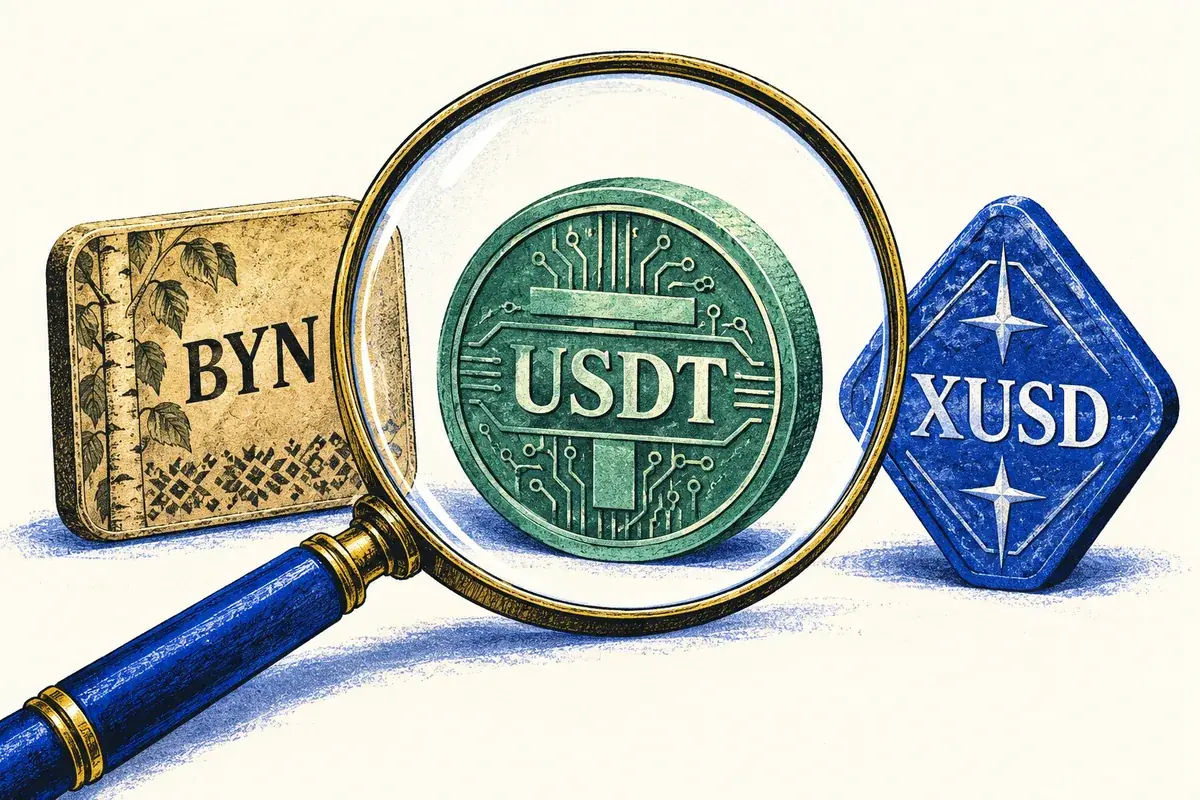
FREE2EX describes leveraged trading through tokenized CFDs and uses internal XUSD and XEUR units in its margin system. These represent the platform's dollar and euro accounting units. Do not send them to a USDT deposit address or assume an XUSD profit is already a withdrawable blockchain token. Closing the position and choosing an available withdrawal asset are separate actions.
That distinction gives the three platforms different strengths. Bybit is closer to the familiar stablecoin-perpetual workflow. Dzengi is worth examining for selected major-coin trades with local funding. FREE2EX gives another local margin environment, but its broader instrument list is not proof that it is cheaper for Bitcoin. Check the particular crypto market, not an advertised maximum taken from another asset class.
Which platform is cheaper for a $4,000 Bitcoin position?
Use the full position value when calculating commission. A $400 margin balance supporting a $4,000 position does not mean the fee is charged on $400. The example below opens and closes an unchanged $4,000 position once. It excludes funding, spreads, conversion, withdrawal charges and any special account discount; those costs are considered separately rather than hidden inside a headline percentage.
| Product and execution | Rate on each side | Two-sided commission |
|---|---|---|
| Bybit standard perpetual, both orders taker | 0.055% | $4.40 |
| Bybit standard perpetual, both orders maker | 0.02% | $1.60 |
| Dzengi selected BTC/USD or BTC/EUR leverage pair | 0.06% | $4.80 |
| FREE2EX crypto margin, both orders taker | 0.25% | $20.00 |
| FREE2EX crypto margin, both orders maker | 0.20% | $16.00 |
For this trade, Dzengi's selected-pair commission is only $0.40 above Bybit's standard taker calculation. That is a small difference: paying extra to move money internationally could wipe it out. FREE2EX's starting taker calculation is $15.20 above Dzengi's. Someone repeatedly trading those major-coin positions has a concrete reason to examine Dzengi first among the two local services.
A maker order rests in the order book rather than immediately taking an existing offer. It may not fill. The cheapest row therefore does not describe an urgent entry or an emergency exit. If you enter with a resting order but close immediately, use one maker fee and one taker fee. For Bybit's quoted standard tier, that mixed example is $0.80 plus $2.20, or $3.00.
Do not apply Dzengi's 0.06% rate to every crypto pair: its help page lists 0.075% for other crypto and DeFi instruments. FREE2EX reduces margin commissions at higher monthly volumes, but its spot and margin tables are different. Bybit also has separate rates for special trading zones. The account's current fee page decides which row applies to your order.
Buying crypto with Belarusian rubles: the payment method can cost more than the trade
Dzengi's published tariff lists a zero platform charge for BYN bank deposits and withdrawals, subject to minimums and possible bank charges. Its listed Belarusian card routes charge 2.5% on deposit and withdrawal. These are substantially different starting points for the same person using the same exchange. A convenient card payment can be more expensive than several ordinary trading commissions combined.
Consider 2,000 BYN paid by card. If a 2.5% deposit charge is deducted from that amount, 1,950 BYN remains. With no trading result or other cost, a later 2.5% withdrawal deduction leaves 1,901.25 BYN. The round trip costs 98.75 BYN, or about 4.94% of the original amount. This is an illustration of the tariff, not a claim that every card or payout uses identical processing.
The point is not to hunt for a smaller futures fee while ignoring the larger bill. Compare the bank-transfer quote before using a card, and check the minimum withdrawal as well as the minimum deposit. Dzengi's tariff lists 100 BYN minimums for the bank route. A small test below that amount would not demonstrate a usable withdrawal path.
FREE2EX should receive the same scrutiny at the payment stage. Its margin commission does not tell you what a specific bank or card processor will accept. The available currency and bank route can depend on residence and the issuing bank. A payment option displayed in Russian does not prove that a Belarusian customer has the same access as a Russian resident.
For a BYN-funded trader, keep your funding quote and your crypto trade calculation separate. One tells you how much money reaches the account; the other tells you what opening and closing costs after it arrives. Mixing those amounts is how a seemingly cheaper offshore contract becomes the more expensive overall choice.
What happens if you keep the position open for a week?
An entry fee is easy to compare because it is charged once. Holding costs need a second look. A Bybit perpetual can collect or pay funding at the market's stated intervals. Dzengi and FREE2EX have instrument-specific financing or swap conditions. The names differ, but the practical question is the same: how much does keeping this particular long or short open add to the trade?
Do not turn a funding rate you see today into a guaranteed seven-day bill. The rate can change and a payment received today can become a payment owed later. For local leveraged instruments, inspect both the long and short carrying conditions. FREE2EX's terminal guidance also identifies the day on which a multiple swap charge may apply; a flat daily estimate can miss that adjustment.
A useful comparison starts with your likely holding period. If two eligible products differ by $15 in entry-and-exit charges but the apparently cheaper one costs $3 more per day to hold, that advantage disappears after five days. Those numbers are a hypothetical break-even example, not a quoted financing rate. They show why the cheapest scalping choice need not be the cheapest week-long position.
There is also a difference between lowering leverage and adding money to an existing position. Lower starting exposure gives the trade more room from the outset. Adding money after losses commits more capital to the same idea. If you are moving between a global perpetual and a local margin platform, learn how the platform shows the remaining margin before assuming a familiar-looking percentage means the same thing.
How Dzengi's margin warnings differ from a Bitcoin price alert
Dzengi documents warnings based on the relationship between account equity and reserved margin. Its first warning is at 100%, another follows at 75%, and positions may begin to close at 50% or below. These are account measures. They do not mean Bitcoin must fall by 50% before the platform intervenes.
For a simplified account with $400 reserved margin, those levels correspond to $400, $300 and $200 of equity, assuming reserved margin remains unchanged. On $4,000 of exposure, a $200 trading loss is only a 5% adverse price move before costs. Actual reserved margin, other positions and financing can change the calculation, so use the account's live figures for a real trade.

This matters when comparing a stop-loss with a margin warning. The stop is your instruction to exit at a chosen condition. A warning tells you that the account is approaching the platform's intervention level. Waiting for the warning before deciding your exit leaves the decision to a much narrower window, particularly with several positions sharing the same balance.
A guaranteed stop is a different feature again. On the Dzengi configurations where it is required, examine its quoted level and cost. Do not assume the ordinary stop order on another exchange carries the same execution promise. This is one reason a comparison based solely on maximum leverage is incomplete even when both platforms display 100x.
Can a Belarus resident use an international crypto exchange?
Belarus distinguishes exchanging crypto for money from exchanging one token for another. The Tax Ministry's guidance on Decree No. 367 explains that purchases and sales involving ordinary money or electronic money must use the relevant High-Tech Park operators in the covered domestic circumstances. This makes an offshore card purchase or fiat P2P sale a different legal question from moving coins between your own wallets.
The ministry's January 2025 clarification says that exchanging your own tokens for other tokens on a foreign platform is not itself prohibited. It also gives an example involving buying through a local operator, exchanging tokens abroad and returning to a local operator for the fiat sale. That clarification is useful, but it is not a futures-specific approval for every margin contract or settlement arrangement.
Before treating an international derivatives account as suitable, identify whether the activity is a token exchange, a fiat transaction or a derivative. A provider accepting Belarus in its country menu answers its onboarding question. It does not answer all three local-law questions. For a derivatives strategy that depends on the token-exchange exception, obtain advice on that actual contract instead of assuming that any crypto-settled activity receives the same treatment.
There is no separate Minsk, Brest or Gomel exchange ranking in this review. The relevant High-Tech Park status belongs to the operator and the activity. Living near an HTP office does not put an individual trader in a special zone where every foreign platform becomes authorised. A different ranking by city would create differences the reviewed rules do not establish.
Do sanctions block every Belarusian crypto account?
No single rule describes every Belarusian customer worldwide. Sanctions may concern a named person, a bank, a particular service or a customer's nationality and residence. The EU's Belarus measures include restrictions on crypto-asset services, with defined exceptions for certain European nationals and holders of qualifying temporary or permanent residence permits. An exchange can also adopt stricter commercial restrictions than the legal minimum.
For a Belarusian who has genuinely moved to an EU or EEA country, a valid residence permit can therefore be important. It is not interchangeable with a tourist visa or a friend's address. The provider still needs to identify the customer and apply the local product rules. Meeting a sanctions exception does not guarantee approval for futures, and it does not move a European resident into an unrestricted global account.
Bank restrictions are another layer. A working crypto account does not ensure that every Belarusian bank can send euros to its payment provider. The Council's current overview lists restrictions affecting the central bank and named banks. Check the actual sending bank and beneficiary, rather than deciding that all bank transfers work because another customer reports a successful crypto deposit.

A platform may accept a Belarusian passport but reject the account because of residence, sanctions checks or the funding bank. The exchange account and the bank transfer therefore need to work together.
What changes for a Belarusian living in Russia?
Dzengi's published access statement excludes residents or citizens of the Russian Federation. A Belarusian citizen resident in Russia therefore encounters the residence condition even without a Russian passport. This is a concrete reason not to send that reader automatically to the local provider that might suit their relative living in Minsk.
FREE2EX publishes guidance on payment services involving Russian banks and rubles. That makes it worth checking for this situation, but not a guarantee that every Belarusian passport, Russian bank or payment option is accepted. Ask about the combination you actually have: Belarusian citizenship, Russian residence, your own bank account and the specific leveraged crypto service. A generic answer about Russian citizens may not settle your case.
Bybit's reviewed global restricted-country page does not list Belarus or Russia as complete country exclusions. Its separate fiat-service rules are narrower and list RUB-only conditions for these markets. That difference matters: crypto trading access and fiat payment access are not the same product. A ruble payment feature also does not erase the rules that apply to a person making a transaction from Belarus.
Moving to Russia does not create the European residence-permit exception described above. Nor should you continue using an old Belarusian address simply because it was accepted when you registered. If the provider needs to change the account's region, find out how it handles existing positions and balances before relying on that account for a new trade. The move can change a previously workable exchange choice.
Can you make dollars and still finish with fewer rubles?
Yes. The currency in which a contract reports profit can differ from the currency you eventually spend. A BTC/USD trade measures the Bitcoin position against dollars; it does not lock the dollar-to-BYN conversion you will receive when you cash out. If your budget and bills are in BYN, compare the final ruble proceeds with your original ruble outlay, after charges.
For an illustration, suppose 1,000 units of a dollar-linked balance become 1,050 after trading, a 5% increase before tax. If the BYN received per dollar falls by 8% over the same period, the ruble value becomes 1.05 × 0.92 = 0.966 of its starting value. That is a 3.4% decline before conversion charges, despite the positive trading result. These are assumed exchange-rate movements, not a forecast for the Belarusian ruble.
This is also why buying Bitcoin merely to move value between platforms changes the exposure. During the transfer, you hold Bitcoin rather than a dollar-linked balance. A cheaper withdrawal network can still be the more expensive journey if the transferred asset moves against you. Compare the asset you need at the destination, the supported network and the conversion needed there, rather than choosing the lowest visible withdrawal fee alone.
How should you separate trading profits, transfers and taxes?
Belarusian tax guidance identifies different treatment for activities such as qualifying HTP operations, mining, token-to-token exchanges and foreign fiat transactions. It does not support the shortcut “all crypto is tax-free.” Equally, transferring coins between wallets you own is not automatically a new profit. Keep those categories distinct when reviewing an exchange export.
The most important unresolved classification for a leverage trader is the actual derivative. A spot token-exchange exemption should not be applied to a cash-settled contract just because both appear on a crypto platform. Keep the instrument name, settlement asset, closed-position result and financing charges. These are the facts needed to classify the income; a screenshot of the account balance alone cannot do it.
A person living abroad also needs to establish tax residence rather than treating a change of address as an instant tax reset. Belarusian guidance includes a day-count test and additional conditions. The destination country's rules may also apply. If you closed a position before moving and withdrew it afterwards, the withdrawal date alone is not a reliable description of when the trading result arose.
Consider a record showing a $600 deposit, $90 of closed trading gains, $18 of trading and holding costs, and a $672 withdrawal. The withdrawal is the return of principal plus a net result; it is not automatically $672 of trading profit. This is a bookkeeping illustration, not a Belarusian tax calculation. It helps you present the transaction accurately without claiming an exemption that the contract may not qualify for.
Before you scale up, prove that the balance can come back
A profitable position displayed inside a margin account is not yet money in your bank. First check whether closing releases ordinary currency, an internal token or a blockchain asset. Then check whether that asset can use the withdrawal method you planned. This is particularly important with local tokenized platforms, where the trading unit and the final payment currency may differ.
Use a modest completed deposit-and-withdrawal cycle to check the actual account, not a friend's account or an affiliate's demonstration. Meet the provider's minimums and record the amount received after deductions. If the bank asks where the money came from, a matching chain of deposits, completed trades and withdrawals is more useful than a chart showing Bitcoin went up.
For a large balance, establish whether there is a transaction limit, a daily limit or an additional verification requirement. These are different constraints. Splitting a payment does not solve a verification issue, and using another person's bank account can create a new ownership mismatch. Keep the account and payout in your own name under the provider's accepted procedures.
One local detail is easy to miss: Dzengi's tariff lists ERIP as a deposit method, with a 100 BYN minimum and a 1% charge capped at three Belarusian base units, but no ERIP withdrawal option. Someone funding through ERIP therefore needs a different accepted payout route. Select that route before relying on the account as a complete round trip, and check its own minimum and fee rather than copying the deposit conditions.