








Which crypto exchange fits a trader in Poland?
OKX X-Perps is a useful starting point for a Polish trader who wants European crypto futures and a convenient way to buy crypto with złoty. OKX documents BLIK purchases for verified Polish customers alongside its EEA derivatives offering. Those are separate services, but having both within the same exchange group can remove the need for an unrelated local conversion account.
Kraken is the stronger comparison when you already hold euros or supported collateral and care more about the contract list than about BLIK. Its Polish product page explicitly promotes European crypto futures. The choice is therefore between two documented regional offers, not between an offshore leverage advertisement and a traditional brokerage account.
| Exchange | Reason to consider it | Published product ceiling | Local trade-off |
|---|---|---|---|
| OKX X-Perps | European futures plus a documented BLIK purchase option | Up to 10x on eligible contracts | BLIK buys crypto; the documented bank withdrawal route is EUR, not PLN |
| Kraken EEA derivatives | Poland-facing futures information and a detailed contract schedule | Selected EEA contracts up to 10x | Compare EUR funding and the exact collateral rules |
| Other catalogue entries | Additional operator-policy records to investigate | Depends on the regional service | A Polish interface or spot account does not establish futures eligibility |
Neither exchange wins just because a review awards it a bigger score. The local tie-breaker here is the funding and withdrawal combination: OKX has a documented PLN purchase feature, while Kraken provides a direct alternative for someone comfortable using European bank rails. Contract availability can overturn that order if the coin you want to trade is missing from the other service.
The listed products have published country and product eligibility information. We have not opened a Polish account or made a withdrawal; personal approval still depends on the customer.
How much leverage can you actually get in Poland?
The current European offers from Kraken and OKX advertise selected crypto contracts up to 10x. Your available setting can be lower, depending on the instrument, position size and account conditions. A global exchange page advertising 100x or 200x does not establish that a Polish retail account receives those terms.
Kraken’s EEA schedule contains contract-level information, including minimum trade sizes and position limits. OKX publishes a separate X-Perps specification. The latter uses funding payments with long-dated contracts; a strategy built around an international perpetual contract should not assume every market or settlement detail carries over unchanged.
The Polish “experienced client” rule is often misunderstood
Poland has a specific experienced-retail-client category for certain CFDs. It does not turn every crypto CFD into a 100x product. The KNF decision keeps crypto in the category with a 50% initial margin requirement, equivalent to 2:1, including for the experienced retail category described in that decision.
That restriction concerns CFDs. It is not a blanket statement that all European crypto futures are limited to 2x. The product’s legal characteristics matter, and ESMA has warned that some perpetual-style instruments can fall within CFD restrictions. Use the regional contract documentation rather than an app label or a claim that joining a “pro” programme automatically removes the limit.
Find the altcoin contract before comparing the fee
A Polish customer searching for SOL, XRP or a smaller-token short needs the regional derivatives market, not merely a spot pair. In the verified account, identify the precise contract, accepted margin asset and available order size. A token may be available to buy in Europe while its futures contract is absent.
For BTC and ETH, the shortlist offers a sensible first comparison. For less common markets, the published EEA list is more valuable than the total coin count on the exchange homepage. A service with hundreds of spot assets can still offer fewer of the particular futures you need.
This is also why the page retains the wider country catalogue below without pretending that every row represents an interchangeable Polish futures account. The shortlist answers where to begin; the catalogue preserves the more detailed operator-policy record, including limitations.
BLIK can buy the crypto, but what happens next?
OKX’s BLIK help page is explicit about the purchase side: verified Polish customers can use PLN to buy crypto, with the processing charge shown before confirmation. It is not a general PLN cash balance with a matching PLN withdrawal facility. The same help page says bank withdrawals use EUR rails and that selling directly back to PLN is not supported by that flow.
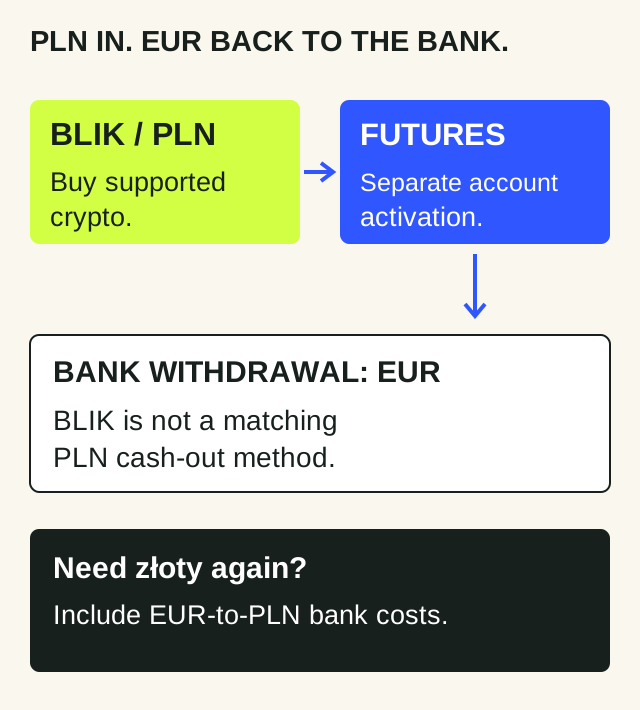
For someone paid in złoty, BLIK is attractive because it works through familiar banking apps. Its usefulness depends on the asset bought being accepted by the European trading account. Buying an arbitrary token first and discovering later that it cannot serve as collateral creates an avoidable extra conversion.
There are therefore two separate confirmations before the payment: the purchase preview should identify what you receive after charges, and the derivatives account should show that the asset can be used or converted into the required collateral. A successful payment cannot complete a derivatives assessment for you.
Compare the outcome of a purchase, not only its convenience
Suppose you are committing PLN 5,000. Record the exact quantity of the asset offered by the BLIK preview. Compare it with a bank-funded EUR purchase at the same moment, allowing for the PLN/EUR conversion and any transfer charge. Prices move, so quotes taken hours apart do not establish which payment route is cheaper.
A fixed fee can matter disproportionately on a small top-up. A percentage-based conversion cost matters repeatedly as the account grows. Neither is captured by saying that an exchange has low futures fees, because the funding transaction occurs before the futures order.
For an existing OKX Europe customer with X-Perps already activated, the integrated purchase feature may be the most convenient answer. For a trader who already keeps a EUR balance, adding a PLN purchase solely to use BLIK may make the process longer rather than simpler.
Funding Kraken or OKX from a Polish bank
The documented bank route to compare is EUR via the available European payment method. Kraken and OKX both publish SEPA deposit instructions. Use the beneficiary, reference and supported account currency displayed for your own account; a domestic PLN transfer to an EUR-only receiving account is not the same transaction.
Many Polish customers hold both PLN and EUR balances. When that is your situation, compare the bank’s actual conversion quote with any exchange-side alternative. The NBP reference rate is useful for accounting, but it is not a promise that your bank will exchange money at that rate.
For illustration, PLN 5,000 buys about EUR 1,190.48 at a rate of 4.20 PLN per euro, but about EUR 1,168.22 at 4.28. The difference is around EUR 22.25 before transfer fees. These are deliberately assumed rates, not today’s market quotes; the example shows how a small-looking currency margin can outweigh a modest trading-commission difference.
Starting with crypto instead of złoty
A trader who already owns supported collateral need not buy it again through a Polish payment service. However, the receiving European account’s restrictions come first. Kraken’s EEA restrictions include USDT deposits and trading, so a copied international “send USDT to start futures” instruction can be wrong for a resident of Warsaw or Kraków.
The asset and network must both match the actual deposit instructions. A transfer of the right ticker on an unsupported network is not fixed by being an otherwise eligible Polish customer. Use the receiving account’s current deposit screen, including any memo requirement, before sending the main balance.
Avoid buying crypto through a third party merely because its advertisement mentions BLIK. A direct provider purchase and a person-to-person payment are different arrangements, with different recipient information and dispute handling. The route discussed here is the provider-documented purchase flow, not a recommendation to send money to an unknown seller.
Compare futures charges, not Polish spot-trading prices
A general Polish crypto-exchange ranking may display spot commissions. Those figures do not necessarily describe a futures trade. At the entry tier, Kraken’s EEA derivatives schedule and OKX’s X-Perps overview each publish 0.02% maker and 0.05% taker rates. The matching starting rates mean funding, collateral and execution can decide the more useful account.
A PLN-equivalent 50,000 position opened and closed at an unchanged value would incur about PLN 50 in total commission if both executions cost 0.05%, using the same assumed conversion rate throughout. Two maker fills at 0.02% would instead correspond to about PLN 20. Those are illustrative equivalents; the exchange charges in its specified settlement currency, and a limit order is not guaranteed to qualify as a maker fill.
Why the cheapest entry fee may not produce the best result
Futures funding is separate from the execution fee. OKX X-Perps currently settles it at eight-hour intervals, and the direction and rate determine whether a position pays or receives. Kraken’s multi-collateral arrangements can involve conversions when the account needs a settlement currency it does not already hold.
For a Polish trader keeping the final budget in PLN, another cost sits outside the contract altogether: returning the result to złoty. A favourable trade in dollars can look less favourable after currency conversion, especially if several small withdrawals incur repeated charges.
The useful comparison is the same planned trade on both regional services: the same coin, comparable position value, intended holding period and a documented path back to your bank. There is no responsible fixed monthly “cheapest exchange” result without those choices and the actual funding rates.
Neither our ranking nor an affiliate offer changes a fee tier automatically. Use the fee shown in your verified account and the programme terms actually attached to it. A promotional reward should not be silently deducted from every cost example as if all readers qualify.
Does Poland’s MiCA dispute prevent crypto futures trading?
The Polish legislative dispute should not be read as a free extension of old crypto registrations. KNF’s notice says the MiCA transition ended on 1 July 2026 and that an entry in the Polish virtual-currency activity register was not equivalent to MiCA authorisation. That distinction matters when an exchange advertises only an old Polish registration number.
The political process continued after that deadline. The Sejm reported that it had not overridden the veto at the September sitting, and the presidency announced another proposal on 8 September 2026. These dated events explain the uncertainty around domestic implementation; they do not establish that an unlicensed provider may keep serving customers indefinitely.
What to look for in the account terms
For crypto services, identify the European legal entity and its actual authorisation. For futures, identify the investment-services entity providing the contract. KNF itself explains that financial instruments sit outside MiCA’s scope; a crypto-service permission alone does not answer the derivatives question.
Kraken’s European derivatives requirements identify Payward Europe Digital Solutions (CY) Limited. OKX’s X-Perps information identifies OKX Europe Markets Limited. The value of those names is practical: they let you distinguish the recommended service from a similarly branded international site or a copycat claiming to represent the exchange.
We retain Kraken and OKX because there is product-level European documentation, not because every uncertainty in Polish legislative implementation has disappeared. Polish users do not need a lengthy politics lesson to select a contract, but they do need a recommendation tied to an identifiable current provider.
A DEX interface loading in Poland would not answer these authorisation questions. This guide therefore does not substitute an unverified on-chain platform when a European account declines an application. Wallet ownership, interface eligibility and permission to provide a leveraged service are different matters.
Futures profits are not just another crypto swap
Poland’s tax treatment contains a distinction that directly affects leveraged traders. The general virtual-currency guidance says a qualifying crypto-to-crypto exchange is not taxed as a sale into fiat. That does not mean a futures profit settled in crypto is automatically tax-free until you withdraw złoty.
In a March 2026 individual interpretation, the Director of National Tax Information rejected that approach for the derivative transactions described by the applicant. The relevant question was the realisation of rights under the contract, even where its result remained in virtual assets. The interpretation is case-specific, but it directly challenges the shortcut that “no PLN withdrawal means no tax”.

Keep the derivative result separate from the coin holding
The official PIT-38 material separates income from financial instruments from the virtual-currency section. For ordinary private-investor cases covered by those categories, 19% is the starting rate; the way income, costs and losses are recorded is not identical merely because the percentage matches.
For example, assume a correctly classified and documented derivative calculation leaves PLN 7,000 of taxable income after its allowable costs. At 19%, the corresponding tax is PLN 1,330 before other relevant adjustments. This does not say that every wallet increase is a PLN 7,000 derivative gain, or that a loss on a separate coin holding can automatically be deducted from it.
A separate crypto purchase can create reportable acquisition costs even in a year without a fiat sale. The official virtual-currency guidance describes carrying excess acquisition costs forward, rather than treating them as an ordinary freely interchangeable loss. Keep those costs identifiable instead of allowing tax software to pool everything under “crypto”.
A 2026 ruling addresses the double-counting problem
The August 2026 interpretation reviewed a trader who received USDT from perpetual swaps, exchanged it for ETH and later sold ETH for PLN. The authority accepted, on the facts presented, the cost treatment of the value already recognised as derivative income. Its significance is that the same economic amount should not simply be entered as fresh income twice without considering acquisition cost.
This is not a universal ruling for every token, contract or business account. It is a reason to retain the entire transaction chain and have the actual product classified correctly. The cited primary record lets a Polish reader or accountant examine the relevant facts, rather than relying on a slogan about stablecoin profits.
What to export for PIT-38 and a PLN withdrawal
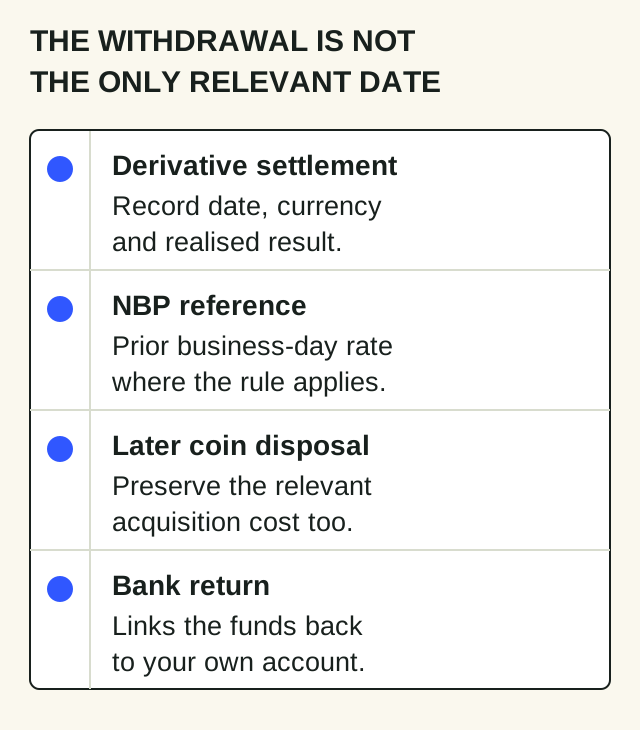
An exchange’s annual dollar P&L total is not a complete Polish calculation. The Ministry of Finance’s PIT-38 instructions use the NBP average rate from the last business day preceding the relevant foreign-currency income or cost event. The conversion dates can therefore matter as much as the final annual total.
Imagine two separate USD settlements at different dates. Converting their combined total at the rate on 31 December can produce a different PLN result from valuing each event correctly. Keep the dates and amounts so the correct conversion can be reconstructed. The NBP archive provides the historical reference tables; it does not replace the exchange transaction history.
Build a usable export before the account becomes busy
Save the contract history, realised results, funding payments, trading charges and wallet transfers. Preserve whether each figure is expressed in EUR, USD or a token. That makes it possible to tell an internal transfer from a gain, and a later disposal from the original derivative settlement.
Kraken and OKX provide account-history export instructions, but the existence of a CSV download is not a promise of a completed Polish PIT-38. Run a small export early and check that the futures activity is present. A file covering only spot purchases will be incomplete for this purpose.
For withdrawals, the bank-facing record and the tax record serve different jobs. The bank needs an explainable origin and recipient trail; the tax calculation needs the relevant income, costs and classifications. A screenshot of a wallet balance rarely does either job well on its own.
Ukrainian residents, Belarusian residents and Poles abroad
A foreign passport is not the same as foreign residence. Someone who has moved to Poland should use the real Polish home address and the identity and residence documents requested by the exchange. Keeping an old country selected to preserve a familiar international futures menu can leave the account inconsistent with its actual customer information.
For Ukrainians living in Poland, the tax authority’s published explanation uses two alternative residence criteria: the centre of personal or economic interests, or presence exceeding 183 days in the tax year. The day count is not the only test, and relevant treaty rules matter where more than one country claims residence.
The same core distinction helps a Belarusian citizen settled in Poland. Nationality screening and residence verification remain separate, so a Polish address should not be presented as a guarantee of acceptance. Equally, restrictions directed at residents of another country should not be casually described as a blanket ban on every holder of that country’s passport. Submit the real combination of nationality and residence and use the account’s documented decision.
What changes when a Polish trader moves abroad?
A person moving to Germany generally remains within the EEA product framework, but still needs to update address and tax information. A move to the UK can change the available retail crypto-derivatives offering substantially. Retaining a Polish bank account or PESEL does not by itself preserve Polish product eligibility.
Within Poland, Warsaw, Gdańsk, Wrocław and the other regions do not have separate leverage ceilings in the national sources reviewed. There is no useful reason to invent sixteen regional rankings. The meaningful local differences are the customer’s bank and funding options, actual residence, tax position and the European contract offered to that account.
The practical conclusion is specific: use OKX when its verified Polish purchase flow and X-Perps access fit together; use Kraken when its regional contracts and your existing EUR or collateral balance make the cleaner account. Compare the whole return to PLN, and keep futures results separate from subsequent coin transactions. That is a more useful choice than following the biggest global leverage number.