









Start with the crypto contract you want to trade
For a Lithuanian resident looking for a dedicated crypto futures account, Kraken is the most straightforward starting point in this review. Its European service offers perpetual and fixed-maturity contracts, with EUR among the accepted collateral currencies. That combination is useful if you want to keep a euro trading budget and choose the contract around your holding period.
OKX X-Perps is the alternative to examine for a particular altcoin market or its selected-asset margin setup. Compare the live European contract lists before transferring money. The larger global brand inventory is not the number of futures available to your Lithuanian account, and a coin appearing on the spot page does not prove that you can short its future.
| Intended trade | Relevant product | Check before funding |
|---|---|---|
| A BTC or ETH perpetual with EUR collateral | Kraken EEA derivatives | Approved account, available contract and its actual funding and margin terms |
| An X-Perps market with selected crypto collateral | OKX European expiry futures | That market's regional listing and the assets committed to it |
| Borrowing a coin to trade it on the spot market | Bybit EU spot margin | Borrow availability, interest and repayment instead of a futures funding comparison |
Kraken is not the winner simply because it serves Lithuania. It fits the combination of cash collateral and contract choice. If OKX has the specific regional market you need with a better executable price at your size, that can be the better account for that trade. Our comparison leaves that choice open without pretending that all spot exchanges are equivalent futures venues.
Product limits belong beside that choice. X-Perps is advertised up to 10x, but the approved account and instrument govern what you can place. In-scope retail crypto CFDs have the separate European intervention ceiling of 2x. ESMA's 2026 reminder says the product's features matter even when it is marketed as a perpetual future. A Lithuanian trader should not infer universal access from either a MiCA badge or a global leverage banner.
An old Lithuanian registration no longer answers the access question
Many crypto platforms used a Lithuanian company registration in their marketing. The Bank of Lithuania states that the domestic VASP transition ended on December 31, 2025. From January 1, 2026, affected operators without the required authorisation could no longer continue the relevant crypto-asset services under that old status. A company name and address are therefore not enough evidence for a current recommendation.
The useful check is the entity that serves your account now. It might be authorised elsewhere in the EU and operate across borders with the relevant notification. The Bank of Lithuania's June 2026 notice specifically covers that wider European framework. You do not need to reject a legitimate European service merely because its licence was issued outside Lithuania.

What this changes in an exchange comparison
A current CASP authorisation concerns the crypto services within its scope. Futures that are financial instruments use an investment-services framework. For Kraken, the derivatives service names Payward Europe Digital Solutions (CY) Limited; OKX X-Perps names OKX Europe Markets Limited. Review the product relationship rather than borrowing a licence from another company in the same brand group.
That sounds formal, but the practical payoff is simple: you know which account terms and complaint process apply to the trade. If a website sends you from a Lithuanian-language landing page to a global agreement with a different company, the language of the first page has not established that product's local eligibility.
Existing customers also need this distinction. An old login can continue to work while the service is transferred, restricted or reduced to withdrawals. Check whether opening a fresh position is permitted before sending additional collateral. A functioning login and a successful coin withdrawal are not, on their own, evidence that new leveraged trades remain available.
Will the Lithuanian account have your altcoin future?
Treat the trading pair as the unit of comparison. Write down the asset, direction, position size and intended holding period, then inspect that market in each eligible European account. The exercise is short enough to do before a deposit and more useful than memorising the number of tokens advertised by the brand.
For instance, wanting a €700-equivalent short on an altcoin is a different requirement from wanting to buy €700 of that coin. You need the shortable contract, enough margin, an executable order and a way to close it. A spot listing only settles one of those questions. The purpose here is not to explain what a short is, but to avoid selecting the wrong product for one.
Thin exits can undo a cheap entry
Suppose the first exit quote covers €100 of your €700 position, with the remaining €600 available only at worse prices. The headline bid does not describe the full exit. A wider spread or a thin book can outweigh a small commission difference. Check the visible depth near your intended price, and remember that it can change before the order reaches the market.
This is particularly relevant when a Lithuanian resident compares a restricted European menu with a much larger international one. A global screenshot showing heavy volume on a similarly named contract does not measure the liquidity of your regional market. Use the order book and terms of the actual product available to you.
If neither account has a suitable contract, the useful answer is to skip that specific leveraged trade or reconsider the instrument. Taking a different coin purely because it has a futures button changes the investment idea. Registering an inaccurate country to recover the global product creates an account problem rather than solving the comparison.
Check how the position ends
X-Perps has an expiry date as well as funding payments. Kraken's fixed-maturity and perpetual contracts have different holding mechanics. For a multi-week idea, compare the end date, the cost of maintaining exposure and whether you expect to close early. For a brief trade, execution may matter more. The winning platform can change with the intended position without requiring a different country ranking every day.
Can you fund futures from a Lithuanian bank or payment account?
EUR gives Lithuanian traders a useful direct funding option. Kraken's published European collateral list accepts euros, while OKX lists EUR among its X-Perps margin assets. There is no universal need to purchase a dollar stablecoin first. Start with the deposit method the verified account actually offers and compare what becomes available as margin.
A Lithuanian IBAN is a payment-account identifier, not evidence that the person using it lives in Lithuania. An LT account held by someone abroad does not override that person's exchange residence. Conversely, a Lithuanian resident may have a legitimate bank account with another country's IBAN. The sender's ownership, supported payment method and account instructions are more useful than assuming that the first two letters decide eligibility.
For a euro transfer, copy the current beneficiary and reference from the exchange. A payment made through a provider that sends money under an intermediary's name may need additional checking. Use the method's own requirements instead of assuming all payment apps work the same way. We are not promising that every Lithuanian bank or fintech approves every crypto transfer.
Keep incoming money and trade backing distinct
You may see the deposit in the app before it is committed to derivatives. OKX Selected Margin counts designated assets in the Trading Account. On Kraken, inspect the derivatives account's available balance after the transfer. This is a useful final checkpoint: it tells you whether the intended €500 or €1,000 budget is actually ready to back an order.
If you already own crypto, a coin transfer can be an alternative to the euro route. Price the network fee, confirm support for the same network at both ends and inspect how much collateral value the asset receives. A cheap on-chain transfer does not make a volatile collateral asset equivalent to cash. It also adds a separate asset record for Lithuanian tax reporting.
When returning funds to your bank, use the amount released from margin and actually available for withdrawal. The exchange's display of total account value can include backing that an open position still needs. A bank withdrawal should come from free funds rather than from a guess based on the largest number on the dashboard.
Taking some profit without closing the whole future
If you plan to scale out of a position, compare the exit controls as well as the market list. Kraken documents partial take-profit and stop-loss quantities for its futures interface. That is a useful feature for a Lithuanian account whose intended trade is to close one part at a target and leave another part running. It is more specific than choosing an app because it has a large leverage number.
Consider an illustrative €2,000-equivalent position. Closing half removes half the contract quantity, not necessarily €1,000 of current market value: the price may already have moved. The remaining half continues to gain or lose, and its margin requirements still matter. Taking one profit does not make the rest of the trade free or automatically protect the original deposit.
Check the remaining order, not just the realised gain
Kraken's derivatives bracket instructions let you specify an exit quantity or use the entire position. After reducing a position, review the remaining quantity and its protective orders together. An order meant to close a trade should not become an unintended position in the opposite direction. Use the futures interface's closing controls and check the confirmation rather than entering an unrelated sell or buy order from memory.
A stop trigger also differs from a guaranteed execution price. If the market jumps, the eventual fill can be worse; a limit condition can instead leave an order unfilled. For the regional altcoin comparison above, that makes exit depth relevant twice: when planning the take-profit and when assessing how an urgent close might execute.
Count charges on the pieces actually filled
Both reviewed starting futures schedules quote 0.05% taker and 0.02% maker fees. As a simplified example with unchanged prices, a €2,000 taker entry costs €1. Two €1,000 taker exits cost €0.50 each, for €2 in total. Splitting the close does not double the percentage fee on the original position; each execution is charged on its own value. Different exit prices, tiers and order types change the numbers.
Funding belongs to the exposure still open under the contract's rules. Once the first piece closes, retain its realised result, fee and timestamp separately from the unfinished trade. For Lithuanian reporting, this prevents an open-position estimate from being mixed into the realised figures used later in the annual return. The account export should let you reconstruct both pieces without relying on a screenshot of the combined profit display.
Can Lithuania's investment account shelter crypto futures profits?
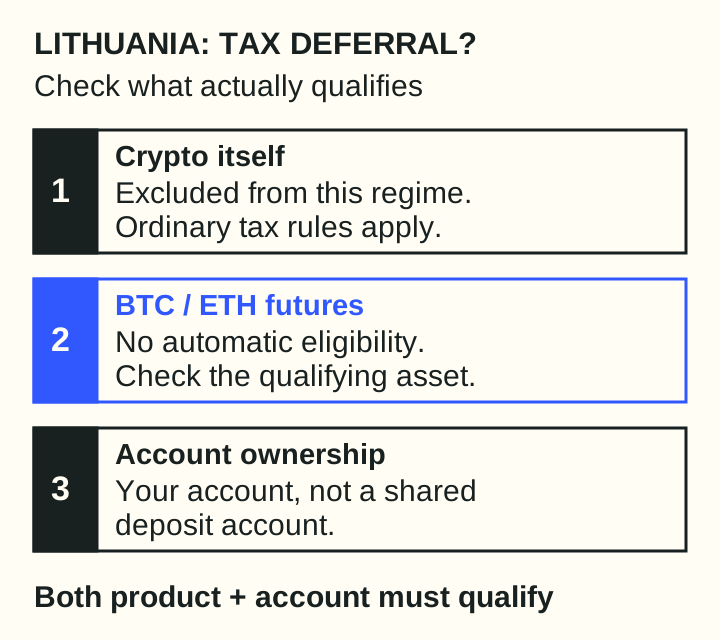
Do not assume that it can. VMI expressly excludes direct cryptocurrency investments from the investment-account regime. Its list of eligible derivatives is tied to specified qualifying underlying financial products. A BTC perpetual is not shown to qualify merely because the exchange calls it a financial instrument or because the account is offered by a regulated European firm.
That is our reading of the published eligibility list, not a VMI ruling approving or rejecting every named exchange contract. The decisive details are the underlying asset, the contract and the account arrangement. For an ordinary crypto future, avoid claiming tax deferral unless its eligibility has actually been established. An investment-account label in your own spreadsheet cannot provide it.
VMI also distinguishes an account held in your name from a provider's omnibus account. The pooled beneficiary account you send a deposit to is not automatically your own declarable investment account. This matters because an exchange deposit instruction and a personal account statement can look similar while describing different ownership arrangements.
Keep the futures budget separate from an established investment account
If you already use a declared investment account for qualifying securities, do not casually fund unrelated crypto trading from it. Money used outside the permitted purpose can affect the regime's withdrawal calculation. Keeping a separate ordinary funding balance for the crypto account makes the payment trail easier to understand and prevents one deposit from being mistaken for a qualifying reinvestment.
The choice of Kraken or OKX should therefore stand on its trading merits, not an unsupported claim of Lithuanian tax deferral. Compare the contracts, costs and accepted collateral first. Resolve the tax category from the product you actually selected, rather than choosing a platform because a promotional article uses the phrase investment account loosely.
This avoids a common false saving: allowing all futures profits to remain in the app while assuming there can be no tax until they reach a Lithuanian bank. The timing follows the applicable income rules. The physical location of the balance is not a replacement for those rules.
How should a Lithuanian trader record realised futures results?
VMI's financial-instrument guidance includes acquisition costs and compulsory transaction charges in the gain calculation, with a €500 annual allowance where its conditions are met. It is not a separate allowance for each exchange, each coin or each successful trade. Do not import the €2,500 figure sometimes discussed for other property into a financial-derivative calculation without establishing that category.
For illustration, assume €2,200 of qualifying gains before €180 of allowable costs, no other relevant gains, eligibility for the €500 allowance and a 15% rate on the remaining income. The arithmetic is (€2,200 − €180 − €500) × 15% = €228. If any assumption changes, including the applicable rate, the result changes. This is not a flat tax quotation for every Lithuanian futures trader.
From 2026, the general treatment of relevant non-employment income uses a €27,745.80 annual band at 15%, with higher amounts entering the applicable progressive framework. Other annual income affects that framework; 2025's thresholds should not be copied into a 2026 projection. The separate 15% investment-account treatment applies only where that regime actually qualifies, which is the issue explained above.
VMI identifies GPM311D2 for the relevant financial-instrument and realised-derivative reporting. Prepare euro figures that can be traced back to the exchange export. Keep realised trades separate from unrealised open-position values and retain the charges separately enough to review their treatment. Sending a single final wallet balance leaves out how that balance was earned.
A liquidation also needs its transaction record. It may end the position and create a realised result, while other trades earlier in the year remain part of the annual calculation. An account falling to zero is not a tax return. Equally, a positive withdrawal can include original capital rather than pure profit. Use the ledger rather than either extreme as a shortcut.