









Latvia's futures shortlist: choose what backs your trade
OKX X-Perps is a useful fit for a Latvian trader who already holds several crypto assets and wants to decide which of them support a futures position. Its Selected Margin setting lets you choose the assets involved. Kraken is the stronger alternative when you want a choice between perpetual and fixed-maturity contracts, with an established euro funding path. Neither requires moving to an offshore account simply to obtain a crypto futures product.
This is a comparison of the European services offered to an approved Latvian resident. Global exchange rankings often mix spot turnover, worldwide contract menus and maximum leverage from unrelated accounts. Those numbers do not establish which Bitcoin or altcoin contract you can actually open from Latvia.
| Your starting point | Platform to examine | What decides the choice |
|---|---|---|
| You hold crypto and want control over the collateral pool | OKX X-Perps | Selected assets, isolated versus shared margin, and the exact available market |
| You want a perpetual or a contract with a nearer fixed maturity | Kraken EEA derivatives | Contract availability, expiry and the collateral you intend to use |
| You specifically want borrowed spot exposure | Bybit EU spot margin | The borrowable asset, interest and repayment; this is a separate product |
For a short trade, look for the exact shortable instrument rather than a large overall coin count. An exchange can sell hundreds of coins without offering futures on each of them. For a longer position, compare the ongoing payments and any expiry. A favourite interface is worth keeping only if the European account supports the trade you intend to place.
OKX advertises X-Perps up to 10x, subject to its product and account conditions. Latvia's retail crypto CFD restrictions belong to the CFD category; they should not be turned into a blanket statement that every crypto position has the same ceiling. Equally, calling something a future does not settle its classification: ESMA specifically warned about that in February 2026. Use the named European contract and the limit shown for your approved account.
Keep your long-term coins outside the trade you are testing
Suppose you hold Bitcoin for the long term but want a short-lived SOL position. The important question is how much of that Bitcoin the futures account is allowed to draw on. Putting every asset into a shared collateral pool makes the account convenient, but it can connect positions that you intended to keep separate.

OKX documents two relevant choices: isolated margin allocates collateral to a position, while Selected Margin shares the assets you designate across positions. Selected assets must also be in the Trading Account; leaving them in the Funding Account does not make them available as margin. EUR is among the supported assets. Crypto collateral may receive a valuation reduction, so its entire market price need not count toward your trading balance.
When the flexibility helps
A Latvian resident paid in euros can fund with euros and leave an unrelated coin position out of the shared pool. Someone with existing BTC and ETH might instead select part of those holdings, but then falling collateral prices can put pressure on the futures account. The attraction is control over the selection, not a claim that crypto collateral is free capital.
Here is a simple planning example, not an exchange liquidation model. Imagine €1,200 of coins plus €400 of cash. Allocating €200 to an isolated trade is a different decision from exposing a selected €1,600 pool to several positions. The account's precise loss treatment depends on its terms, but those two setups plainly commit different resources. Decide which setup matches your intention before choosing the order size.
When Kraken is the cleaner fit
If you mainly want BTC or ETH futures and already have euros available, Kraken's accepted EUR collateral can avoid an unnecessary coin purchase just to fund the position. Its published EEA table assigns EUR no collateral haircut. That does not eliminate exchange risk, trading losses or currency movements where the contract and margin valuation use dollars. It simply removes one particular deduction from the collateral calculation.
Our preference changes with that starting balance. OKX has a useful selected-asset workflow; Kraken has a useful cash-and-contract choice. There is little reason to transfer an entire existing portfolio just to obtain a feature you will not use.
Check the market itself before moving an existing position
The European OKX product is an expiry future with periodic funding, despite the X-Perps name. Kraken documents both perpetual and fixed-maturity futures. This difference matters most when the holding period is part of your idea: a brief BTC trade, an altcoin position held through an announcement, and a hedge lasting several weeks may favour different contracts.
A Latvian account should be assessed using the European market list. Do not assume that a contract visible in a global tutorial, copy-trading screenshot or public price widget is tradable in that account. Search the pair after the regional derivatives service is enabled. Look at the settlement currency and the smallest order you can enter, too; a market can exist but still be unsuitable for a small account.
For an altcoin, inspect both entry and exit liquidity at the size you expect to trade. The first quoted price might cover only a small amount. If the rest of your order consumes worse prices, a nominally low commission does not make the transaction cheap. That check is especially useful when choosing between a familiar global brand and its more limited European contract list.
Moving a trade is two executions
An open future normally cannot be sent to another exchange like a coin deposit. Closing it at one venue and reopening it at another creates two executions, possible price movement between them and fresh fees. Transferring collateral while the old position remains open can also reduce its buffer. Compare the cost of finishing the current trade where it is against the benefit of changing platforms for the next one.
For example, if you sell one BTC contract to close a long and wait before buying the replacement, a rising Bitcoin price can make the replacement more expensive. That difference is not a withdrawal charge. Keeping the two execution prices beside the transfer record helps explain what the move actually cost.
A fixed maturity also deserves a deliberate exit plan. Know whether you intend to close before expiry or use the contract's settlement. This is about your crypto position ending, not stock-market opening hours. It is relevant even when the trading interface operates around the clock.
Getting euros from your Latvian account into usable margin
For an ordinary EUR budget, start with the exchange's current SEPA instructions. Kraken publishes several euro deposit providers with their own availability, minimums and processing terms. Read the method displayed inside your verified account instead of reusing bank details saved from an old guide. Your Latvian bank or payment provider can impose its own checks and charges.
A transfer arriving on the exchange is not necessarily the final funding step. On OKX, the selected collateral must reach the Trading Account. On Kraken, check the derivatives wallet's usable margin before treating the deposit as ready. The useful confirmation is the amount available to support an order, rather than a notification saying that the payment arrived somewhere in the app.
Do not buy USDT merely because an overseas video uses a USDT contract. Compare the assets accepted by your European product first. An extra purchase can add a spread and create another transaction to track in euros. If you already hold a supported stablecoin, transferring it may be convenient; if your starting money is EUR, the same route may add work without improving the trade.
Latvia's euro membership makes a direct euro comparison meaningful. Ask what leaves your bank, what becomes available as margin and what comes back after a withdrawal. These are three amounts, not three different exchange rankings. A platform does not become cheaper because the first of those steps is labelled free.
For an initial transfer, use an amount that clears the method's minimum and lets you check the account flow without committing the full trading budget. There is no need to execute a leveraged trade to test whether a cash deposit is credited. Keep the beneficiary, payment reference and account holder consistent with the exchange instructions so an avoidable payment mismatch does not become a futures-funding problem.
How much does repeatedly changing a position cost?
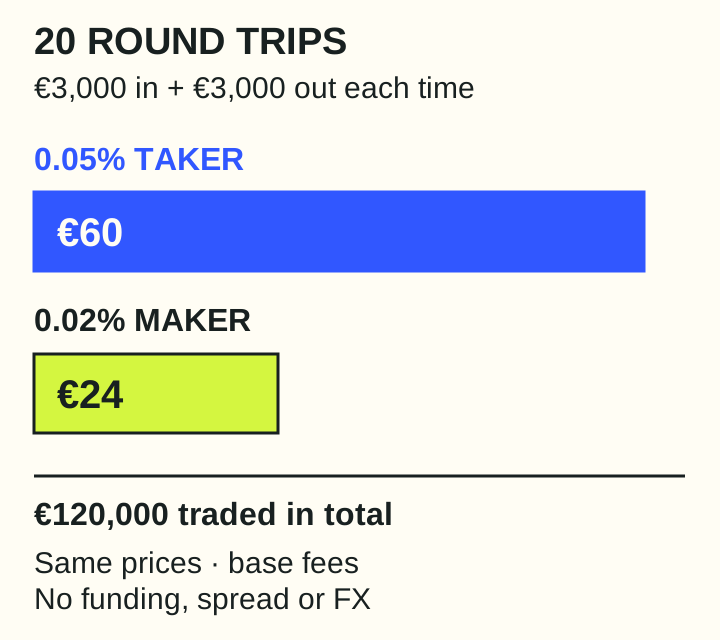
Consider a Latvian trader who opens and closes the equivalent of €3,000 twenty times in a month. At a starting 0.05% taker rate per side, unchanged entry and exit values would produce €60 of execution fees. At 0.02% maker on both sides, the equivalent figure is €24. These are illustrative totals, not a recommendation to trade twenty times; actual fills, closing values and tiers change the result.
The €36 difference is meaningful on a small cash balance. But earning a maker fill is not just choosing a button labelled limit. An order that trades immediately against an existing order can be charged as a taker. Missing an entry while waiting for a resting order to fill also changes the strategy. Pick the execution that fits the trade and account for its cost honestly.
Kraken EEA and OKX X-Perps publish the same starting maker and taker rates in the checked schedules. Fees alone therefore do not settle the choice. The contract’s execution prices, holding costs and available account tier can make the difference.
For X-Perps, OKX describes funding settlements every eight hours in its overview. A quoted rate is not a permanent daily charge: it can change and the payment direction can reverse. Read the rate and the next settlement for the actual contract. If you close before a particular settlement, do not include a payment you did not incur; if you remain open across several, count the actual entries.
A break-even calculation should therefore start with the trade you are considering. Estimate execution fees, allow for the spread and inspect the likely holding period. Then compare the required price move with your intended target. This is more useful than calling a platform the cheapest based on a VIP rate your account has not earned.
Latvian tax: a coin swap is not a futures settlement
The current VID guidance gives a 25.5% capital-gains rate. It also describes deferring the income date for a qualifying crypto-to-crypto exchange until the resulting asset is exchanged for money, goods or services. The same guidance explicitly limits its scope, however: financial instruments are among the exclusions. A futures profit should not automatically inherit an ordinary coin-swap rule because the payment lands in a crypto balance.
Our reading is therefore to separate the derivative result from subsequent dealings in its settlement asset. The cited material does not supply a universal worked ruling for every exchange's futures settlement. Keep the contract description and the euro value of the realised result, and obtain a product-specific classification if the payment form leaves the treatment unclear. Do not assume that leaving the profit on an exchange postpones tax until a bank withdrawal.
Budget from the taxable gain, not the amount withdrawn
If €1,600 is the relevant taxable capital gain, 25.5% produces €408 of tax before any applicable additional rules or adjustments. A €1,600 bank withdrawal could instead include your own original capital. The identical amount on a bank statement does not establish the same taxable gain. Reconcile the trading record before using a percentage.
VID's ordinary capital-gain timetable distinguishes quarters above €1,000 from those that do not exceed it. In the first case, filing is due by the following month's 15th and payment by the 23rd; the smaller-quarter schedule runs to January 15 and 23 of the following year. Use the rule applicable to your income category, including any additional annual liability at high income levels.
That timetable is a practical reason to retain euro records during the year. A dollar PnL screenshot, an internal wallet transfer and a bank withdrawal each describe something different. Keep the realised result, trading charges and relevant conversions identifiable. When the exchange export combines spot and futures, separate them rather than sending an accountant one unexplained net number.
What a Latvian licence check should tell a futures trader
Latvijas Banka separates crypto-asset services from financial instruments in its classification guidance and maintains a financial-market participant register. For the two promoted products here, the relevant named investment services are Kraken's European derivatives entity and OKX Europe Markets' X-Perps service. A spot-service permission alone does not demonstrate the complete futures offering.
You do not need to become a licensing specialist to use this distinction. Match the legal entity in the derivatives agreement to the service you are activating. If a brand's footer lists several companies, an authorisation held by one is not automatically the authorisation behind all its products. This matters particularly when an old account is moved to a European entity.
A residence in Riga, Liepāja or Daugavpils does not by itself create a different X-Perps menu in the regional conditions reviewed here. We found no city-specific product advantage to rank. A genuine move abroad is different: it can change which entity serves the account. Tell the provider about that change before relying on the Latvian product description.
Language is another account setting, not a separate jurisdiction. Choosing a Russian or English interface does not turn a Latvian resident into a customer of a different country. Where a translated help page seems to contradict the account's European terms, use the exact product agreement and ask for clarification about that contract. Avoid treating a global promotional page as evidence of an extra Latvian permission.