








Which crypto futures exchange should you use in Germany?
Kraken is the strongest starting point for a German resident who wants a dedicated crypto derivatives account with both perpetuals and dated futures. Its European documentation separates the derivatives service from ordinary coin trading and explains the eligibility process. That is a more useful basis for choosing than a worldwide exchange league table advertising leverage that your German account may never receive.
OKX X-Perps deserves a place alongside it, particularly if your coins and euros already sit in an approved European OKX account. The attraction is a familiar crypto trading environment with European product documentation and advertised leverage up to 10x. Activation still depends on the account assessment and current rollout; an existing spot balance does not unlock it automatically.
Coinbase is the alternative to examine when you want selected crypto futures within Coinbase Advanced rather than a separate futures-first workflow. Its March 2026 European announcement explicitly includes Germany and describes both conventional expiry contracts and longer-dated products designed for ongoing exposure. Availability is being introduced progressively, so the product actually enabled for your account matters more than the announcement alone.
| Exchange | The strongest reason to choose it | What can change the decision |
|---|---|---|
| Kraken European derivatives | Choice between perpetuals and dated crypto contracts | The approved limit, collateral treatment and exact market you need |
| OKX X-Perps | An integrated European crypto futures account with published fees | Account activation and the cost of funding while you hold |
| Coinbase Advanced European futures | Selected futures inside an existing Coinbase workflow | Contract selection, rollout and the complete commission rather than an advertised minimum |
This ranking is about the documented European products. When comparing market coverage, count the BTC, ETH or altcoin futures enabled in the European account. A long list of spot assets is not the same as a broad choice of derivatives, and the international account can contain different markets. For a German futures trader, the decisive question is whether the approved account supports the intended crypto trade at an acceptable total cost.
Can German traders use more than 2x leverage?
There is no useful single answer called “Germany’s crypto leverage limit” without naming the product. A crypto CFD sold to a retail client is subject to the 2x limit under the applicable intervention rules. A separately structured futures contract cannot be assigned that same limit merely because its underlying asset is Bitcoin. Conversely, calling a CFD a perpetual does not remove the CFD rules.
ESMA addressed this directly in February 2026: providers must consider whether products marketed as perpetual futures fall within the existing CFD measures. The commercial name is not the deciding factor. Where the CFD definition is met, the associated restrictions and protections apply.
That explains why a European provider can publish an “up to 10x” futures offering while a German retail crypto CFD remains limited to 2x. Those are product-level statements, not two conflicting country rules. The advertised maximum also remains a ceiling, rather than a promise that every customer, market and position size receives it.
How to read the number on the order screen
For a comparison between exchanges, ask for the same thing: the same BTC or ETH contract, the same position size and the same retail account classification. Comparing a global professional maximum on one site with a small retail order on another produces a ranking that is numerically impressive and practically useless.
A higher limit is helpful only if it gives you flexibility you actually intend to use. If you normally trade at 3x, a product offering 10x is not automatically better than another that supports the same intended position with clearer margin controls, better execution or lower holding costs.
Can a liquidation leave you owing the exchange money?
This is a particularly important German distinction. BaFin’s intervention on futures offered to retail clients has applied since January 2023 and targets contracts with additional payment obligations. In plain English, the concern is a customer being required to pay more after the money committed to the futures account has been exhausted. The measure includes defined exceptions, including certain genuine hedging situations; it is not a blanket prohibition on every retail future.
Before treating a European futures account as suitable for a German retail customer, look at the agreement for that service and how it deals with a negative balance. Do not use a promise on an unrelated international or institutional product as proof. A liquidation engine and a legally enforceable protection against a further debt are different things.
Three different boundaries
A stop order is an instruction to close. Its actual execution can be worse than the trigger during a fast move. Isolated margin, where the chosen product offers it, controls which balance supports a position. A protection against additional payment obligations addresses what happens if the account nevertheless goes below zero. None of these should be presented as interchangeable.
Consider a hypothetical €900 margin balance. A sharp move may consume that balance. Protection against a further payment demand does not restore the €900, pay your trading losses or guarantee the intended stop price. It answers the narrower but valuable question of whether a market gap can create an additional debt to the provider.

For an active trader, the practical response is to favour a product with a clear German retail framework and readable loss-allocation terms. If the application asks you to accept a different entity or professional classification, revisit those terms before assuming that protections from the previous account carry across.
What does a German crypto futures trade actually cost?
At the entry tier reviewed for this article, Kraken’s European derivatives schedule lists 0.02% maker and 0.05% taker commission. OKX X-Perps also lists 0.02% and 0.05% at its standard tier. These percentages apply to the size of the trade, not just the margin you put down. The figures alone therefore do not establish a price winner between the two.
A maker order adds liquidity when it rests on the book; a taker order removes existing liquidity. A limit order is not automatically a maker order if it executes immediately. For the trade you need now, use the likely execution type rather than choosing the cheaper label in a fee table.
A €15,000 position funded with €3,000
Suppose the entry and exit are both taker trades, and the position remains worth €15,000 for this simplified calculation. Commission is €7.50 to open and €7.50 to close: €15 altogether. That is 0.1% of the position but 0.5% of the €3,000 margin. Price changes between entry and exit would change the closing charge.
The equivalent maker-maker calculation is €3 plus €3, or €6. The €9 difference is useful, but it must be weighed against missed fills and price movement while a resting order waits. It would be misleading to claim the cheaper outcome without considering whether your strategy can actually obtain it.
| Execution | Opening commission | Closing commission | Total before funding and other costs |
|---|---|---|---|
| Taker both ways at 0.05% | €7.50 | €7.50 | €15.00 |
| Maker both ways at 0.02% | €3.00 | €3.00 | €6.00 |
Funding, spread, slippage and any collateral conversion come after that comparison. A promotional Coinbase rate “as low as” a given percentage cannot be placed in the same table as a guaranteed all-in charge: Coinbase’s European announcement expressly notes additional exchange, clearing and NFA fees. Inspect the selected contract’s complete order estimate.
For larger monthly activity, compare the tier you have already earned, not a VIP rate you might reach eventually. Kraken separates spot and derivatives fee schedules. A history of buying Bitcoin on spot should not be counted automatically as qualifying futures turnover.
Perpetual or dated future: which fits a German trader better?
A perpetual is convenient for an open-ended view because it avoids a near-term expiry decision. Its ongoing funding can, however, change the cost of keeping the exposure. A dated future gives you an expiry to plan around and a futures price that can differ from spot. “No recurring perpetual funding” would not make that price difference free.
For a same-day BTC trade, execution, spread and commissions may dominate. For a position held through several weeks, the accumulated funding or the dated contract’s entry premium can become more important. This is a reason to compare Kraken’s two contract styles rather than assuming that the familiar perpetual button is always the best answer.
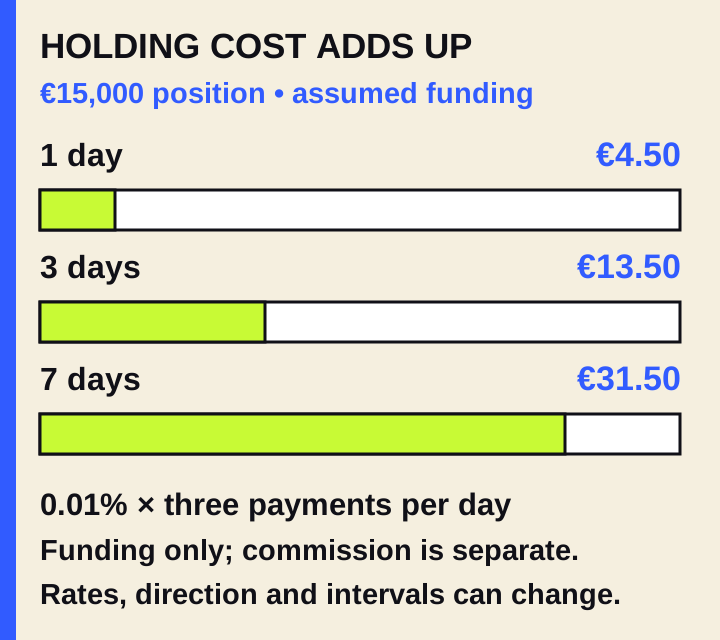
An illustrative funding rate of 0.01% on €15,000 is €1.50 at one settlement. If that rate were paid by your side three times per day for seven days, the total would be €31.50. That is not a forecast or a current market quote: actual rates, direction, intervals and position values change. The example shows why a €9 commission saving can be overtaken by the holding cost.
OKX X-Perps has a funding mechanism even though the contract specifications include long-dated expiries. Coinbase’s European range also distinguishes standard dated contracts from perpetual-style futures. Read the individual product specification rather than treating every contract with an expiry date as funding-free.
Before opening, decide what would make you close: a price, an event or a date. Then price that intended holding period. This produces a useful exchange comparison without pretending that one venue is cheapest for both a fifteen-minute scalp and a month-long hedge.
How are crypto futures taxed in Germany?
For private activity that falls within the German rules for financial derivatives, the starting point is capital income under section 20 of the Income Tax Act. It is not the same calculation as selling privately held Bitcoin under section 23. The contract and the way it settles need to support the classification; the word “crypto” alone does not settle it.
The standard capital-income tax rate is 25%, with solidarity surcharge and, where applicable, church tax affecting the final amount. With the 5.5% solidarity surcharge calculated on the income tax, the combined figure without church tax is 26.375%. An available savings allowance or an applicable assessment option can change the actual bill. This is not a flat tax on every euro you withdraw.
A straightforward private futures example
Assume €6,000 of qualifying net derivative profit, no other capital income using the allowance and a €1,000 individual savings allowance available. The simplified taxable amount is €5,000. At 25%, income tax is €1,250; the solidarity surcharge on that tax is €68.75. The combined example is €1,318.75 before church tax and any personal adjustment.
A jointly assessed couple can have a €2,000 savings allowance under the statutory conditions. It is an allowance across relevant capital income, not €1,000 or €2,000 separately at Kraken, OKX and every other account. Interest and other investment income may already use it.
The amount deposited is not a deduction from profit simply because it came from your salary. Returning €5,000 of original capital is also not €5,000 of new futures income. Work from closed trades, relevant settlement entries and allowable transaction costs, then reconcile those records to the account movements.
Does waiting a year make a future tax-free?
No such one-year exemption follows from the private coin holding rule. A future is a contract, not automatically a purchase of the underlying Bitcoin. Holding a qualifying private coin for more than one year and leaving a BTC derivative open for the same period are different tax situations. A strategy built around confusing them can create a tax bill that the trader has not budgeted for.
The section 20 treatment described here is for the qualifying private derivative case. Business activity, a company account or a product that transfers actual coins can require a different analysis. Keep the contract name and settlement terms with the result so that the classification can be checked against what you actually traded.
Germany removed the €20,000 derivatives-loss cap
Older German futures guides often warn that only €20,000 of derivatives losses can be deducted in a year. That specific restriction was repealed by the 2024 tax legislation. It should not be carried forward as the current general rule in a September 2026 exchange comparison.
The change is substantial for active traders who can accumulate large winning and losing trades while making a much smaller net result. It does not make all investment losses deductible against a salary. The current section 20 still keeps capital losses within the capital-income system, and separate restrictions remain for certain categories such as share-disposal losses.
Why an old guide gives the wrong impression
Imagine €70,000 of qualifying derivative gains and €65,000 of losses in the same year, before further adjustments. Applying the former €20,000 cap would leave €50,000 of gains unoffset in that simplified calculation. With qualifying same-year derivative losses fully taken into account under the current rules, the economic result to examine is €5,000 instead.

This is a tax-law correction, not a recommendation to generate turnover or losses. It does mean that judging a European futures account using an obsolete tax scenario can rule out a product for the wrong reason.
What about an older tax assessment?
Do not assume every historic assessment changes automatically. Whether a past decision can be revised depends on its procedural status and the applicable transitional rules. If an earlier return was affected by the cap, retain the loss records and ask about that assessment specifically. A current-year calculation and reopening a settled earlier year are separate tasks.
When tax software still offers an old loss-cap setting, confirm the assessment year and the version of the calculation. An imported CSV can be perfectly accurate while the tax rule applied to it is out of date. That is one reason to check the final report rather than accepting a green “import complete” message as proof of a correct tax return.
How do losses at one exchange affect gains at another?
German tax reporting concerns the taxpayer’s relevant income, not a league table of account performance. If one foreign futures account shows a qualifying €12,000 profit and a second shows a qualifying €7,500 loss in the same year, reviewing only the first account would miss an important part of the calculation. Subject to the capital-income loss rules, €4,500 is the combined result to examine before the savings allowance and other adjustments.
The losing exchange will not normally send the profitable exchange a German tax offset on your behalf. Collect the records from both. This is especially important when moving providers during a year: closing an account does not remove the earlier trades from the return, and an unused loss does not vanish merely because the balance was withdrawn.
What if another German institution already withheld tax?
Keep its tax certificate separately from the foreign exchange exports. The assessment needs to distinguish income on which German tax was already withheld from income that still needs to be declared without that withholding. Otherwise the same result can be included twice or the tax already paid can be missed.
Where a domestic institution holds a loss pool, its certificate and reporting procedure can affect how losses are brought into the assessment. Do not treat an account screenshot as a substitute for the appropriate document. ELSTER’s instructions distinguish the relevant circumstances; the exact entry depends on where the income and the loss arose.
A bad year followed by a good year
Assume a qualifying unused capital loss of €6,000 is established for one year. In a following year, there is €8,500 of income against which that loss is eligible to be used. The simplified amount left after the offset is €2,500, before the savings allowance and other items. This is not a €6,000 cash refund and it is not permission to deduct the loss from wages.
The important record is the recognised loss carried forward, including any amount already used. A spreadsheet showing an old negative account balance does not establish that figure by itself. Keep the relevant assessment and reconcile the carry-forward with the next return.
This changes how you judge an exchange’s reporting quality. A platform need not calculate your entire German return to be usable. It does need to let you recover the trades and charges that support your part of it, including after you reduce activity or close positions. Download the records while access is straightforward rather than depending on a future support request to recreate a closed account.
Why a Bitcoin loss may not cancel a futures gain
Many German traders keep long-term Bitcoin and trade shorter-term futures in the same app. The shared account screen can make them look like one taxable portfolio. They are not necessarily one tax basket. Private coin disposals and capital-income derivatives follow different rules.
Suppose a qualifying private BTC sale produces a €4,000 loss within its taxable holding period, while a cash-settled future produces a €4,000 profit. Economically, the two results cancel. That does not justify entering zero as the taxable derivative result. The private-disposal loss and the derivative gain must be assessed in their respective categories, including the restrictions on where each loss can be used.
The reverse matters too. A Bitcoin holding that qualifies for a tax-free private disposal after the relevant holding period does not turn a futures hedge loss into a deduction against that tax-free gain. A hedge can reduce market exposure without creating symmetrical tax treatment.

Coin settlement adds a second record
If a derivative pays you in a cryptoasset, record the value of what you received when the contract result is recognised. A later sale or exchange of that asset can create a separate coin transaction. Otherwise the later price movement may disappear from the records, or the same original value may be counted twice.
For a trader who wants the simplest possible records, this is a practical reason to compare cash or stable-value settlement and collateral arrangements. It is not a guarantee that stablecoins have no disposal consequences. The useful question is how many different asset acquisitions, conversions and contract results your chosen workflow creates.
A German tax report should be able to show these categories separately. If the software reduces everything to one overall crypto profit figure, inspect the underlying classification before filing. The exchange’s headline P&L is designed for trading, not for reproducing every boundary in German income-tax law.
Funding futures from a German bank account
For a German resident starting with euros, direct EUR funding is usually the clearest route to price first. Kraken documents euro deposit methods, and OKX offers SEPA euro deposits to eligible EEA residents. That can avoid buying coins at another service solely to move money into a futures account.
The right comparison is the amount of usable collateral you receive, not the number of steps in a tutorial. Include the bank’s fee, any currency conversion, the exchange’s deposit treatment and any subsequent transfer or conversion into the derivatives wallet. A route with a free incoming bank transfer can still have a conversion cost later.
Is USDT still the obvious choice?
Not for every German account. Kraken’s current European asset restrictions include USDT limitations. A balance or deposit instruction seen on an older global tutorial is therefore a poor starting point for a new German futures workflow. Use assets and networks supported by the actual European service at the time of transfer.
Kraken’s European collateral documentation lists asset-specific discounts, often called haircuts. This means €1,000 worth of a supported coin may provide less than €1,000 of recognised collateral. The coin’s market value can also change. EUR collateral avoids adding a separate Bitcoin price movement to the margin backing a Bitcoin trade, although the contract itself may still calculate its result in another currency.
For a concrete Kraken EEA comparison, the current collateral table gives EUR a 0% discount and EURC a 1% discount. If each is first valued at the same $1,000, the recognised margin is $1,000 versus $990. That $10 difference is not a fee taken from the balance: it is a reduction in the value allowed to support positions. Exchange-rate changes and conversion charges are separate.

These details become important when you already own coins. Converting a long-held asset solely to fund a derivative can create a separate disposal and alter the tax record. Before moving it, compare keeping that holding separate and funding the futures account with new euros instead. The answer depends on the asset’s history and your intended trade, not on an assumption that crypto funding is always cheaper.
Which payment account should send the money?
Use the account ownership and beneficiary instructions supplied by the exchange. OKX’s euro guidance excludes transfers through certain third-party wallet providers, including Wise and PayPal. A service having an IBAN does not by itself establish that the particular transfer is accepted.
For a meaningful test, move a small amount through the same route you intend to use for the larger balance and confirm how it becomes available to the futures product. A successful euro deposit is useful evidence about that payment route; it is not proof that derivatives approval has been completed.
Taking profits back to a German bank
Separate the trading result from the cash you can withdraw. Open positions can reserve part of the balance as margin. Closing a profitable trade may still leave other positions using the same account, and a currency conversion or internal transfer can be required before the cash withdrawal method becomes available.
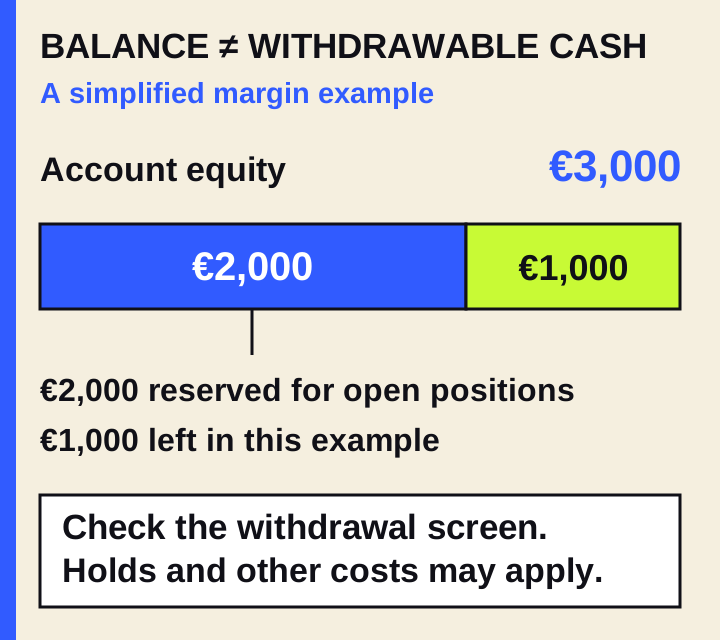
Start with the exchange’s current EUR withdrawal instructions. The available method, minimum, fee and expected processing range depend on the account and banking partner. A public list is useful for planning, but the account’s withdrawal screen is the place to confirm the actual payout route.
If a German bank asks where a larger payment came from, a screenshot of the current portfolio value is a weak explanation. A clearer record connects the original deposit, the account in your name, the relevant trade history and the outgoing payment. This is particularly useful if money has travelled through several crypto services before returning to the bank.
Tax reporting does not wait for that return transfer. Leaving realised proceeds on the exchange or using them for the next position does not automatically defer recognition of the earlier derivative result. Likewise, withdrawing several years of accumulated capital in one payment does not make the whole payment this year’s profit.
For a new account, avoid testing the withdrawal process for the first time immediately after a very large deposit. Kraken documents withdrawal holds associated with some purchase or deposit methods. The relevant hold depends on the method used; it should not be misreported as a universal waiting period for every German SEPA transfer.
What should you keep for ELSTER and your tax return?
If taxable capital income was not subject to German withholding, the German tax return may need the relevant entries in Anlage KAP. A foreign exchange’s trade export is not a German bank tax certificate. ELSTER’s guidance for the applicable return year explains the fields; use that year’s instructions rather than a line number copied from an old blog.
For each derivatives account, keep the contract identifier, opening and closing or settlement records, commissions, funding entries and the currency of each amount. When a report uses dollars, retain a consistent, supportable conversion into euros for the relevant events. An annual bank conversion rate cannot simply replace every event value without considering the reporting method.
The practical challenge is reconciliation. Begin with the opening balance, add deposits and trading results, subtract withdrawals and charges, and account for transfers and conversions. If that reconstruction does not approach the closing balance, investigate the difference before calling the export complete. Open positions and valuation changes need to be distinguished from realised entries in the reconciliation.
Avoid two common import mistakes
First, moving money from the spot wallet to the derivatives wallet is not necessarily a new deposit of outside wealth or an immediate trade. Importing both sides as unrelated events can manufacture income. Preserve transfer identifiers so that the two records can be matched.
Second, do not deduct funding twice. Some P&L reports include it in the displayed result while other exports list it separately. Check the definition of the field you imported. The same applies to commissions: the number labelled “profit” may be gross in one report and net in another.
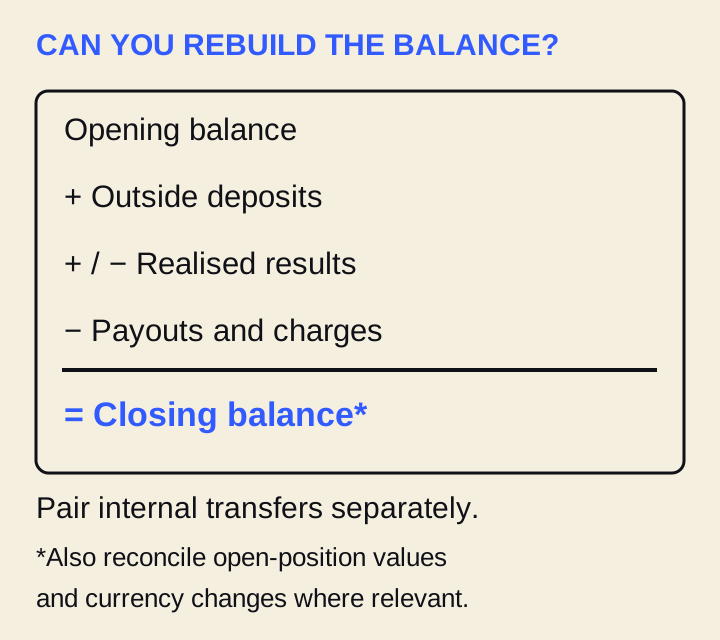
Save original exports before editing a spreadsheet. Keep a short note explaining any correction, missing transaction or conversion method. Germany’s crypto guidance emphasises that a third-party tax report depends on the quality and completeness of its inputs; a polished PDF cannot repair a missing account history.
Does your German city, nationality or account history change access?
Berlin, Hamburg, Frankfurt and Munich do not operate separate national crypto futures permission systems. A resident should not have to pick a different exchange ranking simply because the postcode belongs to another federal state. The important differences are the provider’s service, the customer’s actual residence and classification, and any restrictions attached to the individual application.
A foreign national living in Germany should apply using the real German residence while supplying the identity and tax details requested. A German passport held by someone living elsewhere does not make the person a German-resident customer. Country of citizenship, tax residence and residential address are related facts, but they are not substitutes for one another.
For someone moving into Germany with existing futures positions, preserve the account and position records around the move and establish when German tax residence begins. Do not assume that the old app configuration settles the tax treatment after relocation. Similarly, changing a profile address does not erase earlier reporting obligations in the country of departure.
Returning to Kraken after an older German account arrangement
Kraken announced direct MiCA services for Germany in August 2025. Older German onboarding articles can describe a previous arrangement that is no longer the current starting point. Read the present account notice and the separate derivatives agreement rather than following an archived migration tutorial as if it were a new-account instruction.
This matters because an existing account may contain several service relationships: ordinary crypto custody, cash services and derivatives. The brand name at the top of the screen can remain the same while the agreement relevant to a particular product differs. For an unresolved access problem, quote the actual product and account notice to support rather than simply asking whether “Kraken works in Germany.”
Should you open a company or seek professional status for leverage?
Neither is a sensible shortcut merely to obtain a larger leverage number. A company account has its own ownership, verification and tax treatment. Kraken documents business applications separately from personal applications. Money belonging to a company should not be casually mixed with the owner’s personal trading balance.
Professional-client classification is a separate assessment from incorporation. It can change the protections and product terms that apply, and it is not established merely by answering that you trade frequently. Compare the actual agreement and the commercial benefit before pursuing it.
For the ordinary German private trader, the clearer decision is usually between approved retail crypto derivatives products and their real contract choices. The fact that a professional specification lists more leverage does not make a private customer’s product defective. It means the comparison must stay within the account category the person can legitimately use.
A self-hosted wallet or decentralised trading interface is also not a substitute for resolving German product and tax rules. This guide does not present a DEX as a regulated German retail alternative or as a way to avoid a provider’s restrictions. The documented European exchange products already provide a concrete starting point for the intended comparison.