










Which exchanges offer crypto futures to Dutch residents?
Kraken is the most useful starting point for a Dutch resident who wants crypto futures, an established euro funding route and a choice between perpetual and dated contracts. Its European derivatives account publishes leverage up to 10x on eligible instruments. The Dutch iDEAL deposit option is a practical advantage for someone funding from their own local bank account, although iDEAL itself is not a withdrawal method.
OKX X-Perps belongs beside it when the priority is the European crypto contract range. One Trading deserves a separate look for its Dutch-supervised trading venue and very different pricing for automated orders. Bitvavo is relevant for readers wanting leverage inside a familiar Dutch crypto account, but its borrowed-asset margin service should not be presented as the same product as a perpetual futures exchange.
| Provider | Relevant offering | Reason to consider it |
|---|---|---|
| Kraken EEA derivatives | European perpetual and dated crypto futures, published up to 10x | Euro funding, iDEAL deposits and a dedicated futures account |
| OKX X-Perps | European expiry futures with periodic funding, ordinary access up to 10x | An alternative crypto contract range and transparent regional fees |
| One Trading | Current ONEX crypto dated futures, published up to 10x | Dutch investment-firm supervision and a distinctive API price schedule |
| Bitvavo | Margin trading advertised up to 5x on eligible assets | Leverage within the local platform, if borrowed spot exposure is what you want |
This ordering is for the European Netherlands. Aruba, Curaçao, Sint Maarten and the three Caribbean public bodies have their own sections later in the article. Applying the Dutch shortlist to every Dutch passport holder would overlook real differences in exchange restrictions, currencies and bank transfers.
What does each Dutch futures account actually give you?
Kraken: a futures account connected to euro funding
Kraken's European service is provided under its regional derivatives framework, with the relevant investment entity identified in the product documents. A Dutch customer should use that documentation rather than an international page advertising higher leverage. The useful feature is access to actual crypto derivatives, including both perpetual and dated markets, without having to treat an overseas account as the default starting point.
A euro deposit does not mean every contract is quoted or settled in euros. The collateral rules determine how that cash supports a position, and conversion costs can arise when a dollar-denominated charge has to be paid from another currency. That matters to someone assessing returns in EUR. Compare the approved collateral list with the contract you intend to trade before buying a stablecoin purely out of habit.
The derivatives application is separate from simply opening a spot account. Kraken describes identity verification, the regional eligibility process and an assessment of the customer's knowledge. Having successfully bought Bitcoin does not mean the futures screen is already enabled. Complete that process before moving a large balance intended only for derivatives.
OKX: use X-Perps terms for a Netherlands account
OKX's European X-Perps offer advertises up to 10x for ordinary eligible customers. Its expiry-futures structure includes periodic funding, so a dated product label does not by itself remove holding costs. The relevant comparison with Kraken is the particular coin contract, the charges and the account's collateral arrangement, not which global website displays the largest leverage number.
Some OKX material describes selected markets with higher limits for approved professional clients. That is a separate classification with eligibility requirements and different protections. A Dutch retail customer cannot assume that a 50x professional offer is the default account, nor does selecting an aggressive trading style qualify someone for it. The ordinary published product is the basis of our main comparison.
One Trading: the current contract sheet matters
One Trading Exchange B.V. appears in the AFM investment-firm register, including permission to operate an organised trading facility. Its June 2026 supplementary contract specifications list five-year crypto dated futures on markets including BTC, ETH, SOL and XRP, quoted in USD. They accept USD, EUR and GBP collateral, with a 1% adjustment to the collateral value of EUR and GBP, and publish a 10x limit.
Some older introductory material uses a different product description. We use the current legal specifications here rather than relabelling the whole venue as an EUR-only perpetual exchange. Before placing a specific order, the instrument shown in the order ticket should match the contract documentation. A long expiry does not mean that the trader has to hold the position for five years.
Bitvavo: an alternative for margin, not a substitute label
Bitvavo's June 2026 product update describes margin trading with up to 5x on more than 20 eligible assets. It can suit someone who wants leveraged exposure without leaving that platform. Borrowing charges, the eligible asset list and the account's margin conditions become the relevant comparison. A global perpetual-futures funding rate should not be pasted into this product's cost estimate.
If your requirement is a particular perpetual contract, start with the futures providers above. If the requirement is borrowing against an account to trade a supported asset, Bitvavo deserves consideration on those terms.
Which exchange is cheaper for a Dutch trader?
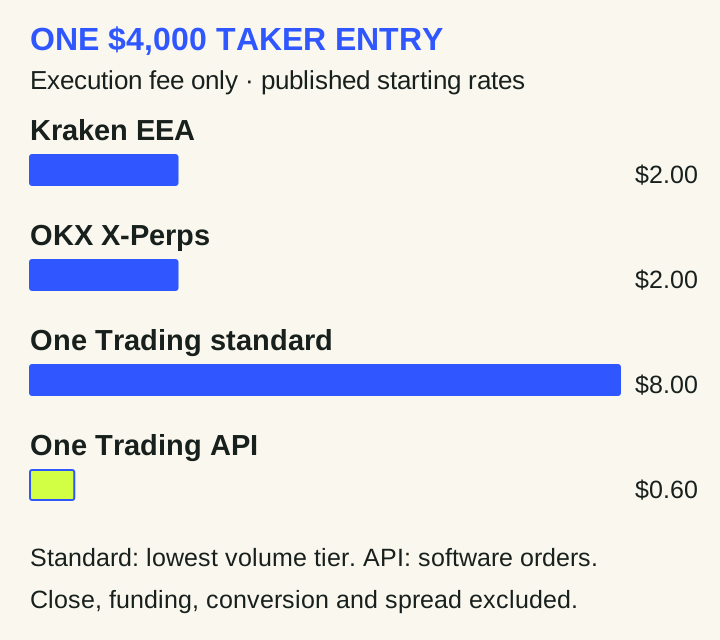
The published entry-level execution fees are 0.02% maker and 0.05% taker for Kraken EEA derivatives, and the reviewed OKX X-Perps overview gives the same starting rates. A maker order rests on the book before execution; a taker order trades immediately against existing orders. These are commission rates on the traded position value, not percentages of the smaller amount you set aside as margin.
One Trading's standard futures schedule starts at 0.10% maker and 0.20% taker for the lowest rolling-volume band. Its separate API schedule lists a 0.005% maker rebate and a 0.015% taker fee. API means orders sent by software through the venue's interface. Someone clicking manually through the trading screen should not budget using the API rate just because it appears prominently on a fees page.
| Product and method | Commission rate | Execution fee for this entry |
|---|---|---|
| Kraken EEA derivatives | 0.05% | $2.00 |
| OKX X-Perps | 0.05% | $2.00 |
| One Trading standard futures, lowest volume band | 0.20% | $8.00 |
| One Trading API schedule | 0.015% | $0.60 |
These are deliberately entry-only examples. Closing the trade is another execution, and the later position value or fee tier can differ. The table excludes funding, conversions, price movement, spread and liquidation charges. Its conclusion is specific: at these published rates, Kraken and OKX are cheaper than One Trading's lowest standard tier for the same taker entry; an eligible API execution reverses that result.
One Trading's higher-volume standard bands reduce the gap. Its schedule also identifies a separate custody charge on certain inactive balances, excluding futures collateral under the stated conditions. A reader parking unused funds should read that condition rather than assume the trading commission is the complete account price. Conversely, it would be unfair to apply an inactive-balance charge to every live futures position.
Funding crypto futures with iDEAL or a Dutch bank
For Kraken, iDEAL is specifically documented for verified customers residing in the Netherlands. The sending bank account must be in the same name as the Kraken account. The minimum is €10, the deposit charge is listed as free, and processing is normally near-instant. The payment links your bank to the verified exchange account; it does not require a separate purchase of crypto from an intermediary.
There is a relevant limitation: Kraken describes iDEAL as deposit-only. Money does not return through an iDEAL withdrawal button. An approved bank withdrawal method is the separate return route. Also distinguish putting euros into the exchange from allocating eligible collateral to the derivatives account; the first action does not automatically open or fund a position on every product.

SEPA is the other obvious option for euros already in a Dutch bank. Kraken's cash-deposit table lists supported SEPA methods from €1, while provider availability and beneficiary details depend on the account. OKX documents EUR SEPA deposits for eligible EEA residents. The advantage is avoiding an unnecessary first purchase of USDT or another asset just to move cash into a service that can accept euros directly.
Card funding can be substantially dearer. Kraken's published EEA debit-card cash-deposit charge is €0.25 plus 3.75%, which makes a €1,000 deposit cost €37.75 under that schedule. That comparison concerns the named cash-deposit method, not every instant-buy quote or card product on the platform. It explains why a free supported bank method can be more important than a tiny difference in futures commission.
Moving existing crypto from a Dutch exchange
Already holding crypto at Bitvavo or another exchange changes the calculation. Selling it, transferring euros and repurchasing collateral can introduce costs that a direct supported crypto transfer avoids. But the destination's regional asset and network support must match. Kraken's EEA restrictions include USDT trading and deposits; a generic international tutorial that begins by sending USDT is therefore a poor guide for a Netherlands-resident account.
Do not confuse the name of the collateral asset with the network carrying it. A supported balance at the sending exchange does not prove that the receiving European account accepts the same token on the same network. The practical choice is between the destination's supported cash route and its supported crypto route. There is no need to insert an unsupported stablecoin into either one simply because it is widely used elsewhere.
Why a transfer can arrive on-chain but still wait for credit
For EU customers, Kraken can request sender or recipient information under the crypto-transfer rules and confirmation that a self-hosted wallet belongs to the customer. This is relevant when moving collateral from a personal wallet or another Dutch exchange: a blockchain confirmation and completion of the exchange's ownership checks are different steps. Do not plan a last-minute margin top-up on the assumption that only network speed matters.
Kraken documents account-based ownership confirmation and, where applicable, wallet-verification methods. Follow the request inside the genuine account rather than sending a recovery phrase to someone offering to release funds. A request for transaction or ownership information is not a request to hand over control of the wallet. Keep transfers between the correctly identified own-name accounts so the information describes the actual sender and recipient.
Bitvavo describes a related “Awaiting wallet verification” status for relevant transfers. When sending from an exchange account, identify the sending provider as requested rather than describing it as your private wallet. When sending from self-custody, use the ownership procedure for that address. The practical benefit is fewer mismatched transfer records between the two platforms; repeating the transaction with a larger amount does not resolve missing information on the first transfer.
Is crypto leverage legal in the Netherlands?
Dutch residents have documented regulated crypto-derivatives options. That makes a blanket claim that all crypto futures are banned here inaccurate. It also does not make every international perpetual platform available. The actual product, provider authorisation and customer classification matter together. The AFM's investment-firm register is especially relevant for financial instruments; a crypto-service registration alone does not answer the derivatives question.
MiCA regulates specified crypto-asset services, but crypto derivatives can fall under the financial-instrument regime instead. In plain language, permission to hold or exchange coins is not automatically permission to sell the leveraged contract you want. One Trading's investment-firm entry and the regional derivatives entities identified by Kraken and OKX give more useful evidence than a provider's general claim to be compliant in Europe.
| Product or permission | What it establishes |
|---|---|
| Retail crypto CFD | AFM intervention sets a 2:1 limit. |
| Named eligible regional futures product | Use its current contract specification and account classification; some cited providers publish up to 10×. |
| MiCA crypto-service authorisation | Does not by itself authorise a leveraged financial instrument. |
For a reader, the useful result is a shorter, better defined shortlist. Match the contract offered to the regulated entity and its current terms. You do not need to become an expert in legal labels before comparing the accounts, but neither a spot licence nor the word futures alone proves that every leverage setting is permitted. If the available Dutch account offers less than a global advertisement, the regional account terms take precedence.
Can a Dutch resident simply use a DEX instead?
A wallet connection does not establish that a service permits Netherlands residents. Some decentralised frontends impose geographic restrictions, and a product's technical accessibility does not establish compliance with Dutch rules. We do not use a DEX to replace an unavailable exchange recommendation or suggest changing location details. The useful comparison here is between the documented products a Dutch resident can actually apply for.
Crypto.com's own on-chain perpetuals exclusion list, for example, names the Netherlands. That is a concrete reason not to advertise that service as a workaround for a Dutch reader. It is also separate from Crypto.com Exchange derivatives, which independently exclude the Netherlands. General app access cannot overturn either product restriction.
Dutch residents, expats and people moving abroad
A resident of Amsterdam, Rotterdam or Maastricht uses the same national framework for this comparison. We found no basis for a separate city-specific futures permission or a higher provincial leverage limit. The differences that can alter access are more practical: actual country of residence, accepted documents, the approved account entity and whether you trade personally or through a business.
A foreign passport does not automatically place an expat living in the Netherlands into an international exchange account. Supply the real Dutch residential address and the applicable tax-identification information. Kraken's regional eligibility process and verification requirements are based on more than citizenship. A provider may still apply nationality or sanctions checks, but those are not a reason to omit the Dutch home address.
Someone living in Belgium or Germany and working in the Netherlands should not substitute the office for their home. Likewise, a Dutch citizen genuinely moving to Curaçao needs the platform to assess the Curaçao residence, even if they retain an NL bank account. The change may affect the legal entity, collateral menu and positions that can remain open. Keep the previous account's statements before a migration divides the trading history.
Can a Dutch BV open the same account?
A company needs the business-account process and its own ownership and funding records. Kraken's corporate application is distinct from a personal derivatives account. Incorporating a BV does not automatically make the owner a professional client or unlock an international product. The company's eligibility and the account's customer classification still have to be established for the service being requested.
That distinction is useful for a founder who already has a Dutch business bank account and wants to trade company money. Do not send that money into a personal account and assume the company can later claim the same ledger. The exchange onboarding, beneficial-owner records and tax reporting need to describe the same customer. A personal bank-to-exchange route and a corporate route are not interchangeable merely because one person controls both.
How does the Netherlands tax crypto-futures activity?
For many private investors, Dutch crypto holdings belong in Box 3. The Belastingdienst's ordinary crypto guidance uses the value on 1 January. That is different from a simple system that taxes only cash withdrawn from an exchange. Keeping profits on-platform does not, by itself, remove the asset from the return, and an account at a foreign exchange is not automatically outside Dutch reporting.
For 2026, the tax authority's crypto explanation gives a 6% deemed return and a 36% tax rate on the calculated Box 3 return, subject to the applicable calculation. It does not mean paying 36% of the entire account balance. Futures require an additional distinction: a €20,000 leveraged position is not necessarily €20,000 of owned crypto. Keep the collateral balance, contract value and associated obligations identifiable instead of entering gross position size as a coin holding.
What if the actual return was lower?
The actual-return calculation can matter when it is lower than the deemed calculation. The Belastingdienst describes this across the relevant Box 3 assets, including changes in value, rather than allowing someone to select only their losing futures trades and ignore gains elsewhere. Under the published explanation, a negative total is treated as zero for that calculation and cannot simply be carried forward as a loss to the next year.
This is why keeping only screenshots of realised winners and losers is insufficient. A useful year file combines the account's opening and closing balances with deposits, withdrawals, executed trades, funding and fees. Kraken provides account-history exports and derivatives ledger records. They help reconstruct what happened; the export itself is not a tax classification ruling for every kind of contract.
Does frequent trading automatically become a business?
The Dutch tax authority distinguishes ordinary speculative investment from activity that goes beyond normal asset management. A high trade count alone should not be turned into a universal rule that every active crypto trader owes business-income tax. Equally, a professional operation cannot assume private-investor treatment merely because the assets are digital. The person's actual work and circumstances matter.
DAC8 adds crypto information-reporting obligations from 2026. It is a reporting framework, not a newly invented tax on every transfer. Use the same name, tax details and account ownership consistently across the exchange and return. That makes the records easier to reconcile when the provider reports information, especially after a move or a switch between personal and company accounts.
Withdrawing profits to a Dutch bank
For a euro-based household, assess the result after any necessary conversion and the chosen withdrawal charge. Kraken publishes several EUR withdrawal providers with their own prices and processing conditions. The presence of iDEAL on the deposit side is not a reason to assume a free instant withdrawal in the other direction. Use the available verified bank method for the account.
If the receiving bank asks where the money came from, a coherent record links the original deposit, the exchange account and the trading results. A transfer labelled with a large round sum does not explain which part was original capital. Keep the exchange export and ownership evidence together. This is more useful than creating a series of unnecessary wallet hops that makes the money harder to trace.
For choosing between the Dutch candidates, the final comparison is therefore fairly concrete. Kraken combines the futures service with a documented local deposit option. OKX is an alternative for its European crypto markets. One Trading's API price can change the answer for someone genuinely using that channel. Bitvavo serves a different margin requirement. The published Dutch products are sufficient for that comparison, without relying on international leverage advertisements.
The Dutch Caribbean: six locations, different account rules
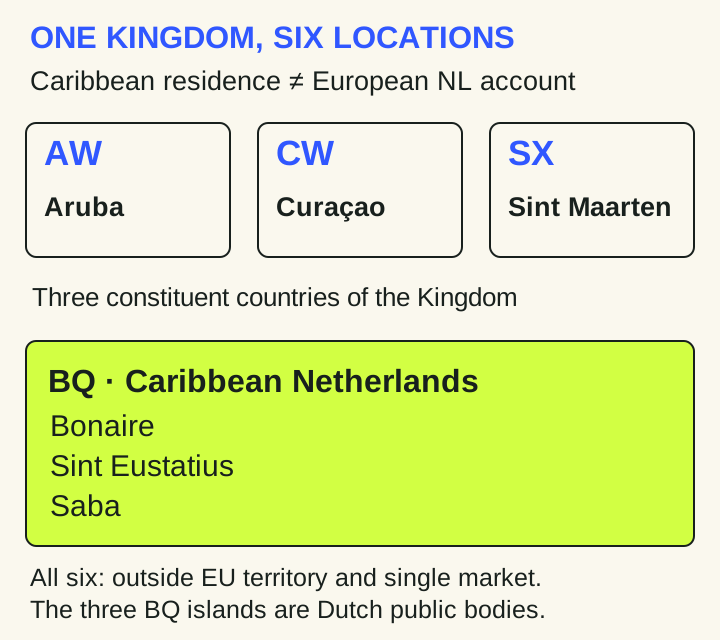
The Kingdom includes the Netherlands, Aruba, Curaçao and Sint Maarten. Bonaire, Sint Eustatius and Saba are public bodies within the Netherlands. All six Caribbean locations are associated with the EU as overseas countries and territories, but they are outside the EU territory and single market. That difference is why Dutch nationality alone does not establish access to the European products discussed above.
For exchange research, the country codes are useful: AW for Aruba, CW for Curaçao, SX for Sint Maarten and BQ for Bonaire, Sint Eustatius and Saba. A platform may group the last three together. That does not mean their residents should select the European Netherlands to obtain a different product. Use the actual residence and the matching location in the provider's records.
What the published exchange policies actually establish
Kraken's international derivatives exclusions do not name AW, CW, SX or BQ. That supports considering its international application, subject to the platform accepting the actual residence, documents and product request. It is not evidence of a completed account-opening test on every island. OKX's reviewed general exclusions also do not individually name them; its EEA X-Perps and SEPA pages should not be used as proof of Caribbean product or bank access.
Crypto.com offers a clearer example of why the product must be checked separately. Its general Web availability page includes these locations. Its Exchange derivatives exclusion list specifically includes BQ, while AW, CW and SX are not named in that list. Its on-chain perpetuals restrictions name all six. General website availability is therefore not a sufficient basis for recommending either derivatives product.
| Residence | Crypto.com Exchange derivatives | A separate payment restriction |
|---|---|---|
| Aruba, AW | Not named in the reviewed exclusion list; approval still required | Bybit lists Aruba as excluded for EUR SEPA |
| Curaçao, CW | Not named in that exclusion list; not an automatic approval | Use the actual bank and currency; EEA SEPA is not established by residence |
| Sint Maarten, SX | Not named in that list; distinct from French Saint Martin | Bybit lists SX among its general fiat-service exclusions |
| Bonaire, Sint Eustatius and Saba, BQ | Explicitly excluded | Dutch citizenship does not create an exception to the BQ restriction |
Aruba: international applications and florin funding
Aruba has its own country status within the Kingdom and uses the Aruban florin. A resident considering Kraken's international derivatives service is not applying on the same residence basis as someone living in Utrecht. The international policy provides a candidate to investigate; it does not turn a Dutch passport into European-account eligibility. Crypto.com Exchange is another non-excluded candidate under the reviewed product list, while its on-chain perpetuals are restricted.
The most useful funding finding is Bybit's explicit Aruba exclusion for EUR SEPA. An Aruban resident should not choose it expecting that named euro bank method to work. If trading capital is held locally in florins, currency conversion and the sending bank's transfer charge belong in the comparison with any supported international exchange method. A generic European free-SEPA claim leaves out the part an Aruban customer actually pays for.
CMB publishes separate international wire charges for its Aruba customers. Use the destination account's currency and beneficiary details when comparing the bank quote; a dollar-quoted futures contract does not itself tell the bank which currency to send. The source below is a bank tariff, not a confirmation that the bank approves every crypto recipient. That distinction avoids promising a local cash route that the evidence has not established.
Curaçao: which exchange and which currency code?
For a Curaçao address, Kraken international and OKX international remain candidates based on their published exclusion policies. The residence is CW, not NL. Crypto.com Exchange derivatives are not excluded by a Curaçao entry in the reviewed list, but the on-chain perpetual service does exclude Curaçao. This gives the reader a real product-level distinction rather than a vague statement that crypto is available everywhere in the Kingdom.
The local currency changed to the Caribbean guilder, XCG, on 31 March 2025. It is shared with Sint Maarten and pegged at 1.79 per US dollar. Do not build a new funding instruction around the assumption that an old Netherlands Antillean guilder code remains the current currency. The bank may offer foreign-currency accounts, but the exchange's accepted deposit currency and the bank's conversion quote still need to match.
The Central Bank of Curaçao and Sint Maarten is the relevant local monetary authority. A website's Curaçao gambling licence is not evidence that it is a licensed crypto-futures exchange. For the services covered here, look at the financial entity and the actual derivatives policy. The fact that a company has another type of island connection does not improve its standing in a futures comparison.
Sint Maarten is not the same exchange location as Saint Martin
The island is shared, but the Dutch constituent country is Sint Maarten, SX, and the French side is Saint Martin, MF. Crypto.com's Exchange derivatives restrictions name Saint Martin but do not name Sint Maarten in the reviewed list. That is not a reason to choose whichever address produces the better result. It is a reason to record the real side of the island where you live, because the provider distinguishes them.
Bybit's payment restrictions give another important result: Sint Maarten is listed under general fiat-service exclusions. Do not recommend a direct Bybit bank deposit here solely because the broader trading-service exclusions omit SX. A crypto-funded account application and a fiat payment service are separate questions. Kraken's international eligibility policy provides another candidate, with the bank method assessed on its own published terms.
Sint Maarten shares the XCG currency with Curaçao. That helps explain local money, but it does not mean an exchange offers XCG collateral or accepts a domestic transfer. A supported USD or EUR bank method may involve conversion and international bank costs. The useful comparison is the verified outgoing and return route for an SX account, not the presence of a euro or dollar symbol on a marketing page.
Bonaire: the BQ exclusion and the cost of a dollar transfer
Bonaire is part of the Caribbean Netherlands, but Crypto.com Exchange explicitly excludes the grouped BQ location from derivatives. That is a stronger finding than saying a website might be unavailable. A reader should remove that product from the shortlist rather than deposit first and discover the restriction later. Kraken's international derivative exclusions do not name BQ, leaving it as a candidate subject to actual account approval.
The local banking comparison is dollar-based. MCB Bonaire's published international-transfer tariff gives an online outgoing fee of 0.1%, with a $7 minimum, plus listed correspondent charges for covered USD transfers. On its $1,000 example band, the minimum bank fee and $15 correspondent charge make $22 before any separate receiving-bank or exchange charge. This illustrates why sending a small sum internationally can cost far more than a mainland Dutch bank deposit.
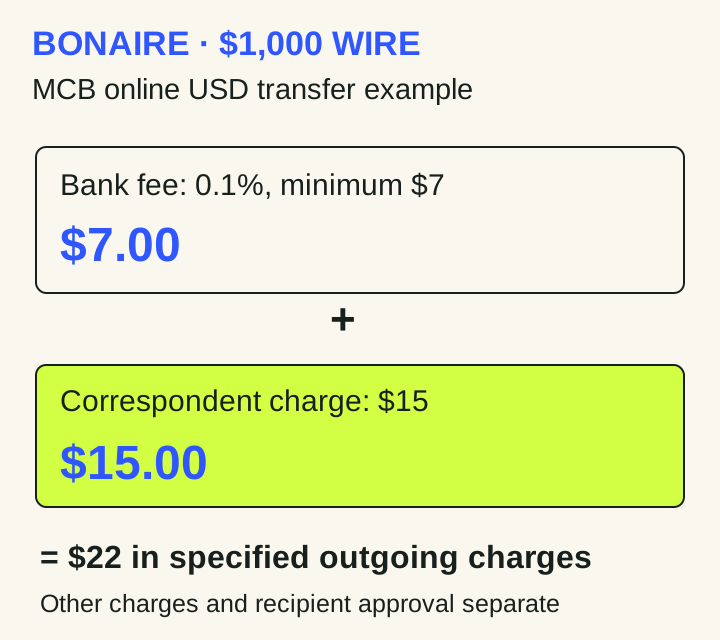
This is a cost illustration, not a tested deposit into Kraken or any other exchange. DNB publishes financial registers for the Caribbean Netherlands; a local bank's presence there does not require it to accept every destination. The exchange and the bank must each permit the transaction. A supported crypto transfer may avoid that particular bank tariff, but then its purchase, network and eventual cash-out costs belong in the comparison instead.
Sint Eustatius: use the island's actual residence record
Sint Eustatius shares the BQ product restriction above. We found no published exception allowing its residents to use Crypto.com Exchange derivatives while excluding Bonaire. The meaningful alternative is an international provider whose policy does not exclude BQ and which accepts the applicant's real documents and product request.
The public-body status matters when a form groups the three islands under one name. A resident of Sint Eustatius may encounter Bonaire, Sint Eustatius and Saba as the combined jurisdiction, while their street address remains on Statia. That grouping is different from selecting the European Netherlands. A Dutch-issued identity document and the correct island address can describe the same person without inventing an NL residential address.
For funding, do not assume the European iDEAL offer applies because the island is constitutionally within the Netherlands. Kraken's iDEAL instructions describe Netherlands-resident availability but do not separately establish an island-specific bank route. The useful recommendation here remains conditional international derivatives access, with supported funding checked for the BQ account. There is no documented basis in the sources for a special Statia-only leverage ceiling.
Saba: a nearby banking hub does not change exchange residence
Saba is also a Caribbean public body within the Netherlands and belongs to the grouped BQ location in the reviewed exchange restrictions. A resident using a bank or another service connected with Sint Maarten does not thereby become an SX-resident customer. That matters because the Crypto.com Exchange derivatives list distinguishes SX from BQ. Bank location cannot replace the residential information required by the trading platform.
For a resident struggling to document the address, Saba's Census Office has a specific PIVA extract / proof-of-address service. That gives a concrete local document route instead of telling the reader to invent a mainland utility bill. Acceptance remains subject to the exchange's document list and recency requirements, but the source below identifies where the official island residence record comes from. Kraken international and OKX international are the candidates identified in the Caribbean policy comparison above.
Finally, moving from the European Netherlands to any of these islands can change both exchange service and tax circumstances. Retaining Dutch nationality is not enough to carry the mainland Box 3 discussion or an EEA derivatives account across unchanged. Preserve the old records, update the real residence and use the destination's own rules. The reason for treating all six locations separately is precisely that a single Dutch flag would hide differences that affect an actual trade.