












Bybit or WhiteBIT for a Ukrainian futures account?
For an eligible resident outside excluded territories, Bybit is a useful starting account when control over the UAH purchase offer matters. Its Ukrainian-hryvnia marketplace lets you compare advertisers, payment methods and order limits before buying the USDT used for trading. The available futures account remains subject to identity, location and product approval.
WhiteBIT deserves a serious comparison, especially if you prefer an automatically matched UAH-to-USDT purchase. Its P2P Express service ties the offered local currency to the country used for verification. This can simplify the purchase, but the quote is still supplied through a third-party P2P service; it is not a guaranteed bank exchange rate.
The choice is not “international exchange versus a Ukrainian banking licence”. Both the trading service and the payment method need their own assessment. Local-language support, a familiar bank name in an advertisement or a football sponsorship cannot establish a Ukrainian derivatives authorisation.
| Account | Reason to consider it | What can change the choice |
|---|---|---|
| Bybit | Choose the UAH advertiser and payment offer yourself | Territorial eligibility, bank permission and the final USDT received |
| WhiteBIT | Guided UAH purchase plus its perpetual account | Automatic-match quote, account verification and contract limits |
| Kraken international derivatives | Alternative for already-funded eligible residents | Explicit exclusions for Crimea, Donetsk and Luhansk; not a dedicated UAH bank route |
Which leveraged products are actually being compared?
Bybit documents USDT perpetual and expiry contracts. WhiteBIT documents perpetual futures with a maximum advertised leverage of up to 100x, subject to the selected market and position bracket. A UAH purchase option does not mean either contract is denominated in hryvnia.
This matters when comparing the amount you can trade. A deposit of UAH 10,000 first becomes a quantity of the supported trading asset at the actual purchase price. The platform then calculates collateral and position limits from that credited balance. Multiplying the original hryvnia payment by the biggest advertised leverage number skips the conversion and the contract rules.
WhiteBIT’s bracket documentation gives a particularly useful detail: the permitted leverage changes as the position exceeds the relevant size band. Its margin and futures settings can also interact. That is worth reviewing before adding to an existing position, rather than assuming the setting displayed for a smaller trade remains unchanged.
Compare the market you intend to use
Someone primarily trading BTC or ETH should inspect those contracts first. A large total coin count does little for a trader whose chosen market has poor execution at the intended order size. Compare the spread and available orders for the same notional amount, then the actual fee tier and funding interval.
For an already-funded account, moving crypto to another exchange solely to obtain a slightly lower headline commission can be a false economy. The withdrawal fee, transfer time and second account approval all belong in the comparison. The advantage needs to be visible on the trades you actually make, not just on a global exchange leaderboard.
Binance’s UAH closure: what changed on September 28?
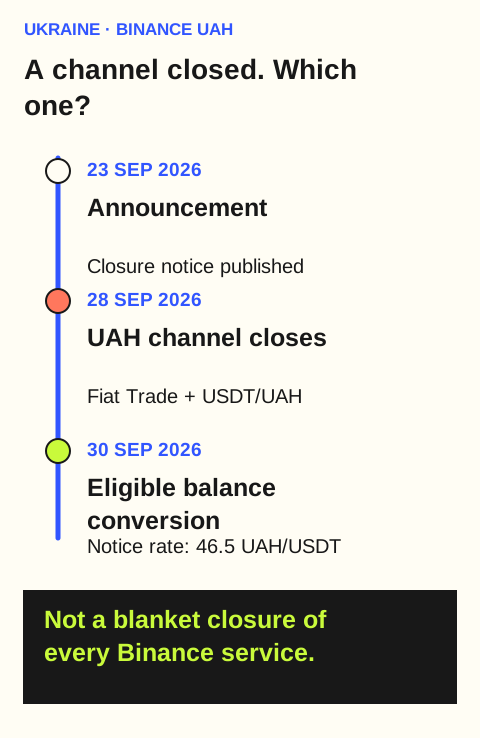
Binance announced that deposits and withdrawals through Fiat Trade UAH would end on September 28, 2026, together with the USDT/UAH spot pair. Those dates have passed. The older description of that direct channel should therefore no longer be used as the funding plan for a new Ukrainian futures account.
The announcement also set September 30 for conversion of remaining eligible UAH balances to USDT at its specified conversion rate. This was an account-balance operation under that notice, not a market exchange rate to use for future deposits. Existing customers should reconcile their transaction history against the notice if they held UAH at the deadline.
The scope matters: closure of a named fiat service and a spot pair is not the same as closure of every Binance product for Ukrainians. It also does not establish that every alternative payment method will be available to a particular account. This review consequently compares currently documented alternatives rather than extrapolating an entire country ban from one payment change.
UAH funding: compare the quote and the bank’s permission
Bybit’s UAH market displays advertiser payment methods such as PrivatBank and Monobank. These are methods named in offers, not evidence that those banks have endorsed leveraged trading or partnered with the exchange. An offer can exist while your bank declines the proposed transaction.
WhiteBIT’s Express process instead matches a purchase through its provider. Its documentation says the available local currency follows the KYC country, with UAH associated with Ukraine. A Ukrainian national who changes verified residence abroad should not assume that an old Ukrainian funding menu survives unchanged.
The lower commission can still produce the worse starting balance
Suppose two hypothetical quotes turn the same UAH 20,000 into 440 USDT and 436 USDT. The difference is 4 USDT before any futures order. At a 0.02% execution rate, trading a 5,000 USDT position costs 1 USDT for one execution. A worse funding quote can therefore outweigh several small commission differences immediately.
These figures are an illustration, not a live P2P offer. Actual advertisements have amount limits, available inventory and payment conditions. Compare a quote that can fulfil your intended amount, not the cheapest tiny advertisement that cannot accept the transaction you want to make.
What the NBU’s UAH 100,000 figure actually covers
Paragraph 14(9) of the reviewed consolidated foreign-exchange resolution permits specified foreign-currency-account transfers and quasi-cash transactions within a combined UAH 100,000 equivalent per calendar month under its conditions. Cryptocurrency purchases are included in that quasi-cash category. It is not a fresh allowance for each exchange and not a blanket permission to use a hryvnia card for any crypto purchase.
This is a payment restriction, not a maximum futures position size. A bank-permitted transfer, exchange verification and derivatives eligibility are separate questions. Treating a card limit as an exchange leverage limit would give the reader the wrong answer to all three.
WhiteBIT’s maker advantage versus Bybit’s funding flexibility
The reviewed basic schedules show a WhiteBIT futures maker fee of 0.01% versus Bybit’s 0.02%; the compared taker rate is 0.055% for each. For a 5,000 USDT-equivalent execution, that is 0.50 versus 1 USDT as a maker, or 2.75 USDT at the stated taker rate.
Those numbers give WhiteBIT a real but specific advantage. They do not establish the cheaper complete account for someone who buys USDT at a worse UAH quote or pays more funding while a position remains open. A limit order that immediately matches another order can also be a taker execution, so the label on the order button alone does not establish the fee.
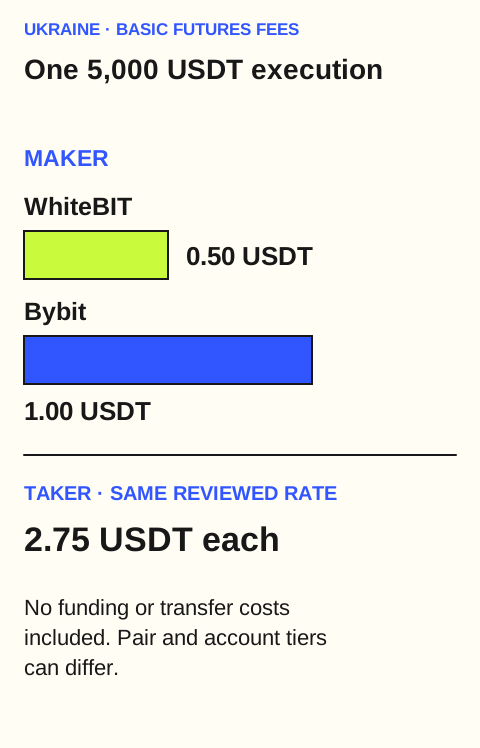
A trader who often supplies liquidity may reasonably prefer the lower maker charge. Someone who wants to choose a particular UAH advertiser and payment method may value Bybit’s manual offer selection more. These are different advantages, which is why the shortlist does not pretend the same provider wins every Ukrainian use case.
For cashing out, repeat the comparison in the other direction. The amount of hryvnia actually received matters more than a gross USDT profit displayed inside the futures interface. Keep the funding conversion separate from the trading result so the two do not become confused when assessing performance or tax.
Why a WhiteBIT profit display can differ from the cash-out
WhiteBIT says its realised profit figure excludes funding, while its position calculator omits both trading fees and funding. The two displays therefore answer different questions. Neither should be copied into a comparison as the amount that will reach a Ukrainian bank account.
For example, a realised result of 20 USDT with a separate 3 USDT funding debit leaves 17 USDT from those two entries, before the UAH sale and payment costs. A funding credit would change the result in the other direction. Use the actual funding history rather than counting the same charge twice or assuming every open position pays a fixed daily fee.
Crimea, Donetsk and Luhansk: where the shortlist changes
For crypto derivatives, Kraken explicitly excludes Crimea, Donetsk and Luhansk in its location policy. Bybit also lists restrictions involving Crimea, Donetsk, Luhansk and Sevastopol. WhiteBIT applies regional exclusions during identity verification. These are provider eligibility rules; a national account recommendation does not override them.
The practical distinction is the scope of each provider’s address restriction. Kraken names regions in its derivatives policy, while other providers use a broader regional assessment. A rejection from one provider therefore does not establish the exact policy of another.
| Provider | Published territorial wording relevant here | Editorial conclusion |
|---|---|---|
| Kraken derivatives | Crimea, Donetsk and Luhansk regions are excluded | Do not recommend its derivatives to residents of those named regions |
| Bybit | Regional restrictions including Crimea, Donetsk, Luhansk and Sevastopol | No general approval for a resident in an excluded area |
| WhiteBIT | Regional exclusions assessed during identity verification | A Ukraine-wide product page does not override the territorial restriction |
Residents of an excluded area
The recommended exchanges cannot be presented as dependable new-account options for someone whose actual residence falls within their exclusion. A Ukrainian passport does not cancel that rule. Neither a foreign mailing address nor a connection routed through another country changes the real residence being assessed.
For an existing restricted account, the useful action is to resolve the balance and account status with the provider through its official account process. Restrictions may distinguish new trading, deposits and withdrawals. Do not send additional collateral simply because an old login still works, and do not assume a restriction necessarily means the provider has confiscated the balance.
Kherson and Zaporizhzhia need a more precise answer
Kherson and Zaporizhzhia need a more precise answer than a blanket exclusion of both entire regions. Kraken’s cited derivatives list does not name either whole region. Bybit and WhiteBIT apply broader location restrictions, so their eligibility assessment depends on the actual residential address. The available evidence supports a provider-by-provider distinction, not a universal ban or universal acceptance.
For a resident of either region, Kraken is therefore a candidate under its published regional list, subject to its normal verification and account checks. The evidence does not establish unconditional acceptance by Bybit or WhiteBIT. For someone who has moved elsewhere, current-address documents allow the exchange to assess the new residence without treating a former address as the present one.
Moved from an excluded region? Separate the old address from today’s residence
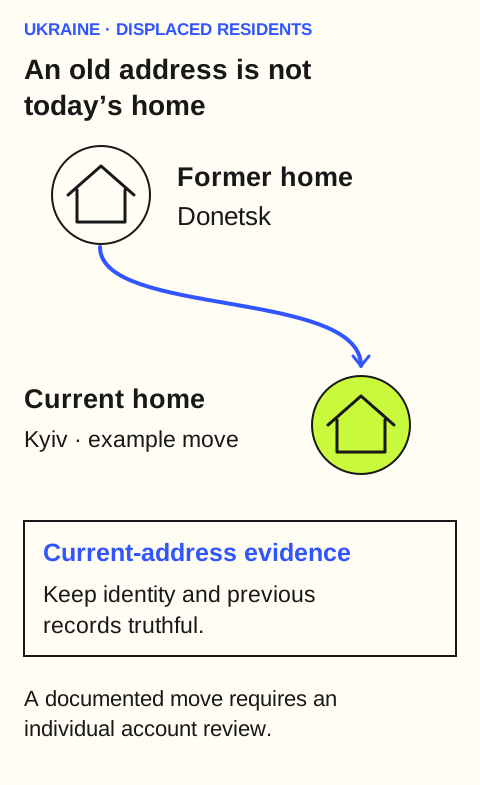
A person who formerly lived in Donetsk and now genuinely lives in Kyiv has a different situation from someone still resident in an excluded location. The application should describe the current residence while retaining truthful identity and history. A document showing a birthplace or former address may need explanation; it is not a reason to falsify the issuing authority or open an account in another person’s name.
Bybit’s verification instructions separate the issuing country of the identity document from proof of address. Its enhanced-verification guidance includes documents such as a recent bank statement, a signed rental agreement or confirmation from a migration authority, subject to its stated requirements. These are concrete types of evidence a displaced reader can prepare.
Acceptance of a particular displaced-person document is still an individual compliance decision. The published examples support a documented change of residence; they do not promise that every certificate will pass automatically. If an application is rejected because of an old address, the relevant correction is a current-address review with supporting evidence.
Avoid contradictory translations
WhiteBIT’s account-ownership certificate guidance highlights a practical Ukrainian issue: an older internal passport may not contain an English transliteration of the name. Its English certificate process can require another document establishing that spelling. The Ukrainian-language certificate has its own full-name requirements.
This becomes useful when the receiving bank is abroad. A consistent name across the exchange certificate, bank statement and passport makes it easier to explain that all three belong to one person. It does not require changing a Ukrainian identity into a foreign one or presenting a relative’s address as your home.
Ukrainians in Poland, Germany, Britain and Canada
Nationality does not keep an account permanently inside Ukraine’s product offer. A Ukrainian citizen who becomes resident in Germany or Poland may receive an EEA account and its regional derivatives conditions. A person resident in the United Kingdom encounters the UK retail crypto-derivatives restriction. Canadian residence can exclude an international futures product that was available before the move.
Temporary protection and exchange verification answer different questions. A protection document may help establish lawful residence, but it is not a derivatives licence and does not entitle the holder to choose whichever national account has the highest leverage. The account needs the country where the person actually lives and the documents the provider accepts for that situation.
Moving while a futures position is open
A genuine relocation may trigger re-verification or a change of provider entity. Before assuming that the existing position can continue indefinitely, review the exchange’s instructions for the change and any trading restrictions it applies. The issue is continuity of the actual contract, not obtaining a new promotional signup link.
Bybit publishes a self-update process for identity and address records, including cooldown conditions between updates. That is a reason to submit accurate, complete documents rather than repeatedly switch country selections while testing the application. A residence change should be handled as a real account update.
An overseas bank account does not move the person
A resident of Ukraine may legitimately hold foreign payment details. That alone does not make the person a resident of the issuing bank’s country. Conversely, a Ukrainian bank card retained after moving abroad does not mean the exchange should ignore the new foreign address. Payment origin and residence should be recorded separately.
What has actually become law in Ukraine?
The parliamentary record for Bill 10225-d reviewed for this update still shows preparation for a second reading. Its inclusion on the parliamentary agenda in September 2026 is not the same as final enactment and commencement. This matters because summaries of proposed crypto-tax rules can otherwise be mistaken for rules already governing the current year.
An exchange’s acceptance of Ukrainian customers is likewise not proof of a fully operating Ukrainian licence for every derivative it offers. Readers should distinguish the provider’s country-access policy, the legal entity supplying the contract and the status of domestic legislation.
The useful result is not “crypto is prohibited everywhere in Ukraine”. The documented platforms and products remain part of the comparison for eligible residents. The limitation is that their commercial availability must not be advertised as state approval or as evidence that a proposed tax treatment is already in force.
How should a Ukrainian trader think about tax on futures?
The State Tax Service’s May 2026 crypto guidance treats income from cryptocurrency sales as foreign income or other income according to the source of payment. This is not a blanket promise that only a net exchange-dashboard profit is taxable. Equally, a crypto-sale answer should not be copied without analysis onto every derivative contract.
For investment income falling within the applicable investment-asset rules, the tax authority’s 2026 guidance cites 18% personal income tax and a separate 5% levy. Whether a particular offshore crypto perpetual qualifies for that treatment, and which expenses or losses count, depends on its legal classification. The 23% combined arithmetic does not settle the tax base.
Keep the records that answer the classification question
A useful export separates the initial deposit, conversion into collateral, realised futures results, fees, funding and withdrawals. The contract statement and provider agreement matter because they explain what was traded. A bank receipt showing a UAH payment cannot identify whether a later gain came from a coin disposal or a derivative settlement.
For example, a withdrawal of 1,500 USDT after an initial 1,000 USDT deposit is not, by itself, a complete annual profit calculation. There may have been other contributions, fees, transfers or still-open positions. That is why an annual ledger should reconcile the activity rather than apply a percentage to the last withdrawal.
Ukrainians abroad can have more than one tax connection
The tax authority’s residence guidance considers permanent home and the centre of personal and economic interests before using the relevant day-count tests. Spending 183 days abroad should not be treated as a universal automatic cancellation of Ukrainian residence. Where two countries claim residence, the applicable treaty and factual circumstances become important.
Ukraine also provides a process for obtaining a tax-residence certificate. Such a certificate can support a treaty position; it is different from the exchange’s proof of address. Keep the two documents for their proper purposes rather than assuming that successful KYC settles the annual tax return.
What makes a Ukrainian cash-out easier to explain?
The strongest withdrawal record connects the original money to the trading account and then to the beneficiary. For someone using UAH purchases, save the purchase confirmation and the exchange trading export. For crypto deposited from an existing wallet, retain the transfer record and the earlier acquisition evidence where available.
WhiteBIT’s ownership-certificate service can include successful deposits and withdrawals, executed orders and a current balance. That can help explain an account to a bank, but it is not a replacement for a complete futures statement or a tax calculation. Request the language and name format that match the receiving institution’s requirements.
A planned cash-out should use a payment method permitted for the verified account and by the receiving bank. The appearance of a bank logo in a P2P advertisement is not that permission. If a provider asks for further source-of-funds evidence, the aim is to reconcile the actual history, not disguise the nature of the transaction.