










Which crypto futures exchange should you choose in Vietnam?
Vietnam has a large international-exchange audience and a new domestic crypto market under development. Those two things do not yet give a resident a straightforward, locally licensed Bitcoin-futures account. Our conclusion is to separate product research from a recommendation to deposit: compare the international contracts below, but do not treat their Vietnamese menus as permission to offer derivatives locally.
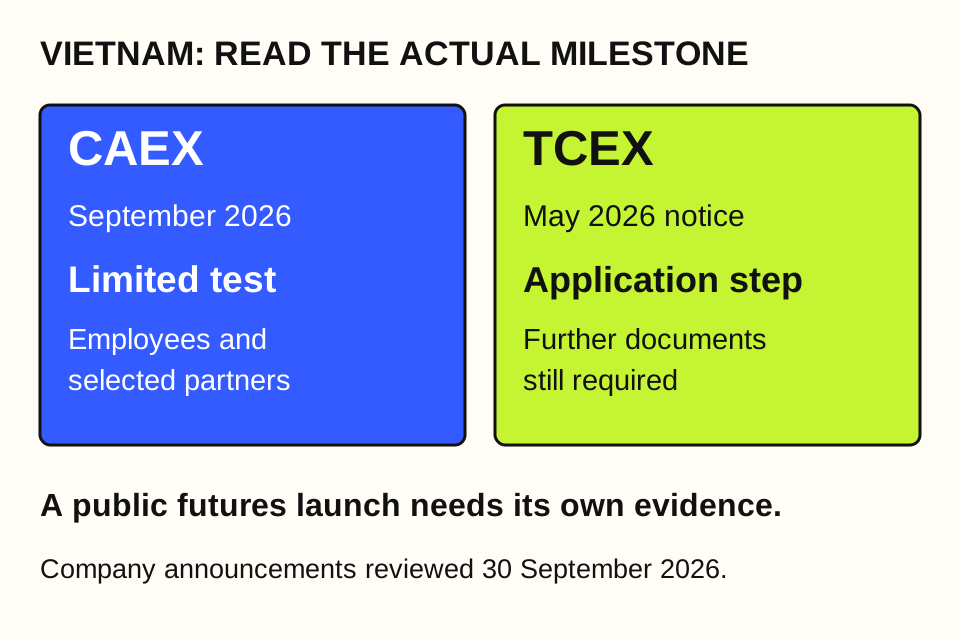
For someone who wants a Vietnamese-licensed venue, CAEX and TCEX belong on a watchlist, not in a live futures ranking. CAEX's September announcements describe a limited employee-and-partner test; TCEX's May notice describes an application that still required further documents. Neither announcement establishes a public leveraged trading service. There is no sensible reason to send money to a supposed early-access agent on that basis.
| Platform | Useful question it answers | Decision for this review |
|---|---|---|
| OKX international | Can I compare perpetual and dated crypto futures, and practise the order controls? | A useful product reference; not a verified Vietnamese-licensed futures recommendation. |
| Binance international | How do USDⓈ-M contracts, BNB fee discounts and recurring funding affect an existing account? | Evaluate the specific enabled contract; the global product is separate from the local pilot. |
| Kraken international | Would the published entry-level fee schedule suit a qualifying trader with supported collateral? | A transparent cost benchmark. Its country policy does not establish local Vietnamese approval. |
| CAEX | Has a proposed domestic exchange progressed from testing to a licensed public launch? | September's limited test is not the missing public-futures launch. |
| TCEX | Has the staged licence application become an operating permission with an actual product list? | The reviewed company notice confirms an application milestone, not approval to trade perpetuals. |
The practical difference is especially important if a search result simply ranks whichever exchange advertises the highest leverage. An available BTC contract, a VND purchase page and a local operating licence are three different pieces of information. A ranking that blends them can look more helpful than it really is. Here, international products remain visible, while the licensing conclusion stays explicit.
What changed in Vietnam's crypto rules in 2026?
Vietnam's pilot framework provides for a licensed domestic crypto market and VND-based transactions. It does not, by itself, establish a retail perpetual-futures product. The rule on domestic investors trading outside licensed providers has a six-month transition tied to the first provider licence. That is not a deadline calculated from a press conference, an application or the date this article was updated.
Does September 2026 mean all offshore accounts must already be closed?
Do not invent a nationwide closing date from the start of a penalties decree. The government describes Decree 284/2026 as taking effect in September and covering unlicensed crypto services and marketing. The pilot's first-licence trigger is a separate provision. To decide whether an actual migration deadline applies, identify the licensing decision that starts it and the customers covered by that rule.
This matters for someone with an existing position as much as for a new customer. Closing a profitable trade, moving coins and withdrawing VND are different actions with different consequences. A dramatic social-media deadline is a poor basis for doing all three at once. Use the dated official instruction and the notice addressed to your account, rather than assuming every headline describes an immediate liquidation requirement.
What would count as a meaningful local launch?
A useful launch notice would let you identify the authorised company, when public customers can start, which assets can be traded and what happens to customer money. For a leverage article, there is another indispensable detail: the actual margin or futures product. A polished app with a buy-and-sell screen does not answer whether short positions, borrowed exposure or perpetual contracts are offered.
CAEX's own news page still describes licensing as in progress. Its September test was time-limited and restricted to employees and selected partners, with an extension through 25 September. That is meaningful progress for the project, but it is not an invitation for every reader to deposit. TCEX separately reported that its initial documents met specified requirements and that further capital, premises and system-security materials were needed.
Does OKX's involvement in CAEX transfer my global account?
CAEX identifies OKX Ventures and HashKey Capital as strategic shareholders and partners. That is a company relationship, not a statement that a personal OKX balance has moved into a Vietnamese-regulated account. It also does not say that every contract on OKX's international platform will appear on CAEX. Until a customer-facing migration notice actually says otherwise, treat the accounts as separate services.
This distinction is useful when someone offers a “local upgrade” through a chat message. There should be a named company and an official account process, not a request to send assets to an individual's wallet. The relevant proof is an announcement explaining your own account and product; a photo of executives signing an agreement answers a different question.
Binance, OKX or Kraken: what changes for a futures trader?
Start with the trade you want to place. A person who wants a short-lived BTC position has a different problem from someone holding a hedge for several weeks. More supported tokens do not automatically improve either trade. The contract's settlement asset, ongoing cost and exit controls usually narrow the choice faster than a long list of platform features.
OKX: compare a perpetual with a dated future
OKX documents both perpetual and expiry futures. A perpetual has no scheduled expiry and uses recurring funding payments; an expiry future ends on a specified date. The dated contract is therefore worth examining when the planned holding period is known, because it changes how the holding cost appears. It is not automatically cheaper: the purchase price and eventual settlement still matter.
For example, suppose a trader wants exposure for one month. Looking only at today's perpetual funding rate does not price the whole month, because future payments can change. Comparing a dated contract requires looking at its price relative to the underlying market and its settlement terms. The useful question is “Which contract better fits this holding period?” rather than “Which exchange has the largest leverage button?”
A beginner who cannot yet explain that distinction can use a practice account to see the two order tickets. That is a better reason to investigate OKX than an unsupported claim that its international app has become a locally approved Vietnamese futures exchange.
Binance: evaluate the contract and discount you actually use
Binance's futures documentation distinguishes trading commission, recurring funding and charges associated with forced liquidation. It also describes a 10% standard trading-fee discount when eligible USDⓈ-M fees are paid with BNB. This can matter to someone already using that setup, but it is not a 10% discount on losses, withdrawals or every cost of holding a position.
If eligible trading commission before the discount were 20 USDT, a 10% reduction would save 2 USDT. There is no need to turn that into a grand claim about the best exchange in Vietnam. Compare the saving with the assets and account arrangement required to obtain it. Someone who would otherwise hold no BNB should assess that extra exposure rather than buying it merely because the discount sounds large.
The Binance fee-calculation FAQ explicitly labels its example rates as assumptions. We therefore do not promote those example percentages as a universal live quotation. The account's current schedule, contract family and tier should supply the rate used in an actual comparison.
Kraken: a useful published-price benchmark
Kraken's September schedule lists 0.02% maker and 0.05% taker fees at its entry tier for international derivatives. A maker order adds to the order book; a taker order trades immediately against an existing order. A limit order is not necessarily a maker order, because it can execute immediately when its price crosses the market.
At those published rates, an illustrative $8,000 taker entry costs $4. If the closing trade also has an $8,000 value, another taker fill costs $4. The $8 total excludes funding, asset conversion and withdrawal. This gives a clean reference point against which a claimed rebate can be judged, without pretending that fees alone settle the choice.
Kraken does not name Vietnam in the reviewed international derivatives exclusion list. That supports a provider-level eligibility inquiry; it does not override Vietnam's domestic service rules. A Vietnamese reader genuinely resident abroad must additionally use the products permitted for that actual residence. The article's international comparisons are not a recommendation to disguise location.
Should you use USDT, BTC or a VND balance?
For the Vietnamese reader, the confusing part often starts before the first order: money is budgeted in VND, an exchange balance may be in USDT, and the futures contract may be labelled BTCUSDT or BTCUSD. These names do not describe three interchangeable balances. Your spending currency, the asset backing a position and the market being traded each play a different role.
USDT-backed contracts make one part easier to read
In a USDT-margined contract, the backing and trading result are expressed in USDT. This makes it easier to distinguish the BTC price bet from a separate BTC holding used as collateral. It does not make USDT identical to cash in a Vietnamese bank, and it does not remove the conversion cost between the trading result and the VND you ultimately want to spend.
With coin-backed futures, the coin used as collateral can itself change in value. Someone who already owns BTC may prefer to retain that exposure, while someone budgeting a fixed VND loss may find it harder to follow. OKX's product documentation distinguishes crypto-, USDT- and USDC-margined contracts; choosing among them is more consequential than changing the display currency in the app.
A bigger VND figure can still hide a weaker crypto result
Consider an illustrative account that moves from 1,000 to 980 USDT after trading. If the VND value of each USDT rises enough, the app's converted VND balance could look unchanged or higher. The trading result remains a loss of 20 USDT. Separating these two effects prevents currency movement from being mistaken for successful futures trading.
For a simple record, keep the starting backing asset, the realised trading result and the final VND conversion as separate entries. This is not elaborate bookkeeping for its own sake. It answers the reader's basic question: did the trade work, or did the currency conversion merely make the number look better? The same separation makes an exchange comparison less vulnerable to attractive screenshots.
What will the position really cost?
A Vietnamese-language promotion may lead with zero P2P trading fees, a futures rebate or a large first-deposit reward. None is a complete price for the trade. The costs most relevant to a leveraged position are what it takes to enter, what it costs to remain open and what is lost on exit or conversion. Compare the same position size and holding period before declaring a winner.
Funding can outweigh a small trading-fee discount
Suppose a position worth 8,000 USDT pays an illustrative funding rate of 0.01% at one settlement. That payment is 0.80 USDT. Three identical payments would total 2.40 USDT. This is a calculation example, not today's rate or a promise that every contract settles three times a day. A different rate, direction or interval changes the result.
Now compare that with saving 2 USDT of commission through a promotion. For a position held through several settlements, the advertised commission saving can be smaller than the holding cost. For a quick trade that is closed before a settlement, the comparison changes. This is why our recommendation cannot be based simply on which referral page advertises the biggest percentage discount.
OKX explains that funding intervals can adjust with market conditions. Binance likewise notes that funding frequency differs by contract. Crypto trading continues around the clock; the relevant time here is a payment event on the open position, not an exchange closing for the evening.
Compare the filled price, not only the fee label
An order that appears cheaper on fees can execute at a worse price. If two hypothetical platforms charge commissions that differ by 1 USDT but the second fills the same trade 6 USDT worse, the headline fee saving loses its meaning. This is particularly relevant when comparing a liquid BTC market with a smaller token promoted for very high leverage.
A useful personal comparison records the requested size, quoted price, actual fill and commission. Do not use one exchange's best observed moment against another exchange's worst moment. We have not run a funded execution test from Vietnam, so we do not claim a measured winner for order-book depth, withdrawal speed or slippage. The product comparisons above are documentary and the numerical examples are transparent calculations.
Does Vietnam's 0.1% crypto tax apply only to profit?
The Ministry of Finance's explanation of Circular 32/2026 says individual crypto-asset transfers are subject to 0.1% of the transfer price, regardless of residence. That is a gross-value rule, not a tax calculated only on an individual's gain. The same explanation describes a different profit-based treatment for domestic organisations. Do not combine the two into a made-up personal allowance.
If an individual buys an asset for 110 million VND and later makes a covered sale for 100 million VND, the 0.1% arithmetic gives 100,000 VND. The transaction has lost value, but the gross transfer calculation is still positive. This example illustrates the stated tax base; it does not determine the treatment of every offshore derivative or every movement between your own wallets.

The distinction becomes more important for a frequent trader. Ten covered sales of 100 million VND each would produce 1 billion VND of gross sales and 1 million VND at 0.1%, even if the final account gain were modest. Those figures illustrate turnover, not a recommendation to trade less or a finding that every futures order receives that exact treatment.
For futures, the unresolved classification should be addressed directly: do not multiply the entire leveraged position by the spot-transfer tax rate merely because both involve crypto. Equally, do not assume the derivative is tax-free because no coin was delivered. Retain the contract record and ask for treatment of that product, rather than applying a reassuring answer about a different transaction.
Already hold crypto on an international exchange?
The first question is whether you hold coins, have an open leveraged position or have already requested a withdrawal. Those situations require different decisions. Transferring a spot balance may be straightforward when permitted, while moving the backing of an open future can alter the account's ability to support it. A withdrawal request is not money available for a second trade until it is completed and credited.
Separate position management from a possible migration
An open future cannot be assumed to move with a transfer of USDT. Sending collateral to another account does not transfer the original entry price, stop order or exchange obligation. If a provider announces a product closure, read the rules for existing positions, new orders and withdrawals separately. Those dates can differ, and the correct response is not necessarily to sell every asset immediately.
Save records while the account remains accessible: executed trades, funding charges, deposits, withdrawals and any account-specific notice. For this purpose, the order history is more useful than a screenshot of the current total balance. It explains how the assets arrived and what happened to the position, which matters if a new licensed service asks about their origin.
Do Hanoi and Ho Chi Minh City have different crypto futures rules?
The national framework reviewed for this article does not establish separate retail crypto-futures permissions for the two cities. A platform's office address is not a city-specific licence for customers. There is therefore no basis here for recommending a different leverage exchange simply because the reader lives in Hanoi, Da Nang or Ho Chi Minh City.
The meaningful local difference is the service actually available to the customer: accepted documents, an enabled payment method and a permitted product. For overseas Vietnamese, actual residence can change the provider entity and available contracts. A Vietnamese passport by itself does not make a US, Japanese or UAE derivatives account follow the same product rules as an account elsewhere.
What can you learn before depositing real money?
Practice should answer a concrete question, not turn into another reward campaign. OKX describes a simulated trading environment that uses virtual funds. Where access is permitted, that makes it possible to learn the order controls without confusing the exercise with a licensed real-money service. A profitable demo result is not proof of withdrawal access, realistic execution or future trading skill.
Try one entry and one exit on a single market. Check what happens when an order is left unfilled, then cancel it and confirm that it no longer appears as open. Next, distinguish closing an existing position from placing an opposite order that could create another exposure. The useful outcome is being able to explain what each order will do before it is submitted.
Finally, compare the practice result with the costs discussed above. Was funding included? Did the account assume a fee tier you would not receive? Were orders filled more easily than they might be in a thin live market? These questions make a short rehearsal informative. They are more valuable than aiming for an enormous imaginary return with a balance you would never actually fund.