





Which Iranian exchanges actually offer leverage?
For understanding a domestic long or short position, Nobitex has the clearer public explanation. Wallex adds a different choice: fixed-term trading credit alongside its margin offering. Someone comparing these services should start with that difference, not with which homepage shows the biggest multiplier. A credit package, an agency-based margin position and an offshore perpetual are not interchangeable.
| Service | What the public material establishes | Our conclusion |
|---|---|---|
| Nobitex | Agency-based leveraged buying and selling; a separate margin wallet | The strongest starting point for reading how a local long or short works. Sanctions remain material. |
| Wallex | Margin marketing plus trading-credit packages with stated repayment amounts and terms | Useful for comparing a fixed credit commitment with a position renewed over time. Check which product is actually being offered. |
| Bitpin, Ramzinex and AbanTether | Domestic exchange services; all named in the reviewed OFAC material | Their presence in a local exchange directory does not establish a better futures product. |
| OMPFinex and Excoino | Other domestic services retained in our wider country catalogue | We do not award a leverage recommendation without a comparable current product record. |
What changed for Iranian crypto exchanges in 2026?
Local no longer means outside the sanctions problem
On 2 June 2026, the US Treasury announced designations covering Nobitex, Wallex, Bitpin and Ramzinex. Its August FAQ also names AbanTether. An older review that only asks whether Binance accepts Iran misses this newer problem: the domestic exchange itself can be the subject of restrictions.
OFAC’s FAQ 1250 separately explains that Iranian digital-asset exchanges are Iranian financial institutions for the relevant blocking rules, even when an individual name is absent from a sanctions list. Consequently, “this smaller exchange was not in the headline” is not enough to establish a clean international transfer path.
Does this affect people who are not American?
Yes, potentially. US-person and US-jurisdiction restrictions are one part of the picture. OFAC also says non-US parties dealing with the named exchanges may face sanctions exposure. The answer depends on the party, transaction and applicable rules; this is not a claim that every Iranian customer has personally been designated.
For an ordinary account holder, the practical distinction is between seeing a balance and finding an institution legally able to receive it. A platform can continue displaying markets while a bank or receiving exchange refuses a transfer. Neither a successful login nor a previous successful withdrawal settles the next transfer’s treatment.

Are the local exchanges closing?
A sanctions designation is not, by itself, a closure announcement. The Nobitex and Wallex product pages were accessible during this review. That confirms the existence of public documentation, not that we completed verification, placed a trade or tested a withdrawal from Iran. Those account-level operations have not been tested here.
This matters when reading social posts that swing between “everything works” and “everything is gone.” A statement about one token, one network or one account is too narrow to prove either claim for the whole service. Read an operational notice for its named asset and date, and keep it separate from the legal status of the exchange.
Nobitex: local longs and shorts, not a copy of offshore futures
Nobitex describes its leveraged product through authority to buy or sell using a shared asset pool. In plain English, the customer puts up backing for a larger market position and settles with the pool when the position closes. Both rising-price and falling-price positions are described. This is a local margin structure, rather than proof that Nobitex offers the same perpetual contract as a foreign exchange.
The dedicated margin page advertises up to 10x, while the homepage reviewed for this article still showed 5x. We therefore do not attach one guaranteed maximum to every market. A reader looking at a specific Bitcoin or altcoin position needs the multiplier displayed for that market and account. A promotional maximum is a ceiling somewhere in the product range, not an entitlement on every order.
Why the asset pool matters
The official API documentation distinguishes an active pool from an inactive one. An inactive pool can prevent a new margin order while still allowing an existing position to be closed. This explains an otherwise confusing experience: a coin can remain visible without fresh borrowing capacity being available for the trade you want.
For a trader comparing local exchanges, this is a useful reason to examine the intended market before choosing the venue. A long list of listed coins is less valuable than a working long or short facility for the two or three coins you actually trade. The presence of a spot pair alone does not answer that question.
Is its “legal and Sharia” description an official licence?
The provider describes this contract structure, but that description is not government approval of every leveraged market. A product can magnify gains and losses even when it is not called an offshore perpetual.
Our assessment is therefore specific. Nobitex is useful to study when the question is how a documented Iranian long/short service works. It is not our recommendation for moving money internationally, and its domestic product explanation does not resolve the sanctions discussed above.
What does keeping a Nobitex position open cost?
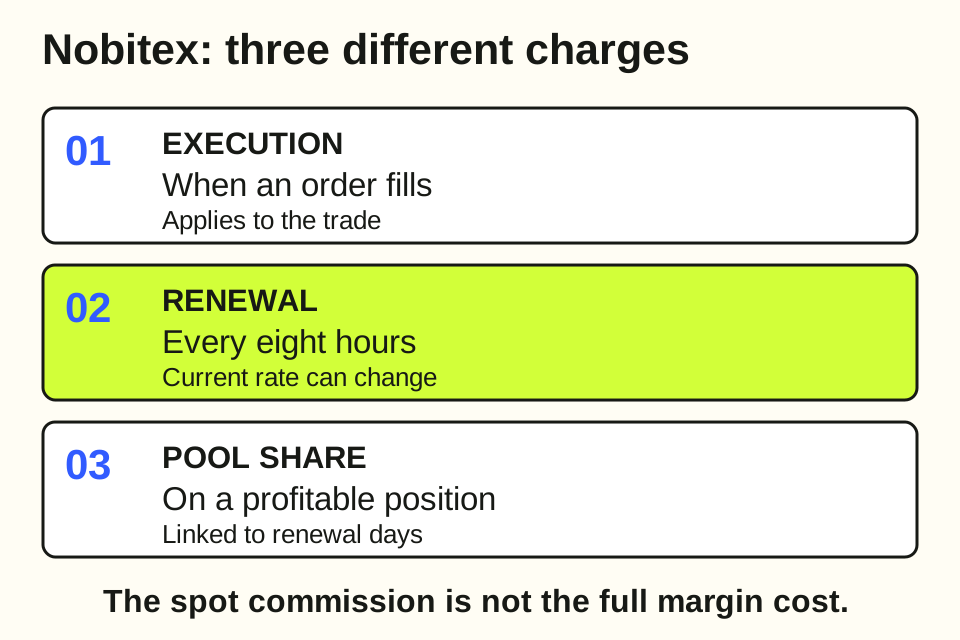
Nobitex’s fee page separates transaction charges from margin costs. It describes renewal deductions every eight hours, a maximum renewal duration of 60 days, and a pool share on profitable positions of 0.5% of profit for each day renewed. The renewal rate itself can change with supply and demand. Treating the displayed spot commission as the entire cost of leverage would miss these additional charges.
The practical question is whether the price move you expect is large enough to cover the charges for the time you expect to hold. A position intended for an afternoon and one kept for several weeks should not be judged from the same entry fee alone. A smaller multiplier does not automatically remove time-based charges.
A simple example of profit versus the final balance
Imagine an illustrative local trade showing 1,000,000 tomans of gross profit. If its applicable pool share is 1% after two charged renewal days, that share alone is 10,000 tomans. The result is 990,000 before the other costs in this simplified example. This is an explanation of the percentage, not a complete quote for a Nobitex order.
Now suppose another 70,000 tomans of transaction and renewal costs applied. The usable profit would be 920,000. Nothing about the chart changed between these two calculations; the difference is whether the costs were counted. That is why a screenshot showing a green percentage cannot, by itself, prove how well a strategy performed.
For a real comparison, use the same market, position size and intended holding time at both providers. Keep the money you contribute separate from the full trade size. Otherwise, a percentage of the position may be mistaken for a percentage of your smaller deposit and the apparent bargain becomes misleading.
Wallex trading credit: read the repayment, not just the multiplier
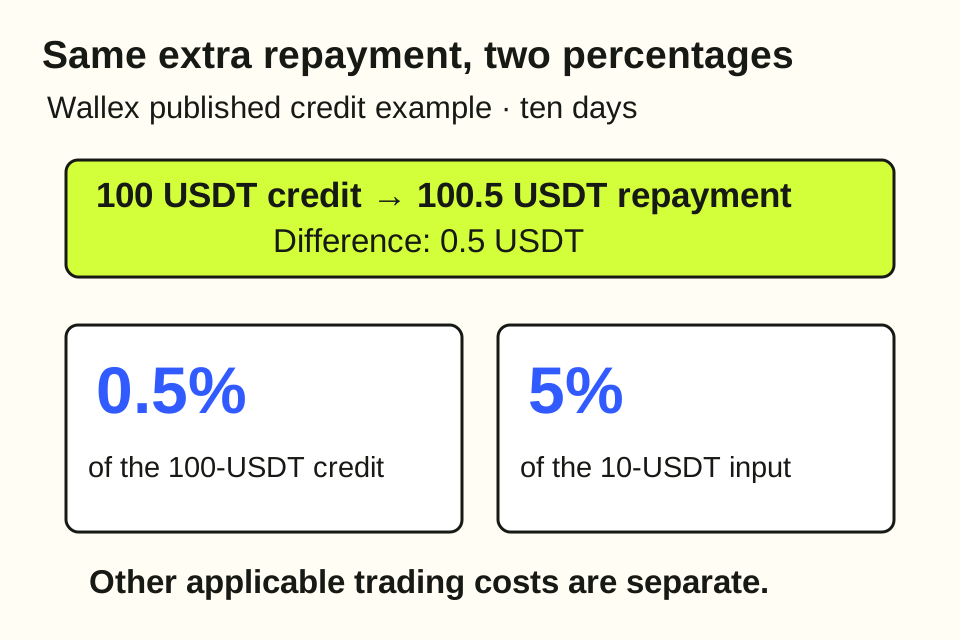
Wallex’s public credit page lists packages with an input amount, credit amount, duration and repayment figure. One reviewed example shows 100 USDT credit for a 10-USDT input, a ten-day term and a 100.5-USDT repayment. That is a specific credit offer, not a universal fee or a promise that the same package will remain available. Other packages were marked full.
In that example, the extra repayment is 0.5 USDT: 0.5% of the 100-USDT credit, but 5% of the 10-USDT input. Both percentages can be mathematically correct while leaving very different impressions. Neither number includes every possible trading charge or price loss. We would reject an advertisement that presents only the smaller percentage as the complete cost to the customer.
This is where Wallex merits a separate discussion from Nobitex. A trader evaluating fixed-term credit needs to understand the repayment commitment. A trader evaluating a long/short margin position needs the closing, renewal and liquidation conditions of that particular product. The familiar brand name does not make those contracts identical.
What about Wallex’s advertised 10x margin?
The homepage describes long and short margin trading and advertises a ratio up to 10x. The older developer documentation found through search described four-hour renewal and a 21-day maximum position life, but that document could not be reopened reliably during this review. Those older figures are not used as current terms or as a reason to rank Wallex above Nobitex.
The useful conclusion is narrower than “Wallex is best.” Its visible credit offers provide a concrete repayment comparison. A current margin order still needs its own terms, particularly if you intend to hold for longer than a short session. We link the functioning official product page rather than making an unavailable document look like fresh verification.
Tomans, rials and USDT: what is your profit actually measured in?
Iranian exchange screens commonly use tomans, while readers also encounter rial figures. In the conventional notation, one toman equals ten rials. Read the unit actually printed beside the balance; a number copied without its unit can be wrong by a factor of ten before any trading calculation begins. The examples in this article explicitly use tomans, not a current dollar exchange-rate forecast.
A more subtle issue is the difference between making money on Bitcoin and benefiting from a change in the local price of the dollar. For illustration, suppose 100 USDT costs 10,000,000 tomans. Later the same 100 USDT is valued at 11,000,000 tomans. Its toman value rose by 10%, although the token quantity did not increase and no profitable Bitcoin position was required.
Conversely, a profitable USDT-denominated trade can produce a smaller gain when translated back into local spending money if the conversion moves against you. This does not make the trade false; it means there are two results worth tracking. Record the change in the trading asset and the change in the amount you could actually receive in tomans after costs.
Does 10x turn a dollar hedge into a better dollar hedge?
No. Holding a stablecoin and taking a leveraged crypto position are different decisions. The leveraged position adds sensitivity to the chosen market and a potential forced close. It may fail before the longer-term currency view has time to work. Someone who merely wants to understand dollar exposure should not be pushed into a Bitcoin short or long because a multiplier looks attractive.
For example, a 5% adverse move on a position five times the backing corresponds to about 25% of that backing before costs in a simplified linear calculation. Real liquidation is not exactly the reciprocal of the multiplier: maintenance requirements, charges and the provider’s chosen price also matter. Use this example to understand scale, not to set an exact liquidation price.
How do Iran’s stablecoin limits affect a trading budget?
The Central Bank of Iran announced a USD 5,000-equivalent aggregate annual stablecoin purchase ceiling and a USD 10,000-equivalent holding ceiling, tied to the customer’s national identifier across broker platforms. These are two separate limits. We found the official announcement; we do not claim to have verified every exchange’s current enforcement screen.
Consider a customer who has already used the annual purchase allowance but currently holds only USD 3,000 equivalent. The smaller balance does not, by itself, establish a fresh purchase allowance. Likewise, splitting purchases between several domestic platforms does not turn an aggregate national-identifier limit into a separate allowance at each venue.
These ceilings also do not describe the size of an allowable leveraged position. A token purchase, a holding and a market exposure are different measures. If a local product displays a larger position value, that display is not evidence that the central bank has granted a larger stablecoin purchase quota.
Already have funds on an Iranian exchange?
Start by identifying what you own inside the account: a withdrawable token balance, money committed to an open position, or the remainder after a position was closed. A total account value can combine these. Treating the total as immediately transferable can lead to an unnecessary new trade when the problem is actually a withdrawal or account restriction.
Nobitex’s published account-level page illustrates another distinction. Its entry tier listed a 1-million-toman-equivalent crypto withdrawal allowance versus a 50-million-toman withdrawal allowance per 24 hours, and states that verification levels are separate from trading-fee tiers. A high trading volume does not automatically unlock the same withdrawal access as a higher identity tier.
That is relevant to a customer who can trade but cannot withdraw the expected amount. It is not necessarily evidence that the exchange has lost the entire balance, nor proof that it is safe. Look for the specific reason in the account notice: identity tier, network interruption, funds committed to a position, or legal restriction require different explanations.
What should the account record show?
Keep the original funding transaction, the position’s opening and closing records, the charges deducted, and the requested withdrawal status. If the problem concerns a receiving provider, preserve its written response too. This gives a support or legal adviser something concrete to assess instead of a screenshot of a single headline balance.
Do not send additional money to a stranger promising to “unlock” a sanctioned account, pay a supposed release tax in crypto, or supply a replacement identity. A genuine account restriction is not resolved by creating a misleading transaction history. Ask the provider for the applicable process and obtain qualified advice where a blocked transfer is involved.
What if you are Iranian but live outside Iran?
Nationality, current residence and sanctions status are different questions. Kraken explicitly excludes residents of Iran from international derivatives, and Bybit also lists Iran among excluded jurisdictions. An Iranian person genuinely living elsewhere should obtain a decision based on the provider’s actual identification requirements, residence and account history; this guide cannot infer approval from a passport alone.
Moving abroad also does not automatically remove the history of funds previously held at a designated exchange. A receiving institution may evaluate where those assets came from. Providing the real history is more useful than relying on a generic claim that the new country is supported.
For someone now resident in a neighbouring country, use that country’s guide to compare its actual account options, then check the cross-border eligibility question with the provider. The Iran page remains useful for understanding the domestic account and the source of the balance, but it is not a portable approval for another jurisdiction.