










Which exchange makes sense for crypto futures in Turkey?
Kraken is the international futures account worth checking first if you live in Türkiye and already have funds that you can lawfully use for trading. Its published derivatives exclusions do not name Turkey. That supports an eligibility check, not a claim that Kraken holds Turkish approval for retail futures. Confirm the product on your verified account before transferring money for it.
The local alternatives solve a different problem. Binance TR, BtcTurk and Paribu are places to investigate for lira-based crypto trading. Their presence in Turkey does not turn their spot markets into leveraged markets. Buying Bitcoin on a BTC/TRY screen gives you Bitcoin exposure; it does not create a short position or multiply your buying power.
For an active trader, Crypto.com Exchange deserves a separate fee comparison. Its international derivatives restriction list also does not name Turkey, and its published VIP structure can undercut Kraken at qualifying volume. The Exchange is the relevant product here, rather than every feature shown in the separate Crypto.com App. Local rules and individual product approval still matter.
Our practical order of preference
Start with Kraken for the international derivatives eligibility check. Compare Crypto.com Exchange if your actual trading volume earns its lower derivatives rates. Use a Turkish spot platform for a genuine TRY purchase or withdrawal requirement, rather than presenting it as another perpetual-futures candidate. This order follows three different jobs instead of pretending that every familiar brand offers the same account.
| Need | Candidate to investigate | What prevents a misleading comparison |
|---|---|---|
| BTC or ETH perpetuals | Kraken international derivatives | Turkey is not excluded in the published product list; that is not Turkish regulatory approval |
| Frequent eligible derivatives trading | Crypto.com Exchange | Compare the tier your account earns, not an advertised VIP rate you cannot obtain |
| Buying or selling crypto against lira | A Turkish spot platform | A BTC/TRY market is not a leveraged BTC contract |
| A short against coins already owned | An approved derivatives account | Selling owned coins and opening a futures short have different cash flows |
Does Turkey allow crypto leverage on local exchanges?
The Turkish rule is unusually important to this comparison. Article 14 of the domestic crypto-platform communiqué prohibits leveraged trading in crypto-assets listed on those platforms, together with their use in derivatives, credit purchases, short sales and lending transactions. It is a restriction on the regulated platform product. It should not be rewritten as “all crypto ownership is illegal in Turkey.”
The SPK’s operating list is also easy to misread. The regulator expressly says inclusion in that transitional list does not itself mean authorisation. A review that sees a company name there and immediately awards it a “licensed Turkish futures” badge has skipped two questions: what status does the entry establish, and what activity does the rule allow?
Why the global brand name is not enough
Binance TR and a Binance global account are not interchangeable product menus. Likewise, finding a Turkish-language page for a foreign exchange does not establish permission for every service described on that page. Your account agreement and the product actually enabled for your residence matter more than the language of a marketing page.
This is why we do not recommend a DEX as a simple workaround for Turkish product restrictions. Connecting a wallet changes how you access a service, not the legal treatment of the activity. If a provider declines your genuine residence or the product is unavailable on your verified account, selecting another country is not a sound solution.
For Turkish residents, the honest recommendation is therefore conditional: investigate a documented international product without labelling it a locally authorised retail-futures service. A trader who wants only a straightforward local account should compare spot products instead. That distinction narrows the recommendation, but it also prevents depositing money for a futures tab that never appears.
The Turkish funding issue that can change your trade
The most consequential local question is not simply whether you can buy USDT. It is whether the balance can reach the derivatives account when you need it. A confirmed bank deposit, purchased stablecoins and available futures margin are three different stages. Money waiting at an originating platform cannot support a losing position elsewhere.
Binance TR’s January 2026 announcement applies a 48-hour wait to Binance TRansfer crypto transfers from 9 January. That matters because older instructions described this linked-account route as an exception to ordinary withdrawal delays. An old tutorial can still look convincing while giving you the wrong answer about an urgent top-up.
Plan the trade around the cleared balance
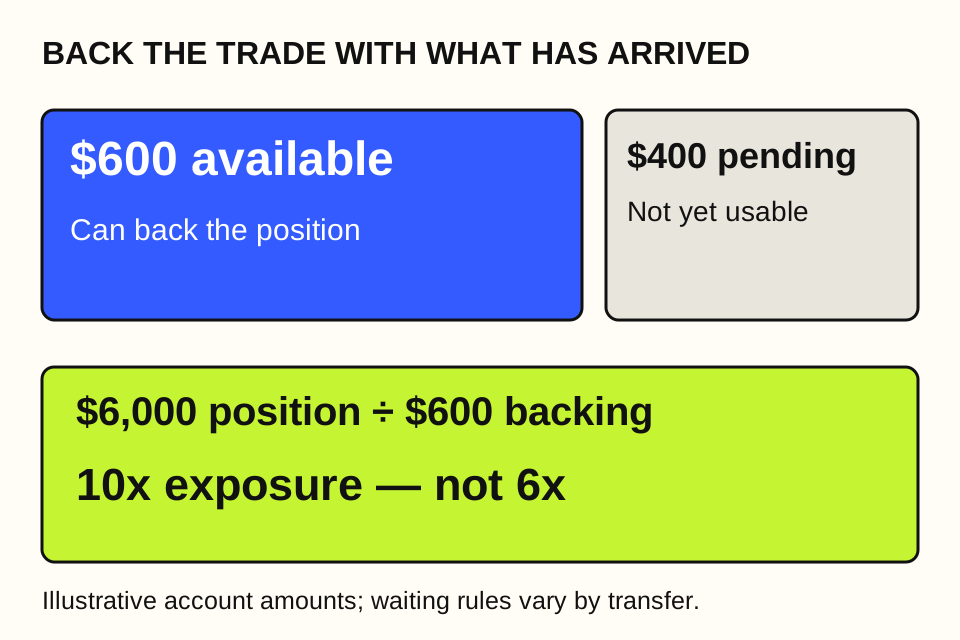
Consider someone with $600 already available in a derivatives wallet and another $400 in crypto awaiting release from a Turkish platform. A position opened today is supported by the available $600, not by an imagined $1,000 total. Counting the second balance early would understate the effective leverage. If the position is worth $6,000, it is ten times the available backing, not six times.
The distinction also affects a hedge. Suppose you own Bitcoin and want a short to offset part of its price movement. Opening the short before its intended funding has arrived can leave you with a much more fragile position than the planned hedge. A sensible hedge size comes from the collateral already credited, rather than the amount you hope to transfer tomorrow.
This does not mean keeping all your savings on an exchange. It means deciding the trade size only after you know the trading balance and keeping money needed for ordinary expenses outside that calculation. If the account cannot support the intended position without an emergency transfer, reducing the position is a more dependable adjustment than relying on an unconfirmed release time.
Do the 48-hour and 72-hour waits always apply?
OKX TR describes a 72-hour first crypto withdrawal wait and a 48-hour period for later purchases, exchanges or deposits. It also describes transfer-message exceptions when the required sender information is verified and the platform’s checks permit them. Completing identity verification alone does not guarantee a waiver.
Its published stablecoin transfer limits are $3,000 daily and $50,000 monthly, with possible increases to $6,000 and $100,000 where the specified information and verification conditions are met. These are transfer limits, not a permitted futures position size. A $2,000 withdrawal and a $20,000 contract backed by it measure different things.
Why “Travel Rule compliant” is not an instant-transfer promise
The useful question is whether your particular transfer qualifies and what release time the sending platform gives it. General rules can permit an exception while an operator applies an additional waiting policy. Binance TR’s later transfer notice is a concrete reason not to assume identical treatment across two Turkish platforms.
The destination also matters to the exception: identify whether the recipient is another provider or your own wallet, and supply the information the sending platform requests for that case. A previous successful withdrawal to a different recipient does not establish that the next one receives the same treatment.
If you frequently trade short-term moves, this is a platform-selection issue rather than a footnote. The cheapest advertised commission may be less useful if your normal lawful funding process cannot provide a usable balance before the setup expires. Someone with existing eligible collateral faces a different decision from someone starting each trade with a new TRY purchase.
How much do Turkish traders pay for futures?
Use the derivatives fee schedule of the actual product. A spot commission on a Turkish exchange, a global perpetual commission and a simplified app trade can have different prices. Comparing them without identifying the account makes a low-fee ranking look more precise than it is.
Kraken’s published derivatives entry tier is 0.02% for a maker fill and 0.05% for a taker fill. A maker order adds an order that waits on the book; a taker order trades against an order already there. A limit order that executes immediately can still be a taker. The name of the button does not determine the final fee.
A $4,000 trade with $400 of backing
At those entry rates, opening and closing an unchanged $4,000 position with taker fills costs $4 in trading commissions. Two maker fills cost $1.60. These examples exclude funding, spread, price movement and any conversion or withdrawal charges. They use the contract value, not the $400 set aside as margin.
That is the first useful comparison for a small account: $4 is 1% of the $400 backing before the market has moved in your favour. Increasing leverage while keeping the same $400 makes the contract bigger, so it also increases the dollar commission. A higher leverage selector does not give you a cheaper trade.
When Crypto.com’s VIP rate wins
At $6 million of qualifying 30-day derivatives volume, Crypto.com publishes VIP 1 rates of 0.008% maker and 0.028% taker. Kraken’s published $5 million tier is 0.0175% maker and 0.045% taker. For $100,000 of subsequent one-sided taker turnover, that comparison is $28 versus $45, or a $17 commission difference before other costs.
This is a completed comparison for a qualifying trader, not a promise to a new account. Crypto.com’s fee tier is reviewed daily, and the VIP label can remain after the qualifying fee tier changes. Compare the effective rate in the account. Do not increase trading merely to reach the volume threshold: unnecessary losing trades can outweigh a fee reduction very quickly.

Which exchange is better for your actual trading style?
For a BTC or ETH trader taking a few planned positions, account access, the exact market and order execution come before a VIP table. Open the same contract on both candidates and compare the amount that can trade near the quoted price. A busy exchange in general can still have a thin market in the particular altcoin you want.
For a trader repeatedly entering and exiting with market orders, taker fees and slippage deserve more attention. Slippage is the difference between the price you expected and the prices your order actually receives. The practical check is the order preview for your intended size, not a screenshot showing one attractive price at the top of the book.
For someone holding positions overnight
Funding becomes more important when a perpetual position stays open. It is a periodic payment between the two sides of the market, with its direction and rate able to change. A lower opening commission does not automatically make an exchange cheaper over several days. Compare the same asset and direction over the expected holding period.
A made-up example shows why: $2 saved on commissions is overwhelmed by $8 of additional funding. Those numbers are not a current quote. They illustrate why we would choose the lower total cost for a multi-day position, while an intraday trader who closes before a funding event might reach a different conclusion.
For a Turkish holder who wants to short
First decide whether you want to reduce a holding or keep it while offsetting some price exposure. Selling part of owned Bitcoin reduces the holding without creating a derivative. Keeping the Bitcoin and adding a short retains the coins but introduces margin, funding and liquidation management. These are different tools, even if both can reduce exposure to a falling BTC price.
The futures route makes more sense when retaining the underlying coins is part of the plan and the account can maintain the hedge. It is less convincing when the only goal is “own less Bitcoin” and a spot sale already achieves it. Choosing the appropriate action is more useful than treating leverage as an upgrade that every crypto holder needs.
Does a rising BTC/TRY price mean your futures trade won?
Not necessarily. Bitcoin’s lira price reflects both its dollar price and the lira’s value against the dollar. An international BTC perpetual normally references the crypto market in its quoted currency, not the return shown by a local BTC/TRY chart. A large green number in lira can therefore coexist with a flat or losing dollar-based trade.
Imagine BTC remains at $60,000 while a hypothetical exchange rate moves from TRY 40 to TRY 44 per dollar. The equivalent BTC price changes from TRY 2.4 million to TRY 2.64 million. That is a 10% lira-price increase without any increase in Bitcoin’s dollar price. A long on an unchanged dollar-based BTC contract has not earned 10% from that currency move.
Keep the account result and the household result separate
Your trading result is the contract’s realised profit or loss after its costs. Your eventual lira result also includes the rate at which you convert the proceeds. Tracking both avoids a common mistake: believing a losing strategy is profitable merely because the remaining dollars buy more lira.
The same applies in reverse. You could make a modest dollar profit and receive fewer lira than expected if conversion rates move against you or the cash-out quote is poor. This is not a reason to forecast currencies before every trade. It is a reason to record the units correctly and assess the futures decision on its own result.
USDT is also not a bank-dollar balance. A platform can quote a USDT/TRY market at a premium or discount to a simple currency conversion. When sizing a trade, use the actual number of tokens credited and the collateral value accepted by the derivatives account. Do not count a local quoted premium as extra exchange margin.

Binance TR, BtcTurk or Paribu for the lira part?
The best domestic companion depends on the pair, the bank route and the cost of the amount you actually plan to move. Familiarity is useful, but a local app you like does not necessarily offer the best quote for a larger stablecoin purchase. Compare the final tokens received after the purchase and the onward transfer charge.
Binance TR’s public FAQ describes own-name bank transfers and says it charges no TRY deposit or withdrawal fee. That removes one platform charge; it does not prove that every conversion or crypto transfer is free. FAST and supported same-bank transfers also have different processing arrangements from an ordinary bank transfer. These affect receipt of funds, not whether the crypto market itself is open.
A better comparison than “zero deposit fee”
Ask each candidate the same practical question: how much transferable USDT would this exact TRY amount produce? Include the purchase price, trading commission and crypto withdrawal charge. Then check when the amount becomes transferable. A slightly better quote that remains unavailable for your intended use may not meet the purpose of that purchase.
For illustration, offer A produces 1,000 USDT and charges 2 USDT to withdraw; offer B produces 997 USDT and charges 0.50 USDT. The final amounts are 998 and 996.50 USDT. Offer A is better by 1.50 USDT despite its larger withdrawal fee. These are example offers, not live quotes or assigned rates for the named Turkish platforms.
For cashing out, repeat the comparison in the opposite direction. Compare the TRY amount actually paid to your own bank, not the headline coin price. An exchange that was attractive when buying can be less competitive when selling because its current order book and available withdrawal routes have changed.
How to avoid an oversized trade before it opens
A practical first trade is one you can explain in one sentence: the asset, direction, position value and amount supporting it. If your explanation is only “I chose 20x,” you have not yet described the position. The same leverage setting produces very different exposure when applied to $100 or $2,000.
For example, a $2,000 long backed by $200 has ten times that backing in market exposure. A 2% adverse move is roughly a $40 trading loss before costs, equal to 20% of the initial backing. Liquidation occurs according to the exchange’s maintenance requirements and account state, so this simple illustration is not an exact liquidation-price calculator.
Choose what else the position can consume
Where available, isolated margin assigns a defined amount to a position, while cross margin can draw on a shared balance. The latter may make liquidation less immediate, but it can also expose funds supporting other trades. Read the selected mode before submitting, especially after switching between the exchange’s simple and advanced interfaces.
A stop order is another separate decision. It is an instruction triggered under specified conditions, not guaranteed insurance at the price typed into the form. Thin markets and fast moves can worsen the exit. Confirm the trigger reference and whether the closing instruction reduces the position rather than opening an opposite trade.
For someone funding from Turkey, these controls have a particular connection: a withdrawal waiting period can prevent a last-minute rescue deposit. Plan a position that makes sense with its present backing. Adding money after a bad move should not be the sole reason you think the original position is manageable.
Turkish citizens abroad and foreign residents in Turkey
A Turkish passport does not automatically place every Turkish citizen under the same exchange product menu. Someone genuinely resident in Germany, the UK or another jurisdiction must be assessed under the relevant provider’s rules for that residence. A holiday address or a language preference is not a replacement for the account’s actual location and documentation.
Conversely, a foreign citizen living in Istanbul should not assume a global account opened elsewhere will always retain identical features after updating residence. Make the update before planning a migration of open trades. Ask what happens to existing positions, unsupported assets and withdrawal methods if the provider changes the servicing entity.
Local identity checks can be different
Binance TR’s published identity-verification explanation refers to Turkish identity and residence documentation and directs foreign-national cases to support. That is not a blanket promise that any foreign passport or residence permit will be accepted. Establish eligibility for the local fiat account before making it essential to your trading plan.
We found no basis in the reviewed national rules for giving Istanbul, Ankara or Izmir a separate retail crypto-futures allowance. The city can affect which services are convenient, but it does not convert a domestic spot product into a leveraged one. A useful country review should explain that distinction without inventing regional exceptions to make the article look more local.
Can you withdraw futures profits back to a Turkish bank?
Treat the withdrawal as its own transaction. Closing a position settles the trading result, but the withdrawable balance can still differ from the amount shown elsewhere in the account. Open orders, other positions, fees or a balance left in the derivatives wallet can affect what is available to transfer.
Start with the receiving account’s supported asset and network. “USDT accepted” is incomplete unless the sending and receiving networks match. Compare the destination instructions with the actual withdrawal form each time, particularly if you last used the address months ago. A cheap network that the destination does not support is not a saving.
Keep a simple record of the complete trip
The useful record is not a folder full of random screenshots. Keep the original funding amount, exchange trade history, settled futures result, crypto transfer reference and final TRY sale or withdrawal. That connects the money arriving at your bank to what happened on the trading account and makes a provider’s source-of-funds question easier to answer.
Do not assume that an app’s profit figure settles your Turkish tax treatment. The account’s jurisdiction, your residence and the type of activity can matter. For a meaningful or recurring amount, take the transaction history to a qualified local adviser rather than relying on a generic “crypto is tax-free” sentence from an exchange ranking.
The checks that decide whether to proceed
Proceed only when the intended derivatives product is enabled, the right collateral is credited and the order preview fits your planned size. For Turkey, those checks resolve three separate uncertainties: international product access, the domestic transfer process and the actual leverage of the position. A familiar exchange logo cannot answer all three.
If you cannot complete the access check, do not fund the account just to find out later. If the collateral is pending, judge the trade against the smaller cleared balance or wait. If the quoted cost changes the trade’s expected outcome, compare the other eligible product before entering. Each problem has a different fix; adding more leverage fixes none of them.
Keep the accepted fee tier and transfer release time with the trade plan. If either changes, revise the plan before opening the position; do not assume that yesterday’s quote still applies.