















Bybit or Kraken: which fits your futures trading?
Starting with drams
Bybit combines an AMD purchase marketplace with USDT perpetuals. Judge the offer your bank and budget can actually use.
Read the verdictAlready holding crypto
Kraken has a small base taker-fee advantage. It matters more as trading volume grows.
Read the verdictThe deciding question is how often you need to turn AMD into a trading balance. For an occasional buyer, keeping the purchase and the futures account together can save an extra transfer and a second account. For an active trader who already has crypto, that convenience may be irrelevant; the recurring cost of completed trades matters more.
This is not a claim that Bybit is the cheapest place in Armenia to buy USDT. Advertisers set their own prices and minimums. Nor does a lower published Kraken commission prove a better fill on every coin. The comparisons below show the actual size of the difference, so a small fee advantage does not become a sweeping recommendation.
Armenia is absent from the reviewed Bybit and Kraken international derivatives exclusion lists. That supports considering the accounts, subject to verification and product approval. Their international trading policies and Armenia’s developing local licensing system answer different questions. The regulation section below explains the September 2026 changes without putting paperwork ahead of the exchange choice.
Why use Bybit for AMD-funded crypto futures?
Bybit’s local marketplace was showing AMD offers using Ameriabank, IDBank, Inecobank and other methods at our check. You buy USDT from a marketplace advertiser, then use the released balance for an enabled futures account. A bank appearing in an advertisement is a payment method, not the bank endorsing the trade.
That gives a beginner one place to inspect the purchase receipt, the trading balance and the futures order. It also puts both the trading balance and the platform’s operational risk in one account. A simpler workflow is a genuine convenience; it is not protection against an exchange incident or a losing position.
A small AMD budget changes which offer is best
On 29 September, one purchase advertisement quoted AMD 367.900 per USDT but required at least AMD 100,000. Another quoted AMD 370.390 with a minimum of AMD 10,000. For an AMD 20,000 purchase, the first advertisement was not an available deal at all. Sorting by price alone would give the wrong answer.
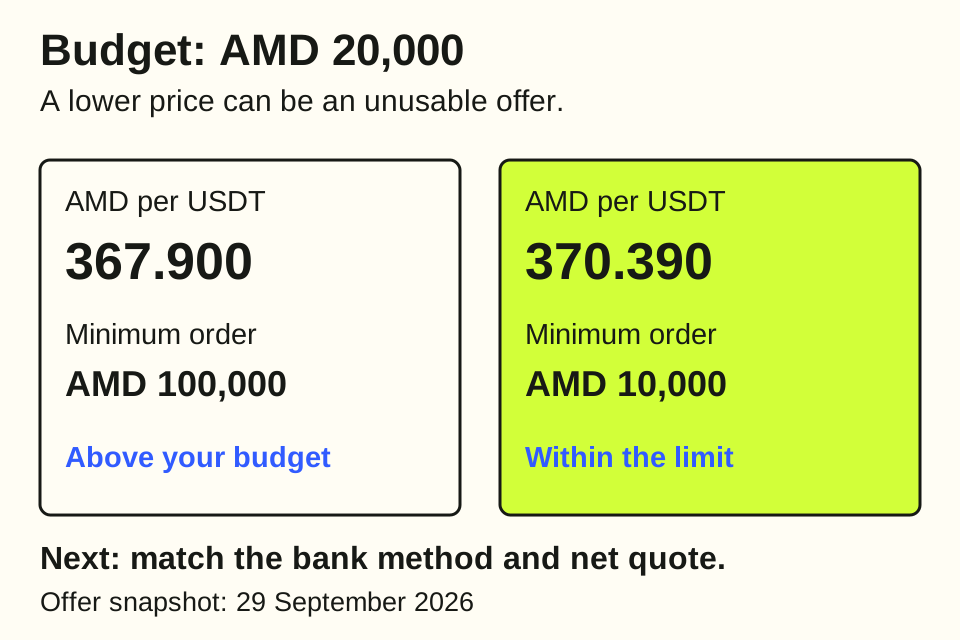
At 370.390, AMD 20,000 buys about 53.997 USDT before any separately stated payment charges. That is the acquired balance, not a promise that the full amount can be committed as futures margin. Use the actual released amount in the trading screen; do not estimate it by dividing by a headline USD/AMD reference rate.
There is no reason to increase a planned purchase fivefold just to qualify for the cheapest visible advertisement. A trader intending to start small should filter for a usable bank method and order size, then compare the resulting offers. The purpose is to find a workable price for the intended amount, not redesign the budget around an advertiser.
Approval comes before the local purchase
Complete the required identity review and check that the intended futures product opens in your account first. Buying USDT can work even when a particular trading service is unavailable. This is especially relevant to readers who find the site through an AMD purchase search but actually want a leveraged Bitcoin position.
If the account already has the right trading balance, buying more through P2P is unnecessary. Go straight to the contract comparison. The Armenian payment example is here to answer the local starting problem, not to make every futures trade depend on another dram transaction.
When is Kraken the better choice?
Kraken becomes more attractive when funding is already solved and you expect repeated immediate entries and exits. Its international derivatives base tier publishes a 0.05% taker fee versus Bybit’s standard non-VIP 0.055%. Both publish 0.02% maker rates at the tiers compared here. These figures were checked on 29 September 2026; region, product, volume and account-specific adjustments can change them.
| Completed order pattern | Bybit standard non-VIP | Kraken international base |
|---|---|---|
| Immediate entry + immediate exit | $4.40 | $4.00 |
| Resting entry + immediate exit | $3.00 | $2.80 |
| Resting entry + resting exit | $1.60 | $1.60 |
For one all-immediate round trip, the difference is forty cents. If moving the balance costs more than forty cents, transferring solely for that single trade does not recover the transfer cost through commission. Across fifty equal round trips, the difference becomes $20. The same tariff difference can be trivial for one reader and worth comparing for another.
A resting order waits for someone else to trade against it; an immediate order accepts available liquidity. Simply choosing a limit price does not guarantee the maker rate, because the order may fill immediately. Compare the fee actually assigned to the completed order, not the label you clicked.
Kraken’s multi-collateral derivatives account measures profits and losses in USD and can use supported assets as backing. Bybit’s USDT contracts settle in USDT. A reader who wants a single USDT-denominated result may prefer the latter even with a slightly higher immediate-order fee. A reader already familiar with Kraken’s USD accounting may gain nothing from changing the arrangement.
We have not measured a matched series of live fills from Armenia. There is therefore no execution-speed or liquidity winner in this article. A worse purchase or sale price by just $0.40 on that $4,000 position would cancel the base commission saving for one round trip. The useful conclusion is a conditional fee advantage, not that one logo always produces the cheapest trade.
How much leverage can a small account actually use?
Start with the size of the trade you want, then look at the money required to back it. In a simplified example, a 250-USDT position at 5x needs 50 USDT of initial margin before fees. The same position at 10x needs 25 USDT. The position still gains or loses on 250 USDT of exposure; changing the leverage setting alone does not change that.
If a hypothetical Bitcoin long of that size falls 2%, its price loss is about 5 USDT, ignoring fees and other effects. That is 10% of the 50-USDT margin or 20% of the 25-USDT margin. A larger percentage return displayed on a smaller margin is not evidence that the exchange generated a larger cash profit.
Now consider the roughly 54 USDT acquired in the local purchase example. Committing 50 USDT as initial margin leaves little room for opening costs, the estimated closing charge and changes in the required backing. The practical response is to reduce the position until the order preview fits the intended commitment—not keep raising leverage until the largest possible order is accepted.
Why 100x on a banner is not your account limit
Bybit’s product guidance ties maximum leverage to the contract and position tier. The advertised maximum on one market does not apply to every coin or every order size. Look at the specific pair, the available setting and the margin shown for the quantity you intend to trade. A bigger maximum does not improve an otherwise identical 5x position.
For a first BTC or ETH trade, the screen should make three things obvious: the direction, the position value and how it will be closed. You should not need to understand every advanced account setting to identify those three. If a quote is in coins but you think in USDT, convert the quantity into its approximate position value before confirming.
How do you close a position without opening the opposite trade?
An exit order should reduce the position you already hold. It should not quietly become a new short after your long has been closed another way. Bybit documents a reduce-only option for limit orders that prevents the order from increasing or reversing the position. This is useful order behaviour, not an exclusive feature that makes Bybit superior to all other exchanges.
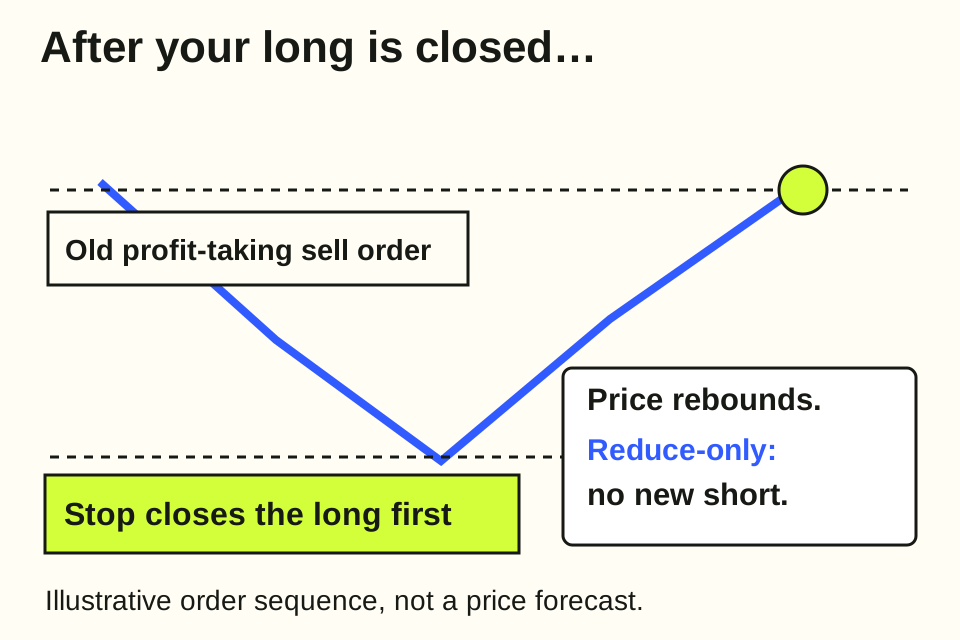
Imagine you buy a Bitcoin-price contract, place a protective exit below the entry and a profit-taking limit above it. The market first drops through the protective exit and then rebounds. Without the appropriate closing instruction, an old sell order can become an unwanted trade when the price later reaches it. Check the order’s purpose as well as its price.
Partial exits deserve the same attention. Closing half a position should leave half, rather than leave several old orders whose combined quantity exceeds the remaining trade. After a fill, inspect the position and pending orders together. A green “order submitted” message is not proof that your intended exposure now matches the plan.
The illustration shows order logic, not a guaranteed stop price. Fast price changes and available liquidity affect execution. Use the actual close controls for the product and account mode; do not assume a screenshot from a different contract behaves identically.
What can reduce a profitable trade before it returns to AMD?
A position held open can have additional payments
Perpetual contracts can exchange funding payments between longs and shorts. On Bybit, the applicable interval and rate belong to the particular contract, and the direction of payment can change. These payments are separate from the entry and exit commission. Read the current figure on the market you intend to hold instead of assuming every coin uses the same schedule.
A hypothetical 1,000-USDT position paying 0.01% at a funding event incurs 0.10 USDT for that event. That is a calculation example, not a forecast. If the position lasts through multiple events, use the actual rates from its record. A price gain shown while the position is open is not yet a complete account of what the trade earned.
The AMD sale price can be different from the purchase price
The sale marketplace checked on 29 September included an IDBank offer at AMD 365 per USDT with a minimum of AMD 10,000. The purchase example above used a different advertisement and banking choice. Comparing those prices is useful for understanding the gap, but it is not a claim that every reader can execute both sides with the same bank.
If both offers were usable and unchanged, 53.997 USDT sold at 365 would return about AMD 19,709. Against the original AMD 20,000, roughly AMD 291 has gone before a futures trade earns or loses anything. That 1.46% difference comes from the two quotes. It should not be mistaken for an exchange commission or a guaranteed current conversion cost.
For your own bank method, repeat that comparison with a purchase and a sale you can actually use. If a profitable trade adds a small amount of USDT but the sale quote has worsened, the result in drams can disappoint. This is a local reason to inspect the exit before deciding that a platform’s low trading commission settles the whole choice.
An on-chain withdrawal is another option when you need crypto elsewhere, rather than AMD in a bank. It has its own network availability, minimum and charge. Read the confirmation before sending; a cheap network is useful only if the receiving service supports the same asset on that network. We do not assign a fixed withdrawal cost to every Armenian account.
Is crypto futures trading locally licensed in Armenia?
Armenia now has a formal crypto-asset service-provider framework. The CBA’s September reminder gives qualifying businesses already operating on 4 July 2025 until 31 January 2027 to register and obtain the required licence. That deadline concerns a defined group of providers; it is not a personal deadline to liquidate your coins or a free pass for any new business.
For an exchange user, the important question is which legal entity provides the service you are opening. A well-known international brand, an Armenian-language advertisement and a local bank transfer are not interchangeable with a CBA authorisation. Look for the entity and authorised service rather than treating every regulatory reference as a futures approval.
What does the new Meta-X permission change?
The CBA’s 8 September 2026 decision authorises Meta-X Markets to provide specified crypto-asset services, including custody, buying and selling, order transmission and transfers. The decision reviewed does not itself establish a retail perpetuals product or its leverage conditions. We therefore do not insert Meta-X into a futures ranking merely because the local authorisation is concrete.
It may still be relevant when comparing a local crypto purchase or custody service. Ask whether the coin can be withdrawn, what amount arrives and which charges apply. If the aim is a leveraged BTC trade, a separate product must actually deliver it. The page should not replace your question about futures with a list of locally named financial businesses.
The distinction also protects against the opposite error: an international provider’s residence policy is not automatically invalid because it is not the local service described in that decision. We assess the stated account eligibility and explain the limits of the local evidence, rather than presenting an unverified legal guarantee in either direction.