















Which exchange should you choose in Nigeria?
Kraken is our first choice for a Nigerian trader prioritising ordinary futures execution fees: its base taker rate is 0.05%, versus KuCoin’s 0.06%. This is a starting point for an eligible international account, not a claim of Nigerian product approval. Funding during the holding period can still change which venue costs less overall.
Kraken: lower base taker fee
Start here for the execution-cost comparison; include accrued funding and applicable taxes.
Read the verdictKuCoin: a different funding clock
Evaluate the actual settlement schedule, Nigerian fee VAT and verified Futures access.
Read the verdictKuCoin’s alternative is most relevant when its contract and settlement schedule suit the trade. Its Nigerian tax notice makes the fee calculation clear, while its July 2026 local SEC admission has a limited scope. Better documentation alone does not make a product cheaper or more suitable: the comparison below works through the actual differences.
| Your goal | Service to examine | What it does not prove |
|---|---|---|
| Open a leveraged crypto position | Kraken or KuCoin international Futures | An account recommendation is not an SEC product licence. |
| Buy crypto or return money to a Nigerian bank | A supported local service such as Busha or Quidax | An NGN wallet does not establish a perpetual-futures offering. |
| Keep business or household money available | Your normal spending account | A leveraged trading balance is not a cash reserve. |
The wider catalogue retains eleven available and seven limited platforms. A shortlist of two does not mean the rest have been removed. We distinguish exchange-policy eligibility from local approval and from the practical ability to deposit or withdraw naira. Those distinctions prevent a familiar brand name from doing more work than its actual service.
KuCoin or Kraken: the answer changes with holding time
Kraken’s international derivatives eligibility page does not name Nigeria among its excluded locations. Its base derivatives taker fee is 0.05%, compared with KuCoin’s 0.06% before Nigerian VAT. On equal $10,000 entry and exit values, the listed trading components are $10 and $12 respectively. This is a base-fee comparison, not a claim that Kraken transactions are exempt from Nigerian tax.
If fees were the only difference, Kraken would win that taker comparison. But an overnight position is not simply two execution fees. Perpetuals also transfer funding between traders, and the two platforms do not charge it in the same way. A lower execution fee can be outweighed by the funding accumulated during the actual holding period.
Compare the same hours, not the smallest percentage
KuCoin’s September 2026 guidance says major contracts generally settle funding every eight hours, many others every four, and stressed contracts can move to an hourly cycle. Only positions held at the settlement time pay or receive that payment. The contract’s live countdown is more reliable than assuming every pair follows the Bitcoin schedule.
Kraken’s linear perpetual specification uses continuous funding accrual, realised hourly or when the net position changes. Closing a Kraken position just before an hourly boundary does not erase funding already accrued. This differs from relying on a discrete settlement cutoff and is a real product distinction for short holding periods.
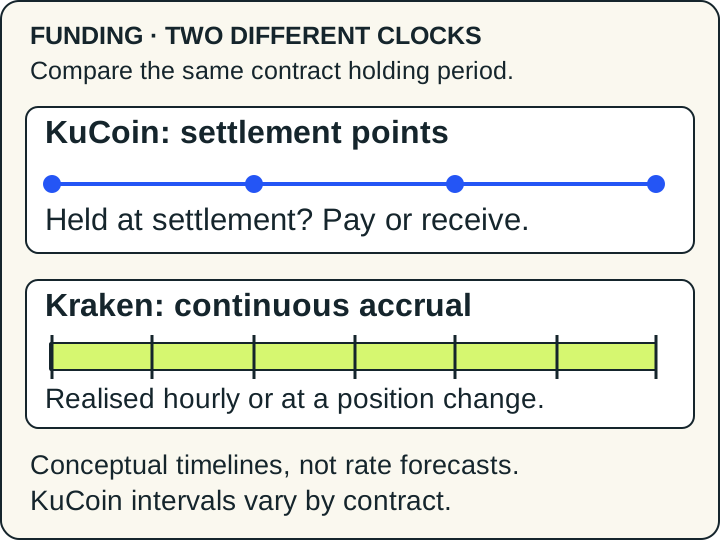
For an illustration, suppose one venue quotes 0.01% for an eight-hour period and another averages 0.0015% per hour across the same eight hours. On unchanged $10,000 exposure, those amounts are $1 and $1.20. The second number looked smaller on the screen but produces a larger charge over the same period. These hypothetical rates are not current offers from either exchange.
For a quick trade, entry and exit costs can dominate. For a position held through several funding periods, collect the relevant funding history and compare the total over the same hours and direction. A positive funding rate charges longs and pays shorts under the usual contract rule; a negative rate reverses that relationship. Do not label a possible receipt as a guaranteed rebate.
Our verdict: compare Kraken first when minimising the listed execution charge is your main need. Keep KuCoin on the shortlist when its contract and settlement schedule suit the planned trade and its full Nigerian charges are understood. Neither gets a universal “cheapest” badge, because the cost winner depends on the actual position.
KuCoin Nigeria: what changed, and what should you check?
The SEC’s notice, published on 3 July 2026 and signed the previous day, names KuCoin Nigeria Limited and GIGX Technologies for admission to ARIP. It expressly says approval-in-principle is not a final licence and is confined to the programme’s defined scope. A claim that this announcement made all KuCoin global futures SEC-approved would go beyond the source.
For your own account, check the legal entity, completed identity verification and whether Futures is enabled before transferring collateral. The global futures terms do not list Nigeria by name as excluded, but they require lawful use and allow service restrictions. A marketing page and a successful email registration are not the same as permission to trade the intended contract.
Do not fund an account that can only close old positions
KuCoin’s verification guide explains that older unverified accounts may retain limited functions such as selling assets or closing futures. Seeing those buttons can make an account look more capable than it is. The relevant test for a new trade is whether the verified account can open the position, not whether an old balance can be withdrawn.
Before committing money, identify one contract you actually want and inspect its collateral, minimum order and next funding time. A list of hundreds of markets is not useful if your chosen market is absent or unavailable to your account. Keep the initial transfer small enough that reversing the decision would not become an expensive conversion exercise.
This recommendation is for the reader who can establish those conditions. If your priority is a product with explicit Nigerian approval, the conditional local announcement alone is insufficient. Do not use a different residence, another person’s documents or a VPN to manufacture eligibility.
How much does KuCoin’s Nigerian VAT add?
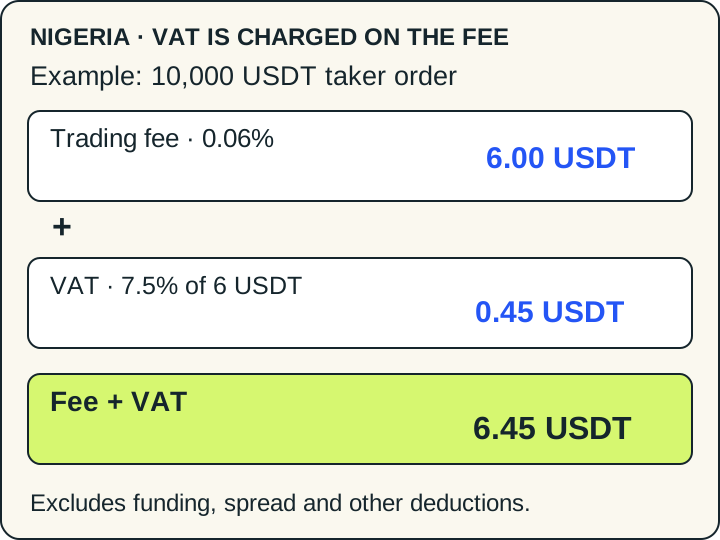
KuCoin’s Nigeria notice applies 7.5% VAT to transaction fees for accounts whose KYC country is Nigeria. It does not apply 7.5% to the entire trade. At the published VIP 0 futures taker rate of 0.06%, a 10,000 USDT order has a 6 USDT trading fee; 7.5% of that fee is 0.45 USDT.
| Fill type | Trading fees, both sides | VAT on those fees | Combined |
|---|---|---|---|
| Taker entry and exit | 12 USDT | 0.90 USDT | 12.90 USDT |
| Maker entry and exit | 4 USDT | 0.30 USDT | 4.30 USDT |
The effective illustrated taker charge including this VAT is 0.0645% per side. That is very different from losing 7.5% of the trade value. It is also separate from tax on your eventual income or gains: paying VAT on an exchange service does not settle your personal income-tax position.
Use the actual account tier and contract charge when estimating a trade. Maker treatment depends on how an order fills, and fee promotions have their own scope. A calculator that applies a headline discount to every order will produce a neat but unreliable total.
Keep fees, VAT and funding as separate statement entries. If the exchange shows one combined deduction, reconcile it with the fee rate and tax notice rather than subtracting it again in your own spreadsheet. Double-counting a charge can make a profitable strategy appear worse; omitting it can make an unprofitable one appear viable.
How do you move between naira and a futures balance?

Start with the payment service you can actually use under your own verified name. Busha and Quidax appear in the SEC’s ARIP participant directory as digital-asset exchanges. Their role in this guide is local conversion and payment handling, not an assumed Nigerian perpetual-futures product.
Quidax’s June 2026 tariff says direct bank deposits have no Quidax deposit charge, apart from any bank-side fee. Its stated naira withdrawal charge is ₦200, with an additional ₦50 stamp-duty charge at ₦10,000 and above. Crypto send charges vary with the asset and network. These are provider tariff components, not a complete tax-inclusive quote for every later transaction.
For that listed bank-withdrawal component, a ₦10,000 withdrawal incurs ₦250, or 2.5%. A ₦100,000 withdrawal incurs the same ₦250, or 0.25%. Splitting a planned payment into many small withdrawals can therefore be costly. Do not split transactions to evade a legal charge; use the example to understand the tariff and plan ordinary cash movements.
Use the correct Busha tariff for your account
Busha’s Business FAQ publishes ₦150 deposits and ₦107.50 withdrawals including VAT. That is a business-product source. Its developer documentation gives other fee figures, and neither should be silently promoted as a guaranteed retail-app quote. A personal user should compare the amount shown in their own account with the amount their bank receives.
Busha’s quote documentation makes a useful distinction: specifying the crypto amount tells you the local amount you will receive; specifying the desired local amount tells you how much crypto is required. For a fixed naira bill, the second question is more useful than watching a generic exchange-rate ticker. The documented API is a business integration, not proof of identical retail screens.
Before sending USDT between services, match the asset and network supported at both ends. A cheaper send fee is irrelevant if the receiving service does not credit that network. Check any minimum credit amount and whether a memo is required for the asset. A transfer that reaches the blockchain but cannot be credited does not solve your funding problem.
A direct local conversion service can reduce the need to negotiate with a P2P counterparty, but it still has a quote and conditions. P2P can offer a different price, yet introduces a separate buyer or seller and payment dispute process. Compare net proceeds and practical recourse, rather than assuming either method always wins.
What does a futures return mean for a naira budget?
Keep the money needed for rent, payroll or an approaching bill outside the leveraged position. A platform’s return percentage usually measures the trade relative to a selected margin amount, not the change in your entire naira budget. It can exaggerate how much progress you made toward a real spending goal.
Consider a hypothetical ₦750,000 converted into 500 USDT at ₦1,500 per USDT. Only 100 USDT is allocated as margin, while 400 remains outside that position. If the trade earns 20 USDT, its margin return is 20%, but the total crypto balance rises from 500 to 520: a 4% gain before other charges.
If the eventual conversion quote is ₦1,450 per USDT, the 520 USDT returns ₦754,000 before fees. The spending gain is only ₦4,000, about 0.53% of the initial naira amount. The illustration uses invented exchange rates to expose the difference between a margin return, total-account return and spendable naira result.
That cash comparison is not a Nigerian tax calculation. The NRS guideline uses a specific valuation method for covered disposals, and a derivative settlement may require its own classification. Keep the original bank debit, the trading statement and the final conversion receipt so the economic result can be reconciled without treating every naira movement as trading profit.
If a bill is due in naira next week, holding a leveraged dollar-linked position is not a reliable way to reserve that amount. You are exposed to the crypto trade, its funding cost and the conversion rate. The three can move in different directions even when the chart you watch looks favourable.
What crypto taxes apply in Nigeria in 2026?
The Joint Revenue Board’s 2026 guidance treats income and gains from digital assets as taxable under the Nigeria Tax Act. Individual rates are progressive: 0% on the first ₦800,000 of chargeable annual income, followed by bands of 15%, 18%, 21%, 23% and 25%. The first band is not a separate allowance for each exchange account.
For example, ₦3 million of total chargeable income gives ₦330,000 under the first two bands: zero on ₦800,000 and 15% on the next ₦2.2 million. That illustration assumes chargeable income has already been established after applicable deductions. It is not a flat crypto-profit tax or a personal assessment for someone who also has salary and other income.
The July 2026 NRS circular adds important distinctions
The NRS virtual-asset guideline, dated 31 July 2026, separates 7.5% VAT on service fees from income tax. Its table also describes 1% withholding on covered gross disposal proceeds for categories 1, 3 and 5, and 1.5% stamp duty on covered token/fiat transfers. Stablecoin disposal gains are listed under self-assessment, not the same category-1 withholding row.
Do not apply every percentage to every futures order. The transaction type, asset category and collection rules matter. The circular also distinguishes transfers between wallets under the same individual ownership from a disposal, and sets out a dollar-referenced valuation method for covered gains. A deposit, a token sale and a derivatives settlement are not interchangeable tax events.
Preserve withholding evidence and obtain advice on the actual contract and return. The full circular is linked here because its distinctions are more useful than an outdated claim that all Nigerian crypto gains face one universal 10% rate.
Does a local registration cover every product?
Nigeria’s July 2026 executive order established a coordination council chaired by the CBN, with the NRS and SEC as vice-chairs. The State House explanation says it coordinates existing powers rather than replacing the agencies. A council announcement is not a blanket licence for every international platform.
Check the service named in the relevant approval: a payment function, asset custody, a digital-asset exchange and a leveraged contract are different activities. The SEC directory also separates incubation tracks. An entry in that directory is useful evidence, but its exact status should be carried into a review rather than shortened to “fully licensed for everything.”
For a reader who only needs to buy and withdraw crypto, a local conversion product may solve the whole problem. For a reader specifically seeking futures, it is only one stage of a wider workflow. Ranking a local cash exchange as the best leveraged venue without documenting that product would leave the main question unanswered.
The country catalogue therefore keeps its existing access coverage while the featured comparison narrows the products being discussed. Future restrictions or new operational approvals can change the choice. This review records what the sources establish now; it does not claim that a static article can verify tomorrow’s account permissions.
What should you check before putting real money at risk?
Complete a modest withdrawal through the exact receiving service and network you plan to use. That proves more about your own workflow than a testimonial about someone else’s payout. Our research reviewed public terms and calculations; it did not perform a Nigerian bank-funded account-opening or cash-out test.
Finally, retain the statement files while the account is accessible. You should be able to trace a bank payment into a crypto deposit, a futures result, a conversion and a bank receipt. That makes fees visible, supports tax preparation and helps distinguish a genuine trading loss from money still waiting at another stage of the payment process.