















Where should you trade crypto futures from Paraguay?
Bybit is a useful starting point for manually trading USDT perpetuals from Paraguay. Its country restrictions do not list Paraguay, and its P2P documentation includes guaraní order limits. That puts the funding currency and the intended trading product in one documented workflow, subject to account approval and a suitable live PYG offer.
The recommendation is for making your own futures trades. It does not depend on copying someone else’s account, joining a mining scheme or buying a locally marketed investment fund. If your question is where to open a BTC, ETH or altcoin perpetual, those are different products and do not belong at the top of the answer.
Bybit versus OKX: choose around the contract, not the brand
Bybit is worth opening first when you want its USDT market and order controls, then checking a PYG seller for the amount you actually intend to fund. OKX deserves a direct comparison if it lists the same contract for your account. The published ordinary taker rate in OKX’s example is slightly lower than Bybit’s ordinary VIP 0 rate, but that difference can be smaller than one poor fill.
For a less familiar altcoin, first establish that both products represent the same exposure. A spot coin, a pre-market contract and an ordinary perpetual are not substitutes just because their tickers share letters. Compare the settlement asset, trading status, position size and exit liquidity before comparing commissions.
Kraken is another sensible candidate if you already hold eligible crypto and mainly want a dollar-priced BTC or ETH position. Paraguay is absent from its published international derivatives exclusion list, subject to the account’s verification and product checks. Its collateral choices can be useful, but they are not a reason to force a PYG-funded USDT trader through extra conversions.
| Situation | Decision |
|---|---|
| A usable PYG offer and the desired USDT perpetual are enabled | Bybit is a coherent starting account. |
| The matching OKX contract gives a better complete order quote | Use that result; a ranking is not a reason to overpay. |
| Your starting asset already suits Kraken’s collateral rules | Compare Kraken without selling and rebuying assets unnecessarily. |
| The new token exists only in a special or pre-market zone | Read that zone’s costs and rules before treating it as an ordinary future. |
Why can the same coin have a different price on the futures screen?
Some contracts quote a bundle of tokens rather than a single token. This is especially easy to overlook with low-priced coins. A futures price that looks a thousand times larger than the spot price may describe a thousand-token unit, rather than a spectacular premium you can exploit.
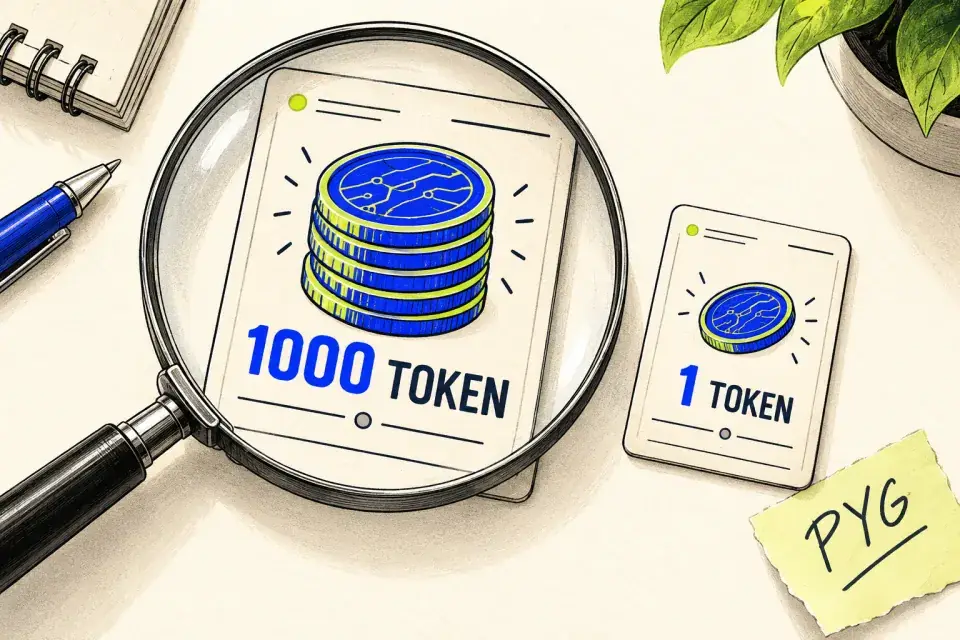
Bybit’s own PEPE guide explains the 1000PEPE unit: an order quantity of 100 units represents 100,000 PEPE. The useful lesson is to read the contract unit before entering a quantity. Do not carry the number from a spot purchase straight into a derivatives order with a different unit.
Compare exposure in USDT before touching the leverage setting
Here is an invented price example. If one token costs 0.00001 USDT, a 1,000-token bundle is worth 0.01 USDT. A position representing 100 USDT therefore corresponds to 10,000 bundles, or 10 million individual tokens. Those are three descriptions of the same exposure, not three different budgets.
At 5x leverage, roughly 20 USDT backs that 100 USDT position before fees and other requirements. It would be a mistake to interpret the 10,000 displayed bundles as 10,000 USDT. It would also be a mistake to enter the same quantity on another exchange without confirming its contract unit.
Bybit documents ordering by value as well as by quantity for supported contracts. Where that option is available, entering the intended USDT exposure can reduce the chance of confusing token units with money. Still inspect the confirmation: minimum size, rounding and fees can change the final order.
A cheap-looking coin is not a cheap leveraged trade
A 10% move in a 300 USDT position creates roughly the same 30 USDT gross change whether the coin trades at fractions of a cent or thousands of dollars. Token price alone says nothing about whether the trade is affordable. For a guaraní budget, the amount committed and the potential loss are the useful numbers.
This is one reason we do not rank a futures exchange by raw coin count. A long list can include contracts with different units, limited depth or temporary trading rules. A smaller set containing the contract you understand and can exit may be more useful than a menu full of markets you have never inspected.
Do new altcoin markets have the same fees as BTC?
Not necessarily. Bybit’s published VIP 0 schedule distinguishes ordinary perpetuals from its Innovation Zone and pre-market products. The ordinary figures are 0.02% maker and 0.055% taker. Innovation Zone figures are 0.04% and 0.11%; pre-market perpetual figures are 0.04% and 0.10%. The account’s actual schedule and market classification control the trade.
| Market category | Rate per side used | Two-sided execution cost |
|---|---|---|
| Ordinary perpetual | 0.055% | 2.20 USDT |
| Innovation Zone | 0.11% | 4.40 USDT |
| Pre-market perpetual | 0.10% | 4.00 USDT |
The table does not suggest that all three products track the same asset or behave alike. It shows why applying the ordinary BTC commission to every new listing is a bad comparison. The same exchange can charge different rates for different trading areas.
On 100 USDT of backing, a 4.40 USDT round trip uses 4.4% of that backing before the market moves, funding or slippage. It is 0.22% of the 2,000 USDT position. Both percentages are correct, but they answer different questions. The second explains the tariff; the first explains why a small account feels the charge so strongly.
When does OKX’s lower ordinary taker example matter?
At an illustrative 0.05% per side, a 2,000 USDT round trip costs 2 USDT. Against Bybit’s ordinary example, the difference is 0.20 USDT. A 0.1% worse entry on the same position costs about 2 USDT, ten times that saving. Compare the actual matching market’s quote before declaring a winner from the fee schedule.
For frequent trading, small commission differences can accumulate. For an occasional altcoin position, the contract’s trading status and available exit size may dominate. This is a concrete reason to keep both exchanges in the comparison without pretending that either wins every scenario.
Do not assume a token available in a special launch area will remain there, or retain the same leverage and position limits. Read the current notice for that particular market. An old social post showing a maximum multiplier or a launch promotion is not a current order ticket.
What if only part of your order gets filled?
A market order asks for execution, but it is not a promise that any amount will fill at one price. On thinner markets, only part of the desired quantity may be available within the venue’s allowed price range. Bybit’s execution documentation describes safeguards around market orders rather than unrestricted execution at any possible price.

Suppose you request 100 units and only 60 fill. A plan to close half should be based on the actual 60-unit position, not the original request. If you later place another buy for the full 100 because the first looked incomplete, you can end up with more exposure than intended. Check filled, open and cancelled quantities before retrying.
A limit order controls price, not completion
A buy limit can keep the entry from exceeding the limit price, but the market may move away without filling it. That is an acceptable outcome if the trade was only attractive at that price. Moving the limit repeatedly to chase the market changes the trade you originally decided to take.
An exit limit has the same practical weakness: it can remain open. A stop-market order prioritises attempting to leave once triggered, with uncertain final price; a stop-limit order adds a price condition that can prevent the exit from completing. Neither label can promise a particular loss during a fast move.
Bybit’s liquidation reference uses mark price, which can differ from the last traded price shown on a chart. If your stop uses a different trigger reference, the two thresholds may not behave in the order you expected. This is worth checking once in the order setup; it does not require a page of formulas to understand the consequence.
A stable connection does not make an order atomic
When trading from a phone, a delayed app refresh can leave the status unclear. Look at the exchange’s order history and position record before pressing again. The useful question is whether the first order was accepted and filled, not whether the button appeared to respond instantly.
This favours an exchange whose mobile order details you can read clearly for the markets you use. It is a more meaningful test than comparing app-store screenshots. We have not measured real-time execution from a Paraguayan connection, so we do not award either venue a speed advantage without that evidence.
How do you turn a guaraní budget into usable futures margin?
Start with the PYG amount you intended to put at risk, then find a compatible purchase order. Bybit’s published platform-level band includes PYG 15,000 to 143,000,000 for its listed P2P coins. That broad band is not a promise that a merchant will sell your chosen amount today; individual adverts can be much narrower.
Paraguay’s SPI instant-payment system raised its per-operation limit to ₲10 million in 2026, with around-the-clock availability among participating institutions. That can help with the local payment leg of a compatible P2P purchase. It does not mean the BCP or the bank has integrated a derivatives account, and it does not remove a merchant’s order conditions.
A useful local example: budget first, multiplier second
Suppose your trading budget is ₲2,400,000 and an illustrative seller quote is ₲8,000 per USDT. That buys 300 USDT before any extra charge. Allocating 60 USDT of it as backing at 5x gives roughly a 300 USDT position. It does not require putting all 300 USDT of your trading balance behind the same idea.
If that position moves 3% against you, its gross loss is about 9 USDT, before costs. At the purchase quote used in the example, that corresponds to ₲72,000 of the original spending. The example is a way to understand size, not a current PYG quote or a guarantee that a stop will fill at that loss.
Separate the total exchange balance from the amount an open position can use. A cross-margin arrangement may draw on eligible shared backing under its rules. If your plan depends on leaving the rest of the budget untouched, confirm that the chosen account mode actually implements that plan.
What if there is no suitable PYG advert?
Wait for a usable quote or compare another supported funding service. Do not increase the purchase merely to meet an inconvenient merchant minimum. The existence of a PYG page or a published order band does not establish seller supply, a bank’s acceptance or a guaranteed exchange rate.
For an existing crypto holder, a supported token transfer may be more direct. For someone starting with local money, the purchase and release must complete before a futures order can use the balance. If the balance appears in a funding wallet, check whether an internal transfer is needed; avoid opening another account just because two parts of the same app have different names.
Does changing leverage change the profit shown in the app?
It can change the displayed return percentage without changing the money made by the same position. Bybit’s P&L documentation distinguishes position profit from return on the margin used. Less backing makes the percentage look larger, even though the price move and position size have not changed.
Take an unchanged 1,000 USDT position that gains 20 USDT before costs. With 200 USDT of initial backing, that is 10% of the backing. With 100 USDT, it is 20%. The second screenshot is not proof of a better trade; both made 20 USDT before costs. The account with less backing had less room for adverse movement.
For a reader funding in guaraníes, neither screenshot is the final local result. Keep the realised trading balance and the later PYG receipt separate. If you leave the money in crypto, you have not yet executed the local conversion; do not insert an imaginary cash-out to make the result look more impressive or worse.
Fees and funding belong beside the trade, not in a forgotten wallet tab
A record of entry and exit prices alone can miss recurring funding and execution costs. Use the account’s realised transaction history to reconcile the result. If several positions share a balance, compare each trade’s records rather than assigning every wallet change to the last position you closed.
There is also a basic product distinction for anyone exploring onchain alternatives. Holding a GMX liquidity token is participation in a pool, not the same action as opening your own leveraged BTC long. The pool’s returns and exposures cannot be used as a substitute for the P&L of the perpetual you meant to compare.
What changed for Paraguayan crypto records in 2026?
DNIT Resolution 47/26 adds a concrete reporting issue for residents. Article 3 covers specified crypto transactions above US$5,000 annually, individually or in aggregate, through nonresident platforms or without an intermediary. It is a transaction threshold, not a statement that the first US$5,000 of profit is tax-free.
The rule’s timetable starts with fiscal 2026 for taxpayers closing on 31 December, with reporting in the third month after year end. Other fiscal closing dates have a different start under Article 4. Check which category applies rather than assuming that every account opened in 2026 has the same filing date.
For futures traders, one boundary matters: the text does not let us equate every leveraged contract’s notional value automatically with a reportable spot-crypto transfer. The instrument and the actual transactions need to be classified correctly. Keep the contract history alongside deposits, withdrawals and purchases so a Paraguayan adviser can resolve that distinction from records rather than guesses.
A simple example shows the problem. Sending 400 USDT between two accounts you own is a transfer; opening a 4,000 USDT perpetual with some of the balance is exposure; closing it with a 25 USDT gain is a trading result. Those are different amounts. Calling all three “income” makes the record less useful, not more complete.
What does a local provider registration actually establish?
SEPRELAD’s lookup warns that an active result is not itself proof of compliance with every obligation. The BCP also distinguishes crypto from state-guaranteed legal tender. A local company name or registration number should therefore not be presented as a guarantee of an international futures account or its returns.
For choosing an exchange, the consequence is practical: use the provider’s real eligibility rules, keep your own account records, and judge the futures product on its own terms. A mining connection, local sponsorship or familiar payment name does not answer whether a particular contract is suitable for your trade.
Should a small Paraguayan account trade several altcoins at once?
A 300 USDT balance can look large after moving it from a guaraní payment, yet it remains 300 USDT of capital. Dividing it between many leveraged altcoin positions does not necessarily diversify the main risk. Several coins can fall together during the same market move.
Consider three hypothetical 500 USDT longs backed by 50 USDT each. The committed initial backing totals 150 USDT, while the combined exposure is 1,500 USDT. If all three fall 4%, the gross loss is roughly 60 USDT before costs. Giving each position a different ticker did not prevent a loss equal to 20% of the original trading balance.
Compare that with one 500 USDT position experiencing the same move: its gross loss is about 20 USDT. The distinction is the combined position size, not whether the app describes the account as diversified. A trader deliberately taking several views can still do so, but should add up the exposure before treating each small margin amount as harmless.
When is a separate exchange account worth the transfer?
A second venue is useful when it gives access to a required contract, a meaningfully better execution quote or an account arrangement the first venue lacks. It is less useful when you are moving a small amount solely to save a few cents while creating another withdrawal charge and another balance to monitor.
For a PYG-funded trader, compare the transferable amount and the exact network before making that move. Do not buy a larger token balance simply to reach the second venue’s minimum. The shortlist leaves several exchanges available; the practical goal is enough control over the trades you actually intend, rather than an account on every platform in the directory.
This is also why the page keeps a complete country catalogue below the selected recommendations. It offers alternatives for different contracts without requiring every reader to split a limited budget across them. Current merchant supply and account approval remain individual checks, not reasons to describe Paraguay as having no trading choices.