










Which exchange makes sense for Saudi crypto futures?
The SAR P2P market supplies a riyal purchase path; the USDT perpetual is the separate trading product. Compare the merchant’s delivered USDT amount before choosing a funding quote. The local banking discussion below explains what that offshore availability does not resolve.
OKX becomes more attractive when you already hold compatible crypto and expect to enter and exit positions with market orders. Its published standard futures taker rate is slightly lower in the schedules compared below. Binance deserves a separate look when its SAR offers deliver more USDT for your payment amount. A cheaper funding quote can outweigh a small trading-fee advantage.
| Exchange | The useful advantage | When another choice wins |
|---|---|---|
| Bybit | SAR P2P and USDT perpetuals within the same exchange ecosystem | An alternative delivers a substantially better net funding quote |
| OKX | Published regular-tier futures taker reference of 0.05%, versus Bybit’s 0.055% | You would spend more reaching the trading balance than the fee saving is worth |
| Binance | Another documented SAR P2P marketplace to price against Bybit | Your required advertiser, amount or payment method is unavailable |
The choice is not “which app displays the largest leverage number?” Start with the BTC or ETH contract you actually intend to trade, the amount you can fund, and the order size you expect to use. An exchange with dozens of extra small-cap contracts is not automatically better for someone who only trades Bitcoin.
These recommendations come from published product, fee and access records. They do not represent completed Saudi bank transfers or a logged-in test of your account. Advertiser availability, derivatives approval and the executable quote still have to match your own circumstances.
What are you actually trading: Bitcoin, USDT or riyals?
For a reader wanting a straightforward long or short on Bitcoin, a BTC/USDT perpetual is easier to compare than a mixture of spot coins, coin-backed contracts and stock futures. You use USDT as the balance supporting the position; the contract follows Bitcoin. Choosing SAR as the app’s display currency does not turn that position into a Saudi-riyal contract.
Bybit’s USDT contract documentation distinguishes perpetuals from contracts that expire. Both can use USDT, but an expiry date changes how long a position can stay open. A perpetual has no scheduled expiry; it can still be closed by you, by liquidation, or under the platform’s contract rules. “No expiry” is not the same as “no ongoing cost.”
A long and a short answer different questions
Suppose you use 200 USDT to support a 1,000 USDT Bitcoin position. A long benefits if Bitcoin rises; a short benefits if it falls. A 2% move is roughly 20 USDT on that position before fees and funding. The same move changes your 200 USDT starting margin by about 10%. The direction determines whether that change helps or hurts.
That example is deliberately smaller than the maximum displayed by many exchanges. It also shows why a 5x setting is not a return prediction. The exchange does not pay you five times more merely for selecting it: you are taking price exposure five times larger than the margin in this example.
USDT-backed and Bitcoin-backed positions are not interchangeable
With a USDT-backed contract, it is easier to read a profit or loss alongside a USDT budget. If the collateral itself is Bitcoin, a falling BTC price can also reduce the dollar value of the collateral. That is a different position to manage, even when both screens say “BTC futures.” For a first comparison, keep collateral the same on both exchanges.
A Saudi trader who wants leveraged crypto should not be sent through a stock-broker ranking simply because that broker offers some kind of futures. The contracts, funding and available markets may be entirely different. This page therefore centres on exchange crypto products; a conventional brokerage account is not treated as a substitute for a USDT perpetual account.
Bybit vs OKX: when does the fee difference matter?
The published regular futures references reviewed are 0.02% maker and 0.055% taker at Bybit, compared with 0.02% and 0.05% at OKX. These are reference tiers, not a guarantee for every account, region or instrument. Check the fee shown for your account and contract before using these numbers in a budget.
A maker order waits on the order book and provides a price others can trade against. A taker order immediately trades against an existing price. A limit order can still be a taker if its price makes it execute immediately. Choosing “limit” does not, by itself, secure the lower fee.
| Execution | Bybit reference | OKX reference |
|---|---|---|
| Two taker fills | 11 USDT total | 10 USDT total |
| Maker entry and taker exit | 7.50 USDT total | 7 USDT total |
| Two maker fills | 4 USDT total | 4 USDT total |
The calculation uses position value, not the margin you set aside. It assumes the same notional amount for both fills and excludes funding, price movement, spreads, conversion and withdrawal charges. An actual exit value can differ from the entry value.
For occasional trades, a one-USDT difference on that illustrated round trip is unlikely to justify an expensive change of funding method. Across fifty identical taker round trips, the illustrated difference becomes 50 USDT. That is a reason for a frequent trader to examine the account tariff more closely, rather than a reason to call either exchange universally cheapest.
The price you receive can matter more than the commission
If a thin market fills your order 0.10% worse than the price you expected, that is 10 USDT on a 10,000 USDT order. It is ten times the one-USDT commission difference above. Compare the order book for the exact pair and intended size. A platform-wide volume claim cannot tell you what a particular altcoin order will cost.
We have not run simultaneous execution tests on these venues. That is why the comparison gives a firm conclusion on the published fee arithmetic, but does not award an unsupported “best liquidity” winner. BTC/USDT and a newly listed token can produce very different results on the same platform.
How much does SAR funding change the result?
The Saudi riyal’s official dollar peg provides a useful reference, but it is not a promise that one USDT costs exactly SAR 3.75. SAMA’s published exchange-rate policy concerns the riyal and the US dollar. A P2P USDT offer is a separate trade with an advertiser, at that advertiser’s price and amount limits.
Bybit has a live SAR/USDT marketplace; Binance also documents SAR P2P support. A payment-method badge in an advertisement tells you what the advertiser proposes to accept. It does not mean that the named bank endorses the exchange or approves every transfer involving crypto.
Compare the USDT received, not a “zero fee” label
Imagine a SAR 3,800 budget. At a hypothetical offer of SAR 3.80 per USDT, it buys 1,000 USDT. At SAR 3.75, it buys about 1,013.33 USDT. The 13.33-USDT difference exists even if both offers display no separate purchase fee. These are worked examples, not today’s market quotes.
This produces a useful decision: do not save one USDT in futures commission while paying thirteen extra USDT to obtain the trading balance. For a small account funded repeatedly, the purchase quote can dominate the published futures-fee comparison. For someone who already owns USDT on a supported network, that first purchase cost may be irrelevant.

The return journey deserves a price too
Buying 1,000 USDT for SAR 3,800 and later selling the same 1,000 at SAR 3.74 returns SAR 3,740. You are down SAR 60 before any futures trade. To get the original SAR 3,800 back at that selling price, you would need about 1,016.04 USDT: roughly 1.60% more USDT, before other charges.
That does not mean every Saudi round trip costs 1.60%. It shows what to calculate with your own two executable quotes. A trading screenshot showing a small USDT profit can still conceal a loss measured against the riyals you originally paid.
Using a Saudi bank account or resident identity
Bybit describes P2P as trading between users, rather than buying directly from Bybit as the counterparty. Its P2P service requires identity verification. The practical consequence is that a completed exchange account and a suitable advertisement are both needed; a general “Saudi Arabia supported” label is not enough to guarantee a particular bank-funded order.
Keep the advertiser’s minimum and maximum amount in view. The best headline price may require a larger order than your intended deposit. A slightly worse price that actually accepts your amount can be the usable offer. Do not enlarge the trade merely to enter a cheaper advertisement if that would commit more money than you planned.

Saudi nationality and Saudi residence are different inputs
A Saudi national living overseas should use the exchange rules for their actual residence, alongside any nationality restrictions. An expatriate living in Riyadh should not select their passport country as their residence merely because its exchange options look better. The right comparison follows the account you can truthfully verify.
We have not established that every Saudi residence document is accepted by every exchange. Before moving money, confirm the document type requested in the actual onboarding flow. A passport, residence record and address document answer different questions; uploading more documents is not a substitute for supplying the requested one.
For someone with an existing overseas account who moves to Jeddah, the useful task is updating their residence with the provider and checking whether their existing derivatives product remains available. Creating a second identity or changing location information to preserve old permissions can leave the account unusable precisely when a position needs attention.
What if the P2P payment is delayed?
Keep the order and its payment evidence together. A bank debit and an exchange release are separate events; seeing one does not prove that the other occurred. Use the order’s support or dispute process when the status differs from the money movement. A request to repeat a payment outside the order creates another transaction without resolving the first.
For cashing out, decide whether you need a crypto withdrawal or spendable SAR. Sending USDT to another wallet does not complete a riyal cash-out. Conversely, closing a perpetual normally returns the resulting balance inside the exchange account; it does not automatically pay a Saudi bank account.
Does Bybit’s Islamic Account include leveraged futures?
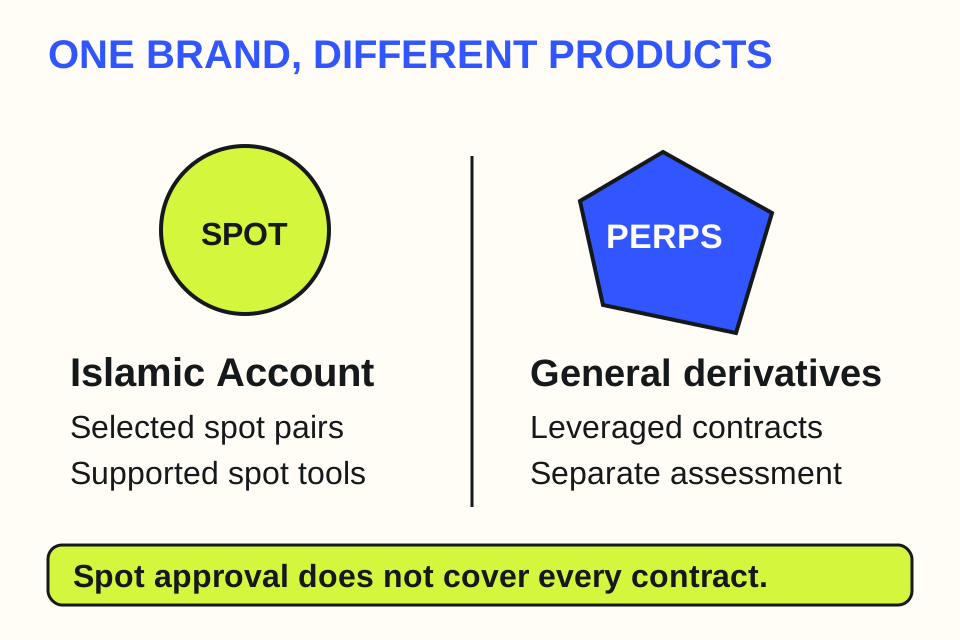
No product evidence reviewed here supports treating Bybit’s Islamic Account as approval for its leveraged perpetuals. The Islamic Account materials identify selected spot trading and supported spot-based tools. September 2026 announcements expand the supported trading pairs, but do not turn the general futures catalogue into a Sharia-certified derivatives product.
This distinction matters more than whether the app has an Arabic interface. A Muslim trader may value an Arabic service while still needing a separate assessment of the actual contract. A label attached to one account or group of products should not be transferred to everything the exchange sells.
Funding payments are not the whole religious question
A perpetual may make periodic payments between its long and short sides. Avoiding a payment at one moment does not settle every question about the contract, collateral or borrowing arrangement. This guide does not issue a religious ruling. If that assessment determines your choice, obtain a product-specific opinion rather than interpreting an exchange promotion as one.
For someone who only wants the documented Islamic Account product, the appropriate comparison is among the supported spot markets and account tools. For someone who wants a leveraged Bitcoin short, that spot product does not answer the request. Keeping those two readers separate prevents a superficially attractive recommendation from promising something it does not offer.
What should you check before opening the first position?
Once the funding and account choice are settled, focus on what could close the trade unexpectedly. On a USDT perpetual, the displayed position size, margin mode and liquidation estimate are more useful than a platform’s maximum-leverage advertisement. They describe the position you are actually about to open.
A trade budget is not the whole wallet balance
With isolated margin, a position has an assigned margin budget. With cross margin, the account can share eligible collateral across positions under its rules. This affects how one losing trade interacts with the rest of the account. If you intend to put only part of a 1,000-USDT balance behind an idea, verify the mode instead of assuming that the amount typed in the order ticket is the full limit of exposure.
Bybit also documents an automatic margin replenishment feature for eligible isolated contracts. When enabled, available account funds can be added to a position. That can move the liquidation point, but it also changes how much balance is committed. Someone choosing isolated margin specifically to contain a trade needs to notice whether this extra feature is on.
Why did a position liquidate when the chart looked different?
Bybit’s contract FAQ identifies the mark price as the liquidation reference. The last traded price shown on a chart can differ. Read the mark-price and liquidation fields together when reviewing the trade. A stop placed beyond the liquidation point cannot protect the position before liquidation occurs.
An ordinary stop order is also not a promise of an exact exit price during a fast move. Decide whether you want a price-limited order that may remain unfilled or an order that prioritises execution. That is a practical choice about the trade, not an invitation to memorise every advanced order type.
A position held overnight needs a second cost check
Commission is charged when trades execute; a perpetual’s funding payments are separate. Look at the live funding rate, direction and settlement schedule for your contract. Do not assume that all pairs charge at the same interval or that longs always pay. The number can change while the position remains open.
For scale, a hypothetical 0.01% payment on a 10,000-USDT position is 1 USDT per applicable settlement. Six such payments would be 6 USDT. That illustration can exceed the commission saving from choosing one platform over another for a single trade. It is not a forecast of a fixed daily or annual cost.
There is no need to build an elaborate spreadsheet for every small position. You do need to know whether your plan is a short trade, a multi-day hold or an open-ended position, because the relative importance of execution commission and continuing payments changes with that choice.
What does Saudi regulation actually establish?
SAMA’s 2018 warning says virtual currencies were not approved as official currencies and describes the absence of licensed local activity at that time. It is an important warning, but its date matters. It should not be rewritten as a newly issued 2026 prohibition, nor used alone to claim that private ownership is a criminal offence in every circumstance.
This review did not establish a Saudi retail crypto-futures licence for the recommended offshore accounts. Their product and country-access records are therefore presented as provider access, with that local limitation stated openly. A UAE, European or other foreign registration would not, by itself, answer the Saudi licensing question.
For the same reason, neither “the website opens” nor “my bank transfer succeeded” proves that an account has local regulatory protection. Those observations concern technical access and a payment. They cannot establish what would happen in a dispute with an offshore derivatives provider.
Do Riyadh, Jeddah and the Eastern Province need separate rankings?
The reviewed materials did not establish separate city-level permissions for these retail exchange products. Creating different legal rankings for those cities would add artificial detail. What can differ is the reader’s accepted documentation, bank relationship, advertiser availability and account approval. Those differences should be checked at account and payment level.
Saudi Arabia’s technology and financial-development initiatives should not be treated as permission for every crypto product either. A blockchain project, a token-related announcement and a leveraged retail exchange account are different things. The relevant proof would name the actual provider, service and customer group.
How should the Bybit security incident affect your choice?
Bybit’s February 2025 security incident belongs in a comparison that recommends the platform. Its incident timeline describes the ETH shortfall and the subsequent replenishment. Hacken’s own account of its February 23 reserve check reports reserves exceeding the measured liabilities after that response. Those are dated recovery records, not a guarantee about every future withdrawal.
For a Saudi customer, this adds a separate decision to the SAR and fee comparisons: how much trading balance to leave with the exchange. The convenience of keeping funding and perpetuals together does not require treating the same account as a permanent home for every crypto holding.
What does a reserve report actually settle?
A reserve snapshot can help assess the assets and liabilities included in that check. It does not prove that the platform can never suffer another security incident, that all possible obligations were captured, or that a customer has Saudi regulatory protection. Read its date and scope before treating a reserve ratio as a safety score.
Our recommendation is consequently about the documented SAR-funded futures workflow, not an assertion that Bybit is the safest exchange in the world. A reader who finds the custody history unacceptable has a real reason to consider another eligible venue even if its funding quote is slightly worse. Conversely, a reader accepting exchange custody can weigh the documented recovery alongside current account controls and the amount they intend to commit.
This is also why we have not declared OKX or Binance safer by default. Establishing that comparison would require equivalent, current custody and operational evidence for each provider. A lower fee answers a cost question; it cannot answer the security question on its own.