













Bybit, OKX or a regional exchange for Jordan?
If you already hold USDT and want to trade Bitcoin or altcoin perpetuals, Bybit is a practical candidate for Jordan. Its ordinary USDT contract keeps the margin and profit or loss in the same token, making the trade easier to follow than a coin-backed contract. Jordan is absent from its reviewed excluded-country list, although the account still needs approval and lawful use.
OKX is the closest alternative in this shortlist. It is worth opening alongside Bybit when the deciding factor is the available contract, the price for your order size or your actual fee tier. BitOasis answers a different question: it lists digital-asset trading for Jordan but does not document the leveraged product compared here. Buying a coin there is not the same as opening a short or a perpetual.
| Your starting point | Candidate | What decides it |
|---|---|---|
| You have USDT and want a straightforward perpetual trade | Bybit | The intended market is enabled, with clear margin and exit controls |
| You trade frequently and compare execution costs | OKX alongside Bybit | Your account fee and executable price for the same position |
| You want regional spot buying rather than leverage | BitOasis | Its Jordan-specific service limitations, especially deposits and withdrawals |
| You need a JOD bank-to-futures account in one step | Do not assume any of the above provides it | Obtain the actual supported funding and withdrawal instructions first |
Bybit’s lead here is a fit for that USDT-funded task, not a claim of exclusive features or a Jordanian derivatives licence. OKX can be the better account for a particular contract or cost. The comparison is based on published rules; we have not executed matched orders from verified Jordanian accounts.
Is crypto futures trading legal in Jordan now?
Jordan has moved beyond the old picture of a country with no virtual-asset licensing framework. Law 14 of 2025 and the subsequent Licensing Regulation 94 of 2025 establish a provider regime overseen by the Jordan Securities Commission. The regulation was published in December 2025 and came into effect 30 days after publication.
For the reader choosing an account, the important distinction is between an international provider’s country policy and a Jordanian operating licence. We are not claiming that Bybit or OKX holds a local retail crypto-derivatives permission. A platform’s ability to accept an application should not be mistaken for that claim.
How to read an “approved in Jordan” announcement
The JSC accepts applications for preliminary approval. Preliminary approval and the later operating licence are separate stages in its process. A company advertising the first stage has not demonstrated the second. Likewise, an approval concerning virtual-asset services should be matched to the particular activity offered, rather than treated as blanket permission for any leverage product.
The practical question to ask a local service is short: “Which company holds the permission for the product in this account?” An answer pointing only to a group’s overseas registration does not resolve a Jordanian licence claim.
Does living in Aqaba rather than Amman change the recommendation?
The reviewed national licensing regulation does not establish a separate retail crypto-futures allowance for Aqaba. An Amman or Irbid address does not change the USDT contract’s settlement rules either. Ask about a specific local funding service if your location matters to collecting or withdrawing money; do not infer a different leverage limit from the city alone.
Can you deposit Jordanian dinars directly into a futures account?
A web page displaying the Bitcoin price in JOD is not proof of a JOD deposit service. Currency converters can show a local equivalent even when the trading balance, receiving bank or withdrawal currency is different. Before choosing an exchange for its dinar page, open the actual deposit options for the verified account.
CliQ is especially easy to misunderstand here. JoPACC describes it as a domestic instant-payment system operating in Jordanian dinars. A transfer to somebody’s CliQ alias is therefore a local payment to that recipient; it does not become a direct international exchange deposit because the recipient says they sell USDT.
Buying USDT from another person is a separate transaction
If a supported, lawful peer-to-peer offer is available to you, compare what you receive after the seller’s price and any transfer costs. Keep the payment within the platform’s documented order process, and make sure the payment name matches the counterparty details. Do not describe a merchant’s private promise as an official exchange banking arrangement.
This article does not assert that a live JOD merchant offer is always available on Bybit or OKX. Offers, local payment acceptance and individual eligibility change. A reader who already owns transferable USDT can evaluate the futures product immediately; a reader holding only JOD needs to settle the funding question first.
What does the dollar peg mean for a USDT budget?
The Central Bank of Jordan quotes US dollars around 0.708–0.710 JOD per dollar. Using 0.709 only as an illustrative reference, JOD 100 is about $141.04. That does not mean a seller must deliver 141.04 USDT: a token can deviate from a dollar and a merchant can add a premium.
If an illustrative JOD 100 purchase delivers 137 USDT, the 4.04-unit difference from that reference is about 2.86%. That difference is much larger than a few hundredths of a percent of futures commission on a similarly sized trade. The example is not a quoted Jordanian market price; it shows how to recognise an expensive entry before taking leverage.
Which Bybit contract makes sense if your balance is USDT?
Start by distinguishing the asset you own from the position you want. With a USDT perpetual, USDT supports the position and the result is settled in USDT. With an inverse contract, the underlying coin plays that role. Somebody starting with a dinar budget and converting into USDT usually has less to track with the former.
Take a hypothetical 200-USDT balance and a 1,000-USDT Bitcoin position. A 2% favourable price move produces about 20 USDT of price profit before fees and funding. The same move against the position loses about 20 USDT. The market exposure is 1,000 USDT; the fact that less money was posted to support it does not shrink the price loss.
Choose the amount of the trade before the multiplier
The better question is “How much do I want this price move to gain or lose?” rather than “What is the highest leverage available in Jordan?” On a 1,000-USDT position, a 1% move is roughly 10 USDT. On a 5,000-USDT position it is roughly 50 USDT. Those amounts remain the same even if you change the margin supporting the same exposure.
The provider’s limit also depends on the contract and position size. A headline maximum is not the size every new Jordanian account can open on every altcoin. On a small or newly listed market, verify the actual order minimum, available multiplier and position limit before converting your whole balance to match an advertised trade.
Do not let automatic top-ups change your intended budget
Bybit’s automatic margin replenishment can add funds from an available balance to an isolated position. That can postpone liquidation, but it also means the amount committed can grow beyond the first margin amount you entered. If your plan was to allocate only a small portion of the account, inspect that setting before opening the order.
The distinction is useful for someone whose next dinar-to-USDT top-up is uncertain or expensive. You may prefer to keep a reserve separate from the active position rather than let the system repeatedly feed it.
How do Bybit and OKX compare on trading costs?
For ordinary non-VIP Bybit futures, the reviewed base schedule lists 0.055% for a taker order and 0.020% for a maker order. A taker accepts available liquidity; a maker adds an order that waits and is later matched. Special categories can have other charges, and the actual account schedule takes priority.
On an illustrative 1,000-USDT entry and a same-value exit, two taker fills at that base rate cost 1.10 USDT in total. Two maker fills would cost 0.40 USDT. The difference is 0.70 USDT, before the spread, any price change and funding. A limit order is not automatically a maker fill if it crosses the available price immediately.
OKX’s official calculation guide uses a level-one example of 0.05% taker and 0.02% maker. Treat that as a documented worked example, not a guaranteed Jordanian tariff. If your logged-in account actually has that 0.05% taker rate, the same 1,000-USDT round trip would cost 1.00 USDT: 0.10 less than the Bybit base illustration.
That ten-cent difference is a reason to compare frequent trading costs, not sufficient evidence to declare a universally better exchange. A slightly worse fill can consume it. If the contract you want is supported on both, compare the total price of the planned order; do not move money solely because one headline percentage is marginally smaller.
Funding can matter more for a trade held over several days
Perpetual funding is paid between the long and short sides at the applicable intervals. The rate and interval shown for the selected market matter. Do not multiply an attractive current reading into a fixed monthly return: the direction and size can change while the trade stays open.
At a hypothetical 0.01% payment on 1,000 USDT of position value, one funding event costs 0.10 USDT. Twelve such events at unchanged rates and value would cost 1.20 USDT, already more than the base taker round trip above. That is why the useful exchange comparison depends on whether you are closing the trade shortly or keeping it open for several days.
How do you turn a futures result back into dinars?
Closing the futures position produces a trading result in the contract’s settlement asset. It does not automatically create a JOD bank transfer. Decide where the final asset will be sold or withdrawn before taking a trade whose proceeds you need for local spending.
BitOasis illustrates why a regional brand name is not enough. Its May 2026 country table marks Jordan’s digital-asset trading as available while deposits and withdrawals are marked unavailable. Do not assume a UAE cash-out guide applies to the Jordan service. That limitation makes it unsuitable as an assumed exit for this comparison without fresh account-specific confirmation.
The advertised trading gain is not the amount reaching your bank
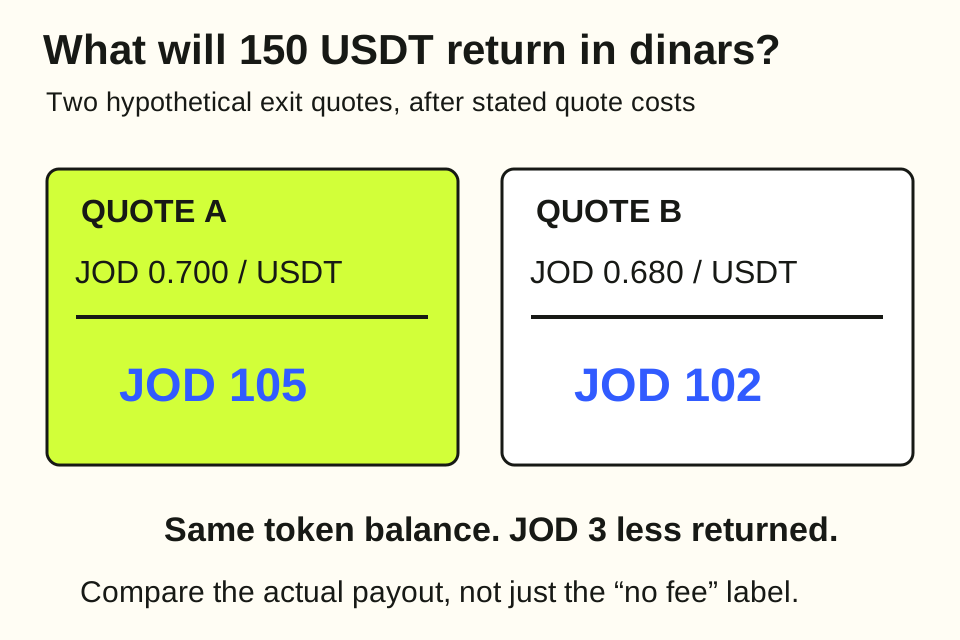
Suppose a round trip starts with JOD 100 and ends with 150 USDT after all trading charges. If a lawful cash-out quote would return JOD 0.700 per USDT, the proceeds would be JOD 105 before any additional transfer fee. At JOD 0.680, they would be JOD 102. The futures result is identical; the final local gain differs by JOD 3 because the exit quote differs.
These are hypothetical cash-out quotes, not merchant offers. Their purpose is to keep the exchange decision connected to the amount you can actually use. Saving a small commission while accepting a poor conversion quote can be the wrong trade-off for someone funding and withdrawing in dinars.
If you intend to keep trading with USDT, you do not need to convert after every position. Repeatedly buying and selling the settlement asset can add unnecessary local conversion costs. If you intend to leave the platform, however, a profitable screen balance is not a substitute for a supported withdrawal destination and network.
What should a beginner check on the mobile order screen?
On a phone, the most important fields can be easy to confuse: order size, margin amount, leverage and the button that opens or closes a position. Read the asset suffix as well. BTCUSDT and a Bitcoin-backed inverse contract are not interchangeable merely because both start with BTC.
Bybit’s default Unified Trading Account margin setting is cross margin, according to its current USDT product FAQ. A reader following an isolated-margin example should not assume that example describes the default account. Select the mode deliberately before entering the order and check whether existing positions or open orders prevent the change.
For a first attempt, use the smallest useful test of the workflow: confirm how to place the intended order, how to cancel one that has not filled, and how to close a position that has. The task is learning the controls, not increasing size until a displayed return looks exciting. A demo can teach the buttons, although it cannot establish live Jordanian funding or withdrawal access.
Three details that can prevent the wrong trade
First, inspect whether the amount field means the value of the whole position or the margin you commit. Second, check whether the order is opening or reducing a position; an opposite order behaves differently in one-way and hedge modes. Third, inspect the estimated liquidation level and your planned exit independently. A liquidation figure is not a recommended stop.
After closing, check both the position and the open-orders tabs. An unfilled entry or an unused exit can remain waiting after you think the trade is finished. Cancel the orders you no longer intend to execute.