







Living in Palestine or living abroad?
For a reader in Gaza or the West Bank, our answer is the same: we do not recommend opening a crypto futures account under the current Palestinian framework. For a Palestinian who has genuinely settled abroad, the answer can change. Their new country, accepted identity documents and the particular exchange product determine the options.
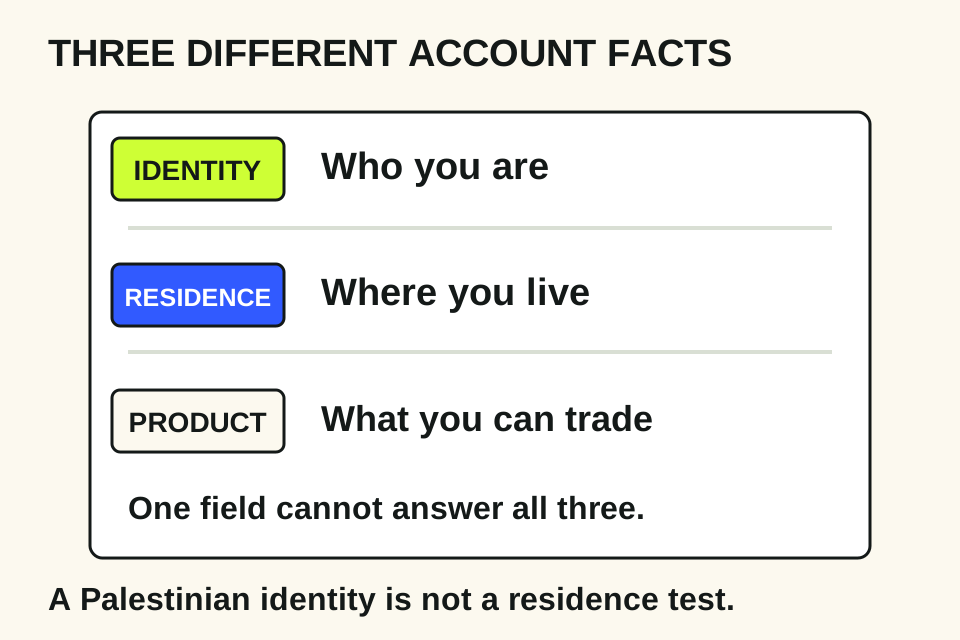
That distinction matters more than a list of twenty exchange logos. A Palestinian passport, a Palestinian bank account and living in Palestine are three different facts. None should be silently substituted for another when a website decides who can trade.
| Your situation | Start here | What changes the decision |
|---|---|---|
| Living in Gaza | Account continuity and existing funds | Reliable access to your account and a usable way to receive money |
| Living in the West Bank | Local payments and exchange claims | Whether an advertised service is actually a permitted crypto product |
| Living outside Palestine | The overseas-resident comparison | Your real country of residence and the provider's customer rules |
| Temporarily away from home | Residence and travel | A trip does not automatically make an account eligible in another country |
The international platforms in the catalogue are restricted-access records. They are useful for checking an existing provider, but do not form an approved resident signup shortlist.
Is crypto leverage allowed in Palestine?
Article 14 of Palestine's National Payments Decree-Law 41 of 2022 prohibits trading virtual assets and providing their services pending instructions from the Palestine Monetary Authority. The law also provides for future regulation and licensing. Those provisions create a way to regulate the sector; they do not, by themselves, open a retail futures market.
The review did not establish a later PMA instruction authorising the crypto futures products discussed here. Accordingly, our resident recommendation remains no signup. This conclusion comes from the Palestinian rule itself, rather than assuming that every global exchange excludes every Palestinian customer.
Does the law distinguish Gaza from the West Bank?
The cited provision does not set out a separate retail crypto permission for the two locations. We therefore do not invent a Gaza exception or a West Bank exchange licence. The important differences addressed below concern practical access to communications, payments and an existing account, not an unsupported claim that leverage becomes lawful across a local boundary.
The PMA also warned about virtual-currency trading in 2017. That is older guidance, not a new September 2026 announcement. A legal research article published through the Official Gazette's journal in December 2025 discusses the tension between prohibition and future regulation. It is useful background, but an academic proposal does not change the operative rule.
Gaza: being able to reach your money comes first
For somebody in Gaza with an existing balance, the pressing question may be whether they can recover access, receive a payment or complete a withdrawal. Ranking platforms by 100x or 200x leverage does not answer that problem.
The PMA's January 2026 banking workshop with Gaza's business community discussed digital payments, cash shortages and operational obstacles involving banks, payment companies and telecommunications. That supports taking access difficulties seriously. It does not establish that every bank branch, mobile connection or cash-out service now works everywhere.
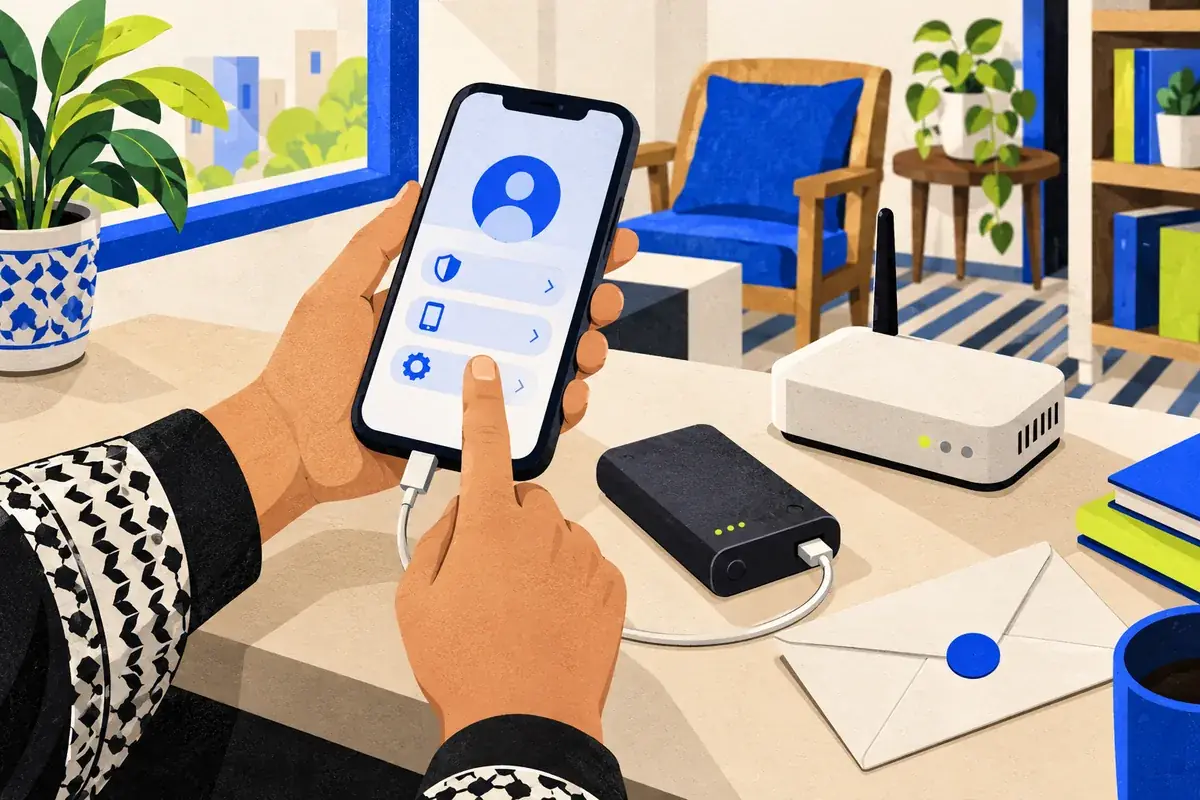
A connection problem is different from a missing balance
If the app stops loading, first establish whether the problem is the connection, the provider's service or the account itself. Do not assume that a blank screen means the money has disappeared. A saved account identifier and withdrawal reference let support investigate without relying on a fresh screenshot from an unreliable session.
Avoid using a stranger's exchange login simply because their connection works. That moves control of the balance to another person's account and creates a different identity problem. Someone helping you contact official support should not need your password, authentication backup codes or wallet recovery words.
For a custodial exchange, account recovery goes through that exchange. For a self-custody wallet, recovery depends on the wallet's backup. Confusing the two is expensive: an exchange help desk cannot recreate a lost wallet secret, and a wallet phrase cannot unlock an exchange account held under somebody else's name.
What if an existing position is still open?
Losing internet access does not pause a leveraged position. Its value continues to change, and a liquidation can occur while the phone is offline. Even a previously entered stop order is subject to the platform's execution rules and available market liquidity.
For a permitted account held by an eligible person, that makes continuity a genuine product consideration: can an order be placed on the platform itself, rather than depending on a phone app staying online? For a resident whose account is restricted, the appropriate task is resolving existing exposure with the provider, not adding another deposit to keep trading.
Receiving a balance is not the same as receiving spendable cash
A bank credit, an electronic-wallet balance and notes in your hand are different outcomes. Before arranging a permitted withdrawal or family payment, ask what the recipient can actually use at their location. A promise of instant digital delivery says nothing about a nearby cash withdrawal point having money available.
Keep the payment reference and the provider's written instructions. If access conditions change, that evidence is more useful than an intermediary's assurance that they can always cash out. We have not tested a Gaza bank withdrawal, and this page does not endorse an informal cash-for-crypto service.
West Bank: what local payment apps can and cannot do
In the West Bank, a familiar bank app or e-wallet can make an offer look more credible than it is. The distinction to make is simple: a payment company can be authorised to move money without being authorised to provide Bitcoin futures.
The PMA maintains information on supervised electronic-payment companies. Use that to check the payment business's identity. If the advertisement offers leveraged crypto trading, the additional question is who supplies that product and under what permission. A payment-company registration is not the answer.
Is iBuraq a way to trade crypto?
iBuraq is a PMA instant-payment system connecting participating bank accounts and electronic wallets. Its published description covers transfers in several ordinary currencies, including dollars, dinars, shekels and euros. It is not an exchange order book or a crypto-futures wallet.
This distinction prevents a common misunderstanding. Seeing USD in a banking app does not mean the balance is USDT. A dollar transfer uses the banking or payment system; a USDT transfer uses a supported blockchain address. Typing a wallet address into a bank-transfer form does not convert one into the other.
The same applies to the PMA's QR Quick announcement for June 2026. Paying through a QR code in the iBuraq system is a local electronic-payment function, not evidence of a new crypto token or exchange. Check what the code requests inside the banking app before confirming it; two square QR images can lead to completely different kinds of payment.
A local intermediary does not solve the product question
Suppose an advertisement says that a Ramallah-based contact will accept a local transfer and provide a funded exchange account. The local contact may make the payment feel convenient, but you still need to know whose name is on the account and who controls withdrawals. Buying access to someone else's verified account is not equivalent to opening your own.
A second warning sign is a request to describe a trading payment as something unrelated. That can leave your payment record inconsistent with the real transaction. An understandable service should be able to state what it provides without asking the customer to falsify the purpose of a transfer.
For ordinary payments in Nablus, Hebron or Ramallah, choose a properly identified payment provider for the actual payment need. For crypto leverage, the resident restriction discussed above remains the deciding issue. The existence of a local office or a fast transfer rail does not settle it.
Which exchange can a Palestinian living abroad use?
There is no single overseas answer based on Palestinian nationality alone. An exchange can assess residence, citizenship, identity-document support and the particular service separately. A person legally settled in one country should be assessed on those actual facts, not assigned automatically to the rules for somebody living in Gaza or the West Bank.
Kraken's international derivatives eligibility page, updated in July 2026, makes verification and geography part of product access. Bybit's September 2026 country policy also restricts particular locations and requires accurate location information. Neither policy's country list should be read as a promise that every document or every customer will be accepted.
The UK, Canada and the United States are not interchangeable
For a Palestinian living in the UK, Kraken's international derivatives conditions distinguish professional clients from retail customers. A normal retail account should not be assumed to qualify. For someone resident in Canada, Kraken's international derivatives product is excluded under the reviewed policy. These are product restrictions applying to the place of residence, not a judgement about Palestinian identity.
The United States uses a different Kraken derivatives offering from the international one. A comparison written for an international perpetual account cannot simply be reused for a US resident. Read the destination-country guide before choosing the trading product; identical branding can sit above materially different accounts.
What if I live in an eligible country?
Then compare the actual accounts offered there. For somebody already holding USDT, an eligible USDT-margined perpetual account avoids having to think in two collateral currencies. For somebody wanting a different collateral setup, Kraken's international product may be worth examining where allowed. This is a starting distinction, not a global ranking of Bybit against Kraken.
The better choice is the one that supports your verified residence, the contract you want and a withdrawal route you can use in your own name. Only after that do headline commission and maximum leverage become useful tie-breakers. There is no benefit in a slightly cheaper trade if the account cannot lawfully serve you.
Visiting family is different from changing residence
A short trip does not normally change the country where you live, but a provider can also restrict access from the place you are visiting. Before travelling with an open leveraged position, ask how temporary presence affects trading, closing positions and withdrawals. Do not wait until the interface refuses an order.
If you genuinely move, update the account rather than continuing indefinitely under an old address. An overseas relative's address is not your residence merely because they can receive mail for you. Where the provider needs documentary evidence, ask which documents it accepts for your circumstances instead of guessing.
Already have funds on an exchange?
The useful response depends on what the provider is actually telling you. An identity-verification request, a country restriction and a rejected bank transfer call for different follow-up. Sending the same generic complaint to several support channels usually adds confusion rather than resolving the particular hold.
If the issue is identity verification, request the accepted-document list and submit documents only through the provider's authenticated process. If it is a residence restriction, ask whether the account is being closed and what withdrawal procedure applies. If the exchange says it sent the funds, obtain the transfer reference and identify whether the next party is a bank or a blockchain recipient.
For a blockchain withdrawal, check the asset, network and destination together. A transaction reaching an address on the wrong network is not the same as a bank transfer being delayed. For a bank withdrawal, a blockchain transaction ID would not establish that the bank received a wire. Matching the evidence to the payment type makes the question answerable.
Can family abroad resolve the account problem?
They can help you understand a message or reach official support, but moving the account into their identity creates a new ownership issue. Similarly, receiving family support for living expenses is a separate decision from putting that support into a leveraged position. The recipient's need for usable money should determine the payment method.
There is no documented reason to pay an unofficial agent an extra deposit to release an account. Anyone claiming they can bypass identity checks or guarantee a frozen balance's return should be required to explain their authority through a verifiable official channel. Do not share authentication secrets as proof that the balance belongs to you.
What would make a resident exchange recommendation possible?
A useful change would be a PMA instruction opening the relevant activity, followed by a provider whose actual customer and product permissions cover Palestinian residents. A foreign exchange adding Arabic support, a Palestinian flag to its selector or another local payment method would not establish those two things.
If a provider claims that such an opening has happened, ask it to identify the current instruction and the actual product covered. The useful evidence is a published permission that applies to the service you want, rather than a screenshot showing that somebody managed to create an account.