









Which crypto exchange makes sense in England and the UK?
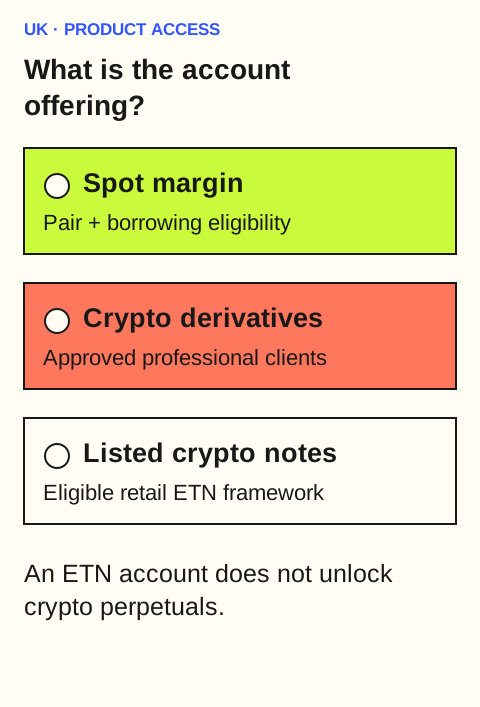
Kraken is the most useful place to start this comparison because its UK documentation distinguishes spot margin from professional crypto futures. That distinction decides what you can actually trade. A retail customer should not open an account expecting the international perpetuals menu advertised to residents elsewhere.
For a reader in England wanting a leveraged Bitcoin position, the first comparison is therefore between an eligible spot-margin transaction and an account approved for professional derivatives. It is not a competition between offshore exchanges promising the highest multiplier. If neither approved service fits, there is no suitable UK retail futures recommendation to substitute into the ranking.
Kraken: the relevant UK product matters more than the brand
Kraken documents UK-specific borrowing conditions for spot margin. It separately restricts UK crypto derivatives to eligible professional clients through its UK professional-client arrangement. These are different approvals. A successful spot purchase, or access to Kraken Pro, does not establish that the futures account is available.
The practical advantage is that the reader can identify the intended transaction before funding. Someone seeking a Bitcoin short should inspect the supported spot-margin pair and borrowing eligibility. Someone who needs a perpetual contract, rather than a borrowed-asset trade, needs the professional derivatives assessment. The latter should not be hidden in small print below a general “trade futures” button.
| Product | Who should consider it? | What the reader must not assume |
|---|---|---|
| Kraken spot margin | An eligible UK customer whose proposed pair and borrowing direction are supported | That margin access unlocks perpetual futures |
| Kraken UK professional arrangement | A client accepted under the professional-client framework | That account size alone automatically qualifies them |
| Bitpanda UK margin | An eligible customer seeking a supported long up to 3x | That this is a perpetual or a general short-selling product |
| Ordinary spot exchange account | A customer buying or selling owned crypto | That a Pro interface implies borrowing or derivatives |
| Retail crypto ETN | A reader seeking an eligible listed security linked to crypto | That this is a crypto exchange perpetual or shorting account |
Why Bybit, OKX and MEXC are not the main UK futures recommendations
A global exchange can have a recognisable brand, extensive markets and a working website without offering the same derivatives service to a UK retail resident. The FCA product restriction is the decisive filter here. We do not take a country’s omission from an international exclusion list as permission to promote retail futures into Britain.
Can you trade crypto futures in England in 2026?
For UK retail clients, the FCA restriction on selling, distributing and marketing covered crypto derivatives remains the central rule. It includes products such as crypto CFDs, futures and options. It is not a special London rule, a rule limited to sterling deposits or a restriction that disappears below a particular amount of leverage.
The relevant legal provision is COBS 22.6. Its territorial and product scope matters: a website being accessible is not evidence that a firm can lawfully offer the product to the reader. Equally, the rule should not be rewritten as a ban on owning Bitcoin. Spot purchases and derivatives are separate activities.
The ETN change did not reopen retail perpetuals
From October 2025, eligible crypto exchange-traded notes admitted to recognised UK investment exchanges became accessible under the applicable framework. That changed one part of the retail investment market. It did not turn crypto perpetual futures into a generally available UK retail product.
This matters when a search result says that the UK has “lifted the crypto ban”. For this site’s audience, the useful question is whether the change applies to a leveraged exchange position. A listed note is not the perpetual order book the reader came looking for. We mention it to explain the legal change, rather than presenting a securities account as a replacement crypto exchange.
Does the European 2x limit apply instead?
Do not substitute the familiar European retail crypto-CFD figure for the UK rule. “Only 2x in England” would give the wrong impression that every retail customer has an approved crypto-CFD route. The product prohibition has to be resolved before any account leverage limit becomes relevant.
A professional account is assessed differently, but the provider’s actual permissions and terms still decide what it offers. The fact that Britain is outside the EU does not, by itself, make it a high-leverage retail market. Brexit is not an exchange eligibility document.
How Kraken’s UK margin conditions affect a Bitcoin trade
The UK borrowing restriction concerns margin extensions in fiat money and fiat-backed stablecoins for certain non-corporate customers. Kraken says other cryptoasset borrowing is outside that particular restriction. Its pair-direction table therefore matters more than a general “margin available” label.
| Example | Long direction | Short direction |
|---|---|---|
| BTC/USD | Fiat-borrowing restriction applies | That particular restriction does not apply |
| BTC/ETH | That particular restriction does not apply | That particular restriction does not apply |
| USDT/GBP | Restriction applies | Restriction applies |
This is not an approval of every account or a promise that every listed pair is currently open. It explains why two orders on the same exchange can receive different eligibility results. The borrowed asset, rather than just the coin shown first in the market name, changes the assessment.
For the restricted borrowing, Kraken describes qualifying high-net-worth borrowers or borrowing used wholly or predominantly for a business. Its published high-net-worth thresholds are previous-year net income above £150,000 or net assets above £500,000, supported by an accountant’s declaration. That borrowing declaration is not professional-client approval for futures.
What to compare if your intended margin trade is supported
The useful comparison is the combined trading and borrowing cost for your expected holding period. A margin position funded by an asset extension has a different charge structure from a perpetual with recurring funding payments. Quoting an international futures maker fee beside a UK spot-margin order would be misleading.
For example, a trader intending to hold a supported short for three days needs the pair’s borrowing charge, its charging interval and the spot execution fee. A reader who normally closes positions within an hour may make a different cost decision. Both should use the margin schedule displayed for the actual UK account, not the international derivatives schedule used elsewhere on this site.
Also distinguish the borrowing ceiling from the amount the interface permits you to order. Available collateral, the pair’s margin requirements and existing exposure all affect that figure. A balance of £2,000 does not establish a universal maximum position for every coin. This page deliberately avoids assigning one international leverage headline to all UK margin transactions.
Bitpanda or Kraken for a UK leveraged long?
Bitpanda’s UK product page documents spot margin up to 3x, with UK-specific product terms dated April 2026. This is a relevant alternative for someone seeking a leveraged long in a supported cryptoasset. It should be compared with Kraken’s eligible margin transactions, rather than presented as a perpetual-futures account.
The comparison changes with the intended trade. For a supported long, Bitpanda offers a defined UK margin product with a modest leverage range. For a short, Kraken’s published pair-direction rules provide a more relevant starting point; Bitpanda’s reviewed margin terms describe borrowing to purchase the selected asset. A person seeking futures still needs a separate professional-product assessment.
The holding charge can matter more than the opening price
The UK product page lists a 0% buy fee, a 0.18% daily charge collected proportionally every four hours, a 0.3% closing fee and an additional 1% charge if liquidation occurs. These are the reviewed published figures, not a promise of the final cost for every account. The contract and current cost document determine the applicable charging basis.
For a long held across several days, an opening fee of zero is therefore not a complete price comparison. Compare the holding period and the closing cost against the eligible Kraken margin pair’s borrowing and execution charges. A futures funding rate taken from a global comparison table would not be a like-for-like substitute.
Why the UK-specific terms carry more weight
Bitpanda’s general help page contains inconsistent availability wording: it mentions a UK maximum while another line excludes the UK. The dedicated British product page and the named UK company’s margin terms provide more specific evidence of the offered service. We use those sources rather than silently treating the conflicting general paragraph as a complete country ban.
The product terms also describe euro-linked borrowed tokens and collateral. A GBP display does not, on its own, mean every component of the position is denominated in sterling. That is worth understanding before comparing the eventual GBP return with a Kraken position using a different pair and borrowed asset.
Bitpanda is therefore a useful alternative in the shortlist, especially for the reader whose need is a supported long rather than a short or perpetual. Kraken remains the lead for the broader documented UK margin comparison and its separate professional route. Neither recommendation requires pretending that the UK retail futures restriction has disappeared.
Who can qualify for UK crypto futures?
Professional status is a separate account decision, not a subscription tier. Under the FCA framework, a firm must assess whether the client has the expertise and experience to understand the relevant risks. For the applicable elective-professional test, at least two of three quantitative conditions are generally required alongside the qualitative assessment.
Those conditions concern significant trading frequency over the preceding four quarters, a financial-instrument portfolio exceeding €500,000, and relevant professional experience in the financial sector. The process also requires the appropriate written request and acknowledgement of protections the client may lose. The exact application belongs with the authorised service assessing the client.
A high salary alone is not enough
Consider an employee in Manchester with a strong income and a large cash balance, but little relevant trading history. A UK margin-borrower declaration and elective-professional classification ask different questions. Passing the first does not answer the second. Conversely, a person with relevant market experience still needs the firm’s assessment rather than assuming that a job title is sufficient.
This prevents a common false comparison: taking the professional product, placing it beside retail offshore futures and describing both as ordinary UK signup options. For a genuine professional applicant, Kraken’s UK derivatives service is relevant. For someone who does not qualify, its existence does not remove the retail restriction.
Which futures details become useful after approval?
At that point, compare the contracts actually enabled on the account: the underlying market, settlement currency, margin requirement, execution fee and holding costs. A trader concentrating on BTC and ETH may value a different market selection from someone seeking smaller altcoin perpetuals. The review should follow the authorised account’s product catalogue rather than borrowing the global exchange’s entire market list.
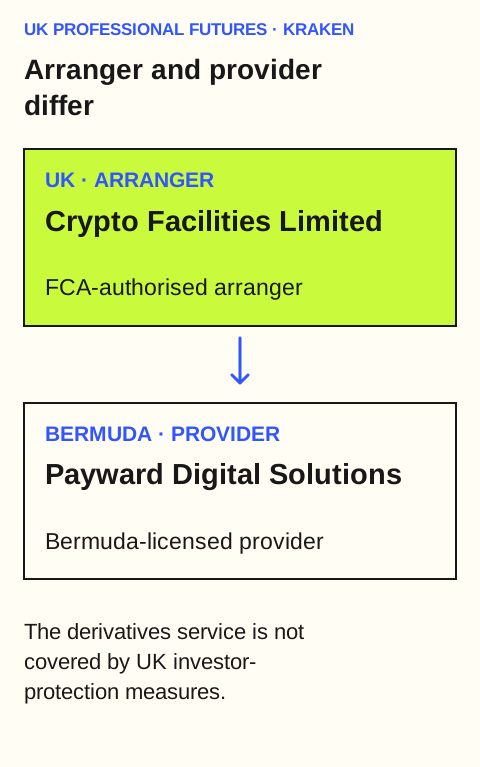
Kraken’s current UK product page advertises up to 10x for professional traders. Its disclosure separates Crypto Facilities Limited, the FCA-authorised arranger, from Payward Digital Solutions Limited, the Bermuda-licensed derivatives provider. It also states that the derivatives service is not covered by UK investor-protection measures. That is more precise than calling the whole arrangement a UK-regulated futures exchange.
Coinbase’s newly updated Global Derivatives documentation similarly identifies UK arranger services separately from its Bermuda agreement. A Coinbase spot account or an investment-services permission does not establish retail access to prohibited crypto derivatives. The main comparison remains the product actually approved for the customer.
Funding a UK crypto account: GBP transfers and bank limits
For a sterling-funded account, compare a supported GBP bank transfer with the total cost of buying crypto by card. The exchange’s deposit menu identifies its accepted provider, account details and payment reference. A GBP balance at the sending bank does not mean every international receiving account accepts a domestic Faster Payments transfer.
Kraken’s cash-funding documentation separates currencies and payment providers. Use the instructions shown for the verified account; sending to old beneficiary details copied from another user is not a reliable deposit method. When a provider changes, the destination and reference can change even though the exchange brand remains the same.
HSBC and Nationwide currently illustrate two different constraints
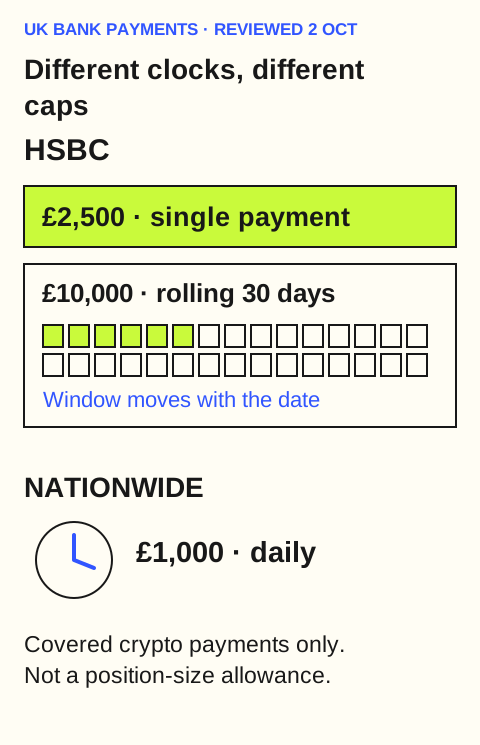
HSBC publishes a £2,500 single-payment limit and a £10,000 rolling 30-day limit for covered crypto payments. Nationwide’s current help page gives a £1,000 daily crypto limit for the relevant adult debit-card and Faster Payments transactions. These are bank payment controls, not futures-position limits or a measure of an exchange’s leverage.
An older Nationwide announcement still appears in search results with a larger figure. The current operational help page is the better source for a payment decision. Bank policies can change independently of the exchange, so an old deposit tutorial may fail even while the trading account works normally.
What a declined transfer actually means
A bank decline does not prove that the exchange has rejected the person’s identity or that their existing coins are frozen. Start by identifying the failed stage: the bank authorisation, the payment-provider receipt or the exchange credit. Those are three different events and require different evidence.
For a permitted payment query, retain the bank reference, amount, currency and intended beneficiary. If the bank says the transaction is outside its policy, that is the operative result. Splitting payments to defeat its controls or describing the destination inaccurately is not a solution we recommend.
The deposit decision should also account for the exit. A low-cost inbound method is less attractive if proceeds can only return through an expensive international transfer. Before choosing the funding method, compare the receiving bank’s currency, the exchange’s withdrawal provider and any conversion on the way back to GBP. That comparison is especially useful for a professional account whose profit ledger is in dollars.
Which fees belong in a UK leverage comparison?
There is no useful single UK “leverage fee” covering spot margin, professional futures and an international account held by a resident of a dependency. The products use different charges and eligibility rules. The right comparison begins with the service the reader can use, then measures the cost of the intended trade.
For UK spot margin, include the spot execution fee and the borrowing charges for the asset and duration. For approved professional futures, include the applicable contract fee and any funding or settlement costs. A card-purchase fee belongs to funding the account, not to the futures execution rate. Mixing these percentages produces a ranking that looks precise but compares different things.
Kraken+ does not erase the Pro account’s trading costs. The subscription waiver described in the fee schedule applies to the app’s qualifying Buy, Sell and Convert transactions; it excludes Kraken Pro spot and futures. A UK margin trader should therefore retain the relevant execution and borrowing charges in the comparison.
A sterling budget can create an additional currency result
Suppose a trader records a $400 gain, then converts the proceeds into pounds. At an illustrative rate of $1.25 per £1, that amount is £320 before conversion charges. At $1.20 per £1, it is about £333.33. This example is not a current FX quote; it shows why a dollar profit and a sterling bank receipt need not match the same percentage change.
For a meaningful exchange comparison, keep the trade result and the currency conversion separate. Otherwise, a favourable exchange-rate move can be mistaken for a cheaper platform. Equally, a poor card conversion can erase a small maker-fee advantage before the trader places the first order.
A BTC margin short: price the borrowed asset
Kraken’s margin schedule currently shows BTC opening and four-hour rollover charges in the 0.01%–0.02% range. Rates can move with conditions; the rollover rate for the position is set when the order executes and is displayed in the order form. Ordinary spot execution fees are additional. This is a different price structure from a professional perpetual’s trading commission and funding transfers.
For an illustrative 0.10 BTC borrowing at a quoted 0.02%, the opening borrowing charge is 0.00002 BTC. Each billed four-hour period at the same quoted rate adds another 0.00002 BTC. Six such periods add 0.00012 BTC, making 0.00014 BTC including the opening charge, before execution fees. The illustration fixes the borrowed quantity and rate; it does not promise those terms to an unapproved account.
That detail makes the earlier short-versus-long comparison practical. A UK customer considering a supported Bitcoin short should price BTC borrowing, whereas a fiat-funded long can face the separate UK borrowing restriction. Choosing a side of the same market can change both eligibility and the asset in which charges accrue.
UK taxes on leveraged crypto: classify the contract first
A crypto futures contract is not the same asset as the Bitcoin used to fund it. HMRC’s cryptoasset manual distinguishes derivatives from directly held tokens. That distinction is essential when importing exchange records into tax software designed primarily for spot purchases and disposals.
HMRC’s guidance on financial CFDs generally places an individual’s non-trading contracts within capital gains treatment, while a trading activity can produce income-tax consequences. Futures have their own guidance, including circumstances where income treatment applies. “Every perpetual gain is capital gains” is therefore too broad, as is “all leverage profit is employment income”.
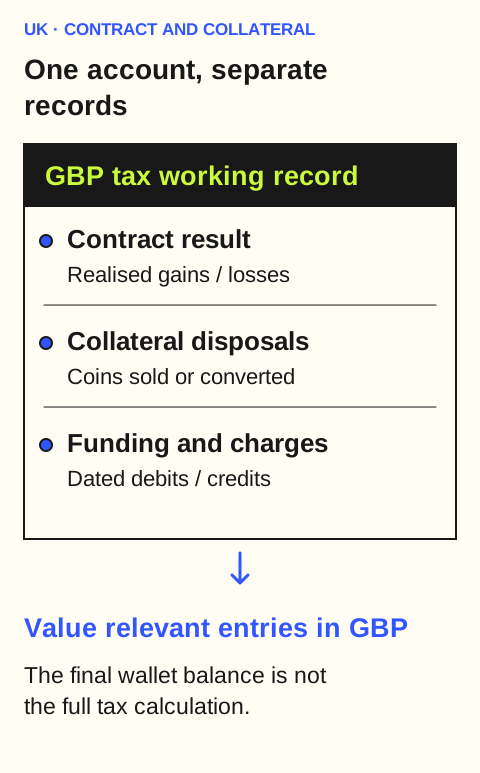
The useful first step is to identify the legal instrument in the account agreement. Then separate the contract result, fees, funding payments and collateral transactions. A platform exporting all of them into one USDT balance does not settle their tax classification.
The current capital gains figures are not the old 10% and 20%
For gains falling within the relevant individual capital gains rules, the main rates are currently 18% and 24%, depending on the person’s income and circumstances. The annual exempt amount is £3,000 for an eligible individual. These figures should not be applied mechanically to a receipt that should instead be treated as income.
A simplified example: if £5,000 is an eligible net chargeable gain and the full £3,000 exemption remains available, the remaining £2,000 is the amount to which the applicable CGT rate is applied. That is not a calculation for someone with other gains, losses, a trading business or different reliefs. It demonstrates the allowance without implying that every exchange withdrawal receives a fresh £3,000 exemption.
Withdrawing to a UK bank is not the only relevant event
A trader may close a contract and leave the proceeds on the exchange, exchange one token for another, or dispose of collateral without withdrawing sterling. Those actions should remain visible in the records. A tax report built only from bank withdrawals can miss the underlying activity.
For an account moving between providers, export the complete history before the old service closes. Preserve opening balances as well as closed positions, transfers and charges. Without the opening balance, an imported deposit may look like unexplained income or acquire an incorrect cost basis. This is particularly important when a UK resident returns from living abroad with an existing crypto account.
Scotland: the same exchange boundary, a different income-tax calculation
An Edinburgh or Glasgow resident uses the UK exchange eligibility framework. Scotland does not offer a separate route to retail crypto perpetuals. The useful local difference is the treatment of income if the person’s activity falls into an income-tax category, rather than a new set of derivatives permissions.
Scottish income-tax bands apply to specified non-savings, non-dividend income for Scottish taxpayers. For 2026/27, the published rates span 19%, 20%, 21%, 42%, 45% and 48%. Savings and dividend income follow the relevant UK rules. Capital gains should not be relabelled as Scottish income merely because the trader lives north of the border.
What changes for a Scottish trader?
If the activity is assessed as taxable trading income, a calculation copied from an English salary example may be unsuitable. If it is instead a capital gain, the separate CGT analysis remains the starting point. The classification of the activity therefore comes before choosing a rate from a regional table.
For example, a Scottish resident with a day job and occasional qualifying investment gains does not automatically pay the highest Scottish income-tax rate on every profitable contract. Conversely, a person conducting a genuine trading business cannot assume the CGT allowance settles the whole position. The tax category, other income and allowable expenses determine the calculation.
The exchange choice remains product-led: Kraken’s documented UK margin service for an eligible transaction, or its professional derivatives service where the client qualifies. A Scottish address should not be replaced with an English correspondence address to obtain a different result. It would not change the central product rule in any event.
For a move from England to Scotland, preserve the relocation date and update HMRC and the exchange separately. The exchange needs the current residential record; HMRC determines Scottish taxpayer status under its rules. A profile update at one organisation is not an instruction to the other.
Wales: sterling funding and the Welsh taxpayer distinction
Readers in Cardiff, Swansea and elsewhere in Wales have the same core crypto-product choices as other UK residents. There is no separately documented Welsh perpetual-futures entitlement. The provider’s UK account rules govern the service, while Welsh taxpayer status affects the appropriate income-tax treatment.
The current published Welsh rates correspond to 20%, 40% and 45% for the relevant income bands. The Welsh mechanism matters even when the final rates match England’s: a person moving between the two countries needs the correct residence information and tax code. It does not create a second capital-gains allowance or a new exchange account category.
Language and address consistency
A bilingual place name or a Welsh-language document should describe the same real residential address throughout the account process. If a bank statement uses one accepted spelling and an identity record another, retain the original documents and explain the correspondence. Do not invent a different residence to make the forms look simpler.
For trading, the practical priority is a supported GBP funding and withdrawal path. The bank’s crypto policy applies to the payment itself; it does not become more permissive because the exchange’s website has a localised page. Compare the bank’s current controls with the exchange’s actual beneficiary instructions.
Northern Ireland: UK residence is not an Irish exchange account
For a resident of Belfast or Derry/Londonderry, Northern Ireland falls within the UK product assessment. The Republic of Ireland is a different jurisdiction. An Irish passport, a euro salary or regular travel across the border does not by itself change the country of residence recorded by an exchange.
This is the distinction that matters most for crypto leverage. A person living in Northern Ireland cannot assume access to a provider’s EEA derivatives service simply because they also hold Irish citizenship. Equally, a person genuinely living in the Republic should not be classified as a UK resident solely because they were born in Northern Ireland.
Cross-border work and banking
Consider someone living in Newry and working in Dundalk. Their payroll and bank account may involve euros, but the exchange still needs their actual home address. Currency choice is a funding question. Residential eligibility is a separate account question. Combining them can produce the wrong product recommendation.
If income is received in EUR and the trading account is funded in GBP or dollar collateral, compare the conversion before sending. A bank’s international-transfer fee and the exchange’s deposit fee are not the same charge. The useful quote is the amount that reaches the permitted trading balance, with each currency conversion identified.
Tax records across the border
A cross-border worker may need a more careful tax-residence and treaty analysis than a person whose home, work and accounts are all in one country. Employment tax treatment does not automatically decide how a private derivatives position is taxed. Keep the trading records distinct from salary records, then apply the relevant residence and income rules.
For the UK-resident reader, the earlier HMRC discussion remains relevant. There is no basis for importing an Irish tax exemption or a European product permission simply because the account uses an Irish bank. The most useful exchange remains the one offering the correct service to the person’s real residence, not the one whose country selector appears most convenient.
Does FCA registration protect the money in a crypto account?
An FCA cryptoasset registration for anti-money-laundering purposes does not itself provide Financial Services Compensation Scheme protection or Financial Ombudsman Service coverage. The permission and the activity have to be identified. A brand can operate an e-money service, a spot crypto service and a separate derivatives arrangement with different protections.
This matters when deciding where to leave collateral. Money moving through a bank does not automatically turn the final exchange balance into an insured bank deposit. Nor does a professional-client label mean the trader gains retail protections; professional classification can involve giving some of them up.
Coinbase’s current UK agreement provides a concrete example of the distinction. It separates its e-money service from digital-asset services and explains that safeguarding e-money is different from an FSCS guarantee. The cryptocurrency balance should not be described as an insured sterling deposit merely because both appear inside one app.
For Kraken’s UK professional arrangement, use the provider and arranger distinction above. For an ordinary margin account, use that account’s actual terms. The practical comparison is who owes the balance, under which service, and what happens to client assets if that entity fails. A regulator’s logo alone does not answer those questions.
British citizens abroad and residents moving between jurisdictions
Nationality, residence and tax residence are related facts, but they are not interchangeable. A British citizen permanently living in an eligible overseas jurisdiction may have a different product assessment from a retail resident in England. A foreign citizen living in London still faces the UK account rules.
Before a genuine move, identify the destination service and how the exchange handles open positions during an account migration. Some products may not transfer to the new entity or account. A trading history exported before migration is easier to reconcile than a partial record recovered after the account interface changes.
A move does not instantly erase the UK tax position
HMRC uses residence rules rather than the name of the exchange or the country where its servers sit. Split-year treatment and temporary non-residence provisions can matter. An overseas address entered in an app is not sufficient evidence that all subsequent gains fall outside UK taxation.
This is especially relevant for readers considering the Crown Dependencies or the Caribbean territories below. Their local tax systems may differ substantially from the UK’s, but the person must establish which jurisdictions can tax them. A territorial section is an account-and-rules comparison, not a recommendation to relocate for a particular trade.
The order is straightforward: a real change of residence, accurate supporting documents, the exchange’s product assessment, then the appropriate tax analysis. A holiday, a friend’s address or a newly incorporated company should not be treated as the equivalent of that sequence.
Exchange access beyond the UK: what the evidence supports
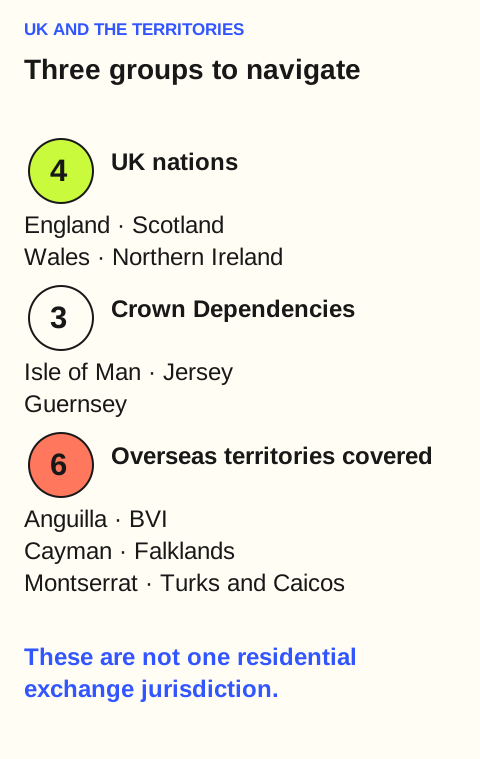
The Crown Dependencies and British Overseas Territories are not additional UK counties. A British passport or a pound-linked currency does not make every resident subject to the same exchange onboarding as a person in England. Jersey, Guernsey and the Isle of Man are Crown Dependencies; the other territories covered below have their own local institutions and legislation.
We reviewed Kraken’s international derivatives location policy and Bybit’s current service exclusions. The nine jurisdictions in this table are not individually named as excluded locations in those documents. That makes the services candidates for an eligible resident, subject to local law, the correct account entity and individual approval. It does not establish a completed resident signup or a local derivatives licence.
| Residence | Exchange starting point | The useful local distinction |
|---|---|---|
| Isle of Man | Kraken international derivatives; Bybit as an alternative | Manx registration and UK professional status are different questions |
| Jersey | Kraken for derivatives; Coinbase explicitly covers general services | Revenue Jersey distinguishes occasional disposals from trading activity |
| Guernsey | Kraken or Bybit under their international policies | Check the VASP register and the resident’s tax category |
| British Virgin Islands | Kraken; Bitstamp also has a local VASP record | The recorded spot permissions do not establish futures permission |
| Cayman Islands | Kraken or Bybit as conditional international candidates | Trading-platform licensing changed in April 2025 |
| Anguilla | Kraken or Bybit, with an accepted funding route | Utility-token legislation is not a general futures licence |
| Montserrat | International candidates assessed separately from local providers | Virtual-asset business regulations coexist with local income tax |
| Turks and Caicos | Kraken or Bybit subject to territorial approval | A 2026 virtual-assets consultation is not proof of an enacted licence |
| Falkland Islands | Kraken as the initial derivatives candidate | Bank-transfer currency and local tax residence need separate treatment |
The table uses one common evidence standard so the later sections can concentrate on what changes locally. It intentionally does not assign an identical maximum leverage to every territory. Once an account is accepted, the relevant contract and position bracket determine the limit; the territory’s name alone does not.
Bermuda and Gibraltar now have their own guides, covering exchange eligibility, local funding and the rules that affect leveraged accounts.
Crypto leverage in BermudaCrypto leverage in GibraltarIsle of Man: crypto derivatives outside the UK retail classification
A Manx resident should be assessed as resident in the Isle of Man, rather than automatically placed into a UK-only product category. Kraken’s international derivatives policy provides a starting point; Bybit is another candidate under its location policy. Coinbase’s current general-services agreement explicitly includes the island, although that fact alone does not establish access to its derivatives offering.
Use the Manx residential jurisdiction and the corresponding agreement, rather than a previously assigned UK account.
What the Manx regulator’s registration means
The Isle of Man FSA’s March 2025 virtual-assets guidance explains the boundary between designated-business registration and regulated financial services. Registration for anti-money-laundering supervision should not be described as a blanket investment licence. A business dealing with a regulated instrument may have additional obligations beyond its virtual-asset registration.
For a futures trader, this makes the product description in a register important. An exchange’s ability to hold or exchange tokens is not necessarily permission to offer every leveraged contract. The investor should be comparing the actual service agreement with the relevant permission, not simply counting how many regulators a brand lists in its footer.
A Manx tax return is not a UK tax return
The island does not impose capital gains tax, but income remains a separate category. The government’s personal-tax material addresses resident income, including overseas income. A speculative activity conducted as a business cannot safely be labelled tax-free just because the exchange calls its result “PnL”.
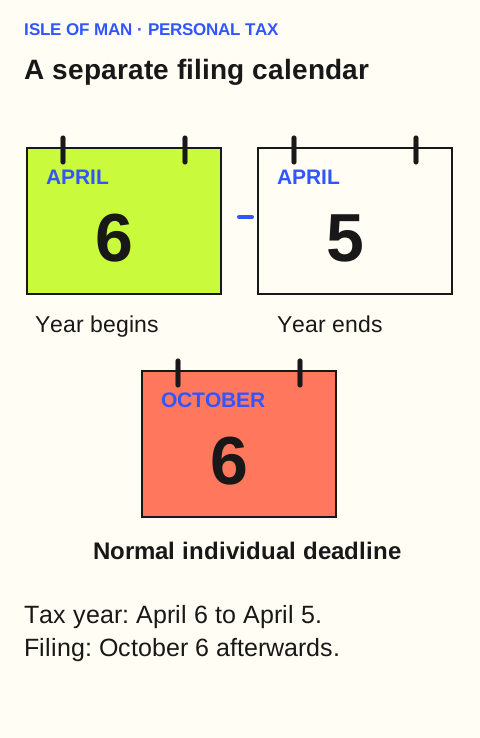
The Manx tax year runs from April 6 to April 5, with the normal individual filing deadline described as October 6. That calendar differs from the UK online Self Assessment timetable. Keeping the date distinction with the account records is more useful than assuming that every sterling-based jurisdiction follows HMRC’s filing process.
For someone moving from Liverpool to Douglas with existing positions, preserve the move date and the pre-move history. The local absence of capital gains tax does not settle any remaining UK residence or temporary non-residence question. The account change and the tax change should each be documented on their own terms.
Jersey: choosing a futures account and separating investment from trade
Jersey offers a particularly useful distinction between the exchange access question and the tax question. Kraken’s international policy leaves a conditional derivatives route for eligible island residents. Coinbase’s agreement separately names Jersey among the jurisdictions covered by its general service. Neither statement means every customer can use every leveraged product from either group.
For a Jersey reader already holding crypto on Coinbase, the first decision is whether the desired derivatives service is actually enabled under the account’s applicable agreement. Transferring to another provider simply because a global product page advertises higher leverage can add fees without resolving eligibility. For a fresh futures account, Kraken is the initial comparison because its international derivatives policy addresses the product directly.
Revenue Jersey gives a clearer investment-versus-business distinction
Revenue Jersey’s crypto guidance says occasional cryptocurrency disposals by individuals are not normally taxable, while activity amounting to a trade is treated under ordinary business-tax rules. The absence of capital gains tax should not be turned into an unconditional promise about a professional derivatives operation.
Its April 2026 digital-asset tax strategy reinforces the distinction between individual investment returns and other forms of activity. A company’s tax treatment, a non-resident investor’s position and a Jersey-resident person’s trading income are not interchangeable examples. An article quoting a corporate zero rate as the tax result for every individual would answer the wrong question.
Records that make the local distinction usable
A Jersey trader should retain enough information to describe what they were doing: occasional investment, repeated speculative dealing, or an organised business. The exchange ledger supplies dates and amounts, but the surrounding activity determines the classification. There is no honest universal answer based only on the number of trades visible in one month.
Where the account reports dollar or stablecoin results, preserve the sterling valuation used for the local records. Do not merge unrelated receipts such as rewards, interest-like payments and closed-contract gains merely because they reach the same wallet. Separating them keeps the explanation of the activity much clearer.
The Jersey Financial Services Commission’s authorisation material also identifies VASP registration as its own category. That local supervision is relevant when a provider operates from Jersey; it should not be confused with an overseas brand simply accepting a Jersey customer. The shortlist distinguishes those two relationships instead of awarding a local-licence badge based on residence alone.
Guernsey: VASP permissions, income categories and the Bailiwick
Guernsey’s Financial Services Commission has a specific virtual-asset service provider category in its regulated-entity search. That is the relevant place to test a claim that a local provider holds a Guernsey permission. It is more informative than an exchange describing itself as “offshore regulated” without identifying the entity or service.
Kraken and Bybit remain conditional international candidates under the policies described in the table. For a Guernsey resident seeking futures, the comparison is between the accepted account’s actual contracts and funding arrangement. A local VASP registration held by another business should not be attributed to either exchange unless the legal entity matches.
Guernsey residence categories affect the tax answer
Locate Guernsey, the government’s relocation service, describes a flat 20% personal income-tax rate, subject to allowances and the applicable residence category. It also explains that the basis of assessment changes with residence status. The island does not levy capital gains tax, but that does not remove the need to distinguish a capital result from taxable income.
A new arrival should therefore avoid importing either a UK CGT calculation or a company’s zero-rate headline into a personal trading return. The relevant facts include the residence category and the character of the activity. Keeping a clear start date for residence and a complete exchange statement is useful when a year spans two places.
Alderney and Sark should not disappear into a label
The Bailiwick includes smaller islands, but a form’s country label and the person’s actual island address are different pieces of information. Provide the correct address rather than converting it into a fictitious UK residence. An account provider may group a territory in its forms while still needing the precise address for verification.
The Guernsey tax summary here should not be treated as a complete Sark tax guide. That distinction matters more than adding an unsupported promise that every island within the Bailiwick has identical taxes. For the exchange comparison, our published-policy candidates remain a starting point, with actual residential approval required.
British Virgin Islands: what the Kraken registration actually covers
The BVI FSC register provides a direct local record for Payward Trading Ltd, trading as Kraken. The listed activities include virtual-asset exchange and related services. This is useful confirmation of a named entity in the jurisdiction, rather than a vague reference to an international company registration.
However, the listed spot and virtual-asset services should not be expanded into a claim that this particular registration authorises every futures contract. The international derivatives agreement may involve another group entity. A BVI resident comparing Kraken products needs to distinguish the local register entry from the legal agreement for the leveraged account.
Bitstamp is a relevant local comparison, with a narrower conclusion
The regulator also publishes a record for Bitstamp Global Ltd. That makes it relevant when comparing documented crypto exchange services, especially for a reader who needs to acquire or transfer the collateral asset before trading elsewhere. It does not establish that Bitstamp supplies the same perpetual account as the international futures candidates.
Payroll tax is not the same as a tax on every token gain
BVI’s 2025 budget includes self-employed people in its tax-registration and good-standing programme, and Inland Revenue administers payroll tax. A resident conducting trading as a business needs the applicable business assessment. These rules do not justify deducting a payroll percentage from every private investment gain without classification.
The useful record is the nature of the activity and who owns the account. A resident trading personal assets, a self-employed operation and a BVI company investing corporate funds should not share one assumed tax answer. The presence of a company in the territory does not, by itself, change the tax residence of its owner elsewhere.
For a resident receiving dollars and trading dollar-settled contracts, the absence of a headline currency mismatch may simplify the comparison, but it does not eliminate withdrawal fees or intermediary-bank charges. The account’s accepted bank route remains a separate cost from the futures commission. Compare the actual net receipt, not a claim that every dollar transfer is domestic.
Cayman Islands: derivatives candidates and the newer VASP licence rules
The Cayman Islands Monetary Authority brought important virtual-asset licensing changes into effect on April 1, 2025. Custody and trading-platform activities within the relevant scope require the appropriate licence; registration alone should not be treated as equivalent. That distinction is central when a platform promotes a Cayman base.
For a resident choosing an international derivatives account, Kraken and Bybit remain conditional candidates under their published location policies. A platform’s Cayman incorporation is a different fact from CIMA authorisation, and both are different from the customer’s product eligibility. None should be used as a substitute for the others.
A company address is not a resident-access list
Crypto businesses often have corporate structures spanning several jurisdictions. A Cayman company named in a contract may serve customers internationally, while a different group company handles deposits or custody. The address at the bottom of the website does not reveal which country’s residents can use every product.
A resident’s useful comparison is the intended contract, the assigned entity and the accepted collateral route. If the reader is already holding USDC or USDT, an exchange-to-exchange transfer may avoid one fiat conversion, but only where both services accept that asset and network. A domestic currency balance should not be sent to a receiving account that only supports USD merely because both balances use a dollar sign.
What the Cayman tax position does and does not settle
PwC’s Cayman practice, in its May 2026 review, reports no personal income or withholding taxes imposed on individuals. Its territory summary also records the absence of individual capital gains tax. This is materially different from the UK tax calculation earlier in the article.
The conclusion applies to the Cayman tax framework. It does not determine whether another country also treats the person as resident or taxes a particular source of income. A newly arrived trader with continuing UK ties should resolve that question using the residence rules, rather than assuming that a Cayman lease cancels all previous obligations.
For a genuinely Cayman-resident individual with no competing tax claim, the local absence of those taxes can make the after-tax result very different from a UK resident’s result. It does not reduce exchange funding charges, liquidation exposure or the consequences of choosing the wrong account entity. Those costs remain part of the futures comparison.
Anguilla: crypto futures, utility-token rules and EC-dollar funding
Anguilla’s utility-token legislation is sometimes cited as though it approved all forms of crypto trading. The Financial Services Commission’s own material is more specific: the token-offering framework has defined purposes and excludes certain investment products from that route. It is not a general licence for a retail perpetual-futures exchange.
For an eligible resident, the international candidates in the territory table are therefore a separate question from an Anguilla utility-token issuer. Kraken’s derivatives policy and Bybit’s service policy do not individually exclude Anguilla in the reviewed versions. The relevant futures account must still accept the territory and the intended product.
The local currency is not the contract’s collateral
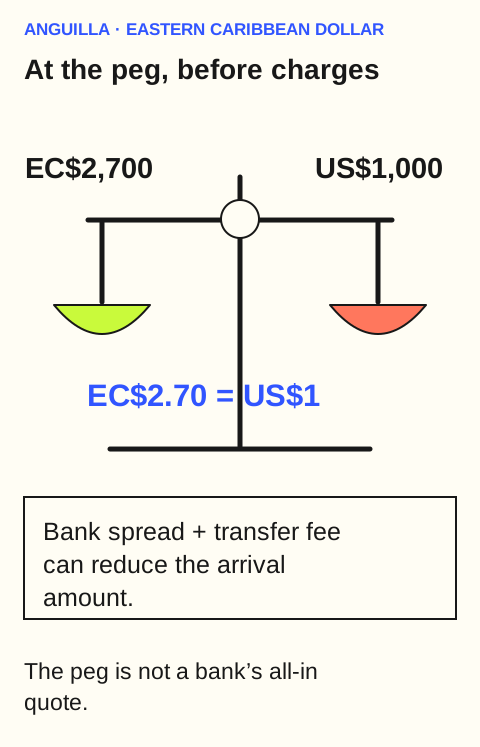
The Eastern Caribbean dollar is pegged at EC$2.70 to US$1. An EC$2,700 budget therefore corresponds to US$1,000 at the peg before bank spreads, transfer fees or a crypto purchase premium. The peg does not require a bank or payment provider to deliver the full US$1,000 to an exchange account.
This is a useful comparison for a smaller deposit. An illustrative US$25 transfer charge would consume 2.5% of a US$1,000 amount before any trading fee. Choosing between two tiny maker-fee differences would have much less impact on that first deposit than the funding route. The example is a calculation, not a quoted tariff for a local bank.
Local levies should not be erased by a tax-haven label
Anguilla’s Inland Revenue Department publishes a Universal Social Levy. Its guidance includes a 6% obligation on qualifying self-employed gross earnings above the stated monthly threshold. That is relevant to a person operating a business; it is not a published rule applying 6% to every private crypto disposal.
Montserrat: local virtual-asset rules and a taxable-income framework
Montserrat has its own Virtual Asset Business Regulations, including provisions concerning client assets, records and complaints. The 2024 framework is more specific than a generic statement that British territories all follow UK crypto rules. It concerns the businesses within its scope, rather than turning every person who trades their own coins into a licensed exchange operator.
Montserrat residents can compare the conditional international candidates in the table. A local register claim should separately identify the exact licensed business.
Montserrat is not another Cayman tax example
The government’s official Income and Corporation Tax Act establishes an income-tax system. A reader should not import the Cayman personal-tax result into Montserrat merely because both are British Overseas Territories. The nature of the receipt, residence and applicable local provisions matter.
A futures trader’s records need to show the contract result separately from money transferred between accounts. A deposit of existing capital is not automatically new income, and a withdrawal may include both original capital and trading results. That separation becomes useful when explaining an overseas exchange balance under a local income-tax framework.
The funding question is the amount that reaches the account
For a resident starting with EC dollars, the exchange’s accepted deposit currency decides whether the transfer needs a conversion first. The platform may support an international USD or EUR account without accepting a direct XCD deposit. Selecting Montserrat during verification does not mean that the exchange supports the local currency as collateral.
Compare the full transfer amount and the net credited balance, then compare the trading product. A lower futures commission is not a substitute for a workable withdrawal route back to the resident’s bank. Where the exchange offers several networks for the same token, use the network accepted by both sending and receiving services; the ticker alone is insufficient.
Turks and Caicos: current access versus a proposed crypto framework
The Turks and Caicos Islands FSC published a proposed Virtual Assets Business Bill for consultation in 2026. The consulted draft must not be described as an enacted licence regime simply because its provisions are detailed. For a resident choosing a futures exchange, that difference prevents a proposed reform being used as a current regulatory endorsement.
Kraken and Bybit are conditional international candidates under the reviewed location policies. Their availability assessment is not based on the consultation bill. It is based on the provider’s product rules, territorial treatment and individual approval, with local legal requirements remaining relevant.
Dollar funding does not make the account American
Turks and Caicos uses the US dollar. That does not make a resident eligible for a US-only derivatives account, nor does it mean every bank transfer can use a US domestic payment route. Residence, citizenship-related restrictions and the payment network are separate facts.
For example, a dollar account at a local bank may need an international transfer to reach the exchange’s beneficiary. A US routing number shown in a tutorial may belong to a method that the account does not support. The correct comparison is the bank route actually available to the verified resident, not a US signup guide translated by changing the country name.
The local direct-tax position
Invest Turks and Caicos, the territory’s investment agency, describes the absence of personal income and capital gains taxes. That is a material local difference from Montserrat and the UK. It does not determine obligations in another jurisdiction that may still treat the trader as resident or tax them on another basis.
The practical benefit of dollar-denominated funding is that the trader may avoid a home-currency conversion when the accepted account and bank transfer both use USD. There can still be transfer charges, a stablecoin purchase spread or conversion between supported collateral assets. A matching currency symbol is not a zero-cost guarantee.
Falkland Islands: international access, bank transfers and overseas income
Kraken is the first international derivatives candidate for a Falkland Islands address under the shared eligibility qualification in the territory table.
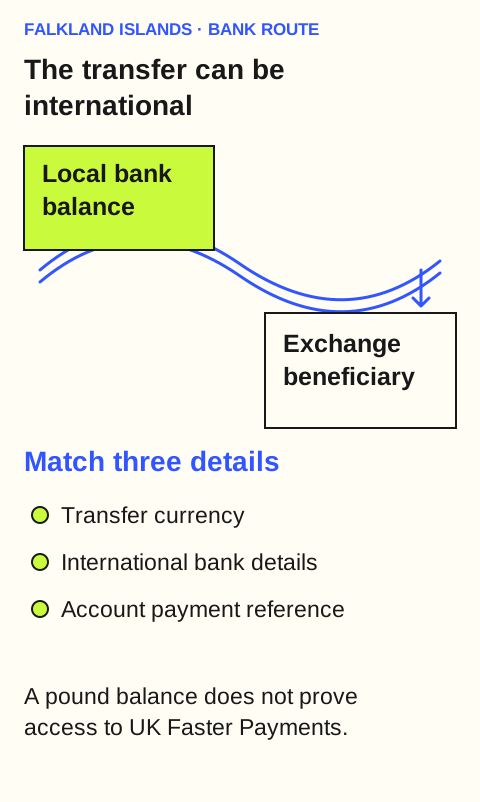
The practical funding question deserves more attention here than a long list of global brands. Standard Chartered’s Falkland Islands service describes foreign exchange in GBP, USD and EUR and international telegraphic transfers. This identifies a local banking capability, but does not promise approval of a particular exchange payment.
A pound balance does not establish a domestic UK transfer
The sending bank’s location and the beneficiary instructions determine the payment route. A balance described in pounds should not be treated as proof that a UK Faster Payments method is available. Confirm the settlement currency and international bank details shown by the receiving service before deciding whether the transfer is economical.
This can affect the platform choice for a small account. A service with an attractive futures fee may be less convenient if its cash route creates several conversions. Someone already holding a supported cryptoasset faces a different funding comparison from someone beginning with a local bank balance. Those are different starting positions, not two universal rankings.
Local residence brings a local tax analysis
The Falkland Islands government describes residents as generally assessed on worldwide income and states that there is no general capital gains tax. Its guidance also uses a calendar tax year, with an individual return deadline normally falling on July 31 of the following year. This is a separate system from UK Self Assessment.
The government specifically warns that overseas income can remain taxable even where a UK wrapper would treat it favourably. The broader lesson for an exchange account is that an overseas provider does not make income disappear from the local return. A contract’s treatment depends on the local classification of the activity and receipt.
Someone moving between the UK and the islands should preserve the dates and statements covering both periods. That record helps distinguish the original assets, later trading results and any overlapping residence questions. The exchange should hold the current residential information; the tax calculation should follow the relevant rules for the period being reported.