












Which crypto exchange makes sense in Thailand?
Kraken deserves the first look for an eligible international futures account. Its published derivatives exclusions do not name Thailand, and it has a documented crypto-perpetual product with transparent entry-level trading fees. That is a useful starting point, not a Thai licence or a promise that every resident can fund and use the account.
For buying coins with baht, Binance TH and Bitkub answer a different question. They provide local spot markets: you buy the asset itself rather than open a leveraged bet on its price. Neither should be presented as an equivalent replacement for an offshore perpetual account. Choose the product first, then compare the platforms that actually provide it.
| Your aim | Where to look | What changes the decision |
|---|---|---|
| Trade crypto perpetuals | Kraken, subject to account and local eligibility | Published international product rules; no Thai regulatory approval claimed |
| Buy or sell crypto against THB | Binance TH or Bitkub | Compare the baht order book and complete cash-out cost |
| Use Bybit or OKX from Thailand | Do not treat them as ordinary resident recommendations | The SEC named both in its June 2025 blocking action |
| Recover assets from KuCoin Thailand | The local operator’s withdrawal support | Its licence-return announcement changes this from a trading choice to an account-recovery issue |
This ranking is based on public product documentation and Thai rules, not a funded test from a Thai account. The wider availability list remains below the article. Its entries include conditional products and decentralised protocols; they are not all equally suitable for opening a new account in Thailand.
Why consider Kraken for crypto futures?
Kraken is worth considering when you want a straightforward long or short position on a crypto market, rather than a local baht investment account. Its international perpetuals continue without a fixed expiry date. You post collateral, open a position and later close it; you do not receive the underlying coin simply because you bought the contract.
The strongest reason to investigate this option is product fit. A Thai spot exchange cannot create leverage just because it lists the same Bitcoin ticker. Kraken documents the leveraged product, collateral, commissions and liquidation process separately, so there is something concrete to compare before funding. Full verification and derivatives eligibility still come before trading.
How much leverage can I get?
Kraken announced up to 100x on selected BTC and ETH perpetual position tiers in May 2026. Treat that as a product ceiling for qualifying positions, not a Thailand-wide allowance or a limit available on every altcoin. The live contract and account determine your actual margin requirement. Larger positions may qualify for less leverage.
The more useful question is how much exposure you intend to control. With $200 of position margin, 5x exposure is $1,000; 20x exposure is $4,000. Those are very different trades even though the money initially set aside is identical. A higher maximum does not make one exchange the better choice if you only need modest leverage on BTC.
Where Kraken is less convenient
There is no ordinary THB cash-deposit option in the funding table we reviewed. The table lists international cash methods in supported currencies, with provider and residence conditions. Someone paid in baht should therefore examine the lawful funding route and its conversion cost before comparing tiny differences in futures commissions.
Our verdict: investigate Kraken for the derivatives account, especially if your permitted funds are already in a supported asset. For a person whose sole requirement is buying Bitcoin with a Thai bank transfer, the local spot comparison below is more relevant. That distinction prevents the recommendation from promising a baht-to-futures service that has not been established.
Is Binance TH the same as Binance Futures?
No. Binance TH and the global Binance platform must be assessed separately. A familiar brand name does not transfer product permissions between businesses, and an account approved for local spot trading does not establish access to global futures. Check the website, the operator named in the agreement and the market you are opening.

Binance TH’s public fee schedule distinguishes THB spot pairs from crypto-to-crypto pairs. Those are two ways to exchange assets, not two leverage settings. Buying BTC with THB gives you Bitcoin exposure without borrowing. Buying USDT with THB gives you a token balance; it does not automatically create a futures position anywhere.
This is where generic exchange rankings can mislead. A global Binance fee, leverage banner or referral page says little about the product provided by Binance TH. Conversely, a local licence is not evidence that all products advertised by the international brand are covered. Use the local service’s own product and fee pages when checking a baht account.
If you already have a global Binance account, do not assume a Thai bank account or local verification changes that account’s eligibility. Ask the operator which entity serves your actual residence and which products remain enabled. Moving money between two familiar-looking services is still a transfer between accounts with different conditions.
Are crypto futures legal in Thailand now?
Thailand’s framework is changing, but a headline about legalising crypto derivatives is not enough to identify a trade you can place. The SEC says the addition of digital assets as derivatives underlyings took effect on 5 March 2026. Its 31 August consultation still discussed contract specifications and conditions for intermediaries arranging overseas access, with comments due on 30 September.
Under that proposal, retail access through intermediaries would depend on matching specified domestic contract features. Other overseas digital-asset derivatives would be confined to institutional investors. These are proposed intermediary rules, not a general announcement approving every offshore perpetual or giving every Thai resident a 100x account.
For the reader, the missing step is an actual approved product with an eligible customer group. Before a new Thai offering changes this ranking, it must have a named operator, live contract terms and a clear retail-access rule. A consultation, cabinet decision or future launch plan does not supply those things by itself.
What should I do with conflicting claims?
Give more weight to the exact product than to broad statements such as “Thailand allows crypto” or “Thailand bans futures.” Both erase important differences. Crypto ownership, local exchange services, international derivatives and outward payments have separate conditions. A person can be accepted for one activity and still be unable to use another.
Keep the question narrow: can this verified resident open this specific product using these permitted funds? That is answerable. Whether a country is generally “crypto-friendly” is too vague to choose an exchange. Check for the final rule and an actual product launch before relying on a proposed change.
Can I still choose Bybit or OKX?
The Thai SEC announced that access to Bybit, OKX and three other platforms would be blocked from 28 June 2025 because of unauthorised services. That is why Bybit and OKX do not appear as ordinary recommendations for a new Thailand-based account here, even though both feature elsewhere on this site.
A provider’s global country list is only one part of the answer. A signup form may accept details while a local authority has already acted against the service. Similarly, an old app remaining on a device is not confirmation that deposits, trading and withdrawals will work normally. Neither observation reverses a published local restriction.
If you have an existing balance, use the operator’s official support to establish the available withdrawal or account-resolution process. That is a different task from choosing a new venue for fresh leveraged positions. Resolve the existing balance before considering any fresh deposit.
Does travelling change the answer?
Access can depend on both residence and physical location. Moving temporarily between Bangkok and another country does not justify declaring a false home address. If you have genuinely relocated, update the exchange and confirm the product available under the new account conditions. We do not recommend using a location workaround to defeat the blocking decision.
Binance TH or Bitkub for baht trades?
At the standard rates reviewed, Binance TH charges 0.25% on THB spot pairs and 0.10% on ordinary crypto-to-crypto pairs. Bitkub lists 0.25% for both maker and taker crypto trades. Comparing Binance TH’s 0.10% headline with Bitkub’s baht market would therefore give the wrong answer to someone starting with Thai currency.
For a 40,000-baht matched purchase, a 0.25% fee is worth 100 baht. The fee may be collected in the asset received, so the token quantity matters as well as the displayed baht value. At these baseline rates neither venue wins the THB purchase comparison on commission alone. The actual quote, order-book depth and eventual withdrawal determine the better result.
Compare the same purchase, not two different headlines
Imagine two executable quotes for the same amount of USDT. One costs 33,100 baht before commission and the other 33,000 baht. A 0.25% fee is about 82.75 or 82.50 baht respectively. The 100-baht difference in purchase price matters much more than the 25-satang difference in commission. These are illustrative quotes, not prices observed during this review.
That is the comparison to make immediately before an order: same coin, same quantity, same payment balance. For a large purchase, examine what the whole order costs, not just the price of the first available coin. A market order can consume several offers. A limit order controls its price but may remain partly or entirely unfilled.

Which is better for cashing out?
Bitkub’s withdrawal table differentiates the receiving bank and amount. It lists 20 baht for the lower withdrawal band at other Thai banks, with higher bands costing more; its KASIKORNBANK column has different limits. Do not apply a small-withdrawal fee to every large cash-out. Binance TH also publishes its own withdrawal conditions and minimums.
Our conclusion is deliberately specific: compare Binance TH and Bitkub on the actual baht transaction. Neither has a standard-rate advantage in the 40,000-baht example. A better coin price, supported receiving bank or suitable withdrawal network can make one preferable for you. That is stronger evidence than simply declaring one brand cheapest.
Can foreigners open a Thai crypto account?
The answer depends on the provider and your documents, not merely whether you have a Thai phone number. Binance TH publishes a detailed foreign-national verification policy. Its accepted-visa guidance requires a passport, a second government-issued identity document and an eligible visa, each with at least three months’ remaining validity, plus evidence relevant to the purpose of entry.
The same guidance explicitly excludes tourist visas, visa-on-arrival, visa-exempt entry and the Destination Thailand Visa. A DTV holder should therefore not arrive at the deposit step expecting that visa alone to qualify. Retirement, family, work and other accepted categories have their own supporting-document requirements. An accepted category still does not guarantee an individual application.

Thai citizens, long-term residents and short-term visitors
A Thai citizen is not applying under the foreign-visa checklist. A long-term foreign resident needs to match the correct category rather than borrowing a friend’s documents. A visitor using an established overseas exchange should review that account’s travel and location conditions instead of assuming that every Thai local product is open to tourists.
These differences matter more than whether someone is staying in Bangkok, Chiang Mai or Phuket. None of the reviewed national rules establishes a separate crypto-futures permission for one of those cities. Changing cities does not change the visa category shown in your documents.
A recent nationality-specific change
Binance TH’s foreign-KYC page says new onboarding for Myanmar nationals stopped from 13 July 2026. This is provider-specific and should not be expanded into a claim that all exchanges reject the same nationality. It is nevertheless a material detail for someone comparing accounts while living in Thailand.
If you are eligible, complete verification before arranging a large transfer. If you are not, choose another legitimately available service rather than paying someone to supply an account. Account ownership must match the person who will later need to withdraw, answer questions or recover access. An account that works only while somebody else controls it is a poor foundation for leverage.
How can I fund a futures account from Thailand?
Start by distinguishing money already held in an eligible overseas account from a new outward payment originating in Thailand. The Bank of Thailand’s exchange-control summary lists payments associated with digital assets among purposes requiring prior approval. Its general overseas-investment allowance should not be repackaged as an automatic crypto-futures funding allowance.
If a Thai bank is sending the payment, tell it the actual recipient and purpose and establish the permitted procedure. Do not describe a derivatives deposit as travel, tuition or a family gift. A successful transfer attempt would not prove that the payment was correctly authorised.
Does buying USDT locally solve everything?
It solves the asset-conversion step, not every legal and account question. A locally purchased token is still subject to the receiving exchange’s eligibility and deposit conditions, and the transaction’s purpose remains relevant. This article does not present a local spot purchase as a workaround for an outward-payment restriction.
Where a transfer is permitted, check the destination’s supported asset and network before withdrawing. “USDT” is the token name; the network tells the services where to send it. A cheap network is useless if the recipient does not accept that route. Obtain the receiving instructions from inside the account rather than from a message sent by a supposed support agent.
What about a direct bank deposit to Kraken?
Its cash table lists international USD SWIFT methods, but labels them subject to funding-provider and regional availability. The bank’s outward-payment approval and the exchange’s acceptance are separate. Do not wire THB into a USD instruction or assume a method marked worldwide is enabled for every Thai account.
The practical priority is to establish a permitted, usable deposit and exit before analysing the trade. Once that is settled, the next section explains the futures costs. It would be misleading to sell a low commission as an advantage while leaving the reader with no confirmed way to fund the account.
What does a leveraged trade really cost?
Kraken’s reviewed international derivatives schedule starts at 0.02% for maker fills and 0.05% for taker fills in the lowest volume tier. A maker order waits on the book; a taker order trades against an existing offer. The fee is calculated on the position traded, not merely the small amount of margin you put down.
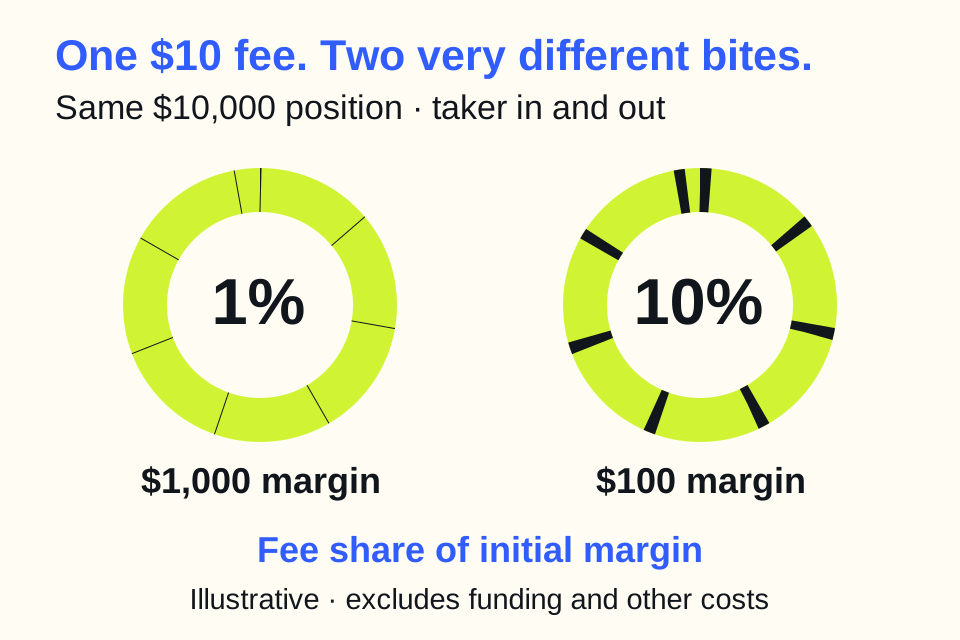
Take a $10,000 opening position followed by a closing trade of the same value. Two taker fills at 0.05% cost $10 together. Two maker fills at 0.02% cost $4. Actual closing value, account tier and execution can differ; these examples exclude funding, spread, slippage, liquidation charges and all deposit or withdrawal costs.
Why high leverage makes a small fee feel large
With $1,000 of initial margin, that $10 taker round trip uses 1% of the margin. With $100 supporting the same position, it uses 10%. The commission did not increase. The amount backing the trade decreased. A trader focused only on the advertised percentage can miss how much of a highly leveraged account is consumed before the market moves.
Funding matters when you keep a position open
Perpetual funding is a payment between the long and short sides, separate from execution commission. Kraken describes continuous calculation with hourly realisation. Its direction and rate can change. A low opening fee cannot tell you the cost of holding a heavily crowded trade for several days.
Compare the contract you actually intend to hold. If a position pays $2 of funding on average per day in a hypothetical week, that adds $14. The assumption is not a forecast: it shows why holding time can outweigh a $6 difference between the maker and taker examples above. A funding receipt can also turn into a payment later.
Our verdict for frequent trading is to control execution cost and position size together. For a longer-held position, examine funding as well. Neither decision requires picking the largest available leverage number. The appropriate exchange is the one that supports the intended trade at an acceptable complete cost.
Should I use dollars, USDT or Bitcoin as collateral?
Kraken’s Multi-M product accepts several collateral assets, but it does not credit each asset identically. The reviewed table shows no haircut for USD, 0.5% for USDT and USDC, and 1% for BTC and ETH. A haircut is the part excluded when calculating how much collateral supports the account; it is not automatically a withdrawal fee.
For example, 1,000 USDT valued at one dollar each would contribute $995 after a 0.5% haircut, before other account effects. That does not mean five tokens have been sent away. It means the platform counts slightly less backing when measuring the account’s ability to support positions. These figures concern the named Multi-M collateral table, not every wallet or product using the Kraken brand.
Bitcoin collateral can add a second moving part
If you hold Bitcoin as backing for a long crypto position, a falling market can hurt both the trade and the value of the collateral. Dollar-linked collateral makes the result easier to interpret, although stablecoins retain their own issuer and market risks. Holding BTC as collateral may suit somebody deliberately retaining coin exposure; it is not a free substitute for dollar cash.
For a Thai beginner, keep the first comparison simple: what asset am I risking, what asset measures the profit, and what will I eventually receive? A USD-denominated result is not automatically a baht profit. You need the final THB conversion before comparing it with the money that originally left your bank account.
How do I turn a futures balance back into baht?
First close or reduce the position as intended and establish how much is actually available to withdraw. The visible account total can include funds still supporting open trades. Withdrawing backing while keeping a position can change the remaining account’s ability to absorb a price move.
Then use the permitted receiving route for your actual asset. If you are sending crypto to a Thai spot account, confirm that its deposits are open on the network you intend to use. If you are receiving foreign currency through a bank, confirm the bank’s requirements for that transfer. These are alternative receipt arrangements, not a guarantee that either is enabled for everyone.
Binance TH’s withdrawal instructions specify an own-name Thai bank account and a 100-baht minimum. Its example deducts a 20-baht fee from the requested amount. The exact current confirmation remains more useful than a universal “instant cash-out” claim, particularly with larger payments or additional account checks.
Keep the futures statement and transfer record together. A Thai exchange sees an incoming token transfer, not necessarily the complete trading history that produced it. If questions arise about the origin of funds, the closing trades and withdrawal transaction connect the two accounts. A screenshot of an account balance alone does not explain that movement.
For someone withdrawing regularly, this receipt process can decide the platform choice more strongly than a temporary trading bonus. Test an appropriately small permitted transfer before relying on a service for a large exit; a successful small test checks the address and workflow, not a promise that every future amount will pass without review.
Does Thailand’s crypto tax exemption cover futures?
Do not assume so. The Revenue Department’s consolidated rules include an exemption for gains on qualifying crypto or token transfers through licensed digital-asset exchanges, brokers or dealers for 1 January 2025 through 31 December 2029. That describes a particular disposal and licensed channel, not every form of crypto-related income.
An offshore perpetual profit is not automatically the same transaction as selling coins through a licensed Thai spot exchange. Moving the proceeds onto a local exchange later does not, by itself, establish that the earlier derivatives profit falls inside the exemption. Keep those events separate when reviewing tax treatment with a qualified Thai adviser.
The practical record is the realised trade result, commissions, funding payments and the later asset sale or currency conversion. A deposit is not necessarily income, and a withdrawal is not necessarily profit. Combining everything into one bank receipt can hide the distinction. This is particularly relevant for residents with an overseas account and foreigners whose tax residence has changed.
Are decentralised perpetuals a better Thai option?
A wallet-based platform changes who holds the trading funds and how orders are handled. It does not make the Thai rules disappear. We therefore retain decentralised services in the broad catalogue without promoting them as an automatic solution to restrictions on offshore exchanges.
There is a practical difference too: a wallet connection does not supply a baht bank withdrawal, an accepted visa or a local complaint process. Those questions still need their own answers. Choosing a DEX solely because a centralised service is blocked can leave the original funding and eligibility problem unsolved while adding wallet-management risk.
Readers who already understand self-custody should assess the specific protocol’s access terms and collateral requirements. Beginners do not gain a simpler Thai account merely by replacing a login with a wallet address. For a beginner, the extra wallet responsibilities make this a less straightforward choice.
What happened to KuCoin Thailand?
KuCoin Thailand, operated by ERX, announced on 25 April 2026 that it was in the process of returning its digital-asset exchange licence. Its notice directs customers to support for withdrawals and explains that monthly custody fees would begin in May. Its July notice, referring to the cessation of exchange operations, raises charges from 24 August: the listed monthly custody charge is 30 USDT for a USDT balance, with a separate 30-USDT withdrawal fee and a 31-USDT minimum withdrawal.
That is materially different from describing the service as simply paused while waiting for normal trading to resume. Someone with assets there needs the current withdrawal instructions and fee notices. Someone choosing a new futures exchange should not treat old Thai listings or the international KuCoin brand as evidence that this local account offers a fresh trading route.
Use the contact channel published on the operator’s own site, and verify any message claiming that a separate payment is needed to release funds. The task is recovering the existing balance, not opening a new leveraged trade. Follow the local operator’s current instructions rather than an old signup link.