
What can you trade on ApeX Omni today?
Omni’s perpetual exchange remains active. The closure of Omni Spot on 5 August 2026 did not close its perpetual contracts. That distinction matters if a search result sends you to a review discussing spot swaps, ApeX Pro and Omni as though all three were one current account. For a new futures trader, the relevant interface is Omni and the relevant balance is its Perpetual account.
Our 6 October contract snapshot contained 86 perpetuals with trading, display and position opening enabled. The same response also contained disabled perpetual records, stock contracts and prediction contracts. Those other records are not extra active crypto perpetuals. BTC, ETH, SOL and HYPE were among the contracts available to inspect; the contract selector is a better starting point than a combined headline market count.
BTC and SOL do not have the same leverage ceiling
BTC and ETH showed a 100x maximum at the smallest risk tier, while SOL and HYPE showed 50x. BTC’s minimum order was 0.001 BTC; ETH’s was 0.01 ETH, and SOL’s was 0.1 SOL. These are token quantities rather than fixed dollar minimums. A move in the underlying price changes how much exposure the minimum order creates, even when the quantity rule stays unchanged.
The maximum is not an account-wide entitlement. Larger positions enter higher margin tiers, so a trader sizing a substantial BTC position cannot simply multiply the entire account by 100. Omni publishes the applicable Risk Limit information alongside the selected contract. That is particularly useful when adding to an existing position: the next purchase may change the requirement for the combined exposure, not just for the last order.
Order size and total position size are separate limits
The captured BTC configuration allowed a maximum single order of 50 BTC and a maximum position of 225 BTC. These are quantity ceilings, not a promise that the whole amount can be executed near the displayed quote. They answer different questions: whether one instruction is too large, and whether the resulting position exceeds the permitted exposure.
For an account already holding BTC exposure, an additional order must fit the remaining position capacity as well as its own order limit. Splitting an instruction into smaller orders does not remove the position ceiling or lower the combined margin tier. That makes Omni’s size controls particularly relevant when comparing venues for a larger account: inspect the total intended position, not just the size typed into one ticket.
| Contract | Smallest-tier maximum | Minimum order |
|---|---|---|
| BTC-USDT | 100x | 0.001 BTC |
| ETH-USDT | 100x | 0.01 ETH |
| SOL-USDT | 50x | 0.1 SOL |
| HYPE-USDT | 50x | 0.1 HYPE |
Why an Omni deposit may not appear as trading margin
Omni distinguishes its Funding account from its Perpetual account. Depositing successfully is only the first step. Supported assets have to be transferred into Perpetual before they contribute to the margin available for a futures order. If Funding shows money but the order ticket shows little or no available margin, increasing leverage will not fix the missing transfer.
The official onboarding guide supports wallet-based access and an email-based embedded wallet. Fiat purchasing is documented for the email route, rather than as a universal feature of every connected wallet. The login method therefore changes the funding choices. It also changes which wallet identity you must retain to return to that account; opening another wallet connection is not a way to recover the first balance.
Deposited is not yet available for a futures order
- FundingThe supported deposit is credited here.
- Transfer into PerpetualOnly the permitted asset amount moves into the trading account.
- Recognized marginThe collateral ratio and existing exposure determine what can support another order.
Select the asset and network together
The deposit documentation covers Ethereum, Arbitrum, Base, Mantle and BNB Chain, with a separate TRON USDT process. This does not mean every supported collateral asset can be sent over every listed chain. The deposit flow supplies the particular route and asset. For example, a USDC deposit and a USDT deposit can have different supported destinations even though both are dollar-denominated stablecoins.
After the deposit is credited, the transfer screen determines how much can move into Perpetual. Asset-specific transfer limits exist. Money above a permitted collateral amount can remain in Funding rather than becoming additional margin. This is why a screenshot of total assets alone cannot establish the buying power of an Omni account.
A practical reason to choose a stablecoin route is that it avoids making your margin value depend on another volatile asset. Retaining ETH as collateral may be more convenient for an existing ETH holder, but it introduces a different account exposure. Neither route is intrinsically cheaper: compare the source-chain fee, any conversion needed to obtain the deposit token, and the later withdrawal route you intend to use.
Which collateral counts, and by how much?
USDT is the settlement currency, but it is not the only asset that can support Omni perpetual positions. The current configuration also includes USDC, ETH, WBTC, WETH, cmETH, mETH, USDe and cbBTC. The exchange applies a collateral ratio to those assets. This is the portion of their market value recognized for margin; the rest is a valuation buffer, not a trading fee deducted from your wallet.
At the first captured tiers, USDT counted at 100%, USDC at 99%, and ETH, WBTC, WETH and cbBTC at 95%. The staking-related cmETH and mETH assets counted at 92.5%, while USDe counted at 97.5%. Larger amounts can enter lower-ratio tiers. These figures therefore describe the initial bracket, not an unlimited conversion promise.
A small example makes the effect clear. Assume 4,000 USDC is worth exactly $4,000 and falls entirely within the first USDC tier. Omni recognizes $3,960 for margin. The $40 difference is not a loss on a filled order. Conversely, depositing $4,000 worth of ETH at a 95% ratio supplies $3,800 of recognized collateral, and that amount changes as ETH’s market price moves.
Shared collateral can link otherwise unrelated trades
Omni’s documented perpetual margin model is cross margin. Positions use the same available collateral pool. A losing altcoin trade can consume the support that also backs your BTC position. Leaving extra tokens in that same Perpetual account does not isolate the BTC trade merely because the tokens themselves are different.
The most awkward combination is a long position financed with collateral that falls alongside it. If ETH collateral declines while an ETH long loses money, both sides reduce the account’s margin buffer. A short can offset some directional exposure, but it does not remove haircuts, trading charges or the possibility that the hedge and collateral move differently.
Omni is consequently more compelling when retaining supported assets is a deliberate choice. If you want the balance supporting one trade to have a simple dollar value, USDT is easier to follow. If you require strict isolated-position accounting, this cross-margin design should be a selection constraint rather than something to discover after funding the account.
ApeX Omni fees: execution first, hourly funding separately
The published base perpetual fee is 0.02% for maker fills and 0.05% for taker fills. A limit order is not automatically a maker order: it can immediately match an existing quote. Post-only is the relevant control when the intention is to add liquidity, because an order that would execute immediately is rejected instead of silently becoming a taker fill.
Consider a $10,000 position opened and closed at the same notional. Two taker fills cost $10 in trading fees; two maker fills cost $4; a maker entry followed by a taker exit costs $7. Those totals exclude funding and price movement. A stop-market exit belongs in the taker budget even if the initial position was entered patiently with a resting limit.
Omni does not charge blockchain gas for each submitted or cancelled trading order under the documented trading workflow. That is different from declaring the entire account free to use. Deposits, withdrawals, conversions and any forced on-chain exit have their own costs or dependencies. Keeping these separate makes a comparison with another wallet-based exchange more useful than one combined “low fees” label.
What improves at the VIP tiers?
The VIP schedule uses 14-day trading volume or eligible APEX/esAPEX staking, applying the better qualification. In the published volume ladder, $5 million brings maker/taker fees to 0.015%/0.045%; $25 million to 0.01%/0.04%; and $100 million to 0.005%/0.035%. The zero-maker level starts at a substantially larger volume threshold. A new account should not budget as though it already has that rate.
A token-based qualification has a different cost from naturally qualifying through existing volume: it ties the fee saving to holding or staking an asset. Buying a token solely to obtain a small reduction in trading costs needs its own comparison. The referral link in this review is not evidence that a particular staking benefit or VIP tier will be granted.
Funding is charged on an hourly schedule
Omni’s current funding guide specifies hourly payments for positions held at the relevant timestamp. Funding is applied to position value, rather than only to the collateral posted. At an illustrative 0.01% rate, a $10,000 position pays or receives $1 for that event, depending on the direction and the sign of the rate. The next event can have a different rate.
The trading screen can show hourly, eight-hour and annualized views. An eight-hour comparison display does not change the actual hourly payment schedule. Funding history belongs alongside filled-order fees when reconciling the result of a multi-hour trade. Contract-specific caps also vary, so a general cap quoted in an older guide should not override the selected market’s current settings.
Omni order controls that matter when closing a position
The current Omni ticket separates ordinary limit and market orders from conditional orders. Its useful controls include reduce-only and take-profit/stop-loss instructions. Reduce-only constrains an order to reducing existing exposure; it is especially relevant after a partial manual close, when an old exit quantity could otherwise exceed what remains of the position.
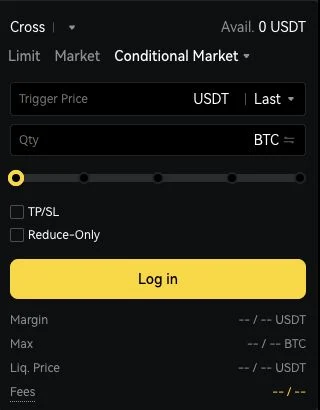
For conditional orders, the trigger price decides when an instruction activates. It is not a guaranteed execution price. Omni’s order guide documents last, mark and index reference choices for TP/SL, together with partial-position exits and multiple levels. The reference should match the event you intend to react to. A last-price spike and a change in the mark used for risk accounting are not necessarily simultaneous.
Partial exits need quantities that match the remaining trade
Suppose the intention is to close half a BTC position at one target and the remainder at a higher target. Separate quantities make that intent explicit. After a discretionary close, revisit the outstanding instructions instead of assuming they have all inherited the new position size. The order and conditional-order lists are where an accepted instruction can be distinguished from an unsubmitted form.
Omni documents immediate-or-cancel and fill-or-kill choices for limit execution. They solve different problems: one permits a partial immediate fill, while the other requires the requested quantity to fill in full immediately. Neither manufactures liquidity at the chosen price. For an ordinary resting instruction, the time-in-force and expiry determine how long it remains eligible to execute.
A market exit prioritizes getting out over a fixed price, but its actual fill still depends on the book. A conditional limit can limit the execution price but remain unfilled after its trigger. That is a meaningful choice for a smaller Omni contract whose visible liquidity can change substantially during a sharp move. Our inspection confirms the documented controls and the unsigned ticket; it does not establish slippage for a funded account.
Why using ETH collateral can still create a USDT liability
Omni settles trading results and relevant charges in USDT. Retaining another asset as margin does not turn those liabilities into that asset’s own denomination. When the available USDT is insufficient, the account can develop a negative USDT balance while still holding collateral with positive market value.
The cross-collateral guide says USDT is used first and documents manual repayment and Auto Repay. Manual repayment currently carries no repayment fee; Auto Repay carries a 0.10% fee and can sell collateral to meet the liability. The currently documented interest rate is zero, but a zero interest setting does not remove the debt or promise that collateral will never be converted.
This distinction changes the appeal for a long-term ETH holder. Omni lets that holder support a short-term futures position without first selling the whole ETH balance. It does not guarantee that the account can indefinitely pay USDT costs while preserving every deposited ETH unit. The liability field is therefore more informative than looking only at the headline dollar value of collateral.
The practical comparison is between keeping sufficient settlement currency and relying on later conversion. Someone making frequent trades may prefer a USDT buffer for fees and realized losses. Someone intentionally holding most collateral in another token accepts the extra exposure and should evaluate the repayment mechanism as part of the product, not as an unrelated borrowing service.
Normal, fast and forced ApeX Omni withdrawals
A normal withdrawal and a fast withdrawal serve different timing needs. Omni’s normal route can take up to four hours under its published guide because processing depends on the L2 workflow. The relevant network fee is deducted. It is not accurate to turn a documented maximum processing window into a promise that every request takes exactly four hours.
Fast withdrawals use liquidity providers. The current guide lists Ethereum, Arbitrum and BNB Chain for that route. It quotes a 2 USDT charge on the supported non-Ethereum routes and a dynamic gas-derived cost for Ethereum. Availability also depends on sufficient liquidity. A fast option being displayed on one chain does not establish that an equivalent fast withdrawal exists for every supported deposit chain.
Get the balance to the correct place before requesting a payout
Withdrawals are made from Funding. Collateral in Perpetual first has to be transferable without leaving the trading account below its requirements. An open position, its unrealized loss and reserved margin can reduce the amount available to transfer. Closing one position does not necessarily release the entire account if other positions or orders remain.
The sequence is therefore position management, available transfer balance, then the chosen withdrawal route. It prevents a common misunderstanding: “My total equity is $2,000, so why can’t I withdraw $2,000?” Equity is an account valuation. It is not a statement that every asset can leave immediately without affecting the remaining trades.
A forced exit is a separate recovery mechanism
Omni also documents a forced-withdrawal process. It involves a forced exit on the L2 side followed by claiming assets on L1. This is not the fast-withdrawal button and should not be budgeted as an instant, fee-free alternative to normal processing. On-chain interaction and gas can be involved, and recovery depends on the applicable protocol state.
That distinction is useful when evaluating custody claims. Retaining a wallet and having a documented exit mechanism provides a different arrangement from depositing into an ordinary centralized account. It does not establish that the website, settlement infrastructure or bridge can never interrupt access. We did not submit a withdrawal or exercise the forced-exit procedure.
Choose a withdrawal route for the available Funding balance
- Normal
- Published window up to four hours
Network cost is deducted; processing follows the L2 route.
- Fast
- Liquidity-provider route
Supported Ethereum, Arbitrum or BNB Chain route; fee and available liquidity apply.
- Forced exit
- Separate on-chain recovery
L2 forced exit followed by an L1 claim; not an instant payout option.
Old ApeX Pro or Omni Spot balances: keep the recovery task separate
Omni Spot was closed at 10:00 UTC on 5 August 2026. The official notice describes different handling for remaining assets, including movement of USDT into Funding and separate treatment for other token balances. A returning user should use that notice for the old balance, rather than treat the closure as an instruction to abandon active Omni perpetuals.
An ApeX Pro balance is not spendable Omni margin until the required transfer or migration is complete. Check the destination account and transaction record before placing an Omni order.
For a new user, this history needs only a small place in the decision. The current market selection, collateral transfer, trading cost and withdrawal route are what determine whether Omni fits the intended futures activity. For a returning user, however, resolving an old balance before making another deposit can prevent two unrelated recovery and trading tasks from becoming confused.
When to choose Omni over another wallet-based perp venue
Compared with Reya’s captured five-market catalog, Omni offers more room to move between crypto contracts. Reya’s v2 access is currently gated, whereas Omni exposes its live trading ticket without signing in. That does not prove any particular person is eligible to trade Omni, but it changes how much of the product can be inspected before beginning account onboarding.
Compared with an account funded entirely in USDC, Omni’s USDT settlement and cross-collateral model may require more attention to liabilities. If retaining ETH or another supported token has no value for your strategy, the extra collateral choices are not automatically an advantage. A simpler settlement balance can be easier to reconcile after a series of trades.
ApeX futures: your questions
Did the Omni Spot closure also close perpetual trading?
No. The 5 August 2026 notice concerns Omni Spot. The current perpetual catalog and order interface remain active. Returning spot users should follow the asset-specific handling in that notice; a closed spot service is not the status of the perpetual account.
Can I trade with money still shown in Funding?
Only after the supported amount has been transferred into Perpetual. Funding is not the same as available trading margin. Transfer limits, collateral ratios and existing position requirements can make the usable amount smaller than the total displayed balance.
Is ApeX Omni funding hourly or every eight hours?
The current payment guide specifies hourly funding. An eight-hour equivalent displayed for comparison does not change that schedule. The amount is based on position value at the relevant event and the applicable contract rate, which can change between events.
Does Omni offer isolated margin for one position?
The reviewed Omni risk guide specifies cross margin. Positions share the collateral pool. Do not assume a separate leverage choice creates an isolated collateral compartment for that trade.
Can ETH collateral pay a USDT trading loss?
Supported collateral contributes to account margin, but a USDT loss can create a settlement-currency liability. Omni documents manual repayment and an Auto Repay conversion with a 0.10% fee. Keeping ETH as collateral does not guarantee the ETH balance will never be sold.
Can I withdraw on Base using the fast option?
The reviewed fast-withdrawal guide lists Ethereum, Arbitrum and BNB Chain. Base appears in the broader funding documentation, which is not proof of a Base fast-withdrawal route. Use the supported normal option where offered, rather than assuming the two network lists are identical.
Can a forced withdrawal replace an ordinary quick payout?
It is a different on-chain recovery process involving an L2 forced exit and an L1 claim. It is not the same liquidity-provider route as a fast withdrawal, and it should not be treated as immediate or gas-free.
Evidence behind this reviewSources and research
Sources and research
Official documentation, dated public market data and the unsigned trading interface were reviewed on 6 October 2026. No funded trades, wallet signatures or withdrawals were performed. Market conditions and account-specific permissions can change.
- Current Omni contract and collateral configuration
- Trading fees and hourly funding
- Omni VIP volume and staking schedule
- Cross-collateral, liabilities and repayment
- Depositing into Omni
- Normal and fast withdrawals
- Forced withdrawal process
- Order types and TP/SL controls
- Margin risk and liquidations
- Omni Spot closure notice