
Reya v2 access and the five markets that are actually listed
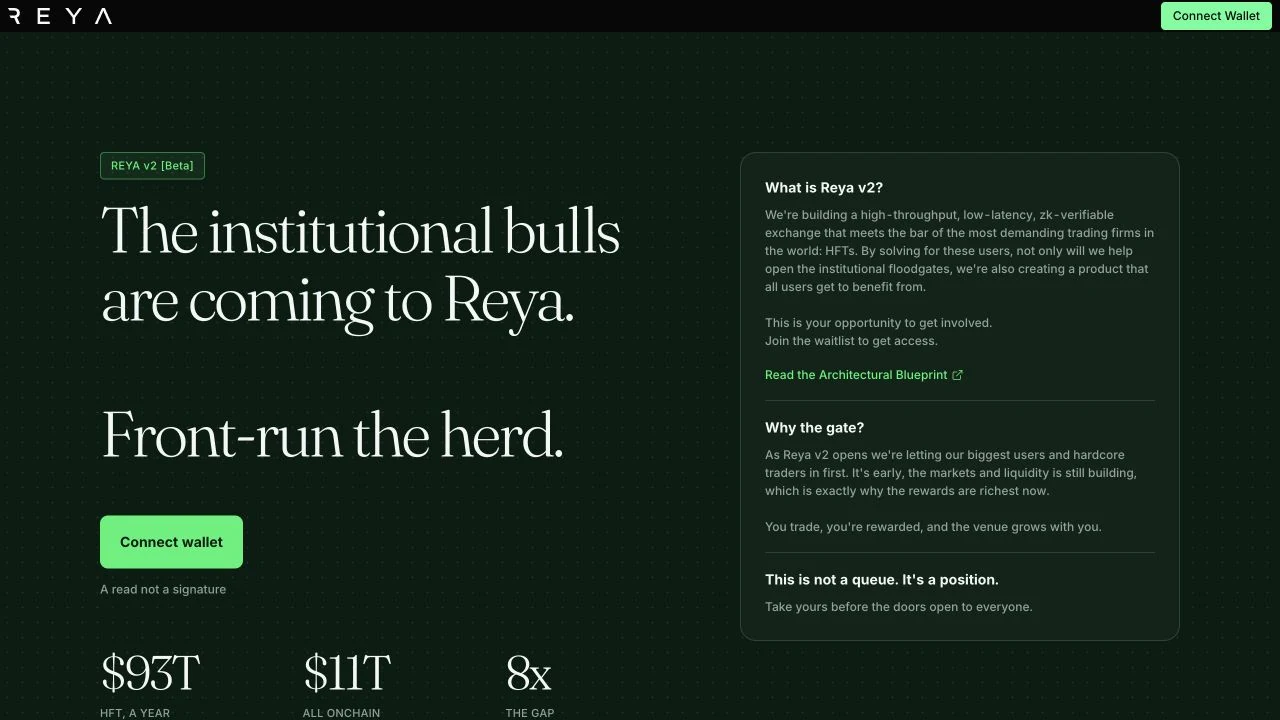
The public v2 app still showed a waitlist on our repeat visit on 6 October. Its notice says access is opening first to selected larger users and active traders. Public API access does not bypass that admission process.
BTC, ETH, SOL, HYPE and XRP are the current selection
The captured market definitions contained five visible perpetuals. BTC’s stated maximum was 40x; ETH and SOL were 25x; HYPE and XRP were 15x. Older reviews describing dozens of markets should not be read as a current v2 catalog. A project can have a long trading history while a new product version launches with a much narrower selection.
The minimum quantities were also different: 0.001 BTC, 0.01 ETH, 0.1 SOL, 1 HYPE and 0.1 XRP. Their dollar value changes with market prices. The relatively larger HYPE minimum, compared with its quantity unit, is a practical constraint for a small test allocation and should be assessed before making assumptions from the BTC ticket.
Reya also publishes open-interest caps. These are market-wide risk limits, not an individual entitlement to execute the whole cap at the displayed price. Other users consume that capacity. For a trader trying to open a larger position, available room under the cap and sufficient order-book liquidity are separate questions.
| Market | Stated maximum | Minimum quantity |
|---|---|---|
| BTC | 40x | 0.001 BTC |
| ETH | 25x | 0.01 ETH |
| SOL | 25x | 0.1 SOL |
| HYPE | 15x | 1 HYPE |
| XRP | 15x | 0.1 XRP |
Reya collateral: what is enabled and what the haircut means
The current asset configuration distinguishes enabled collateral from withdrawal-only assets. Of the 17 records returned, five were enabled: rUSD, BTC, ETH, wstETH and srUSD. The other records should not be counted as additional currently enabled collateral merely because their names remain visible in the configuration.
rUSD is the settlement unit used inside Reya. The documentation describes USDC wrapping into rUSD at one-to-one and the reverse route for USDC withdrawals. A USDC record marked withdrawal-only therefore cannot, by itself, be interpreted as a ban on funding through the documented USDC-to-rUSD route. The product balance and the external token have related but different roles.
A 10% haircut changes buying power, not the quantity of tokens held
The captured configuration applied a 10% collateral haircut to BTC, ETH, wstETH and srUSD, while rUSD had no haircut. If eligible ETH collateral is worth $5,000 at the valuation price, its recognized margin value is $4,500 before positions and other account effects. The account has not paid a $500 transaction charge; the system is simply unwilling to lend buying power against the whole market value.
If that ETH later falls to $4,000, the same 10% haircut leaves $3,600 of recognized value. The change is $900, even before considering any futures loss. This is why someone financing a long ETH position with ETH collateral has two moving parts: the trade result and the value of the asset supporting it.
The absence of a haircut on rUSD makes the settlement balance simpler to follow. It does not mean an account funded with rUSD has unlimited margin or no liquidation risk. Open positions, fees and funding still consume account resources. The benefit is that the collateral valuation does not add a separate volatile-token exposure.
Reya is most interesting when retaining supported assets provides a real advantage to the user. For example, an existing ETH holder may value being able to support an eligible futures position without first converting the entire holding. If the intention is to hold only stablecoin collateral anyway, the non-USDC collateral feature contributes less to the exchange selection.

Account value is not the amount you can withdraw
Reya’s account model makes three different numbers important: the gross market value of assets, their recognized collateral value after haircuts, and the amount that is actually free to leave. A positive total account value does not establish that the account has enough settlement currency available for a USDC payout.
Positions require margin and can have unrealized profits or losses. Fees and funding affect the settlement balance. A collateral asset may be valuable but discounted for risk purposes, and an account can have a settlement-currency shortfall while still holding positive-value collateral. Looking only at the largest dollar figure obscures those distinctions.
Requirements are added across markets
The published margin system adds the requirements of the account’s market exposures. It does not describe a general BTC-versus-ETH correlation credit that cancels their margin requirements. A long BTC position and short ETH position can be an intentional market strategy, but that does not automatically make the pair nearly free to collateralize.
Within a market, net exposure matters. Across markets, the account still needs resources for each applicable requirement. This is a useful distinction for someone accustomed to an exchange’s portfolio-margin product. Moving the same set of positions to Reya does not prove that the previous venue’s offsets or borrowing arrangement will be reproduced.
Separate trading accounts provide another boundary in the documented system. They should not be mentally consolidated into one pool simply because the same wallet can access them. A surplus in one account is different from collateral already available to support a deficit in another.
For withdrawals, begin with the account that holds the assets and the balance it permits to leave. Closing a profitable trade can improve equity without making the entire gross value immediately transferable. The remaining positions and the form of collateral still matter. Reya’s convenience is the ability to use several supported assets; the cost of that convenience is having to distinguish value from settlement liquidity.
Three balances, three different questions
When Reya can convert collateral automatically
Auto-exchange is not just another name for liquidation. Reya documents conditions involving negative asset balances, account-level negative balances and collateral-ratio constraints, as well as conversion associated with liquidation. A conversion can therefore become relevant before a reader would describe the whole account as having no value left.
The public explanation does not establish a single current dollar threshold that we can apply to every account. We do not invent one. What can be established is the mechanism: a settlement need can be met by converting another eligible asset, and the exchange terms are not the same thing as an ordinary maker-order fee.
The collateral haircut and the conversion discount are different
The current asset definitions showed a 2% liquidation discount for BTC, ETH and wstETH, alongside their 10% margin haircut. The first changes the conversion terms in the relevant mechanism; the second changes how much margin value the asset contributes. Adding them together and calling the result a 12% trading fee would be wrong.
For an illustrative conversion using a 2% discount, obtaining $200 of settlement value requires about $204.08 of the other asset at its undiscounted valuation: $200 divided by 0.98. This is not a prediction that the account will be converted at a $200 shortfall, nor a quote for a manual swap. It shows what the documented discount means if that mechanism applies.
The current srUSD record had a 10% collateral haircut but no liquidation discount. That further demonstrates why a collateral list needs more than one percentage. Two assets can contribute the same fraction of market value for margin while having different conversion terms.
An ETH holder choosing Reya should therefore decide whether automatic conversion under the documented conditions is acceptable. Using ETH for collateral is not a promise to preserve every ETH unit throughout the life of the account. Keeping enough settlement balance for expected charges can reduce reliance on conversion, but it cannot guarantee that losses or other changing account conditions will never create a conversion need.
A conversion discount is not the margin haircut
The separate 10% haircut determines recognized margin. It is not added to this conversion rate as a trading fee.
Reya fees and continuous funding
The regular fee schedule starts at 0% maker and 0.03% taker. A $15,000 taker entry costs $4.50. A taker exit at the same notional adds another $4.50, making $9 before funding and execution-price differences. If an entry genuinely receives maker treatment and only the exit is taker, the trading-fee total for that example is $4.50.
A zero maker charge does not mean a marketable limit order is free. Maker treatment depends on how an order interacts with liquidity. Reya’s documentation distinguishes current fees from planned maker rebates; a feature described as planned should not be subtracted from an actual trading budget.
Volume tiers use thirty days, not fourteen
The current regular-user ladder reduces taker fees to 0.028% at $1 million of 30-day volume, 0.026% at $10 million and 0.024% at $50 million. Larger tiers continue down to 0.02%. These are the ordinary published thresholds, not evidence that a new account immediately qualifies for a special early-user category.
The global fee configuration includes a 10% referee discount parameter. Where that benefit actually applies to an account’s 0.03% rate, the arithmetic gives 0.027%. It does not prove that every referral stacks with every other tier or incentive, and we have not tested attribution through a funded account. The effective account fee remains the relevant trading number.
An hourly funding quote is not an hourly payment gate
Reya documents continuous funding accrual, with rate computation updated at short intervals. The hourly unit used in published funding data expresses the rate; it is not a promise that a trader owes nothing unless a position remains open at a particular hourly timestamp. Treating it as a discrete payment window would distort short holding-period costs.
At a hypothetical unchanged hourly rate of 0.006%, a $6,000 position held for six hours would accumulate about $2.16 in funding, assuming constant notional and the paying side. That example explains the scale only. Real rates and position value move, and the side receiving funding can change as the rate changes sign.
This matters most when comparing a maker-heavy strategy with a venue charging more per fill but carrying a different funding balance. A zero entry fee does not settle the total-cost comparison for a position held for days. Reya’s account history and funding accrual need to be evaluated together with the executed-order fees.
Reya stop orders: the detail that can leave a remainder unprotected
The current order documentation describes stop-loss and take-profit instructions that act on the whole position size when they fire. It permits one SL and one TP per account and market, with the pair treated as one-cancels-the-other. This is a different workflow from building several independently sized partial TP levels.
The subtle point is when the other instruction is cancelled. The documented behavior cancels the paired trigger when one fires, even if the resulting execution fills nothing. A reader might otherwise assume that the unused stop remains standing until the position has actually disappeared. That assumption is not supported by the published behavior.
Activation can be followed by a partial or empty fill
For an immediate-or-cancel child order, any unfilled remainder is cancelled. If only part of the position closes, the leftover exposure can remain without an automatically re-armed trigger. For a GTC or GTT child, the order can remain resting according to its conditions. These are different outcomes, even though the same original stop condition activated them.
Imagine that a trigger is meant to exit a position of ten units but the resulting immediate execution closes only six. The remaining four units are still a position. Under the documented OCO behavior, the paired trigger should not be assumed to protect those four. The account needs a fresh decision about its residual exposure, rather than a reassuring reading of the original stop setup.
The current trigger reference is the mark price. The execution limit, where used, establishes an acceptable price boundary rather than a guaranteed fill. For a GTT instruction, expiry affects how long the trigger is armed and the resulting child-order lifetime. A stop that has expired is not waiting indefinitely for the next price move.
Reya’s current API also limits reduce-only support to perpetual IOC orders. We therefore do not describe reduce-only as a universal checkbox applicable to every resting limit instruction. These specific order semantics are a stronger basis for choosing or rejecting the workflow than a generic statement that “advanced orders are supported.” Our assessment comes from the current documentation, not a funded stop test.
What Reya’s liquidation process changes for the trader
Reya’s liquidation documentation describes a sequence involving partial position transfer, backstop mechanisms, insurance and auto-deleveraging. Partial liquidation can reduce an account’s exposure rather than automatically describing every event as closure of every position. It still represents a loss of control over the intended trading plan and can involve conversion or charges under the applicable rules.
The existence of insurance does not make individual trading losses insured. It is part of the system’s handling of deficits. Likewise, the documentation’s planned order-book liquidation features should not be described as already available simply because they appear alongside current mechanisms.
For the account holder, the earlier margin and collateral distinctions explain why this matters. Collateral can lose value, its recognized amount is already discounted, and position losses can consume the remaining buffer. A nominally positive asset holding does not automatically mean the account remains above its liquidation requirement.
Reya’s rules allow reductions in position size, changes in collateral and exceptional deleveraging. Several backstops do not by themselves establish that funds are safer than on another venue.
How the documented Reya USDC exit works
Reya’s withdrawal guide distinguishes assets in a trading account from assets already in the connected wallet. Its wallet-level route unwraps rUSD into USDC and then uses the configured bridge connector. If money is still inside a trading account or an Earn product, it must first leave that product through the appropriate flow. A wallet withdrawal example does not bypass the margin requirements of an open trading account.
This is why “I deposited ETH, so I will withdraw the same ETH” is too strong a conclusion. The current documented external exit centers on USDC. Holding ETH as eligible collateral does not by itself prove a same-asset bridge payout. A trader who requires the original token back should establish an explicitly supported product route rather than infer it from collateral eligibility.
Network support does not establish instant arrival
The reviewed connector documentation lists Ethereum, Arbitrum, Optimism and Polygon routes. A configured connector is evidence of a route, not proof that it has no fee, no delay or uninterrupted liquidity at the moment of a particular withdrawal. We have no funded measurement of the current beta’s end-to-end payout time.
The guide also distinguishes the app’s withdrawal flow from direct smart-contract interaction. Native ETH gas on Reya can be required for the manual contract route. Any gas sponsorship offered through the app should not be assumed to cover an independently submitted on-chain transaction. This distinction matters when someone reads a recovery guide and expects it to behave exactly like the normal interface.
A discontinued standalone bridge website is not the same thing as a discontinued in-app withdrawal route. The official guide documents the current app and contract paths separately. Use the route belonging to the balance being withdrawn, rather than follow an old bookmark merely because it once moved funds into the ecosystem.
Our conclusion is that a prospective user should think in terms of a USDC exit, with collateral and trading requirements resolved before that exit. Reya can be convenient for keeping supported assets inside the margin account. It is not established as a general-purpose service for withdrawing any deposited token to any desired chain.
For admitted users: Reya versus ApeX Omni
Reya’s five-market selection fits a concentrated BTC/ETH strategy more readily than an altcoin rotation strategy. ApeX Omni has a wider documented selection. The extra listings matter only if they include the contracts you intend to trade.
For a user who already holds eligible non-USDC collateral, Reya’s cross-collateral system is the more distinctive reason to compare it. For someone depositing only settlement currency, that advantage largely disappears. Its whole-position triggers also deserve more weight than the maker fee if the strategy relies on staggered partial exits.
Reya futures: your questions
Can a new user immediately trade on Reya v2?
The public app inspected on 6 October showed a gated beta and described phased access with a waitlist. We did not connect a wallet or verify admission for a new account. Publicly listed contracts do not establish that onboarding is unrestricted.
Does the 10% collateral haircut mean Reya takes 10% of my ETH?
No. It discounts the market value recognized for margin. At a $5,000 valuation, eligible ETH contributes $4,500 before other account effects. Conversion or liquidation can affect token holdings under separate rules, but the haircut itself is not a fee transferring 10% of the tokens.
Why can USDC be withdrawal-only while Reya accepts USDC funding?
The documented settlement route wraps USDC into rUSD. Asset status for the direct USDC record is not the same as eligibility to fund through that wrapper. Use the account’s supported deposit path rather than treating every asset record as interchangeable collateral.
Will a Reya stop remain active until the entire position closes?
Not necessarily. The documented paired trigger is cancelled when its counterpart fires, even if the resulting order fills nothing. An IOC partial fill can leave residual exposure without an automatically re-armed stop. Review the remaining position and active orders after the event.
Is Reya funding charged only at the end of each hour?
The documentation describes continuous accrual. The hourly funding unit is a way to express the rate, not a free holding window until the next hourly timestamp. Cost depends on the evolving rate, position and holding period.
Can I withdraw the same collateral token I deposited?
Do not infer that from collateral eligibility. The reviewed external withdrawal workflow centers on USDC, with funds first released from the relevant trading or Earn account. A same-token payout needs its own supported route; it is not established by holding that token as margin.
Does an auto-exchange necessarily mean the whole account was liquidated?
No. The documented conditions include settlement or asset-balance constraints as well as liquidation-related cases. A conversion can address a balance problem without proving that every position was closed. The public material does not provide one universal current numeric trigger for all accounts.
Evidence behind this reviewSources and research
Sources and research
Official documentation, dated public market data and the unsigned trading interface were reviewed on 6 October 2026. No funded trades, wallet signatures or withdrawals were performed. Market conditions and account-specific permissions can change.
- Current perpetual market definitions
- Collateral status, haircuts and conversion discounts
- Thirty-day fee tiers
- Global account discount parameters
- Account margin requirements
- Auto-exchange conditions
- Auto-exchange mechanism
- Continuous funding accrual
- Trigger activation, OCO and residual positions
- Supported order types and time-in-force
- USDC wallet and smart-contract withdrawal paths
- Liquidation sequence and planned features
- Current public v2 access page