
Is Drift still a place to open a futures trade?
A search for Drift can still return its former leverage limits, USDC markets and trading-fee guides. Those results describe the product before the 1 April 2026 incident. They do not establish that a new deposit reaches the same functioning market, or that an old balance is freely withdrawable.
The useful distinction is between recovering an existing loss and choosing a new perpetual exchange. Drift’s 1 October notice opened DFX claims and redemptions. Its current documentation uses the Velocity identity and links to that trading application. For existing Drift users, the immediate issue is the recovery claim and its redemption conditions.
This is a material change from the May recovery proposal. That earlier document contemplated opening redemptions after the fund exceeded 5 million USDT and described quarterly revenue contributions. The October notice says claims and redemptions are open and contributions occur daily. Applying the old threshold today would incorrectly tell an affected reader to keep waiting.
Recovery milestones, with one deadline still ahead
- 1 April 2026 · incident and account snapshotThe historical position record becomes relevant to the loss calculation.
- 7 July · Insurance Fund claimsA separate process for the relevant stakes.
- 1 October · DFX claims and redemptions openThe published October rules replace earlier proposed opening conditions.
- 1 January 2028, 00:00 UTC · claim deadlineUnclaimed DFX is scheduled to be burned. This is not a full-repayment date.

Which wallet can claim DFX, and what does the allocation mean?
The published allocation is one DFX for each verified USDT of loss. A verified 1,000-USDT loss therefore corresponds to 1,000 DFX. That is the number of recovery tokens, not a promise that the portal immediately pays 1,000 USDT.
The claiming wallet must be the address that controlled the affected Drift account on 1 April. Connecting a different address can show no allocation even if the same person owns both wallets. The official claim instructions also require enough SOL for the network transaction fee and acceptance of the DFX terms. Someone with multiple allocations may have separate claims to approve.
The claim window ends at 00:00 UTC on 1 January 2028. Unclaimed DFX is then scheduled to be burned. Claiming and redeeming are separate decisions: receiving an allocation does not itself burn the token for the current USDT payout. We did not connect an affected wallet or inspect anybody’s personal allocation.
Why an old account screenshot may show a different amount
The May methodology distinguished two times on 1 April: positions were snapshotted at 18:31:47 UTC, while the proposed valuation used oracle prices from 16:06:00 UTC, before the incident distorted prices. It also described conversion into USDT and cessation of spot interest at the pause. An old token quantity, an account’s last displayed dollar value and a verified recovery allocation are therefore not interchangeable records.
That May text was a proposal subject to governance. For an individual discrepancy, the useful evidence is the original account address, the portal allocation and the relevant transaction history—not an assumed conversion using today’s token price. Drift’s published recovery plan directs account questions to its official Discord support. This article cannot independently reconcile a private allocation.
How much USDT does one DFX redeem for?
The redemption formula is straightforward: USDT currently in the recovery pool divided by outstanding DFX. It uses the assets presently available for payout, not the headline size of proposed partner support.
On our 6 October dashboard check, the displayed rate was 0.010417 USDT per DFX. At that dated rate, 1,000 DFX would quote 10.417 USDT before the user’s network costs. The rate must be read again when a holder actually considers a redemption; this example is neither a live offer nor an estimate of eventual recovery.
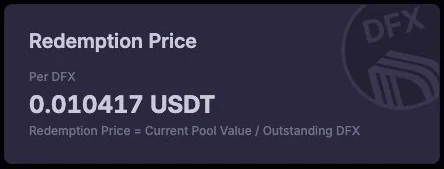
The dashboard displayed roughly 3.11 million USDT in the pool and 298.71 million DFX outstanding. Those abbreviated figures are too rounded to reproduce the six-decimal rate exactly. Use the displayed redemption quote for an action, not a division of the rounded headline counters.
The launch announcement specifies a maximum supply of 299,500,810.998 DFX, while our dashboard observation labelled about 298.96 million as issued. We have not independently reconciled that difference. Neither number should be substituted for the dashboard’s outstanding-supply denominator without establishing what it includes.
Redeem, sell or hold: what actually changes?
Redeeming burns the chosen DFX and pays USDT from the pool. The October rules say both operations happen in one transaction or neither does, with the payout rounded down to the nearest 0.000001 USDT. A completed redemption is final: the burned units no longer participate in future deposits.
Selling is different. A secondary-market buyer receives the DFX and its remaining claim on the pool. The market sale price can differ from the protocol redemption rate, and the amount a seller receives depends on the available market quote and transaction costs. A Raydium listing does not make the token redeemable at one dollar or guarantee a buyer at a particular price.
Holding retains exposure to future recoveries and revenue contributions. It also leaves the holder waiting for uncertain amounts and timing. The public sources do not establish a full-repayment date, so there is no evidence-based answer here that all affected users should hold, sell or redeem immediately.
A smaller token supply does not create an instant redemption bonus
A proportional redemption removes both cash and tokens. In a simple example, a pool with 100 USDT and 10,000 DFX pays 0.01 USDT per DFX. Redeeming 1,000 DFX removes 10 USDT and leaves 90 USDT against 9,000 tokens: still 0.01 each. A later 9-USDT contribution raises that ratio to 0.011.
This matters because the announcement also uses shorthand saying the pool only grows. The pool’s cash balance can fall when people redeem; its own formula and explanation make that clear. Future contributions are shared among fewer remaining units, but another holder’s proportional redemption alone does not increase the current per-token payout.
Burning tokens also pays cash out of the pool
- Start · 100 USDT ÷ 10,000 DFX0.010 USDT per token.
- Redeem 1,000 DFX for 10 USDT90 USDT ÷ 9,000 DFX still equals 0.010.
- A later 9-USDT deposit arrives99 USDT ÷ 9,000 DFX = 0.011 per remaining token.
What has funded recovery, rather than merely been announced?
The public dashboard lets a holder separate capital already contributed from future support commitments. Its history showed an initial contribution of about 3.114 million USDT on 30 September. Our 6 October observation also showed a 3.97-USDT exchange-revenue contribution shortly after midnight UTC. That is evidence of a recorded funding event, not evidence that the same amount will arrive every day.
The associated fee panel attributed that daily contribution to 6.61 USDT of net protocol revenue for 5 October. The 60% first-band share produces approximately 3.97 USDT. This is useful confirmation of how the documented mechanism is being presented; it is not a funded trading test or an independent audit of the underlying blockchain transactions.
The published revenue allocation is progressive: 60% of the first 30,000 USDT of daily net protocol revenue, 70% of the portion between 30,000 and 100,000, and 90% above 100,000. These are percentages of net protocol revenue, not of customer deposits or the notional value of trades. A large trading-volume headline cannot be inserted into that formula.
Separately, the October announcement names up to 127.5 million USDT of Tether support and up to 20 million from other partners. Those ceilings are not the current pool balance. Our observed capital-stream panel showed seed capital dominating contributions and zero under the Tether contribution field at that moment. It would be misleading to describe the whole announced package as cash already redeemable.
For progress, compare cumulative contributions and the redemption rate across dated observations. A single day’s revenue is a particularly weak basis for estimating a multi-year recovery timetable. Changes in trading activity, actual partner deployment and recovered assets can all alter the outcome.
Insurance Fund claims and old trading balances are different
The recovery portal presents an Insurance Fund card separately from the DFX claim. Drift’s April incident update, revised in July, states that Insurance Fund assets were unaffected and that their claims became available on 7 July. A person’s eligibility for that process depends on the relevant stake; it is not a second reimbursement available to every former trader.
An Insurance Fund claim has its own terms. It should not be added to a DFX allocation as though both are interchangeable dollar balances. Likewise, a DFX token held after a transfer is not a continuation of the original leveraged position. Its value comes from the recovery arrangement and any secondary-market quote.
The historical product records remain useful for understanding past activity, but they answer a different question from which account can trade today. In particular, a former maker rebate or high-leverage market limit cannot be carried into a new product comparison without checking its current rules.
| Historical record | What it cannot establish now |
|---|---|
| Old open perpetual position | A continuing position under the same entry price and stop orders. |
| USDC or token balance screenshot | The exact USDT loss allocation in the verified snapshot. |
| Old Drift fee or leverage table | Current Velocity account fees, eligibility or market limits. |
Does Velocity automatically restore a Drift account?
Current documentation identifies Velocity as a perpetuals protocol built from the Drift v2 codebase. That relationship explains why old Drift documentation links can now display another product name. It does not demonstrate that historical deposits, positions, account entitlements or DFX tokens become an immediately spendable trading balance there.
The current product description retains perpetual trading and a money market while removing the former spot-trading product. Collateral movements and swaps do not make it identical to the old spot order-book experience. Anyone investigating a new position needs Velocity’s current collateral, margin and fee rules rather than a cached Drift review.
The security documentation also separates an OtterSec review of the Velocity changes from inherited Drift audits. It dates the new review to June–July 2026 and the final report to September. Those are specific documents with particular scope; an old protocol audit and a later successor audit are not proof that a past loss has been restored or that a new deposit is risk-free.
Our conclusion is deliberately limited: DFX handles the historical recovery claim; Velocity requires a separate trading assessment. We have not transferred Drift’s former rating, liquidity reputation or leverage ceiling to that product. Readers choosing a Solana perpetual venue can compare the separately researched Jupiter Perps review, without treating a different venue as a solution to the old claim.
Where to follow the account update
The official DFX claims notice explains the allocation and deadline. The recovery dashboard shows the pool, supply, rate and funding history. These serve different purposes: the notice describes the rules, while the dashboard supplies changing figures.
Drift recovery: unresolved account questions
Can I claim DFX into a completely different wallet?
The initial allocation is tied to the wallet that controlled the affected account on 1 April 2026. The published claim flow requires that address. Once claimed and transferred, DFX can be redeemed by a wallet holding it; that later redemption rule does not change the original eligibility check.
Does claiming DFX immediately close my recovery claim?
Claiming receives the allocated tokens. Redeeming burns the selected units and settles those units at the current pool quote. The two actions have different consequences, so receiving the tokens should not be confused with cashing them out.
Why does the launch article say 0.0104 while the dashboard shows more digits?
The launch article gives an approximate initial rate. The dashboard displays a more precise, changing redemption rate. A comparison needs both the observation date and the precision; a rounded launch example is not evidence of an incorrect account allocation.
Is the May 5-million-USDT redemption threshold still applicable?
The October 2026 announcement supersedes that part of the May proposal and explicitly opens redemptions. The portal was displaying a redemption rate with a pool below 5 million USDT when we checked.
Can a new user buy DFX instead of opening a perpetual trade?
DFX is a recovery token with a claim on the pool, not a leveraged BTC or SOL contract. Purchasing it would be a separate speculation on recovery and market pricing; this page does not recommend that purchase as a replacement for futures.
Evidence behind this reviewSources and research
Sources and research
Official notices and the public DFX dashboard were reviewed on 6 October 2026. Dashboard figures below are dated observations, not live quotes. No affected wallet, claim allocation or redemption was tested. The October launch notice supersedes the May proposal where their terms differ.
- 1 October: DFX claims and redemption rules
- Incident recovery update, including July Insurance Fund update
- 5 May: historical recovery proposal and snapshot methodology
- DFX public recovery dashboard
- Current Velocity product documentation, including the redirected Drift entry
- Velocity and inherited Drift audit scopes