
Jupiter Perps now has two trading models
If you last used Jupiter only for SOL perpetuals, the expanded market list needs a second look. The established SOL, ETH and wBTC contracts trade against the JLP pool. Newer markets marked Beta use GUM, an order-book engine. Their fees, collateral, position handling and exit controls are different enough that a single generic Jupiter review can give the wrong answer.
For the established JLP markets, the appeal is straightforward access from a Solana wallet and a focused selection of major crypto exposures. The cost of holding comes from borrowing pool resources. You can use supported input tokens, which are converted into the collateral required by the chosen long or short.
For Beta, the additional crypto names at our review were JUP, HYPE and ZEC. These use USDC collateral and hourly funding, with maker/taker fees. They also have early-access conditions and tighter order controls. Someone searching for a HYPE perpetual therefore needs a different assessment from someone looking for a SOL long.

Which coins and leverage limits are available?
The JLP market group offers SOL, ETH and wBTC, with an opening range from 1.1x to 250x in the current product documentation. The interface labels the Bitcoin market BTC, while the collateral and documentation use wrapped BTC on Solana. This is perpetual price exposure; it is not a direct Bitcoin-network deposit address.
The Beta market documentation lists JUP at up to 10x and HYPE and ZEC at up to 20x. These are market settings that can change, so the badge in the selector is the relevant ceiling for a new order. The existence of 250x SOL trading says nothing about the permitted leverage on JUP.
Early access is a separate requirement
At this review, Beta access required 69 JUP actively staked by the connected wallet. The requirement is checked again on submission, and the documentation says the amount displayed on the button takes precedence if it changes. Holding unstaked JUP or staking from another wallet is not the stated qualification. The established three JLP markets do not require that stake.
Jupiter also lists non-crypto Beta contracts. They expand the application catalog but do not make the crypto selection larger. When comparing how many crypto perpetuals are available, count the underlying crypto markets separately from stocks, prediction products and spot tokens searchable elsewhere in Jupiter.
The native Jupiter Mobile app currently offers the three established JLP markets rather than Beta. This is a product limitation, not merely a smaller-screen version of the website. A strategy built around a Beta position should not assume all its controls will appear in that mobile app.
| Markets | Published maximum | Key operating difference |
|---|---|---|
| SOL, ETH, wBTC · JLP | 250x | Pool borrowing; TP/SL supported |
| JUP · Beta | 10x | USDC, hourly funding; early-access stake |
| HYPE and ZEC · Beta | 20x | USDC, hourly funding; no TP/SL at review |
What token backs a Jupiter long or short?
On the JLP markets, a long uses the traded asset as underlying collateral: SOL for a SOL long, wETH for ETH and wBTC for Bitcoin. A short uses USDC. You may start with a different supported Solana token, but Jupiter swaps that input into the required asset before the position opens. The token you spend is therefore not necessarily the token used inside the position.
That conversion has a practical consequence for small accounts. Paying with an unrelated token can introduce a swap and its price impact before the perpetual exposure exists. Starting with the required collateral avoids that particular conversion. It does not remove the base trading fee, pool-impact charge or network cost of the position.
The recorded collateral value is fixed in dollars
Jupiter's collateral documentation says the dollar value is recorded when collateral is deposited. If you deposit $200 worth of SOL, the recorded collateral size is $200 even if SOL later changes price. That differs from simply assuming an unconverted wallet balance of SOL is being marked up and down as margin throughout the trade.
The final payout still depends on the chosen receive token. A long normally returns the market token, with USDC offered as an alternative. If a closed SOL position has $220 of net value and SOL is $110, the token payout is 2 SOL before any additional output conversion effects. A dollar profit does not promise a fixed number of coins.
Beta is simpler in this respect: both directions use USDC collateral. Changing from a JLP SOL long to a Beta HYPE long therefore changes the collateral model as well as the underlying coin. Keep the two product labels in view when reading any Jupiter fee calculator or tutorial.
JLP collateral follows the direction of the trade
Corresponding market token
A different input token is converted first. The deposited dollar collateral value is recorded.
Close: market token or USDCUSDC collateral
The margin uses USDC even when the price exposure is to a different coin.
Close: USDC or market tokenJLP fees: base charge, impact and the input swap
The established JLP markets charge a 0.06% base fee when increasing or decreasing a position. For an illustrative $15,000 at both entry and exit, that is $9 on each leg and $18 combined. It is not a maker/taker schedule, and a limit order does not earn a lower base rate just because it waits for a price.
The pool can add price-impact fees. These respond to the trade's characteristics and pool conditions rather than a visible queue of bids and offers. Jupiter's official fee page describes both size-related and imbalance-related impact components. For a real comparison, use the complete order estimate for your direction and amount instead of treating the base 0.06% as the final price.
An input or output swap adds another layer. The documented base swap fee is 0.10% for non-stablecoin swaps and 0.02% for stablecoin swaps, with adjustments tied to pool composition. A long funded from USDC may therefore involve a conversion that a long funded directly with its required token does not. The displayed combined quote is more useful than adding a generic percentage to every possible route.
A fee example that keeps the layers separate
Imagine the $15,000 position above is backed by $1,500. The $18 base round trip alone equals 1.2% of that starting collateral. If, purely as a scenario, impact totals $7 and the input conversion costs $2, the pre-borrow, pre-network total becomes $27, or 1.8% of collateral. Those $7 and $2 are illustrative amounts, not a measured Jupiter quote.
This format is useful because each number can be replaced with the actual order estimate. A trader can see whether the expensive part is repeated entry/exit commission, the selected swap route or the intended position size. Calling all of these charges slippage makes it harder to choose which part of the trade to change.
Solana transaction fees, any priority component and relevant account setup costs sit outside the base position rate. Some account rent can be returned when an account closes, so distinguish a recoverable balance from an expense consumed by execution. Avoid comparing a first-ever setup transaction with a later trade as if the difference were a change in commission.
How the Jupiter borrow fee affects an overnight position
JLP traders pay for the pool liquidity supporting their position. The borrow rate responds to utilization: how much of the relevant pool resource is already in use. It is not the same as funding paid between opposite sides of an order book, and a short does not automatically earn the charge paid by a long.
During our public interface inspection, SOL displayed a borrow rate of 0.0016% per hour. At that rate, a constant $12,000 position would accrue $0.192 per hour, or $4.608 over 24 hours. Rounded to cents, that is $4.61 for the day. This is a dated illustration using one observed rate, not a quote for another asset or a prediction that tomorrow's rate will remain unchanged.
At the same unchanged rate, seven days would total about $32.26 before entry, exit and other costs. The arithmetic is simple, but the assumption is strong: utilization can move during that week. A long holding period should be monitored using the actual accumulated borrow fees, not only the number seen when the trade opened.
Why available liquidity and borrow rate belong together
A crowded pool can affect both the room for a new position and the cost of keeping it. The Available Liq. figure is useful for deciding whether a proposed increase is feasible; the borrow rate tells you the ongoing price of using that room. They should be read for the selected market, not inferred from the total JLP value elsewhere in the application.
Borrow fees also reduce the margin supporting an open trade. If a position is close to liquidation, time passing can matter even when the asset price barely moves. For that reason, an overnight trade planned with only a tiny remaining buffer is not economically equivalent to the same trade closed within minutes.
For a trader who regularly holds for several days, compare the projected carrying cost with an order-book venue's relevant funding scenarios. That is a conditional comparison: funding can change sign, while the JLP borrow charge is a cost of using the pool. Neither a currently low rate nor a favorable rate elsewhere guarantees the cheaper outcome over the whole week.
Beta fees and funding work differently
Beta markets charge 0.005% for a limit order that rests and fills as maker, or 0.035% for taker execution. A limit order that crosses the market immediately pays the taker rate. The form's Maker Fee label predicts the intended behavior; the actual fill determines what is charged.
For a hypothetical $8,000 order, the maker fee is $0.40 and the taker fee is $2.80. Two taker fills affecting $8,000 each total $5.60. One maker entry and one taker exit total $3.20. These examples assume unchanged affected size and exclude funding, network fees and execution-price differences. They do not imply that a resting maker order will fill.
There is no JLP base fee, JLP price-impact fee or JLP borrow fee on Beta. An order book can still produce a worse execution price for a larger market order. The absence of a separately named impact charge does not make its available depth unlimited or its market-order price equal to the chart.
Funding is applied hourly
Beta shows a one-hour funding rate and a countdown. Positive funding means longs pay shorts; negative funding means shorts pay longs. Payments are based on the position value when applied. An $8,000 position paying a hypothetical 0.01% at one payment incurs $0.80 for that payment, not $0.80 for an entire day.
The interface may display eight-hour and annualized equivalents. These are simple expansions of the current rate rather than forecasts. Use the hourly rate and expected holding period for a comparison, then review Funding History for what actually happened. A low maker commission can be overtaken by repeated funding payments.
That difference is a reason to identify the product before choosing a cost calculator. A tool using 0.06% plus borrowing models Jupiter's JLP markets; it does not correctly model JUP or HYPE Beta. Our major-coin pool comparison remains scoped to the established JLP route rather than pretending one fee model describes everything inside Jupiter.
Beta order limits can change how you close
The most consequential Beta restriction is the absence of take-profit and stop-loss orders at this review. A limit close is available, but it waits for its price and is not a stop loss. Someone who needs an unattended protective stop should resolve that mismatch before opening a Beta position, rather than plan to add the missing control later.
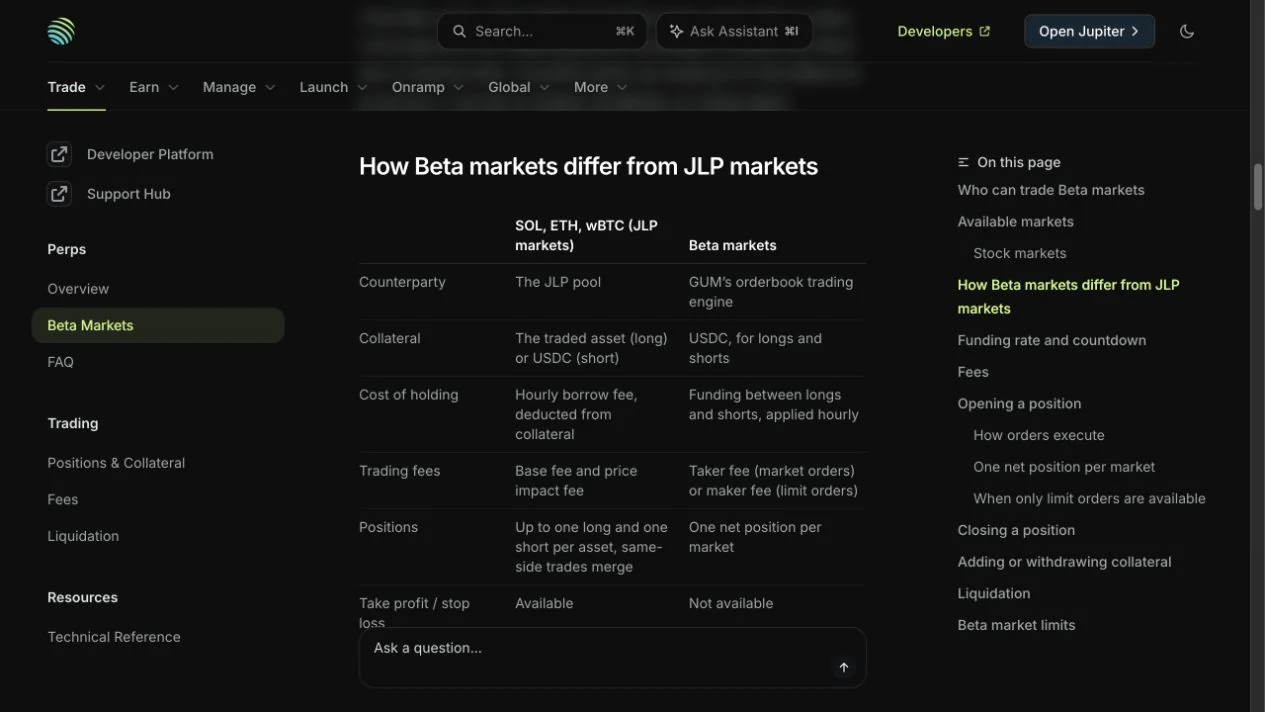
Beta also holds one net position per market. Buying the opposite direction reduces the existing position, closes it if sizes match, or reverses it if the new trade is larger. It does not create a separate hedge-mode position. This is especially relevant to a trader used to keeping simultaneous long and short books at a centralized exchange.
Your position cap is not your market-close cap
The published JUP launch limits allow a position value of up to $10,000 per account, but a single market order is capped at $1,000 or 5,000 JUP, whichever is lower. The limit-order cap is larger. These caps apply to exits too, so a permitted position can be too large for one market-close instruction.
A $4,000 JUP position would require at least four $1,000 market-order portions under the dollar cap alone, assuming each also passes the token-quantity cap and liquidity checks. That is an illustration of the mismatch, not a guarantee that four orders will complete. The actual limit can be lower if the quantity constraint binds.
A $4,000 JUP position may need several market exits
- Position permissionThe published $10,000 account cap can accommodate this position.
- Each market orderThe launch cap is $1,000 or 5,000 JUP, whichever is lower.
- Closing consequenceAt least four portions under the dollar cap alone; more if the quantity or liquidity constraint binds.
A full-position market close is all-or-nothing: if the whole requested close cannot fill within the slippage limit, the position stays open. A partial close can fill partially, leaving a remainder. Quick Close is unavailable when the position exceeds the applicable market-order cap, and Close All can skip such a position. Read the remaining size rather than relying on the fact that a close button was clicked.
If a market is marked unhealthy, Beta can switch to limit orders only. Market execution and Quick Close become unavailable, while a resting limit close still depends on reaching its price. This documented fallback makes Beta less suitable for a strategy whose core assumption is always being able to exit instantly at market.
JLP stop orders, position merging and partial exits
The established JLP product supports take-profit and stop-loss instructions. It also allows one long and one short for each of its three underlying markets, giving up to six positions. Additional trades on the same side merge into the existing position rather than creating a new independent position with its own history.
That means scaling into a SOL long changes the combined trade. After an increase, review the resulting size, average entry, collateral and exit instructions together. A stop amount appropriate to the original trade may no longer describe the position you intend to protect. The important number is the current position size, not the number of entry transactions in History.
A limit entry has a trigger condition and still needs successful execution. Solana congestion, quote changes and the accepted slippage setting can affect the outcome. The documentation's default setting is not a reason to blindly overwrite a setting already saved in your interface. In our public session the visible slippage control showed 2%; users should inspect the actual value attached to their own order.
Use the full close form when settlement matters
The standard Close form lets you choose a portion of the position and the receive token. Quick Close instead closes the entire position at market with USDC output. After its first confirmation, the Don't show again setting can remove that prompt on later use. These are materially different actions for someone who intended to keep a SOL or wBTC payout.
On a phone, the lightning symbol beside a position is consequently not just a shortcut to the same review screen. If size or receive asset needs adjustment, open Close and inspect them. Quick Close can therefore change both the amount closed and the token received compared with a customized close.
The documented JLP limit-order allowance is 20 orders per pair and side. That supports multiple instructions, but the number of orders should not be confused with the number of independent positions. A trader building several exits around one net position needs to keep their combined purpose consistent with the actual exposure.
JLP and Beta liquidations return different amounts
On JLP markets, liquidation occurs when the oracle reaches the position's liquidation level. Jupiter's documentation states that all remaining collateral goes to the pool as the liquidation fee. The amount displayed as collateral immediately before liquidation is therefore not a balance you can expect to recover afterward.
The liquidation formula includes the closing fee and accumulated borrow costs. Its protocol maintenance parameter uses 500, but that is not an advertised 500x opening limit. The trading interface's documented maximum is 250x. Mixing those two values produces an incorrect headline about the available leverage.
A JLP position's estimated liquidation price can move as fees accrue. Adding collateral changes the buffer; removing collateral reduces it. A planned withdrawal of margin should be assessed against the revised liquidation estimate rather than the original entry screen. A stop still needs to execute before liquidation to achieve its intended purpose.
Beta has a different forced-close calculation
Beta uses the mark price and its maintenance-margin requirement. At review, crypto Beta markets carried a 0.75% liquidation fee on position value, with remaining collateral returned after losses and applicable charges. JUP's documented maintenance requirement is higher than that of most other Beta markets, matching its lower leverage ceiling.
Do not translate that into a promise that liquidation preserves a useful balance. The remaining amount depends on the position and execution. The distinction simply prevents the opposite factual error: applying JLP's full forfeiture rule to a product whose documentation says the remainder is returned.
This also affects chart interpretation. Beta's chart follows the last traded price while its liquidation logic uses mark price. They can diverge briefly in thinner trading. JLP instead relies on its oracle-based mechanism. A trader comparing a chart wick with a forced close needs the price reference of the specific product before deciding the records contradict each other.
When a Jupiter order times out or the chart does not load
A timeout is not confirmation that no position exists. Beta checks orders, history and positions for up to two minutes when confirmation is delayed. Its documentation says it does not automatically resubmit the order. If the result remains unknown, refresh and reconcile the position before creating a replacement that might duplicate the exposure.
The same habit is useful when the interface shows a successful request but the expected wallet balance has not yet appeared after a close. Check the fill and transaction history first. A delayed display update, an unfilled order and a filled close awaiting visible settlement are different states, with different consequences for the next action.
During our public review, Jupiter's market selector and rate panels loaded while the embedded chart reported a loading failure. We could verify the listed markets and displayed borrow rate, but that session was not evidence of uninterrupted chart performance. No wallet connection or funded execution was part of the test.
For actual trading, a functioning order panel does not replace the information you need to judge the position. If an essential chart or current quote is unavailable, resolve the display or data issue before using the last number you remember. Do not repeatedly submit orders simply because one visual component has stopped updating.
Keep some usable SOL for network operations even if the intended Beta collateral is USDC. The collateral requirement and transaction-fee requirement are different. For a JLP route that includes a swap, the final estimate should also show whether the conversion leaves enough usable funds to complete the requested action.
Who should choose Jupiter Perps over another DEX?
Beta broadens the choice, but its early-release controls matter more than the extra symbols. For a small JUP trade watched actively, its order-book pricing can be relevant. For an unattended HYPE trade needing a stop loss, the missing function is a decisive limitation. That conclusion follows from the intended trade rather than a blanket endorsement or rejection of the entire Jupiter platform.
GMX is a more natural comparison when the question is flexible collateral and alternative liquidity pools on its supported EVM deployments. Hyperliquid is more relevant when the objective is an order-book strategy with a different catalog and order controls. Compare the actual market and exit workflow instead of transferring a score between products with different architectures.
Jupiter futures: your questions
Does Jupiter Perps still offer only three crypto markets?
The established JLP group has SOL, ETH and wBTC. At this review, the website also listed JUP, HYPE and ZEC as Beta crypto markets using GUM’s order book. Additional stock contracts are a different category. Jupiter Mobile currently offers the three JLP markets rather than the Beta group.
Can I place a stop loss on Jupiter HYPE or JUP Beta?
No. The checked Beta product does not offer take-profit or stop-loss controls. A limit close waits for its price; it is not equivalent to a protective stop. JLP markets have different controls, so SOL’s order options do not establish HYPE’s.
Why can Jupiter reject a full close of a permitted JUP position?
The permitted position value can exceed the per-order market cap. JUP’s published launch settings cap a market order at $1,000 or 5,000 JUP, whichever is lower, while the account position limit is larger. Closing may need multiple portions or a permitted limit order. A full market close also requires the complete amount to fill within its price protection.
Does Jupiter pay my SOL long profit in SOL or USDC?
The JLP long normally returns the market token, with USDC available as an alternative in the close form. Quick Close uses USDC output. The dollar collateral value is recorded on deposit, while the token amount received at exit depends on the chosen asset and its conversion value at that time.
Is 0.06% Jupiter’s maker fee?
No. It is the established JLP base position fee for increases and decreases. Beta uses a separate maker/taker schedule: 0.005% for resting maker fills and 0.035% for taker fills at review. A crossing limit order pays taker commission, so an order labeled Limit is not sufficient to establish its eventual rate.
Can I hold a long and a short together on Jupiter?
JLP supports one position in each direction per underlying asset. Beta uses one net position per market instead. An opposite Beta order reduces, closes or reverses the existing exposure depending on its size. These rules are different even though both products appear under the same Perps interface.
Will a Jupiter liquidation return unused collateral?
JLP’s documented rule forfeits all remaining collateral to the pool. Beta instead returns what remains after losses and applicable forced-close charges. Neither outcome is determined by the entry margin alone. Identify the market group before applying a liquidation explanation or estimating the amount recoverable from a forced close.
Evidence behind this reviewSources and research
Sources and research
Reviewed against current official product documentation and public market data on 6 October 2026. Interface observations are read-only; no funded trading, identity verification or withdrawal was performed.
- Jupiter Perps product overview
- Jupiter: Beta Markets
- Jupiter: Faq
- Jupiter: Positions And Collateral
- Jupiter: Fees
- Jupiter: Liquidation
- Jupiter: Technical Reference