
Is GMX a good exchange for crypto leverage?
For a BTC or ETH trader, the useful advantage is being able to evaluate an oracle-priced position against a particular liquidity pool. You do not need to estimate how many bids your closing order would consume. You still pay for execution, however: position fees, price impact and ongoing charges remain real costs. A visible chart without an order book should never be read as cost-free liquidity.
There are also differences between using funds directly from your wallet and using the GMX Account. The latter brings supported deposits from other chains into Arbitrum markets. That is convenient for funding, but it does not create a local GMX futures market on every sending chain. The rest of this review separates those choices before comparing the trading bill.
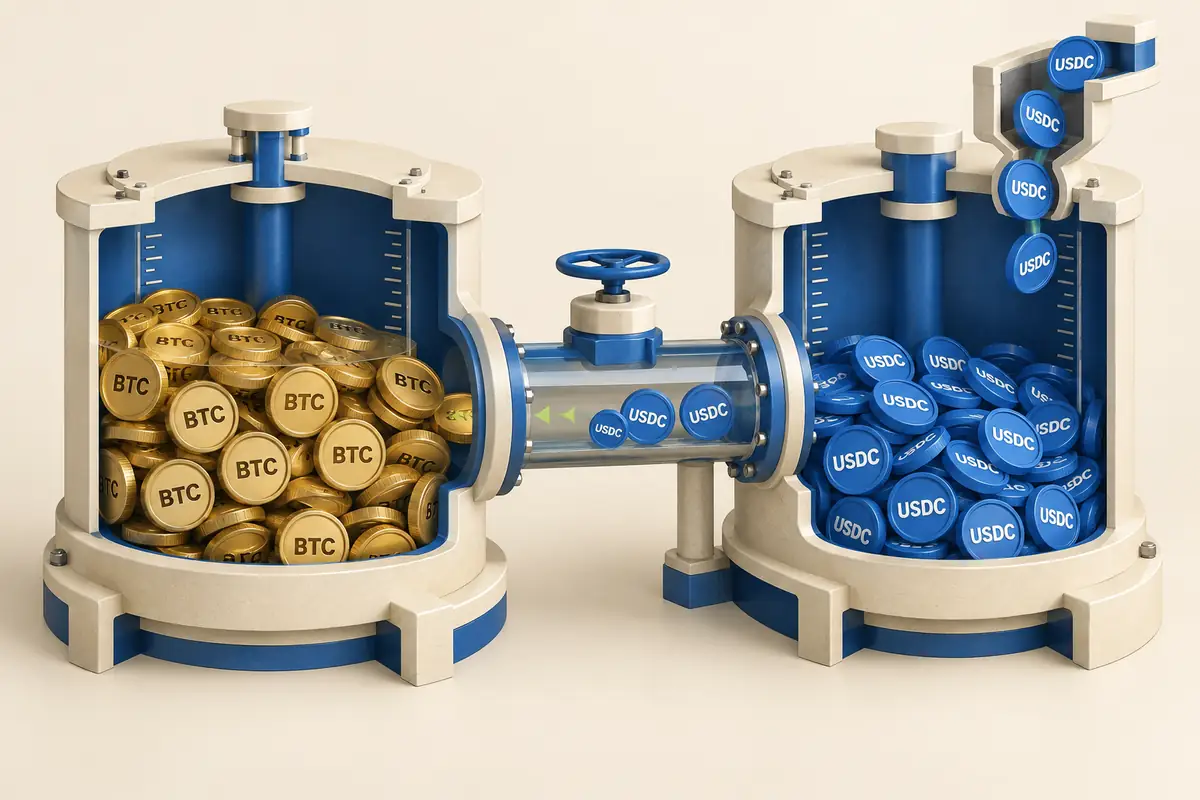
Which GMX network should you use?
The current trading overview lists direct markets on Arbitrum, Avalanche and MegaETH. Choose among them by the actual crypto market, usable collateral and available liquidity. A token sitting in an Avalanche wallet cannot fund an Arbitrum position merely because both networks appear in the same interface.
Arbitrum has an additional funding route: the GMX Account. A supported deposit from Ethereum, Base or BNB is bridged into that balance, and trades settle on Arbitrum. If you already have the required asset on Arbitrum, a same-chain transfer avoids that bridge step. Avalanche and MegaETH use direct wallet trading rather than this account flow.
Funding from Base is not trading on a Base market
This distinction matters when comparing fees. A Base deposit may look inexpensive, but the subsequent trade uses Arbitrum market conditions. The return transfer can also have its own bridge fee and minimum. Do not compare the sending-chain gas alone with the complete cost of a direct-wallet trade.
The published GMX Account transfer table supports USDC and ETH on Base; USDC and USDT on BNB; and USDC, USDT and ETH on Ethereum. Arbitrum deposits support assets the account can hold, while its listed withdrawal tokens are USDC, USDT and ETH. These transfer options are separate from the collateral choices of an individual position.
For a small trade, keeping funding and settlement on a chain you already use can matter more than a marginal rate difference. For a larger position, the pool's capacity and the cost of holding it become more influential. This is a route decision based on an intended trade size, not a permanent ranking of which blockchain is best.
| Starting point | Trade destination | What changes |
|---|---|---|
| Arbitrum wallet | Arbitrum markets | Direct wallet or GMX Account funding |
| Avalanche wallet | Avalanche markets | Direct wallet route; separate pools |
| MegaETH wallet | MegaETH markets | Direct wallet route; separate collateral and gas choices |
| Supported Ethereum, Base or BNB deposit | Arbitrum markets | Bridge into the GMX Account first |
The same coin can have more than one useful pool
A market label such as BTC/USD identifies the price exposure. The bracketed pool label identifies the assets backing that particular market. The two labels answer different questions. A trader selecting a BTC-USDC pool is choosing more than a display currency: the pool has its own balance, rates and available capacity.
Start with the collateral you actually want to hold. Then compare the long or short side's net rate, estimated price impact and available liquidity across the offered pools. A pool with a lower position fee can still cost more over several days if its borrowing charge is higher. Conversely, a less favorable opening fee can be a small expense compared with a meaningful saving on the holding period.
Single-token pools have a specific advantage
GMX documents BTC/USD [WBTC.e-WBTC.e] and ETH/USD [WETH-WETH] pools with zero position-impact factors and no token-conversion swap fee on position operations. This is a precise product feature, not permission to call all GMX trading impact-free. Position fees and the applicable holding and network charges still remain. The collateral is also a cryptoasset rather than a dollar balance.
A person who wants a USDC-funded short therefore should not select a single-token pool only because its impact line is attractive. The changed collateral exposure may defeat the purpose of the trade. Compare both the bill and what remains in your account if BTC or ETH moves sharply.
Pool liquidity also belongs to a particular side and market. The total value displayed elsewhere on the protocol does not establish that your chosen SOL short can use that entire amount. A full capacity indicator can prevent an increase even if another market has substantial unused liquidity. Switching to another pool may resolve capacity, but it changes the terms of the position and deserves a fresh quote.
One BTC idea, three pool questions
- Collateral
- What do you want to keep?
USDC separates dollar margin from the BTC trade. Coin collateral keeps additional coin exposure.
- Holding period
- Which net rate fits it?
A lower opening fee can be outweighed by a higher borrowing cost over several days.
- Capacity
- Does this side have room?
Liquidity in another pool does not automatically fund this position.
GMX trading fees: what does a $10,000 position cost?
For ordinary crypto markets, GMX charges 0.04% when an operation improves the long/short balance and 0.06% when it worsens it. The charge applies to opening, increasing, closing and partially reducing a position. It is a percentage of the affected position value, not a percentage of the margin you deposit.
Take a $10,000 opening order. At 0.04%, its position fee is $4; at 0.06%, it is $6. If an illustrative close also affects $10,000, the two position fees total $8, $10 or $12 depending on the rate of each operation. The close does not inherit the opening rate permanently: the pool balance can change while the position is open.
During our read-only inspection, the Arbitrum SOL/USD [SOL-USDC] short form showed a $6 position fee for $10,000 of size. No wallet was connected and no order was submitted. The quote supports the displayed 0.06% charge for that observation; it does not establish a fee for a different pool, side or future date.
Small margin does not mean a small fee base
If $500 backs the same $10,000 position, a $12 two-leg position fee would consume 2.4% of that starting margin. With $1,000 of margin it would consume 1.2%. The dollar fee is unchanged in this simplified comparison because the position size is unchanged. This is why comparing fees only against the deposited amount can obscure an expensive trading style.
Those figures exclude the movement in price, net impact, funding, borrowing and gas. They also assume equal affected notional on both legs for a readable example. A real trade must use the size shown at each operation. GMX's separate non-crypto markets have their own schedules and are outside this crypto fee comparison.

Why the entry price and the final proceeds can tell different stories
The current fee documentation describes net price impact: opening stores an impact calculation, while the combined effect of opening and closing is settled when you decrease or close the position. The opening price itself is oracle-based. An apparently clean entry price therefore does not mean the trade has no impact cost waiting at exit.
Impact depends on how operations change the imbalance of long and short exposure. A trade that helps rebalance the market can receive a favorable adjustment; one that increases imbalance can pay an unfavorable one. The result is not equivalent to crossing a visible spread on a conventional order book. It can also change as other traders enter and leave.
The trade history displays oracle mark prices, with net impact accounted for separately in the value received. When reconciling a close, compare the proceeds and impact breakdown as well as the displayed price. Otherwise a trader can calculate an apparently incorrect profit from the chart while overlooking a separate credit or deduction.
A cap is not the expected cost
Major markets including BTC, ETH and SOL have a documented negative impact cap of 0.5%; other markets can have materially higher caps. Most markets have a separate 0.4% positive cap. These are configuration limits, not the routine impact of every order. The market's current configuration and estimated close matter more than borrowing a headline cap from another coin.
The documentation also describes a five-day delay before excess negative impact beyond a market's cap can become claimable as a rebate, subject to review. A future claim is different from cash already returned at closing. A trader who needs to reuse every dollar immediately should not count a pending rebate as available margin.
For unusually large trades, TWAP can spread execution over time, but it cannot promise that market balance improves between portions. If the point of splitting an order is to reduce impact, compare the expected benefit with repeated execution costs and the exposure left while the order works. Smaller slices are a tool, not a universal discount.
Borrowing and funding decide whether holding GMX is economical
GMX separates borrowing from funding. Borrowing compensates for the pool resources tied to the position. Funding transfers value between the long and short sides according to the market's adaptive settings. A trader can receive funding while still paying borrowing, so the funding number alone is not the complete carrying cost.
The trade interface's net-rate view is useful precisely because these components can offset each other. Look at the side you intend to hold and the period shown beside the rate. A one-hour rate must be compared with another one-hour rate, rather than directly with an exchange displaying eight-hour funding.
Suppose an illustrative $20,000 position pays 0.0015% per hour in borrowing and receives 0.0005% per hour in funding. At unchanged size and rates, borrowing costs $0.30 per hour and funding contributes $0.10, leaving $0.20 per hour, or $4.80 over 24 hours. If the position instead pays that funding, the total becomes $0.40 per hour, or $9.60 for the day.
These are scenario rates, not the rate we observed or a forecast. They show why the paying direction changes the decision. Over a longer holding period, revisit the actual accumulated charges instead of extending the first displayed rate indefinitely. GMX funding adjusts as market conditions change, and its direction does not have to reverse instantly when the larger side changes.
Comparing two pools for an overnight trade
A $2 saving at entry is quickly outweighed by a $0.25-per-hour difference over a day: that difference totals $6. For an overnight strategy, quote the complete holding period alongside the entry and likely exit. For a short intraday trade, position fees and execution costs may dominate instead. This gives the pool comparison a purpose tied to your strategy rather than a generic cheapest-exchange label.
A funding credit can offset part of the borrowing bill
Illustrative $20,000 position · rates held constant for 24 hours
USDC or ETH collateral: which fits the position?
GMX calculates the price-move profit and loss of V2 perpetuals using linear exposure. A $10,000 ETH position gaining 5% produces $500 of trading profit before costs, whether its collateral is ETH or USDC. Collateral still changes the account outcome because its own dollar value can move.
With USDC collateral, the margin remains approximately dollar-denominated, subject to stablecoin risk. That makes it easier to isolate the result of an ETH long or short. With ETH collateral, you continue holding ETH exposure alongside the leveraged trade. A profitable short and falling collateral value can partially offset each other; a losing long and falling collateral can move in the same unfavorable direction.
Consider one ETH held as margin and a separate short representing one ETH of price exposure. Ignoring costs and differences in execution, a $100 ETH decline gains approximately $100 on the short while removing approximately $100 from the collateral's dollar value. This is useful for understanding a hedge, but it does not turn funding, borrowing or liquidation risk off.
Choose the receive asset before the exit
GMX can involve both collateral and a profit token. Combining them into one desired output can add a swap, whereas a supported separate-receive option avoids that internal conversion. The receive settings of a full close are consequently part of the trade economics, not a cosmetic preference about how the wallet balance looks.
If your objective is to finish in stablecoins, inspect the output token and expected amount before confirming. If your objective is to retain ETH, assess the final coin amount separately from the dollar profit displayed for the position. A dollar-denominated win and an increase in the number of ETH you hold are not automatically the same result.
Limit orders, stop losses and conditional margin
A GMX limit entry waits for its price condition; it does not post liquidity for another trader to hit. Its eventual execution still depends on the oracle, the keeper process, available capacity and the position checks. There is no maker-fee reward simply because the entry was submitted as a limit order.
The market order's slippage setting controls acceptable price movement between submission and execution. GMX treats this separately from net price impact. Increasing allowed slippage lets a market order tolerate a larger price change; it does not remove the separate pool-impact adjustment or guarantee an economically better fill.
A stop can be too close to liquidation
Trigger orders use the protocol's price rules, which can differ from a chart's last displayed price. In a fast move, a position can become liquidatable before a stop closes it. GMX warns when a trigger sits beyond the liquidation price, but a warning is not a protective barrier. The useful action is to revise the position or trigger while it is still possible to do so.
Conditional margin deposits offer another control: reserve funds for a deposit if a price condition is reached. That is useful only when the reserve can arrive before the position fails its collateral checks. The order documentation explicitly does not guarantee this will rescue a position near liquidation.
There is a less obvious cleanup issue. A 100% market close in the interface also cancels the related pending deposit-margin orders, returning their reserved funds. A full triggered TP/SL close, liquidation or TWAP close does not have the same automatic cleanup behavior. Remaining deposit orders need cancellation, especially before reopening the same market, collateral and direction.
That is a reason to inspect both Positions and Orders after an exit. The position being gone does not prove every reserved instruction is gone. A leftover conditional deposit concerns actual funds, so the order-state check is more valuable than simply looking for a zero position balance.
A request can expire without opening the trade
GMX documents automatic keeper cancellation for market requests left unexecuted for roughly six minutes: the request-expiration period plus a processing buffer. Cancellation returns the collateral held by the order and its execution fee. That behavior applies to market swaps, increases and decreases, not indiscriminately to every resting limit, stop or TWAP instruction.
A returned request and a filled trade need different follow-up. If the order was canceled, a fresh quote can reflect new fees, price and capacity. If it filled, a second entry adds exposure. Use the recorded status and current position together rather than deciding solely from a delayed notification or an unchanged chart.
The maximum available leverage can also fall as a pool’s open interest rises. A setting previously accepted for a smaller or quieter pool is not a permanent account entitlement. The interface checks the resulting position and can ask for more margin or a smaller size. This is particularly relevant to a resting entry that becomes executable after pool conditions have changed.
Classic, Express and One-Click: choose the signing method
Classic trading sends each operation through your wallet and requires the network's gas token. On Arbitrum and MegaETH that is ETH; on Avalanche it is AVAX. It is the straightforward choice for someone who wants to inspect a wallet confirmation for each operation and already keeps enough gas on the selected chain.
Express trading uses signed messages and the GMX Relay. Supported payment assets vary by network, allowing execution costs to be paid through eligible tokens rather than requiring the same native-gas workflow for every action. The position-fee schedule remains the same. Express changes transaction handling, not the pool's funding or the price of the crypto exposure.
One-Click trading adds a locally stored signing key for the supported flow. Fewer wallet prompts can improve a repeated trading workflow, but they also remove an interruption that might otherwise catch a mistaken order. It is worth learning the normal form before making submission faster, particularly if you switch between long and short or between collateral types.
GMX Account trading requires the compatible Express flow. Smart-wallet support depends on typed-data signing and the wallet's deployment state; it is not universal merely because a wallet works elsewhere on an EVM chain. If the expected signing mode is unavailable, use the interface's supported route rather than assuming the trade failed because the market is closed.
Execution fees are estimates paid to get orders processed, with the applicable unused amounts refunded according to the order flow. Adding trigger orders can also reserve execution fees. For a very small position, these fixed transaction-related amounts deserve attention alongside the percentage position charge. Ten small operations can have a different total cost from one larger operation even if their combined notional is identical.
Closing a position and withdrawing the proceeds
A direct-wallet position returns the supported settlement assets through its closing flow. The GMX Account adds a separate withdrawal step from its Arbitrum balance. These should not be confused with withdrawing liquidity-provider tokens: a trader closing a perpetual and a liquidity provider redeeming a pool share are performing different operations.
For an account withdrawal on Arbitrum, the wallet still needs ETH for the same-chain transfer. GMX documents an Insufficient ETH in Wallet message for that case. Holding enough USDC in the account does not itself resolve the missing wallet gas. This explains an otherwise frustrating situation where the funds exist but the withdrawal button cannot proceed.
Cross-chain account withdrawals have another failure condition: the bridge fee can increase before execution. The documented response leaves the funds in the GMX Account and asks for a new attempt. Before resubmitting, inspect Transfer history and the remaining account balance. A pending transfer and a transfer returned to the account require different next steps.
The selected destination also needs to support the exact received token and network. A centralized exchange deposit address may not accept every bridged representation that a wallet can hold. Receiving a valid token on-chain is not proof that a receiving exchange will credit it. Use the destination's actual deposit instructions for the final leg.
These funding and withdrawal constraints are most relevant if you move small balances frequently between chains. A trader who can keep the whole lifecycle on one network has fewer conversion and transfer steps to pay for. The account route is useful when it matches where your funds are, rather than as an obligatory first step for every GMX user.
What GMX liquidation takes into account
The displayed liquidation price includes more than the entry price and selected leverage. Remaining collateral, accrued fees, the minimum collateral requirement and applicable negative impact all affect whether the position can remain open. If collateral is volatile, changes in its own value add another moving part.
GMX's published liquidation fee varies by market type. The documentation lists 0.2% for standard non-synthetic markets, 0.3% for specified single-token and synthetic markets, and higher treatment for certain more volatile markets. That fee is not a universal 0.2% promise for every GMX position. The selected market's configuration governs the actual close.
For a trader, the practical distinction is between the estimated amount still recoverable and a price level that guarantees an exit. The former can change as costs accumulate. The latter does not exist merely because a number is printed next to Liquidation price. Moving a stop closer to liquidation to allow more room for a trade can leave too little room for execution.
A smaller partial reduction can help release exposure without always returning the expected collateral. GMX documents circumstances where decreasing a position is allowed but withdrawing collateral with that decrease would breach the leverage check. In that case, the size can fall while the margin remains in the position. Read the result as a risk-control outcome, not an unexplained missing withdrawal.
A profitable position can still be reduced by ADL
GMX can partially or fully close profitable positions when pending trader profits become too large relative to the pool value. This auto-deleveraging rule protects pool solvency; it is different from liquidating an undercollateralized losing trade. The documentation identifies synthetic markets as particularly exposed when the traded asset rises faster than the assets backing its pool.
For a trader holding a large winner, that means the desired duration is not entirely under personal control. A pool with room to open a position does not promise to carry every future profit indefinitely. The practical comparison is the market’s backing and current exposure, alongside the cost quote. Contract vulnerabilities and a collateral-token depeg remain separate risks that favorable trading performance cannot cancel out.
When another perpetual exchange is a better fit
Choose an order-book venue such as Hyperliquid when your strategy depends on posting and canceling quotes, seeing actual bid/ask depth or evaluating maker versus taker execution. GMX instead asks you to evaluate a pool, oracle execution and holding rates. Neither comparison is improved by putting a made-up maker fee in GMX's column.
Jupiter's established JLP markets can suit a trader already operating on Solana who needs SOL, ETH or wBTC exposure. Their collateral and settlement rules differ from GMX, while Jupiter's newer Beta markets form a separate order-book product. Moving to Jupiter purely because both services are decentralized would ignore these product differences.
gTrade is more relevant when a particular synthetic crypto pair or its collateral-denominated position model fits the intended exposure. Its spread, holding-rate and early-close rules need their own calculation. GMX's alternative pools are particularly useful when you want to compare collateral and net rates for the same underlying market without changing the entire trading architecture.
GMX futures: your questions
Do GMX limit orders receive a maker discount?
No. The ordinary crypto position fee follows whether the operation improves or worsens long/short balance, rather than whether it is a maker or taker fill. A limit order sets an entry condition; it does not supply a resting quote to an order book. Compare the applicable position fee and pool costs instead of importing a centralized-exchange fee tier.
Why can GMX show a different fee when I close?
Opening and closing are separate operations evaluated against the pool at their respective times. A 0.04% opening fee does not lock in a 0.04% close. The affected size may also differ, while net price impact, accrued holding costs and any output conversion contribute separately to the amount received.
Can I trade on GMX directly from Base?
The GMX Account accepts supported Base funding, but those trades settle on Arbitrum. Base is a funding source in that flow, not a direct GMX market deployment. Direct wallet markets are documented on Arbitrum, Avalanche and MegaETH. Account transfers must use the supported token list and meet the applicable bridge limits.
Does GMX support USDC collateral for a short?
Yes, where the selected market and pool offer it. The collateral selector matters independently of the asset you are shorting. If you instead use ETH or another volatile collateral, its dollar value moves alongside the short position. Select the margin asset according to the exposure you want to retain after accounting for the trade.
Why did my conditional margin order remain after the position closed?
The documented automatic cancellation applies to a full market close in the interface. A triggered TP/SL close, liquidation or TWAP close can leave a deposit-margin order active. Inspect Orders and cancel the remaining instruction to release reserved funds, especially before reopening the same market, collateral and direction.
Is all GMX price impact charged at entry?
No. Current V2 documentation describes stored opening impact combined with closing impact and settled on a decrease or close. Trade-history mark prices do not themselves include that separate adjustment. The position net-value tooltip and close breakdown are the useful places to reconcile what you actually receive.
Can I withdraw a GMX Account balance without wallet ETH?
For a same-chain Arbitrum withdrawal, the documented flow requires wallet ETH to pay network gas. An account holding USDC can still show Insufficient ETH in Wallet. Cross-chain withdrawals have different bridge-fee checks, so use the error for the selected route rather than assuming every blocked withdrawal has the same cause.
Evidence behind this reviewSources and research
Sources and research
Reviewed against current official product documentation and public market data on 6 October 2026. Interface observations are read-only; no funded trading, identity verification or withdrawal was performed.
Download the dated research record