
Is WEEX a good futures exchange for active traders?
The modeled million-USDT buys reached more expensive price levels in SOL than in BTC. At that size, SOL’s price impact became a substantial extra cost alongside WEEX’s commission; the detailed comparison below shows where each charge came from.
We compared BTC and SOL using V3 contract limits and ten public order-book observations on 6 October 2026. The calculations below use the published standard fee schedule. They estimate execution against displayed orders; they are not filled trades.
WEEX is less compelling as a specialist home for coin-settled hedges. The BTC and SOL products examined here use USDT collateral and settlement. If the purpose is to keep a BTC balance and hedge its dollar value without converting it to stablecoins, Binance COIN-M addresses a different need. Likewise, someone whose access depends on a locally authorized derivatives entity should start with the relevant country page rather than assume that WEEX registration establishes local futures eligibility.
What did our WEEX order-book checks actually show?
We collected five BTCUSDT and five SOLUSDT books in two short windows, around 02:28–02:29 and 02:38 UTC. Each response contained up to 200 price levels per side. We then calculated buys and sells worth 25,000, 250,000 and 1 million USDT against those displayed levels. No orders were submitted, and nothing in the exercise establishes how WEEX would execute an order after network delay or while other traders cancel orders.
For each size, the calculation consumed the best available prices first and continued down the book until the specified USDT value was reached. Average price was compared with the midpoint between the best bid and ask. Consequently, the result includes crossing half the spread as well as deeper-book price impact. Trading fees and funding are separate.
BTC: commission dominated the observed execution cost
Every modeled order fit inside the returned BTC levels. At 25,000 USDT, the buy-side cost relative to the midpoint was about 0.006 basis points. At 1 million USDT, buys ranged from approximately 0.150 to 0.196 basis points. One basis point is 0.01%, so those million-USDT buy observations imply roughly 14.98–19.57 USDT of price impact before commission.
At the published starting taker rate, the same million-USDT execution incurs 800 USDT in trading fees. Combining that fee with the modeled buy impact produces about 814.98–819.57 USDT of one-way cost. A tighter book is useful, but negotiating or qualifying for a lower taker rate would make a much larger difference to this particular calculation.
SOL: position size changed the answer
The smallest SOL scenario cost around 0.415 basis points relative to the midpoint. At 250,000 USDT, buy impact ranged from 0.624 to 1.357 basis points; at 1 million, it rose to 3.901–4.155 basis points. The million-USDT buy therefore added approximately 390.09–415.49 USDT of modeled impact to the 800-USDT commission.
That gives a modeled one-way cost of 1,190.09–1,215.49 USDT including commission. SOL sells had a different range; doubling the buy estimate would not describe a round trip.
SOL’s buy cost rose with the requested size
Average-price impact versus the midpoint · basis points
- 25,000 USDT
- BTC≈ 0.006 bpSOL≈ 0.415 bp
- 250,000 USDT
- BTC0.006–0.008 bpSOL0.624–1.357 bp
- 1 million USDT
- BTC0.150–0.196 bpSOL3.901–4.155 bp
How much weight should you give this sample?
The ten responses cover two brief windows, with several similar books. They do not establish stress-period liquidity or a comparison with other exchanges. The saved record contains the individual observations.
For a 25,000-USDT BTC trader, these observations make fees the obvious next comparison. For a million-USDT SOL trader, both commission and the intended execution method deserve attention. Splitting an order may reduce the amount crossing the book at once, but it creates exposure to price changes between pieces. The sample cannot tell you which approach wins on a future trade.
WEEX futures fees: what does an active month cost?
The public BTCUSDT and SOLUSDT contract records returned 0.02% maker and 0.08% taker fees. These match the standard VIP 0 futures schedule. A passive 50,000-USDT fill costs 10 USDT; an aggressive fill of the same value costs 40 USDT. Commission depends on executed value, so selecting 20× instead of 100× does not change that 40-USDT charge for the same trade size.
Consider an original monthly scenario: twelve entries of 50,000 USDT, each followed by a same-value exit. Total executed volume is 1.2 million USDT. If every execution is taker, fees are 960 USDT. If every entry is maker and every exit is taker, they are 600 USDT. If three quarters of total executed volume is maker, they are 420 USDT. These are alternative assumptions, not records of a trader's achieved fills.
Where VIP discounts become meaningful
The published VIP 1 taker rate is 0.075%, a modest reduction from 0.08%; VIP 2 is 0.06%. Applied to the same hypothetical 1.2 million USDT of all-taker executions, those rates produce 900 and 720 USDT respectively. The comparison holds turnover constant to show the effect of pricing. It does not imply that this turnover qualifies an account for VIP 2.
WEEX lists several qualification routes, including trading volume, WXT holdings and account assets. Our conclusion is to compare the fee level already available to you, rather than buy a token merely to make a fee table look better. For this monthly scenario, moving from VIP 0 to VIP 2 saves 240 USDT at unchanged all-taker turnover. That saving has to justify whatever extra exposure or capital commitment the qualification route requires.
Maker Only, GTC and partial fills
The WEEX fee calculation guide distinguishes executions from orders: unfilled cancellations do not create a trading fee, while reductions and exits do. A normal good-till-cancelled limit order can execute as maker or taker. Maker Only is the relevant instruction when the order must not immediately consume existing liquidity.
Suppose a 50,000-USDT order executes 20,000 immediately and later fills the remaining 30,000 passively. At the standard rates, the two portions cost 16 and 6 USDT, totaling 22. Charging the whole order as maker would understate the bill by 12 USDT. The fill history, rather than the word “limit” on the original ticket, explains the actual charge.
A temporary coupon or trading bonus belongs in a separate calculation. Deduct only the value actually applicable to this product and fee type, and only while the benefit lasts. A welcome reward should not be spread indefinitely over future trades to make WEEX appear permanently cheaper than another venue.
How WEEX 400× leverage changes with position size
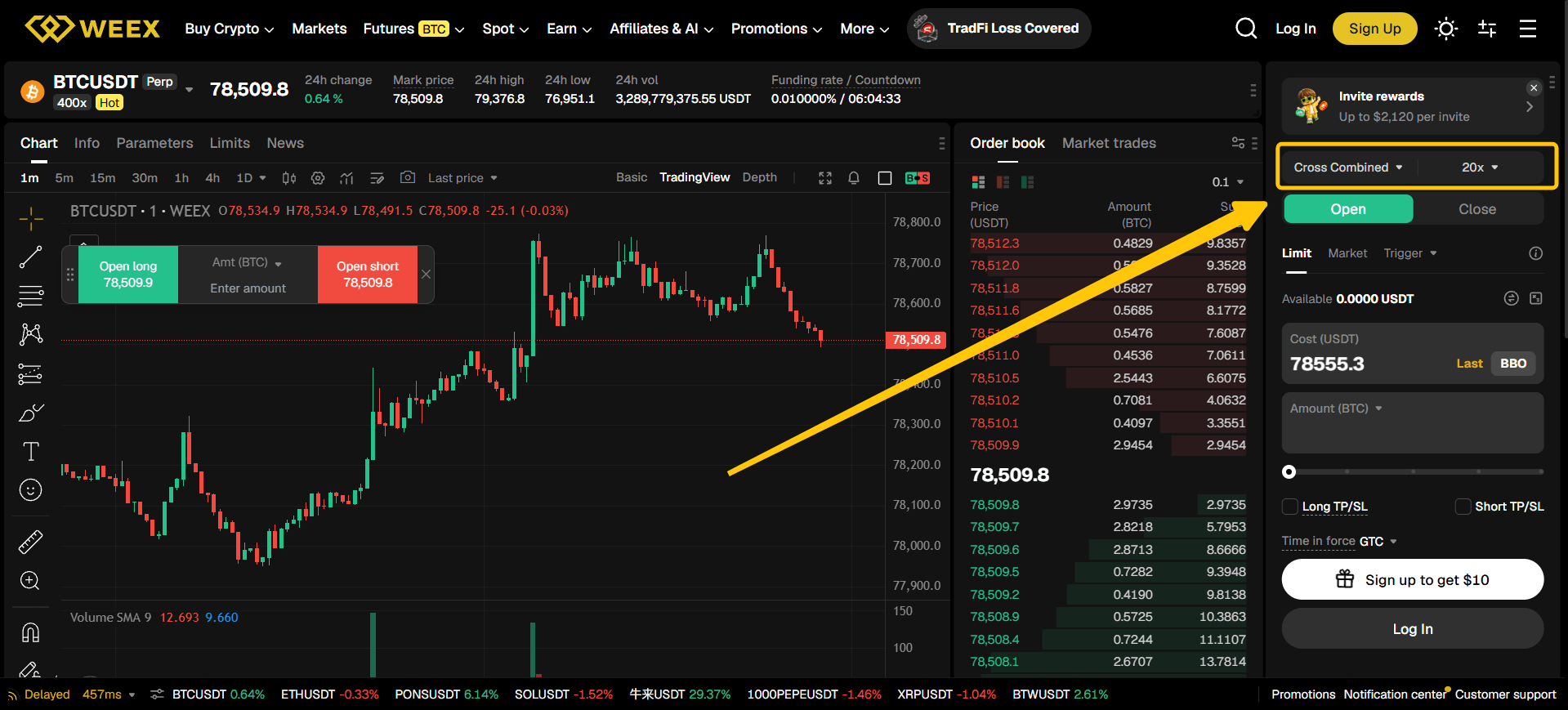
The current BTCUSDT risk-limit response allows up to 400× in its first band, ending at 2 million USDT. Above that, the maximum falls: 300× up to 3.5 million, 200× up to 4.9 million and 125× up to 5.9 million. These are published market bands, not confirmation that a particular account will receive every setting.
SOLUSDT follows a different ladder. Its first band allows up to 300× and ends at 2 million USDT; the next permits 200× up to 4.7 million. The same first-band position ceiling therefore accompanies different leverage and maintenance requirements. We use the live risk-limit response instead of repeating a platform-wide “400× on everything” claim.
| Contract and band | Maximum leverage | Maintenance rate |
|---|---|---|
| BTC · up to 2m USDT | 400× | 0.15% |
| BTC · above 2m to 3.5m | 300× | 0.20% |
| SOL · up to 2m USDT | 300× | 0.20% |
| SOL · above 2m to 4.7m | 200× | 0.30% |
The margin setting does not erase trading costs
At 400×, a hypothetical 10,000-USDT position starts with 25 USDT of initial margin before other requirements. One standard taker execution costs 8 USDT, equal to 32% of that amount. Two same-value taker executions cost 16 USDT, or 64%. This does not mean the liquidation threshold is 64% away: maintenance margin, mark price, fees and available account equity determine a different calculation.
The comparison explains why the headline maximum is a poor way to choose a routine setting. A trader who sizes margin from the leverage slider alone can allocate less room to the position than its ordinary execution expenses demand. Lower leverage changes the margin buffer; a lower fee tier changes the cost. They solve different problems.
Why the live ladder matters for larger positions
Our current BTC response also differs from an older published risk table in the upper bands. For example, the retrieved 20× band extends from 15 million to 200 million USDT. We retain the response date because these limits can be revised. Copying an old screenshot into a permanent “maximum position size” statement would be misleading.
A planned position close to a band boundary also needs room for changes in its value. Price movement can move the exposure toward a higher band without another order. For the unusually large positions covered by these limits, this review is only an initial screen: the live account's displayed requirement is the operational figure. The risk-limit endpoint documentation identifies the fields used in our dated comparison.
Can WEEX accept the whole order in one ticket?
Position capacity and order capacity are separate. In the BTCUSDT contract response, the ordinary maximum order quantity was 2,000 BTC, while the market-opening quantity limit was 240 BTC. Reading only the larger field would overstate what a single market opening can submit. The fields are quantities of the base asset, not USDT amounts.
To make the distinction concrete, a hypothetical 250-BTC market opening exceeds the recorded 240-BTC per-order limit even if the intended leverage and total position fit their applicable limits. A 200-BTC order is within that quantity limit, but its approximate 17.1-million-USDT value at an illustrative BTC price of 85,600 belongs far beyond the first 400× band. Passing one gate does not imply passing the other.
Two different limits for a 200-BTC order
Inside the sampled market-opening quantity limit
At an illustrative 85,600 USDT per BTC: inside the recorded 20× band, far above the 400× band
The V3 API quantity detail that can corrupt a comparison
The contract metadata also contains a contract-value field. However, the V3 depth responses used here supply base-asset quantities. Multiplying every BTC book quantity by the 0.0001 contract value again would shrink the visible book by a factor of 10,000 and completely distort the liquidity analysis. Our stored calculation uses the depth quantities directly.
This is a practical warning for traders importing WEEX data into a scanner or execution bot, not a requirement to understand API internals before manual trading. A book that looks impossibly thin in a third-party tool may have a unit-conversion problem. Compare one visible level with the venue display before using the tool's size estimate to place an order.
The V3 exchange information documentation also distinguishes standard maker/taker fields from API-specific fee fields, which appear when configured. Their absence in our public response is not evidence of free API execution. An automated strategy needs the fee agreement applicable to its account, including any separate market-maker arrangement, before its backtest becomes a credible cost estimate.
Small orders have quantity steps too
The sampled BTC contract permits a minimum quantity of 0.0001 BTC; SOL starts at 0.1 SOL. At illustrative prices of 85,600 USDT and 120 USDT, those represent 8.56 and 12 USDT of exposure. They are not minimum account deposits and do not include the margin or fees required by the selected position. The contract quantity step also matters when an automation tries to submit a fraction smaller than the supported increment.
For a trader rebalancing several small positions, rounding changes the final exposure. A desired 12.05-USDT SOL amount at a price of 120 corresponds to roughly 0.10042 SOL, which does not align with a 0.1-SOL increment. An order sized to one increment produces 12 USDT of exposure. The distinction is small here, but it prevents a scanner from treating an invalid theoretical quantity as an executable trade. Use the current contract’s minimum and step when building the ticket; the BTC settings cannot simply be reused for SOL.
Trigger orders, stop losses and the price you actually receive
WEEX documents triggers based on either the latest traded price or the mark price. Those two references can diverge. A trigger condition being reached authorizes the order to be submitted; it does not establish the eventual fill. The official trigger-order guide describes failures involving available margin, order limits and position limits, as well as price conditions.
For a leveraged SOL position, the choice should match the event you want to react to. A latest-price trigger responds to prints on that market, including a brief move that may not appear to the same extent in the mark price. A mark-price trigger tracks the venue's valuation reference. Neither choice creates a guaranteed stop price when the submitted order reaches a moving book.
A trigger limit can leave an exit unfinished
Imagine a long position with a sell trigger at 120 USDT and a sell limit at 119.80. If executable bids are already below 119.80 when the order arrives, the price restriction can leave it unfilled. A market exit prioritizes immediate access to available bids but accepts the prices encountered. The appropriate comparison is between a controlled minimum price and the possibility of continued exposure.
This matters more on a thinner altcoin than the attractive BTC screenshot might suggest. Our SOL observations show that larger size reached progressively less favorable levels even during the brief sample. That does not predict a future stop's loss, but it makes using a BTC liquidity result to justify a large SOL exit especially weak reasoning.
Are WEEX stop orders guaranteed?
Do not assume so. WEEX has published a separate guaranteed-price feature for specified supported markets, with its own conditions and charges. That is not documentation that ordinary crypto futures stops carry the same protection. For the BTCUSDT and SOLUSDT orders analyzed here, our review makes no guarantee of execution at a trigger price.
On mobile, the fields worth keeping visible are the trigger reference, order type, quantity and the current position being closed. The leverage badge is much less useful at that moment. When adjusting an exit after a partial close, reconcile the remaining amount with the new order rather than rely on the original position size displayed in an earlier screenshot.
Funding and withdrawals: costs outside the order book
The sampled BTC and SOL contracts are perpetuals, so holding them across a funding settlement can create an additional payment or receipt. Their current metadata lists three daily settlement times. A displayed next rate is not a seven-day cost estimate: future rates can reverse, and the position may not remain the same size.
WEEX's funding-rate explanation separates this transfer from trading commission. When comparing venues for a multi-day position, collect the settled history of the exact contract over the same time window. A screenshot of a favorable next payment on WEEX and a screenshot taken several hours earlier elsewhere are not a like-for-like comparison.
In a hypothetical funding path, a constant 40,000-USDT position paying 0.01% at each of six settlements pays 24 USDT. A negative rate reverses who pays. Funding is separate from the one-way execution estimates above.
A cheap deposit route can create an expensive withdrawal
Crypto transfer costs depend on the asset, network and withdrawal minimum. A coin appearing in futures does not mean it can be withdrawn as that underlying asset from the derivatives balance. USDT-settled profit is USDT. Someone trading SOLUSDT who wants SOL in a personal wallet needs a separate asset conversion and a supported withdrawal route.
WEEX publishes network-specific charges in its rate standards. For a small payout, that fixed withdrawal charge can exceed the trading commission saved; compare the amount charged on the network you intend to use.
If a supported network is under maintenance, selecting another chain only works when the receiving wallet or exchange accepts that same chain for that asset. The relevant question is the complete route between the two accounts, not which network has the lowest number in the withdrawal menu. Network selection cannot repair an incompatible destination.
WEEX KYC, restricted countries and account protection
The current identity-verification guidance says requirements depend on the service and account circumstances. It specifically requires verification for P2P. We therefore do not describe WEEX as an unconditional no-KYC futures exchange or promise an unverified withdrawal allowance that every reader can use.
The terms exclude a number of jurisdictions, including the United States and its territories, Canada, Singapore and the United Arab Emirates. The complete list is broader. Passing a signup screen is not a replacement for that eligibility condition. Our country guides are the more useful starting point when local access is the deciding factor.
What security evidence can and cannot establish
A reserve disclosure concerns assets shown at a particular time and the scope of the liabilities included. An advertised protection fund concerns a separate pool and its rules. Neither should be translated into an unconditional promise to reimburse trading losses, a failed strategy or every possible custody incident. Readers should be able to inspect the underlying disclosures without needing to accept a reviewer's general “safe” label.
WEEX links its proof-of-reserves material and protection fund. We did not independently audit their completeness, legal segregation or redemption enforceability. Consequently, these are resources for further inspection rather than a numerical safety score in our verdict. Our positive assessment of the sampled BTC book is unrelated to those custody questions.
Account support is most useful when a problem is tied to an identifiable event. Preserve the market, order or transaction identifier and timestamp when disputing a fill or transfer. This review cannot grade resolution speed from a public help article. The absence of an account-level service test is a real limitation, especially for a reader comparing WEEX with a venue they already use successfully.
WEEX versus other futures exchanges: when would we switch?
For standard-rate market-order trading, Binance and Bitget publish lower starting taker rates than WEEX's 0.08%. That makes them necessary price comparisons if all are available to the reader. However, a fee saving does not establish the better fill on every altcoin. Compare the same pair and intended size, with the fee tier actually available to each account.
Bitget offers a particularly relevant alternative when explicit entry-slippage controls matter: its tolerance feature can reject the portion that would trade beyond the chosen price boundary. The trade-off is an incomplete position. That is a more useful comparison than declaring one exchange “better for beginners” without naming the feature or its consequence.
MEXC is worth considering for a particular listed altcoin, but manual and API costs must be separated there. A low website promotion should not be compared with WEEX's authenticated API rate as if both describe the same execution channel. Our MEXC futures review explains that distinction and includes a separate market sample.
WEEX futures: your questions
Is WEEX 400× leverage available on SOL as well as Bitcoin?
No. The checked BTCUSDT first band lists 400×, while SOLUSDT lists 300×. Both end at 2 million USDT; larger position bands lower the maximum. Account eligibility still applies.
How much does a WEEX market entry and exit cost at VIP 0?
Using an unchanged 30,000-USDT value each way, 0.08% taker commission is 24 USDT per execution, or 48 USDT for the pair. The exit value can change with price. Funding, spread and slippage are additional; leverage does not reduce commission on the same executed amount.
Does WEEX have enough liquidity for a 1-million-USDT BTC order?
The returned books accommodated that modeled size in all five BTC observations. Buy impact relative to the midpoint was approximately 0.150–0.196 basis points before fees. These were short public samples, not live executions or evidence of capacity during a sudden sell-off.
Can I rely on a fixed WEEX withdrawal limit without verification?
No universal allowance is established by the current verification guidance. Requirements vary by product and account circumstances, and P2P explicitly requires identity verification. Use the eligibility and withdrawal conditions attached to your own service rather than an older review’s advertised allowance.
Does the WEEX API report order size in USDT?
The V3 exchange-information fields used here report the relevant order limits in the base asset. For BTCUSDT, the sampled market-opening limit was 240 BTC. Convert that quantity at the intended price to compare it with USDT position-value bands; do not treat 240 as a 240-USDT cap.
Can SOL futures profits be withdrawn directly as SOL?
SOLUSDT settles in USDT, so the futures result is not a new SOL balance. Withdrawing SOL requires a supported conversion and withdrawal route. Compare that extra conversion and network cost if receiving the underlying coin is part of your plan.
Evidence behind this reviewSources and research
Sources and research
Reviewed against official product documentation and public contract data on 6 October 2026. Calculated examples are identified in the text. No funded account, authenticated fee tier, withdrawal or live order was tested. The dated record preserves the inputs and the limits of our observations.
- WEEX V3 contract catalogue
- V3 exchange information and quantity fields
- V3 depth response documentation
- V3 risk-limit documentation
- WEEX standard fees and VIP tiers
- WEEX execution fee calculation
- Trigger orders and failure conditions
- Guaranteed-price feature announcement
- Funding-rate questions
- WEEX live rate standards
- Identity verification requirements
- WEEX terms and excluded jurisdictions
- Proof of reserves
- Protection fund
- WEEX futures order interface guide