
Should an existing WhiteBIT user add futures?
Keeping spot and futures with one provider can remove some friction. You already know the deposit route, can see balances together and may avoid sending collateral to a second exchange. WhiteBIT offers that convenience, but its wallet structure deliberately separates the money received from the money supporting leveraged positions. That distinction is the starting point for our verdict.
For an existing eligible account, the strongest case is a selected BTC, ETH or other supported perpetual that meets your size requirements. Moving a defined amount into Collateral can be more practical than establishing a new funding route elsewhere. It does not make the entire account equally usable, and it does not establish that WhiteBIT is the cheapest venue for every contract.
Main, Trade and Collateral: where your futures money belongs
WhiteBIT deposits arrive in Main. Trade serves spot orders and conversion; Collateral supports margin and futures. Total is an overview rather than a single trading wallet. Seeing a USDT-equivalent figure on that overview does not mean the same amount can immediately support a leveraged BTC position.
Suppose an account has 1,200 USDT in Main, 300 USDT committed to a spot plan and nothing in Collateral. The futures ticket can correctly show no available collateral even though the account visibly owns crypto. Transferring a chosen amount from Main to Collateral resolves a wallet-allocation problem. Increasing leverage or repeatedly entering a smaller order would not address the missing funds in the correct balance.
That separation is also useful after trading. A futures result first changes the relevant collateral balance. Money still supporting open positions is not equivalent to free money available for withdrawal. Before moving funds back, consider the effect on the positions that remain. Closing one market does not necessarily release every asset if other leveraged positions share the same collateral pool.
The distinction is particularly important when fiat is involved. A national-currency deposit and its USDT-equivalent valuation are not themselves a USDT futures balance. Conversion, an eligible collateral asset and the required internal transfer are separate steps. WhiteBIT's balance documentation does not justify treating every currency shown on Main as acceptable futures support.
The practical benefit is control over allocation. A user can decide that only a defined trading budget belongs in Collateral while other funds remain elsewhere in the account structure. That is a meaningful reason to prefer this arrangement over moving the whole visible balance by default. It also makes the eventual result easier to reconcile with the amount originally committed to futures.
Which WhiteBIT crypto perpetuals have useful capacity?
WhiteBIT's public futures catalogue exposes more than a market name: it includes the settlement currency, current maximum, bracket thresholds and funding interval. Those fields let us distinguish between having a listing and having enough capacity for a particular trade. We sampled BTC_PERP, ETH_PERP and SOL_PERP on 6 October 2026 rather than using one market's headline for the entire catalogue.
All three sampled contracts settle in USDT and show a 100x maximum. Their first bracket ceilings are very different: 200,000 USDT for BTC, 100,000 for ETH and 20,000 for SOL. A 60,000 USDT position can therefore sit within BTC's or ETH's first band while extending beyond SOL's. The shared 100x badge conceals that important difference.
The next thresholds differ too. BTC's 50x band reaches one million USDT, ETH's reaches 500,000 and SOL's reaches 100,000 in the saved response. These values are observations of the current schedule, not permanent venue attributes. The older help-page numerical example uses different BTC thresholds; we use that page to explain the mechanism and the current catalogue for the values.
| Market | First slice at 100x | Next ceiling at 50x |
|---|---|---|
| BTC_PERP | 200,000 USDT | 1,000,000 USDT |
| ETH_PERP | 100,000 USDT | 500,000 USDT |
| SOL_PERP | 20,000 USDT | 100,000 USDT |
WhiteBIT also lists products beyond ordinary crypto pairs. Check the named perpetual’s settlement, position limit and available liquidity rather than treating the total catalogue size as a count of cryptocurrencies.
A WhiteBIT position limit tells you what the account may hold; it does not guarantee a fill near the displayed price. A larger or smaller-market order needs a current depth check for that contract.
WhiteBIT leverage brackets: charge each slice at its own rate
WhiteBIT's help centre explains its brackets incrementally. When position value exceeds a threshold, the next portion requires margin at the next bracket's rate. That is different from simply applying the lower leverage to the entire position. It is also different from ignoring the higher slice and applying the first band's headline to everything.
Using the captured BTC thresholds, an illustrative 300,000 USDT position has its first 200,000 in the 100x slice and the remaining 100,000 in the 50x slice. That gives 2,000 plus 2,000, or 4,000 USDT of basic initial margin at those maximum settings. The resulting blended leverage is 75x. This calculation excludes fees and other account requirements; it illustrates the bracket method rather than an order approval.
300,000 USDT of BTC: two slices, one margin total
The blended result is 75x. Neither 100x nor 50x applied to the whole position reproduces this method.
Two common shortcuts get different wrong answers. Dividing all 300,000 by 100 suggests 3,000 USDT and misses the more demanding second slice. Dividing it all by 50 suggests 6,000 and ignores the first slice's treatment. The actual account's selected leverage can demand more margin than this maximum-setting example, but neither shortcut accurately describes the published incremental method.
WhiteBIT also links its leverage setting across futures and margin trading. Its documentation warns that changing the margin-trading setting can change the futures setting as well. A reader who uses both products should not assume that adjusting a margin pair is isolated from the futures workflow. Reducing the setting may require additional available funds, so the change can fail if the account cannot support it.
This is a reason to evaluate WhiteBIT around an account rather than a single screenshot. The selected leverage, existing leveraged positions, recognized collateral and contract slices interact. For a modest BTC-only position, that may be straightforward. For a mixed margin-and-futures account, a settings change elsewhere can be more important than the largest number beside BTC.
WhiteBIT futures fees and the actual benefit of VIP
The public fee page and the inspected BTC ticket both show a 0.01% maker reference and a 0.055% taker reference. The fee page qualifies rates by pair. Spot's 0.1% and the daily charge for borrowed margin funds are different entries; neither should be copied into a perpetual commission calculation.
For a 40,000 USDT entry that rests on the book, the maker commission is 4 USDT. If the entire position later exits at a 42,000 USDT value as a taker, the exit costs 23.10 USDT. Combined commission is 27.10 USDT before funding. The changed closing value matters: multiplying one opening fee by two would not reproduce this trade.
VIP qualification uses alternative paths
WhiteBIT's current VIP programme has alternative qualifying paths. The account receives the highest level reached through a qualifying average balance, spot volume, futures volume or eligible fixed lending amount. It does not require all four thresholds simultaneously. For Level 1, the published table includes a 10,000 USDT average-balance route or five million USDT of monthly futures volume, among the alternatives.
Level 1's futures rates are 0.006% maker and 0.054% taker. The improvement is larger proportionally for maker executions. On a constant 40,000 USDT fill, the maker saving versus Level 0 is 1.60 USDT, while the taker saving is 0.40 USDT. That is useful context before moving additional assets merely to qualify for a fee tier.
| Level | Maker | Taker |
|---|---|---|
| Level 0 | 0.010% | 0.055% |
| Level 1 | 0.006% | 0.054% |
| Level 4 | 0.002% | 0.0525% |
WhiteBIT’s VIP rules combine qualifying main-account and sub-account activity and specify upgrade timing. A temporary balance is not a monthly average, and a referral link does not grant a VIP tier. The account’s trading ticket shows the applicable rate.
WhiteBIT funding and why realized P&L may not match your balance
The sampled BTC, ETH and SOL markets each showed an eight-hour interval in the public response. The catalogue supplies this per contract, so a review should not assume that every future listing will share the same schedule. Funding has its own rate and settlement timing, separate from the maker or taker commission paid on a fill.
WhiteBIT's futures explanation states that realized P&L includes trading fees but excludes funding. That creates a specific reconciliation trap: a positive realized-P&L line can differ from the complete net result after funding transfers. The exchange provides Funding History as a separate area, visible in the public terminal's navigation during our inspection.
Take an illustrative trade whose price move earns 90 USDT and whose entry/exit commissions total 12 USDT. A realized result of 78 USDT can coexist with a net account increase of 69 USDT if nine USDT of funding was also paid. The missing nine is not necessarily an unexplained execution error; it may belong to the separate funding record. The example holds other balance movements constant.
For an existing WhiteBIT user adding futures, this distinction is more valuable than another explanation of what a long position means. It changes how you judge whether the product is working for your strategy. A frequent trader can inspect commissions in trade history; a longer-duration holder needs the funding history as well. Neither should estimate profitability from an isolated chart result.
The direction of a funding transfer changes with the rate and the side of the position. The negative BTC funding observed during our visit is a dated observation, not a promise that every future BTC long will receive funding. We deliberately avoid projecting a temporary rate into a guaranteed yield or presenting funding receipts as an independent reason to use maximum leverage.
WhiteBIT close orders: the reduce-only and TP/SL distinction
WhiteBIT now documents reduce-only support for its advanced margin and futures orders. Its purpose is to keep an instruction from increasing exposure after the remaining position changes. The interface location matters: the standard basic-order form is not the same as the advanced form where this option is offered.
The documented checks resize an oversized reduce-only instruction to the remaining position and cancel remaining reduce-only orders after the position has fully closed. An instruction with no position to reduce, or one pointing in the position's opening direction, can be rejected. That behavior is particularly useful when several planned exits coexist with manual reductions.
Why a closing order can reject attached TP/SL
There is an important incompatibility: WhiteBIT says a reduce-only order cannot carry attached TP/SL. The practical choice is therefore between a dedicated closing instruction and a new order with its own attached exit conditions. A reader should not expect to activate every protective-looking control simultaneously. If a form refuses a combination, the reason can be the order structure rather than missing collateral.
Market Close and Close All automatically use reduce-only according to the guide; Limit Close lets the user control the setting. For an active trader, that difference is worth learning before a fast exit. It determines whether the instruction is expressly limited to the position being removed. A price-limited close still requires a match and does not promise immediate execution.
Our verdict favors these controls for a user prepared to distinguish them. We would not describe WhiteBIT as lacking advanced order types simply because an older review says so, nor call the existence of advanced orders proof of better fills. The meaningful improvement is being able to express a specific exit intention and understand why a conflicting combination is rejected.
Holding a WhiteBIT long and short: what stays separate?
WhiteBIT supports both one-way and hedge position modes. Its published switching conditions require no open futures positions and no open futures orders. If those have been cleared and the switch does not immediately take effect, the guide suggests allowing a short processing interval before retrying. This is preparation for a strategy, not a reliable emergency conversion of an active position.
In Hedge Mode, the long and short remain distinct positions on the same market. A TP/SL triggered on one does not automatically close the other. The web guide also notes that the explicit Open and Close selectors belong to the right-hand layout. A different layout can therefore look different without indicating that the product lacks the mode.
This is useful for separating a temporary hedge from a longer-running view, but it adds a remaining-position problem. After one side exits, the other side still needs a deliberate plan. A trader reviewing only the closed side's history may overlook that the account has become directional again. WhiteBIT's separate position history and order-side labels help establish what actually remained.
WhiteBIT treats equal and unequal opposing positions differently during liquidation. Keeping the legs separate is useful for management, but an offsetting pair does not remove the need to monitor the whole account’s collateral.
USDTB is futures collateral, not a withdrawable USDT deposit
WhiteBIT uses USDTB for eligible futures promotions. It is a bonus asset held in Collateral, not ordinary USDT that can be sent to an external wallet. Profitable trading can produce actual USDT, but the bonus itself has restrictions and an expiry. Eligibility depends on the campaign and the account.

This changes how a displayed reward should influence your decision. An offer of bonus collateral is not equivalent to a cash discount on every future commission, nor a deposit you can withdraw unchanged. The official rules also describe cancellation of free bonuses around external withdrawals and exceptions for funds supporting active positions.
We exclude USDTB from the core fee comparison because the product's value should remain understandable without a temporary campaign. If you already have a bonus, read the applicable withdrawal and expiry conditions before treating the total shown in Collateral as your own freely transferable capital. A profitable futures experience and a promotional balance are separate things to evaluate.
Can a WhiteBIT spot customer automatically trade futures?
No. WhiteBIT's current identity-verification guidance distinguishes country and product eligibility. Its prohibited list includes the United States, United Kingdom, Canada, Belarus and Russia, among other jurisdictions. Swiss identity documents or Swiss residence also have specific restrictions on leveraged and lending products. A successful identity check is not a universal derivatives licence.
The guidance further states that new EEA registrations are no longer available on whitebit.com and directs those applicants to whitebit.eu. That is a distinction between service entities and onboarding routes, not evidence that every whitebit.eu customer receives the global futures product described here. Existing-account transitions can also differ from new registration.
For an account affected by a restriction, the ability to view or manage an existing activity should not be mistaken for permission to open new exposure. WhiteBIT's Activities area is relevant to ongoing account management, but it does not override the current product terms. This review avoids a blanket “available across Europe” conclusion based merely on a European brand presence.
This is the main limit on our existing-user recommendation. The convenient internal transfer is only useful after futures access is confirmed for the account. Our country guides compare alternatives for a particular residence; the linked identity-verification policy records WhiteBIT's own onboarding boundaries.
Finding WhiteBIT futures information on a smaller screen
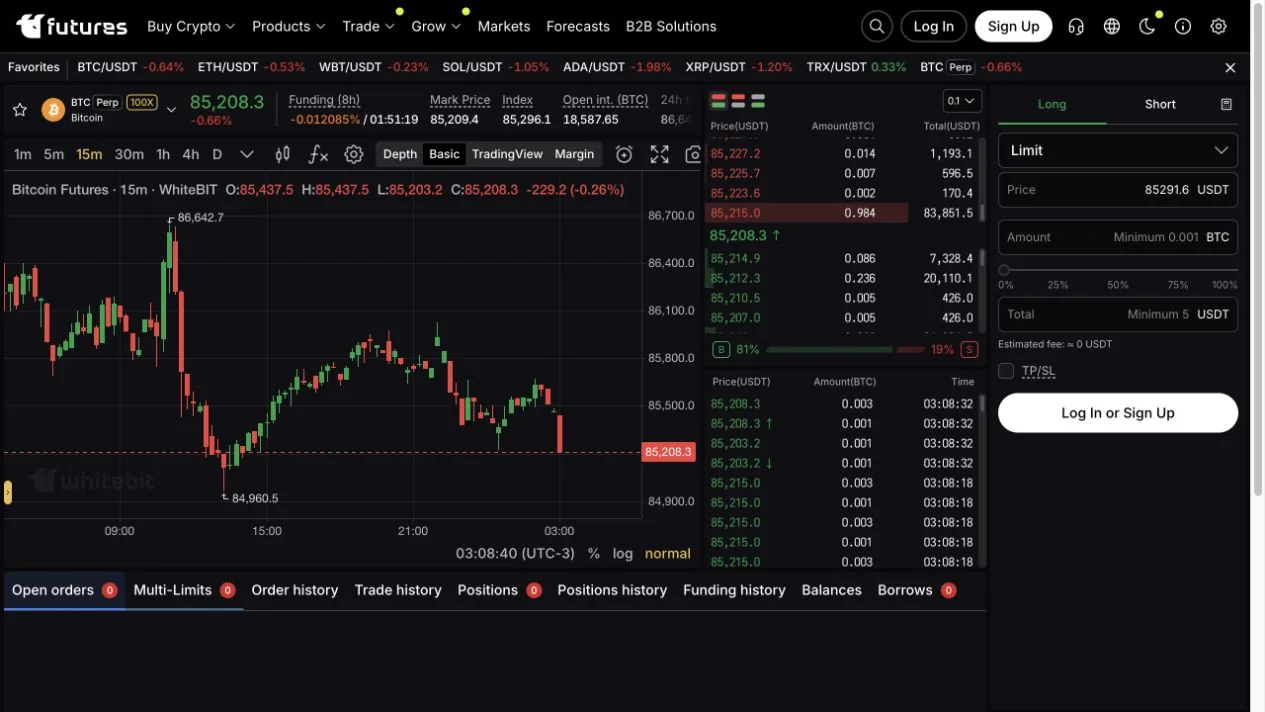
The public BTC terminal provides the minimum amount, minimum order value, maker/taker references, position mode and free collateral as distinct fields. Those are more actionable than an exchange-wide leverage badge. In the inspected market, the minimum quantity was 0.001 BTC and the minimum total was five USDT; both constraints apply together.
WhiteBIT groups several useful futures settings behind the three-dot menu in its app: collateral weights, leverage terms, the arrangement of orders and positions, and the position-mode setting. That makes it possible to simplify the visible workspace without assuming the missing setting has disappeared. The phone guide is particularly helpful when the order panel is on the opposite side from a desktop example.
The reduce-only choice belongs to advanced orders rather than every basic ticket. Start by selecting Futures in the Trade tab, then the intended market and order type. For reviewing previous activity, History is available from both Main and Wallet and includes collateral records and exports. A trader reconciling several internal transfers can use those records instead of trying to infer every movement from the current Total figure.
The capture below preserves the public desktop market, funding display and history tabs. Expand it to compare the account information with the separate order fields. The app has a different arrangement, so this image should guide which information to look for rather than the precise location of every mobile control.
When WhiteBIT is preferable—and when another venue fits better
For a strategy dominated by independent opposing positions and partial exits, Phemex offers a useful comparison because that is the center of its futures workflow. WhiteBIT's own hedge mode remains relevant, but its account-wide leverage setting and advanced-order combinations deserve closer attention if the same account also uses margin trading.
For a reader seeking one particular smaller crypto contract, Gate's catalogue is a more relevant comparison than a generic “best exchange” score. Compare whether the contract exists, how much can be opened at the intended setting, the expected funding period and the available exit depth. WhiteBIT's BTC capacity should not be used as evidence for an unrelated altcoin market.
WhiteBIT futures: your questions
Why does WhiteBIT show money in my wallet but no futures collateral?
Main, Trade and Collateral serve different purposes. A deposit in Main or assets allocated to spot do not automatically become futures collateral. Transfer an eligible amount to Collateral only after confirming that the account has futures access.
Does WhiteBIT apply 50x to my entire position after the first bracket?
Its published method applies the bracket rate to the relevant slice. With the captured BTC limits, 300,000 USDT uses 200,000 at 100x and 100,000 at 50x: 4,000 USDT of basic margin at maximum settings, before fees and other requirements.
Can WhiteBIT reduce-only orders also include attached TP/SL?
The current guide says that combination is incompatible. Reduce-only is available through advanced order forms; basic forms do not offer the same option. Choose the instruction that matches whether you are closing exposure or opening a trade with attached exits.
Do I need both a large balance and high volume for WhiteBIT VIP?
No. The current programme awards the highest level reached through any qualifying metric. Average balance, spot volume, futures volume and eligible fixed lending are alternative routes, each with its own threshold and timing.
Why is WhiteBIT realized P&L different from my full futures result?
WhiteBIT states that realized P&L includes trading fees but excludes funding. Reconcile the separate funding history and any other balance movements before treating that P&L line as the net change in your account.
Can I withdraw a WhiteBIT USDTB reward?
The USDTB bonus itself cannot be withdrawn like ordinary USDT. Successful trading can generate USDT, but eligibility, expiry and external-withdrawal rules affect the bonus. Do not count the promotional amount as unrestricted cash.
Does a WhiteBIT Europe registration include the global futures product?
The current KYC guidance directs new EEA applicants to whitebit.eu, but that does not establish access to whitebit.com perpetuals. Product permission depends on the actual entity and account terms, not just the shared brand.
Can changing a WhiteBIT margin-trading setting affect futures?
Yes. The leverage guidance describes a shared setting across margin and futures. Reducing it can increase the funds required for existing exposure. Review the whole leveraged account before assuming a change only affects the pair currently on screen.
Evidence behind this reviewSources and research
Sources and research
Review based on official product documentation, public contract data and signed-out interface inspection on 6 October 2026. No funded trading, identity verification or withdrawals were tested. Numerical scenarios are calculations, not execution results.
- WhiteBIT balance functions
- Futures product, P&L and settlement
- Live futures catalogue and brackets
- Incremental leverage-bracket method
- Published trading fees
- Current VIP qualification rules
- Funding-rate calculation
- Reduce-only controls and TP/SL incompatibility
- Hedge Mode and layout differences
- USDTB reward restrictions
- Identity verification and geographic product limits
- Activities and existing-account management
- WhiteBIT mobile application
- Inspected BTC perpetual terminal