









Which exchange is the best fit?
| Your starting point | Our pick | Why it fits |
|---|---|---|
| BTC, EUR or several supported balances | Kraken | A multi-collateral account can use more than one type of balance. Check the conversion costs before trading. |
| USDT already held on an exchange or wallet | OKX | A USDT-margined contract keeps margin and trading results in the same unit. |
| Only cash or an Orange Money balance in Bangui | Resolve the funding step first | Neither platform documents a direct XAF cash-in account in the sources reviewed here. |
Why choose Kraken for a mixed balance?
Kraken’s Multi-M account is useful when the starting assets are split between currencies rather than already consolidated in USDT. Its linear contract pays out in dollars by default, and the collateral settings determine which balances support the trade. Decide which assets to allocate instead of assuming every coin visible in the main account is part of the margin.
Choose the contract and the collateral separately
Kraken distinguishes linear Multi-M contracts from inverse Coin-M contracts. In a linear contract, a Bitcoin price move produces a dollar-denominated result. With an inverse Bitcoin contract, the result is paid in Bitcoin. Those are different products even when both screens say BTC/USD.
For a person budgeting household spending in FCFA, a linear contract is usually the easier of those two results to interpret. You can calculate the dollar profit or loss first, then convert the amount you actually withdraw. A BTC-settled result adds another moving price between the trade and the spending money.
Keeping Bitcoin as collateral for a long Bitcoin position also stacks two exposures: the position can lose while the collateral becomes worth less in dollars. Choosing the familiar coin is therefore not automatically the simpler choice. Our preference for a mixed-balance account is about flexibility, not a suggestion to pledge every asset in the wallet.
The collateral adjustment is not a withdrawal fee
Kraken’s reviewed collateral table assigns EUR a 0% adjustment, USDT and USDC 0.5%, and BTC 1%. An adjustment reduces the value counted toward margin; it is not a charge for depositing or withdrawing. Conversion charges are listed separately. Check the row for the asset actually held rather than copying a figure from a Bitcoin example.
What happens if a loss is due in dollars?
A loss on a linear Multi-M contract is settled in USD. Where the account needs a conversion to cover it, the cost depends on the collateral asset used. Kraken’s table lists a 0% conversion fee for USDT and USDC but 0.2% for BTC. This can make a stablecoin-funded setup easier to budget than repeatedly converting Bitcoin to meet dollar losses.
For example, if 50 dollars of BTC must be converted at a 0.2% conversion charge, that charge is 10 cents, apart from the value of the Bitcoin sold. The larger concern is the BTC price at conversion: needing dollars during a Bitcoin fall can force a sale at the same time the futures trade is losing. Keeping the loss-settlement balance separate from a long-term BTC holding avoids treating the entire holding as a trading reserve.
When is OKX the better choice?
Choose OKX over Kraken when the starting balance is USDT and the desired trade is a straightforward USDT-margined perpetual. In that setup, the contract’s fees and result can be followed without switching between a BTC payout and a dollar valuation. This is a more useful distinction than choosing whichever website advertises a larger leverage multiple.
The level-one fee example published by OKX uses 0.02% maker and 0.05% taker. Kraken’s first derivatives tier uses those same percentages. Both can therefore cost the same for a like-for-like trade at those tiers; the platform name alone does not create savings. An account-specific promotion, spread or funding rate can change the actual total.
Do not move coins to OKX simply because it lists many payment methods worldwide. A payment method appearing somewhere in a global catalogue is not a confirmed XAF offer for a Bangui resident. The stronger reason to choose it here is the contract and the balance you already have, not a promised local cash service.
What does a 2,000-dollar trade actually cost?
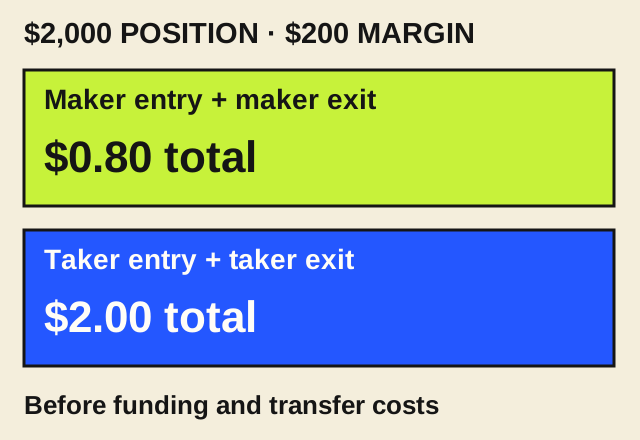
Assume a 200-dollar trading balance supports a 2,000-dollar position and the entry and exit have the same value. At the basic rates compared here, the following arithmetic applies to both venues. These are teaching figures, not a recommended leverage setting or a prediction of your execution price.
| Entry and exit | Calculation | Total |
|---|---|---|
| Both maker | 2,000 × 0.02% × 2 | $0.80 |
| Maker entry, taker exit | 2,000 × (0.02% + 0.05%) | $1.40 |
| Both taker | 2,000 × 0.05% × 2 | $2.00 |
A one-percent adverse move in a linear 2,000-dollar position produces roughly a 20-dollar loss before costs: ten percent of that 200-dollar margin. That is far more important than the 1.20-dollar difference between the cheapest and most expensive execution rows. A lower fee does not rescue a position whose exposure is too large.
A limit order is not automatically a maker order. If it can fill immediately against an existing order, it may take liquidity. A stop that closes at market can also incur a taker fee. Budgeting for a maker entry and a taker exit is often more realistic than assuming both sides receive the cheapest price.
For longer holds, use the live funding figure on the exact contract. Kraken’s perpetual funding is calculated continuously and realised hourly. A published trading fee and a funding rate measure different costs, so a screenshot of one cannot establish the other.
How much of an FCFA budget reaches the trading account?
Central African Republic uses the Central African CFA franc, XAF. A website can display an estimated Bitcoin price in FCFA without accepting XAF as a deposit currency. Kraken’s published cash-funding table does not offer an XAF account; its EUR and USD transfer methods have their own geographic and provider conditions.
Compare the amount credited, not the advertised commission
Suppose a lawful conversion provider quotes a total debit of 120,000 XAF and a final credit of 190 USDT after all its charges. The effective purchase cost is 631.58 XAF per USDT. A second quote of 120,000 XAF for 195 USDT works out at 615.38 XAF per USDT. The second delivers five more units of trading money even if the first advertises “zero commission”. These are invented quotes for comparison, not current CAR offers.
If the first quote is followed by a separately charged 2 USDT transfer, only 188 USDT arrives. Its effective cost becomes 638.30 XAF per credited USDT. Include that last transfer when comparing the offers; otherwise the cheapest-looking seller can become the more expensive one before a futures order is even opened.
For a bank-funded account, ask for the final currency and the full international-transfer charge. A local XAF account is not a SEPA account merely because the CFA franc is linked to the euro. Sending the wrong currency to a EUR deposit instruction can mean a return, a conversion or extra costs.
Can you deposit or withdraw through Orange Money?
Orange Money is relevant to everyday payments in Central African Republic, but it is not listed as a direct Kraken derivatives deposit method. Orange’s own account of its local business confirms its mobile-money presence. That establishes a local payment service, not a connection to either exchange recommended here.
The Orange–Mastercard announcement includes Central African Republic among the planned rollout countries. It does not prove that a particular customer already has the card, that an exchange purchase will be accepted, or that a card can receive a futures withdrawal. Those are separate capabilities; a Mastercard logo is not enough to promise the complete journey.
The practical choice is to use a funding method that both your verified exchange account and your payment provider actually support. If your only balance is Orange Money and no permitted conversion method is available to you, practise first rather than sending it to an unofficial “exchange agent”. Do not give that person your exchange login to complete the deposit.
For an offered cash-out, write down the final XAF received after the seller’s rate, any wallet fee and any cash-withdrawal charge. A trading profit of 10 USDT can disappear if the complete exit costs more than 10 USDT. This is why the withdrawal quote belongs in the decision before the first live trade, not after it.
Is Bitcoin still legal tender, and do you need Sango?
The 2022 Bitcoin legal-tender announcement is not the current answer. The IMF’s 2023 programme documents record the repeal of the legal-tender and guaranteed-convertibility provisions. An article that still relies only on the original announcement leaves out the change that matters to someone expecting a guaranteed cash conversion.
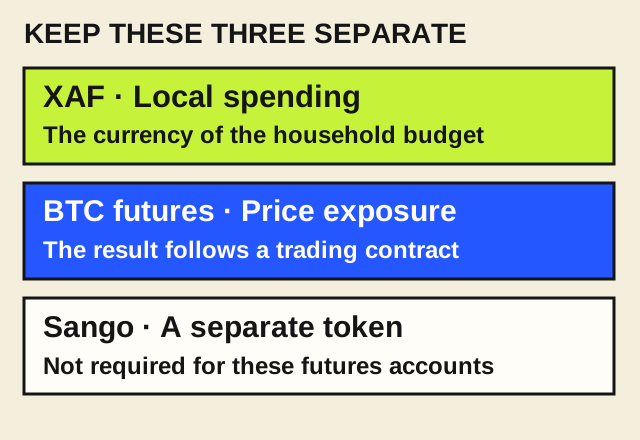
You do not need to buy Sango to use the international Bitcoin futures products described above. The IMF’s separate study explains Sango’s token project and its relationship to the country’s earlier crypto initiative. Neither is the same as owning Bitcoin, and neither supplies the margin for a contract unless an exchange explicitly supports that asset.
Our exchange availability labels describe provider coverage, not a CAR-issued derivatives licence. The local banking and foreign-exchange rules still matter when money is moved from a resident’s account. The useful conclusion is that exchange choices exist, while a national crypto announcement cannot be used to promise a bank transfer, local protection or state-backed returns.
Buying Bitcoin, going long or hedging: which do you need?
A CAR resident who simply wants to hold Bitcoin does not need a leveraged contract. A fully paid spot purchase has no futures liquidation threshold. A long future adds price exposure while committing less initial margin, but introduces a position that can be closed by the exchange if its margin becomes insufficient.
For someone who already owns Bitcoin, opening another long position increases exposure rather than protecting that holding. Suppose an existing 0.01 BTC is worth 600 dollars when Bitcoin trades at 60,000. Adding a linear long of another 0.01 BTC roughly doubles the response to a small price move. A 1,000-dollar fall in Bitcoin then produces about 10 dollars of loss on the holding and another 10 on the future, before fees.
A short future can instead offset some of the holding’s dollar price movement. In that simplified example, a 0.01 BTC short would gain roughly 10 dollars while the coin loses roughly 10. Funding, fees, price differences and liquidation still prevent this from being a cost-free guarantee. Nor does a dollar hedge fix the eventual XAF conversion rate.
That is the choice to settle before comparing leverage limits: buying an asset, adding exposure and reducing existing exposure are different jobs. A Sango purchase does not substitute for a BTC hedge, because a separate token need not follow the Bitcoin contract’s price. Choose the instrument whose price actually matches the exposure you intend to change.
What should you test before using real money?
Start with the contract you intend to use, not a different spot-market screen. A practice BTC perpetual helps answer three concrete questions: what quantity represents your intended exposure, how much a small move changes the balance, and how the exit order behaves. A successful practice trade does not establish live account eligibility or prove that a withdrawal will work.
Kraken provides a derivatives demo with separate holding and trading wallets. Move the virtual balance into the intended contract wallet and open a small example position. Then close it and reconcile the result. This is useful for learning the account layout without paying a conversion or international-transfer fee from Bangui.
On Kraken Pro derivatives, attached take-profit and stop-loss orders can use mark, index or last price as their trigger. Choose deliberately: a price displayed on the chart may not be the trigger you selected. The objective is to understand which event sends the closing order, not to memorise three technical labels.
A stop is also not an exact-price guarantee. In a fast market the execution may differ from the trigger; a limit-based exit may remain unfilled. Size the position so an imperfect exit is survivable, and confirm that the protective order was accepted before relying on it when the phone is offline.
How do you turn the result back into usable money?
Closing a futures trade settles the position inside the exchange account. It does not automatically send money to a bank or mobile wallet. Kraken’s derivatives agreement describes transferring assets back to the spot account before an external withdrawal, unless the platform explicitly offers another method.
Keep three amounts separate: the displayed account value, the amount currently free to transfer, and the amount the recipient will receive. Open positions and orders can keep collateral in use. A profitable trade is not a reason to empty the account while another position still relies on that balance.
For a crypto withdrawal, the receiving service must accept the same coin on the same network. A cheap network is useful only when both ends support it. Check the minimum and fee against the amount being sent: repeated tiny transfers can consume a disproportionate part of a small FCFA-funded account.
For a bank withdrawal, confirm the currency the bank receives and the amount it will credit after conversion to XAF. Keep the original funding record, the trading statement and the final withdrawal record together. They explain the source of the proceeds far better than a screenshot showing only a profitable position.