
















Bybit or Bitget: which should you choose?
Bybit for manual trading
A lower published basic taker fee, plus flexible exits for a position you manage yourself.
Read the verdictBitget for copy trading
A specific alternative if following a trader is the feature you need; include the profit share in the cost.
Read the verdictBoth choices serve a different purpose, and Chad is absent from their reviewed exclusion lists. Pick manual trading if you want to set each position and its exit yourself; pick a copy service only if allocating money to another trader’s decisions is the intended product. The analysis below includes the extra cost of that distinction.
Why Bybit is our first pick for Chad
The useful combination is a USDT-settled futures account, a published non-VIP fee schedule and exit orders that can cover either a whole position or part of it. A Chad resident starting with USDT can follow the account result in the same unit instead of adding a changing Bitcoin collateral balance to the trade.
An exit for the whole position or just part of it
Bybit’s take-profit and stop-loss tools distinguish an entire-position exit from exits for selected quantities. For example, someone holding 0.02 BTC of exposure might want to close 0.01 BTC at the first target and leave the remaining 0.01 BTC with a different exit. That is a real use for the feature; it is not simply another menu item to list in a review.
The important question on a phone is whether the accepted exit covers the quantity still open. If a partial order closes half the trade, recheck the remaining quantity and its protection. A screenshot of the original full position is no longer a reliable guide to the current exposure.
For this use we favour a single USDT pair and an explicit exit over adding several correlated altcoin positions at once. Three different coin tickers can still fall together. Splitting one large exposure across them does not necessarily make the account easier to manage when you are away from the screen.
When does Bitget justify a separate account?
Bitget’s copy-trading product is a reason to examine it separately from manual futures. Its published product-fee guide says followers can pay a share of realised profit in addition to the normal trading and funding costs. The stated typical share is 10% to 20%; use the actual lead trader’s terms rather than assuming the lowest figure.
Consider a simplified 100 USDT profit subject to a 15% sharing rate. The share is 15 USDT, leaving 85 before any other costs not already included in that profit figure. If a performance card displays a return before sharing, it overstates what the follower keeps. First establish what the displayed number includes so fees are neither ignored nor counted twice.
Copy trading also does not promise the leader’s entry price. Your allocated amount, order execution and the point at which you began following can produce a different result. A strong past percentage is less useful than the largest drawdown, the leverage used and how the account behaves during losses.
Our verdict is therefore narrow: Bitget is worth considering for a person who has deliberately chosen copy trading and understands the extra charge. For a manual BTC or ETH order, the specific advantage disappears and Bybit’s slightly lower basic taker cost is the more direct reason to choose.
How much cheaper is Bybit in practice?
The standard rates reviewed are 0.02% maker and 0.055% taker at Bybit, compared with 0.02% maker and 0.06% taker at Bitget. Promotions and VIP tiers can change the price. The comparison uses the same 3,000 USDT position value at entry and exit, with no price movement.
| Execution | Bybit | Bitget |
|---|---|---|
| Taker entry and exit | 3.30 USDT | 3.60 USDT |
| Maker entry and taker exit | 2.25 USDT | 2.40 USDT |
| Maker entry and exit | 1.20 USDT | 1.20 USDT |
The largest difference in this example is 0.30 USDT. If funding an additional account costs 3 USDT, ten equal taker round trips would be needed just to recover that transfer cost, assuming everything else stays equal. For an occasional trader already on Bitget, switching for this fee difference alone is a weak argument.
For someone choosing a first account, the advantage is still useful because there may be no switching cost. For a trader entering frequently, add the actual monthly turnover and compare it with the account’s real fee tier. The right conclusion depends on how the platform will be used, not on printing “lowest fees” above every signup button.
When is funding charged in N’Djamena?
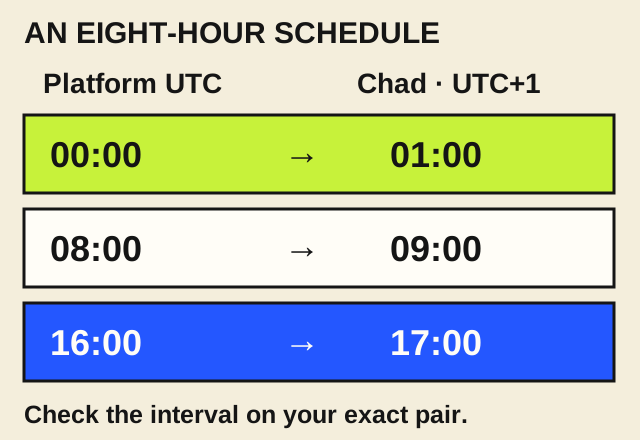
Chad uses UTC+1. If a perpetual contract’s funding times are 00:00, 08:00 and 16:00 UTC, the corresponding local times are 01:00, 09:00 and 17:00. Reading the platform’s UTC clock as local time can leave a position open for a payment you did not plan to make.
Bybit states that funding intervals can differ between contracts. Do not apply the eight-hour example to every altcoin. Open the exact pair and read both the countdown and the rate; an hourly charge cannot be compared fairly with an eight-hour rate without accounting for the number of payments.
Should you close before the payment?
Suppose a 3,000 USDT long position would pay a hypothetical 0.01% funding charge: 0.30 USDT. Closing and reopening at Bybit’s standard taker rate would cost about 3.30 USDT if the position value stayed unchanged, before the spread. Exiting solely to avoid that one payment would cost more in this example.
At a hypothetical 0.20% rate, the same single payment would be 6 USDT. That is a different decision, although closing and reopening can still change the entry price and expose you to a market move. These examples show why the payment amount matters more than the fact that a funding timer is about to reach zero.
Funding is paid between the two sides of a perpetual market and its direction can change. A short position is not guaranteed to receive it. For a position held over several days, review the accumulated payments in the history rather than multiplying today’s estimated rate by the entire holding period.
Can a stop protect the position when your phone is offline?
An accepted exchange-side order does not need a chart to stay open on your phone. But an order you typed and never submitted provides no protection. Before leaving the app, check the active order or position record rather than assuming a saved form has reached the exchange.
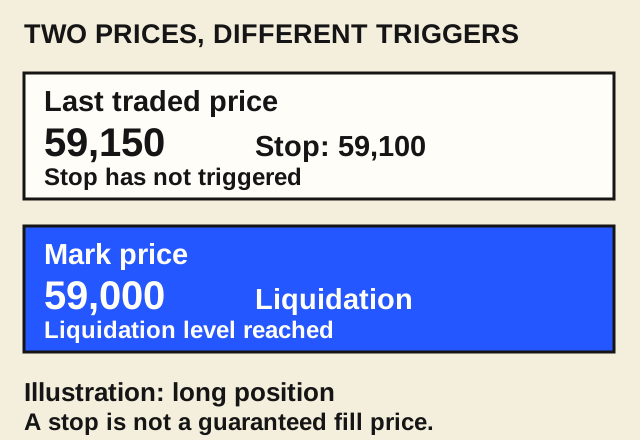
Bybit uses mark price for liquidation. A stop can instead be set to last-traded price, which may move differently. If the stop is too close to liquidation, the account can be liquidated before the selected stop trigger is reached. This explains a common apparent contradiction: the chart seems not to have hit the stop, yet the position has closed.
Imagine a long position with liquidation at a mark price of 59,000 and a last-price stop at 59,100. The mark price could reach 59,000 while the last price is still 59,150. The last-price stop has not triggered, but the liquidation condition has. The figures illustrate the two-price issue; actual liquidation also depends on the account and margin mode.
A mark-price stop aligns the trigger reference, but it does not guarantee execution before liquidation in a fast move. Nor does a stop-limit promise an exit: its limit protects the minimum acceptable price and may prevent a fill. For an exit whose priority is getting out, understand the difference before choosing a limit solely because it looks cheaper.
How much money is actually committed to the trade?
A leverage slider is not the size of the trade. With 300 USDT assigned as margin and a 1,500 USDT linear position, the exposure is five times that margin. A one-percent move changes the position result by about 15 USDT before costs, whether the account contains another 100 USDT or another 1,000 USDT elsewhere.
Bybit offers different margin settings, and its USDT contract documentation explains automatic margin replenishment for supported isolated positions. If that setting is active, available account funds can be added to a position to reduce the immediate liquidation risk. That means the initial margin allocation is not the complete amount the feature may use.
If the intention is to keep the trading experiment separate from money needed in FCFA, check automatic replenishment and the actual margin mode before opening the order. Do not assume that leaving extra money in the trading account automatically keeps it outside the position’s risk. The chosen settings matter more than the account’s marketing label.
For a small first position, define the maximum planned loss in USDT and translate that budget into the XAF amount spent obtaining it. Do not calculate risk from the largest order the platform allows. The purpose of leverage is to change the margin required for an exposure; it does not make a given exposure’s price movement smaller.
What can Airtel Money do for this account?
Airtel Mobile Commerce Tchad appears among the authorised payment institutions in COBAC’s 2024 annual report. That is meaningful evidence about the local payment business. It does not make Airtel the custodian of a Bybit or Bitget position, and it does not establish a direct Airtel-to-futures deposit service.
COBAC’s 6 May 2022 notice addresses crypto-related activity by supervised institutions, including holding, conversion and settlement restrictions. It is the reason a payment provider’s ordinary transfer service cannot simply be presented as permission to fund every crypto trade. The exchange’s country list and the permitted use of a local payment account answer different questions.
For an existing, lawfully acquired crypto balance, compare the receiving network and deposit requirements in the verified exchange account. For money still in Airtel or a Chadian bank account, establish a permitted conversion and funding method before moving it. This page does not quote a local USDT seller or an Airtel crypto tariff because neither was confirmed in the primary materials reviewed.
If a payment fails, identify where it stopped. An Airtel transaction reference concerns the local payment; a blockchain transaction hash concerns a crypto transfer; an exchange deposit record concerns the account credit. Send the relevant reference to the provider responsible for that stage. Retrying the whole payment can create a second debit while the first is still being investigated.
Which identity should you use to open the account?
Use the real Chadian residence and the valid document type requested by the exchange. ANATS is the national secure-document authority for identity cards and passports. An NNI identifies a person in the national system; it is not a promise that an exchange will accept a number alone instead of the document and facial checks shown in its verification flow.
If a name is written differently in a French or Arabic document and a funding account, resolve the mismatch before depositing. Use the document’s actual spelling and the verification form’s instructions rather than inventing an English version. A matching account owner makes a later ownership check easier to explain.
Chad and Sudan are separate eligibility cases. The reviewed Bybit and Bitget lists exclude Sudan but do not list Chad. A Chadian resident should not select Sudan, Cameroon or another neighbouring country because a phone prefix or payment provider looks familiar. Likewise, a Chadian passport does not override the rules of a different country where its owner now lives.
How should you plan a withdrawal from Chad?
Decide first whether the destination is another crypto account, a personal wallet or a supported cash service. A futures trading balance and Bybit’s Funding Account serve different purposes; the interface may require an internal transfer before an external withdrawal. Open-position collateral is not necessarily free to move.
Bybit publishes a fixed on-chain withdrawal fee for the selected coin and network, shown in the withdrawal window. If the screen hypothetically charges 2 USDT, a 20 USDT withdrawal loses ten percent to that fee, while a 200 USDT withdrawal loses one percent. This is an illustration, not a current USDT-network quote.
That does not mean leaving a large balance on an exchange indefinitely is the answer. Compare the transfer cost with the custody exposure and the amount actually needed for trading. A test withdrawal establishes that one destination and network work; it does not guarantee future processing speed or the availability of a local cash buyer.
Once a receiving service converts the proceeds into FCFA, compare the final XAF credit with the original XAF spending. Keep trading gains, transfer fees and conversion differences as separate entries. A positive futures result can still leave less local spending money if the route in and out was expensive.