Can you use a crypto exchange in Sudan?
CBOS Circular 9/2022 reaches banks, other financial institutions and individuals or legal persons. Its coverage of the customer as well as the intermediary is why an offshore website accepting registrations does not resolve the domestic restriction.
| Question | Finding | What to do |
|---|---|---|
| Can a Sudan resident trade through our recommended partner? | No recommendation under the CBOS prohibition | Do not fund a new futures account. |
| Are all ordinary transfers involving Sudan prohibited by US sanctions? | No blanket answer: the old comprehensive restrictions were revoked | Check the actual parties, bank and remaining targeted measures. |
| Can a licensed Sudanese wallet handle ordinary payments? | Yes, within that provider’s authorised service and current reach | Compare the recipient’s usable balance or cash, not a crypto advertisement. |
A working registration form does not change the first answer. Neither does an account that was opened before the war or before the circular. The relevant question is whether the activity is permitted now, not whether the website successfully loads on a phone.
There is consequently no “best exchange” winner here. The useful comparison is between an exchange account you should not newly fund, an existing balance that may need an orderly resolution, and payment claims that must not be mistaken for futures access. Those cases are dealt with separately below.
Is Sudan still under US sanctions?
Sudan still has targeted sanctions, but describing the country as subject to the old comprehensive US embargo is outdated. OFAC says the broad prohibitions under the former Sudan programme were revoked in October 2017. The removal of Sudan’s State Sponsor of Terrorism designation took effect in December 2020. Separate Sudan and Darfur authorities remain, including the 2023 executive order addressing destabilising activity.
For an existing exchange account, ask whether a sanctions hold concerns a named recipient, an intermediary or the provider’s own country policy. It does not follow that every Sudanese customer is personally sanctioned. The account’s actual rejection reason determines whether updated documents or a sanctions review could resolve it.
Why an exchange may still say no
A company can choose to serve fewer countries than sanctions law would theoretically allow. Bybit’s Sudan exclusion is one such practical access barrier. Removing a sanctions obstacle would not compel it to accept the account, and would not repeal Sudan’s domestic crypto rule.
Does your location inside Sudan change the answer?
It can change whether money is reachable, even when it does not produce a different exchange recommendation. A person displaced from Khartoum, a recipient in Darfur and a customer able to use a branch in Port Sudan can face very different combinations of branch access, agent liquidity, communications and identification records.
The World Bank’s 2025 reporting documents severe disruption to financial services and a banknote replacement process concentrated in areas controlled by the Sudanese Armed Forces. Treat that as dated evidence of uneven financial access, not a live map of territorial control in September 2026. A town’s position in a report is not proof that its branch or mobile network works today.
For an existing crypto-account problem, this uneven access affects what you can verify: the latest filled order, a support reply or the credit at a permitted receiving institution. A provider’s completed withdrawal does not by itself establish that the money is usable at your current location. Keep the receiving institution’s confirmation separate from the exchange record.
Changing residence is different from selecting a different country
If you have genuinely relocated abroad, use the destination country’s rules and your actual residence documents. Keep nationality and residence separate when an application asks for both. A Sudanese passport is not evidence that you still live in Sudan; a foreign SIM card is not evidence that you live abroad.
An exchange may still review nationality, source of funds or sanctions exposure independently. Request the account decision for your real situation before transferring an existing balance. There is no published exemption established here that makes Darfur or another Sudanese region a separate futures jurisdiction.
What keeps happening to an old position during an outage?
Losing your phone connection does not pause a futures contract on the exchange. A position that remains open can continue to gain or lose value; its funding and liquidation rules do not depend on whether you can see the screen. This is an account-resolution issue for an existing position, not a recommendation to open another one from Sudan.
A saved screenshot is a record of a moment. It does not show whether the order later filled, a stop triggered or the balance changed. When access returns, read the filled-order and position history before repeating the last instruction. Sending a second closing order without checking can create an unintended trade, depending on the order mode.
A pending exit is not a completed exit
A limit order can remain unfilled if the market never reaches its price. A stop that was only drafted on a disconnected phone may never have reached the exchange. The useful evidence is the provider’s accepted order record and its final status, not a button press remembered from before the connection failed.
If account access is blocked, tell support whether a position is open and ask for the authorised reduction or closure process. Include the account identifier, contract and order reference if available. Do not disclose passwords, recovery phrases or one-time login codes to an unsolicited helper claiming to manage the trade for you.
Does a licensed Sudanese wallet authorise crypto trading?
No. The CBOS register lists payment institutions such as MoMo, SudanPay, Cashi, Bravo, Zikher and SAH. Those entries identify payment businesses, not Bitcoin futures licences. Bankak is a bank-account service, and its transfer functions should not be presented as a substitute crypto exchange.
An advertiser accepting one of these familiar payment methods is still a separate counterparty. The local app does not certify the advertiser’s claimed trading account or repeal CBOS Circular 9/2022. A copied payment licence is particularly unhelpful when the product being sold is a leveraged crypto position.
This distinction also matters for an existing balance. A provider’s proposed payout must be permitted for the actual account and transaction, and the recipient must be able to use it at their location. A domestic wallet logo alone does not establish a supported exchange withdrawal integration. Keep the account-resolution request with the real exchange rather than paying an intermediary to invent that integration.
Can USSD manage a crypto account without internet?
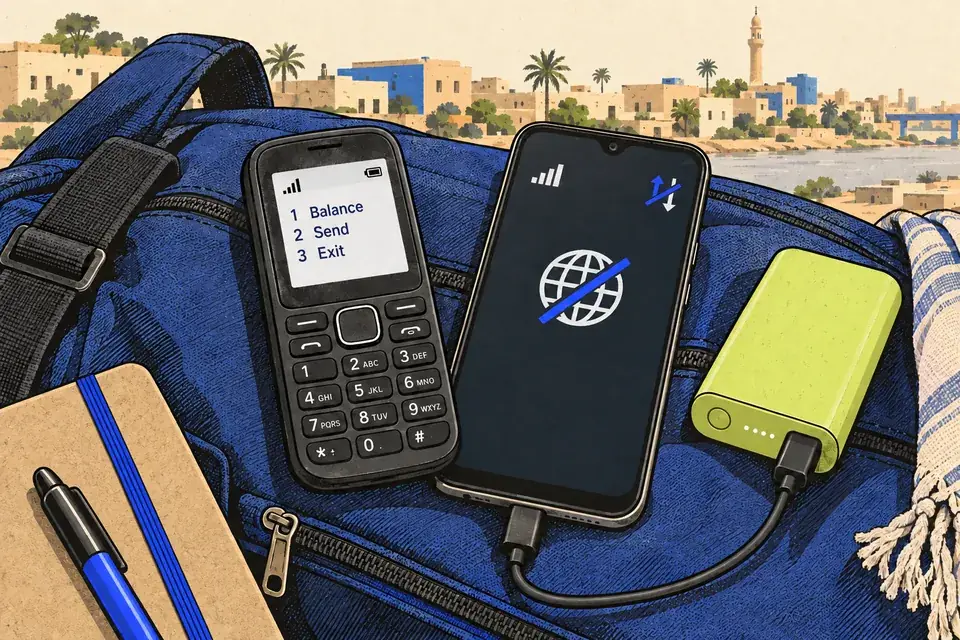
The March 2026 CBOS rules cover financial services using mobile-network menus, including payments and balance enquiries. They do not create a USSD interface for an overseas futures exchange. A phone might make an ordinary wallet payment while still being unable to manage an existing leveraged position.
For a displaced customer, separate access to the device, the SIM and the exchange account. A replacement phone can restore the app while leaving the original authenticator unavailable. A working SIM may receive messages but not restore an account whose identity review is pending. These are different recovery tasks and should be described separately to the provider.
Keep recovery information usable offline
Store your account identifier and official support address where a lost phone will not erase them. If the provider supplied backup authentication codes, keep them private and secure; they are not documents to send to a chat assistant or a social-media support account. Recover through the provider’s accepted process rather than disabling security at a stranger’s request.
When requesting recovery after losing a device, describe which access is missing: the app password, the authenticator or the registered phone number. The provider can then direct the identity check to the correct problem. Do not start a second account just to obtain a new login; it will not restore the first account’s positions or records.
How do you tell a pending transfer from missing crypto?
First identify where the asset was last confirmed. “Withdrawal requested” can mean it is still inside the sending provider. A blockchain transaction ID means a transaction can be traced on its network. A recipient account credit is a further event. Describing all three as “sent” can lead the wrong provider to investigate the wrong stage.
For an existing balance under review, preserve the original asset, amount, network, address and dated provider messages. Do not edit a statement to replace Sudan with another residence or use a third party’s account as if it were your own. Accurate records are what let the provider assess the permitted resolution for the real holder.
A transaction shown as successful on a blockchain may still fail to credit automatically if the receiving account required a different asset, network or additional identifier. The receiving provider must explain whether it can investigate recovery; an outside agent cannot guarantee it. Avoid sending another transfer simply because the first one has not appeared.
CBOS’s August 2026 instant-payment tender does not change any of these crypto-account states. It is a procurement record for payment infrastructure, not a launched exchange-withdrawal service or a repeal of the virtual-asset circular. That is the relevant limit of the development for this guide.

What if you already have money on an exchange?
Treat this as an account-resolution problem rather than a reason to add collateral. First establish whether the balance is free cash or crypto, tied to an open position, or restricted by an account review. Those states require different actions. An exchange’s refusal to accept new trades does not tell you whether a withdrawal-only process is available.
Use the provider’s authenticated support channel to request the procedure for your account and real location. Ask for the permitted destination, documents and any deadline in writing. Keep the balance statement, case number and records showing how the assets were acquired. Do not send another deposit just because somebody says it will “activate” withdrawals.
What can help with ordinary account identification?
Bank of Khartoum’s remote onboarding page gives a concrete example of local banking documentation: national identification or a passport, phone and email details, a face image and a signature. Its stated acceptance of an expired passport is specific to that bank’s onboarding page. It must not be carried over to an overseas exchange with different document rules.
Kraken’s general verification guidance, for example, has its own identity and address requirements. If records were lost during displacement, ask the actual institution which alternative it accepts; another provider’s exception is not a substitute. The answer you need is a permitted resolution of an existing account, not an invented Sudan trading recommendation.