













Can an Eritrean resident actually fund crypto futures?
For a person living in Eritrea and starting with money in the domestic banking system, we do not recommend funding an offshore crypto-futures account. The decisive issue is moving the capital lawfully: the July 2025 ESAAMLG assessment describes outward remittances as prohibited, with exceptional government-approved payments such as medical expenses. It does not identify an ordinary retail investment transfer service.
| Your position | Useful next decision |
|---|---|
| Live in Eritrea; funds are in a local bank | Do not treat signup approval as permission to send investment capital abroad. |
| Live in Eritrea; already have a foreign balance | Review the existing account, lawful use of those assets and product eligibility separately. No automatic green light. |
| Eritrean citizen genuinely resident abroad | Use the rules for the actual residence and the provider’s identity requirements. |
| Only want to understand leverage | Use unfunded calculations; depositing money is not necessary to learn the mechanics. |
The platform catalogue is retained for coverage. Its provider-access labels do not promise a permitted local funding method. In particular, a wallet-connected service being technically reachable does not answer the remittance or investment question. We therefore do not turn those entries into a signup recommendation here.
Did the September 2026 sanctions change open crypto trading?

On 18 September 2026, OFAC announced the expiry of the Ethiopia-related emergency and removed associated designations. The listed removals include the Eritrean Defense Forces, the People’s Front for Democracy and Justice, Red Sea Trading Corporation and Hidri Trust, as well as named individuals. An account review that relies on those specific designations should be assessed against the new official record.
The UN’s Eritrea sanctions regime had already ended in November 2018. These are separate events. An old article can be wrong by describing the UN regime as still active, while another can be wrong by claiming that the newer US action made every financial service automatically available.
What the announcement does not decide
It does not instruct an exchange to approve your account, certify a payment provider, change a futures contract’s eligibility or authorise a domestic bank to send your investment abroad. A provider may have additional policies and screening obligations. The correct question is which restriction applied to your specific transaction and whether that particular restriction has changed.
If a service tells you an existing account is blocked solely by one of the removed designations, request a fresh review with the official reference and your account details. That is a reason to correct stale screening, not a guarantee of release. Avoid sending a new deposit to “test” whether the system has caught up.
Why receiving money is not the same as sending trading capital
The ESAAMLG report describes Himbol’s service as inward remittances and records a small domestic banking system. It also reports no securities sector. Those observations explain why a family-support payment arriving successfully is poor evidence for the reverse journey into an overseas futures account.
For example, a relative abroad sends support to a household in Asmara. The recipient obtains spendable domestic funds. That event does not establish that the recipient can instruct the same service to buy USDT or wire an equivalent sum to a foreign exchange. The receiving and sending services have different purposes and permissions.
A relative offering to trade on your behalf creates another problem. Whose money is it, who owns the account, who bears the loss and who is entitled to withdraw? Calling the arrangement a gift while expecting the money and profits back does not resolve those questions. Do not build a leveraged position around a payment story that differs from the real arrangement.
Keep household cash outside the trading plan
Money needed locally should not depend on closing a foreign derivative and finding a way to turn the proceeds into usable nakfa on time. Even if a foreign platform processes a withdrawal promptly, that only completes its leg of the journey. It does not establish when the household receives funds or on what permitted terms.
This is why the page does not calculate a neat ERN profit from a foreign trading screenshot. Multiplying dollars by an exchange rate gives an accounting value; it does not show that the money can be converted and delivered. A quote must identify the service, the permitted transaction and the actual amount the recipient gets.
What if you are Eritrean but live in another country?
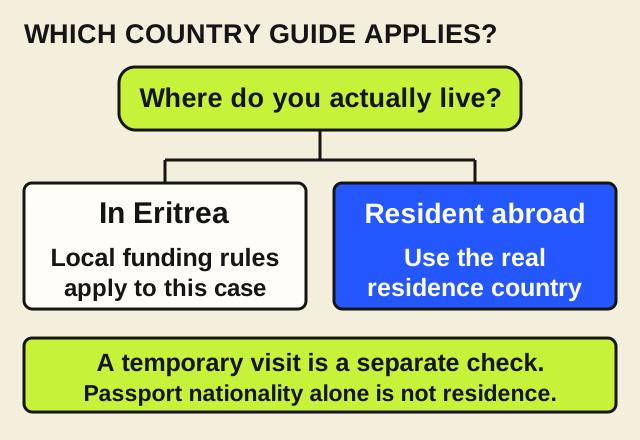
Start with where you genuinely live, then give the exchange the nationality and document information it separately requests. An Eritrean passport is not itself evidence that the account holder lives in Eritrea. Equally, a foreign SIM card or a short trip is not evidence of established residence abroad.
A person living in Canada needs the Canadian product rules. Someone established in the United Kingdom needs the UK rules. These pages can lead to a different conclusion from an offshore exchange’s global product menu, even when the same passport is used. Do not choose the most permissive country in a dropdown; choose the truthful one.
Moving and visiting are different events
If you relocate, update the provider with the documents it accepts for the new residence. Ask what happens to existing positions, cash withdrawals and products that are not offered under the new account terms. Moving the legal account relationship is not necessarily an instant setting change.
If you only visit Eritrea, tell the provider the real situation when checking access. A platform can distinguish residence-based eligibility from restrictions on the location from which it is accessed. For example, Bitget’s terms discuss the effect of travel to a prohibited jurisdiction; that illustrates why an approved home-country account is not a promise of uninterrupted access everywhere.
The practical conclusion is to resolve travel access before relying on the account to manage an open leveraged position. Do not discover during a price move that authentication, account access or the product itself is unavailable from the destination. A VPN is not a substitute for the provider’s permission.
Does owning USDT abroad make futures available?
An existing crypto balance removes the need to buy the first token; it does not settle whether that balance may be used for a new leveraged trade. For an Eritrean resident, separate the local treatment of those assets from the exchange’s actual product permission. The documented outward-remittance restriction should not be stretched into a claim that every Eritrean’s existing foreign wallet is identical.
The provider needs to answer for the verified residence, account entity and requested product. An exchange can allow an existing balance to remain or permit a resolution process while declining new futures activity. A deposit address is only an address for receiving an asset; it is not a futures approval notice.
What changes with a wallet-connected exchange?
A DEX may let you connect a wallet without a conventional customer dashboard. The person holding the keys can authorise transactions, but that does not establish permission to use the trading service from a particular country. Website terms, local rules and the supported chain still apply. It also introduces a separate question: which contract receives the tokens when the wallet approves them?
For a person whose assets are already abroad, compare that custody arrangement with an exchange account before moving anything. In a hosted account, the provider controls the account’s withdrawal process. With a self-custody wallet, the recovery phrase controls the wallet, while a deposit into a trading protocol brings in the protocol’s own rules and risks. Neither arrangement changes the source of the money or the owner’s true residence.
A sanctions update is useful for a specific review
Why a margin call is especially awkward here
A leveraged account needs usable collateral, not merely wealth somewhere else. An Eritrean bank balance, funds held by a relative overseas and money already in a trading account are separate resources. A trading system cannot assume you will obtain permission for a new transfer before its liquidation threshold is reached.
Here is a hypothetical example rather than a live product quote. A trader posts 200 USD against 1,000 USD of exposure. A 3% adverse move creates approximately 30 USD of price loss before fees: 15% of the starting collateral. A further 4% move measured from the original entry would add about 40 USD of loss at unchanged exposure. The account does not wait for a local branch to open.
That does not mean the position necessarily liquidates at either point. Maintenance requirements, fees and the contract’s price calculation decide that. It means “I can add more tomorrow” is an unreliable part of a risk plan when the additional money is not already lawfully usable by the account.
A protective order can reduce dependence on watching the screen, but it is not a fixed-price guarantee. A stop that triggers a market order can fill at a worse price; a stop-limit order can fail to fill. A planned maximum loss and a guaranteed maximum loss are different things.
Compare an exposure supported by funds already usable under the account’s rules with one that depends on a rescue transfer. The second is a poor fit here, regardless of the platform’s advertised leverage.
Already have a foreign trading balance?
Identify what is preventing access before choosing another platform. A rejected password, an identity review, a product restriction, a sanctions hold and a rejected withdrawal are different problems. Moving to a new exchange does not necessarily resolve the original one and can add another identity and source-of-funds review.
- For an identity mismatch, reconcile the name, date of birth, document and actual residence using the provider’s official process.
- For a product restriction, establish whether closing existing positions or withdrawing unused funds remains possible.
- For a stated sanctions hold, ask which authority and restriction is involved; use current official records when requesting correction.
- For a missing payment, retain the transaction reference, beneficiary and amount instead of relying on a balance screenshot.
Ask for a response about the actual operation you need, such as withdrawing an existing cash balance to an approved own-name account. “Can I use your platform?” can receive a general marketing answer that does not address a specific withdrawal or existing open position.
Do not pay someone to impersonate you or “clean” the source of funds. An intermediary’s promise of release is not evidence that the provider will accept the transaction. If the account contains an open derivative, separate the question of reducing market exposure from the question of moving the remaining funds: both need a clear answer, but they are not the same operation.
Can you learn futures without sending any money?
Yes: the basic arithmetic can be practised with a notebook or spreadsheet. You do not need to buy crypto, connect a wallet or sign up under a different residence to understand how exposure changes an outcome. Use hypothetical numbers and mark them clearly as an exercise.
| Starting practice capital | Exposure | Loss from a 2% fall | Share of practice capital |
|---|---|---|---|
| 100 units | 100 units | 2 units | 2% |
| 100 units | 500 units | 10 units | 10% |
| 100 units | 1,000 units | 20 units | 20% |
Then add the costs that a polished profit screenshot often omits: an entry charge, an exit charge, any funding payment and a worse exit price than expected. Keep the exposure constant while changing one cost at a time. This reveals whether a small forecast gain disappears before it could become spendable money.
A crypto perpetual exercise should also record the funding payment shown for the chosen market and whether the planned stop would actually have triggered. Watching only the candle’s last price can miss a different trigger setting. Write the intended order down before the price moves; changing it after seeing the outcome turns practice into hindsight.
The outcome of this exercise should be an understandable account of profit and loss, not confidence that a payment restriction has been solved. If you cannot explain why a 2% market move consumes 20% of a ten-times-leveraged practice balance, a larger real deposit would not fix the gap.