











Which platform should a Comoros resident choose?
| Need | First choice | What decides it |
|---|---|---|
| Regular USDT perpetual trades | MEXC | A country-specific fee reference and supported mobile-app regions; confirm the actual contract rate. |
| A contract with a scheduled ending date | Bybit | An expiry contract can replace repeated perpetual funding with a different price and settlement cost. |
| Money needed soon for local spending | Keep that part in KMF | Neither a volatile coin nor a leveraged position is a cash substitute. |
Bybit is the alternative when a fixed contract expiry fits the plan better. It publishes both perpetual and expiry products, with a separate charge for automatic settlement. A person expecting to hold for weeks should compare that total against perpetual funding, rather than assuming the lowest opening fee makes one venue best for every trade.
Our recommendation concerns residents whose verified accounts qualify for the relevant product. Comoros is absent from the reviewed MEXC and Bybit exclusion lists. A fee notice, an app-store listing and account approval are different pieces of information; none is a claim of protection by the Banque Centrale des Comores.
What are MEXC’s fees for Comoros?
The regional notice effective 12 December 2025 names Comoros and quotes 0% maker and 0.02% taker without MX holdings. It also describes two optional discounts: a 50% reduction for qualifying holdings of at least 500 MX, or a 20% reduction through MX deduction. They cannot be combined; the notice requires the holding condition to be met before activation.
Those are dated reference terms, not a universal September 2026 quote. MEXC’s current fee page says rates can vary by region and event, and some pairs are excluded from token deductions. Its July 2026 update also describes an expanding zero-fee programme. Use the rate attached to your selected contract and account; do not treat the promotional headline as a promise for every pair.
What those rates would mean for a real-sized order
| Rate scenario | Round-trip fee | Meaning |
|---|---|---|
| 2025 Comoros reference: 0.02% | 1.60 USDT | No MX balance required under that notice. |
| Qualifying 50% discount: 0.01% | 0.80 USDT | Only after the applicable token-holding requirements. |
| A currently eligible zero-fee pair: 0% | 0 USDT trading fee | Funding, spread and other charges can still apply. |
| Bybit published non-VIP: 0.055% | 4.40 USDT | Reference for the same taker-only execution. |
If the 0.02% reference rate applies, its saving against the Bybit example is 2.80 USDT per round trip. That is meaningful for repeated trading, but it is not a guarantee of a better final execution: an extra 3 USDT of slippage would already outweigh it. Compare the amount filled and the fee together.
The account’s trade history is the useful check after a small first order. Divide the fee by the filled order value to see the rate actually charged. For example, 0.20 USDT on a 1,000 USDT fill is 0.02%. A fee charged in another asset must first be valued consistently; do not compare an MX quantity directly with a USDT charge.
Is buying 500 MX worth the discount?
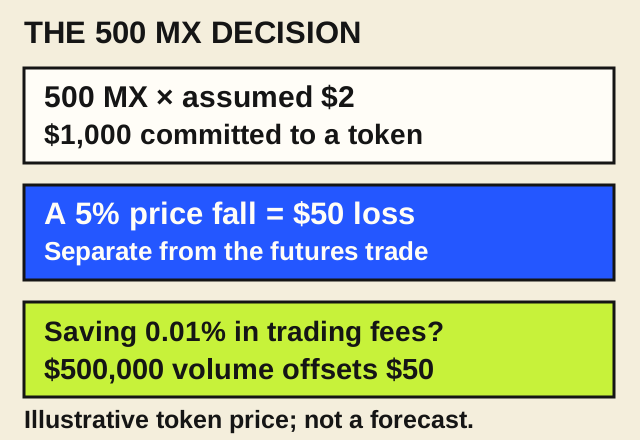
Usually not for a small account bought solely for the discount. The token is an investment whose price can fall, while the fee saving depends on how much you actually trade. “Half-price fees” describes a percentage of a charge, not a guaranteed return on the money spent holding MX.
Take an invented MX price of 2 USDT. Buying 500 tokens costs 1,000 USDT. If their price falls 5%, the holding loses 50 USDT. Reducing a taker rate from 0.02% to 0.01% saves 0.0001 times the filled trading volume. Recovering 50 USDT through that saving requires 500,000 USDT of volume, ignoring every other cost.
For the 4,000 USDT entry-and-exit example above, each round trip contributes 8,000 USDT of volume and saves 0.80 USDT. It would take more than 62 such round trips to offset that hypothetical token loss. Trading extra merely to chase the discount introduces more market risk and can defeat the purpose.
Someone who already intends to hold MX may value the discount differently. Even then, compare the fee actually available without it: if the intended pair already has zero trading fees, buying more tokens cannot lower that charge below zero under the examples here. Do not assume two overlapping promotions multiply together.
Our recommendation is to choose the exchange and contract first, then assess a token programme separately. A plain account at a competitive confirmed rate is a better starting point than turning a 200 USDT trading plan into an additional 1,000 USDT token position.
When is Bybit’s expiry contract worth paying for?
An expiry contract ends on a stated date. A perpetual has no scheduled expiry and exchanges funding payments while it remains open. Bybit’s documentation lists a 0.05% settlement charge when an expiry position is automatically settled. That charge belongs in the comparison alongside the opening trade and any difference between the futures price and the spot price.
Suppose a long position represents 4,000 USDT at both entry and settlement. A taker entry at 0.055% costs 2.20 USDT; automatic settlement at 0.05% costs 2 USDT. The resulting 4.20 USDT is the fee subtotal, not the complete economic cost. This illustration assumes the position value stays constant.
Compare the price premium as well as the fees
If the dated future is hypothetically priced 0.50% above spot at entry, that premium is about 20 USDT on 4,000 USDT of exposure. For a long position held to expiry, the premium can reduce the result relative to buying the same spot exposure. It is not an extra invoice, but it still matters to the comparison.
For contrast, a perpetual with a constant hypothetical positive funding rate of 0.01% every eight hours would cost a long position 1.20 USDT per day at that size. Fourteen days would add 16.80 USDT. Add the trading fees separately, and do not assume the funding rate stays constant in a real market.
With a 20 USDT entry premium plus 4.20 USDT in the dated example, avoiding 16.80 USDT of perpetual funding would not by itself justify the expiry contract. At a much smaller premium or a much higher funding cost, the answer can reverse. Bybit is therefore our fit for a planned expiry, not an automatic lower-cost winner for every long hold.
For a short trade, the direction of the premium and funding benefit changes. Use the side actually intended. Also choose an expiry beyond the planned exit: if the trade must continue after settlement, opening a later contract adds another order and possibly a different price premium.
How do KMF savings translate into a futures budget?
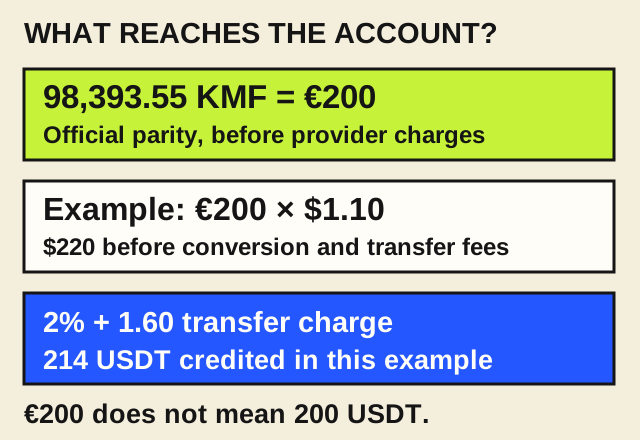
The BCC publishes the fixed euro parity of 491.96775 Comorian francs per euro. Therefore 98,393.55 KMF corresponds to 200 EUR before service charges. It does not correspond to 200 USDT: the euro-dollar rate and the price charged for the stablecoin still sit between those two balances.
If a hypothetical provider converted the 200 EUR at 1.10 dollars per euro, the starting dollar equivalent would be 220. A 2% all-in charge would leave 215.60 units, assuming a dollar-valued stablecoin at parity and no extra transfer fee. If another 1.60 USDT is charged to send it, only 214 USDT reaches the account. These inputs are examples, not live currency or wallet prices.
That distinction matters when setting a loss budget. A plan to risk “twenty” needs a currency beside the number. Twenty euros, twenty USDT and twenty thousand Comorian francs are three very different amounts. Use the final credited balance for the order and keep the original KMF spending amount for evaluating the overall result.
The BCC’s June 2025 public notice states that local transactions use the Comorian franc. A profit left as USDT is therefore not yet the money to budget for ordinary local spending. Plan a permitted conversion back to KMF; do not count the exchange balance and the expected bank credit as though they were already identical.
Can MVola, Huri Money or Holo fund the exchange?
The BCC’s 2023 annual report describes Telco Money, Huri Money and the BDC’s Holo service in the local electronic-money landscape. It also records services such as bank-to-wallet transfers and card-funded wallet top-ups. Those details help identify the payment sector; they do not establish a direct MEXC or Bybit deposit integration.
Do not copy a Madagascar MVola fee into a Comoros calculation. A shared brand does not make an Ariary tariff a Comorian-franc tariff. Use the fee and limits displayed by the Comorian service for the actual transaction. This is especially important when searching online, where a similarly named service can return information for the wrong country.
For an account already holding crypto, the immediate funding task is choosing a network accepted by both the sending wallet and the exchange. For someone holding KMF locally, a permitted conversion service must first supply an actual quote and a supported destination. MEXC’s terms make clear that third-party fiat services have their own conditions.
A remittance from family abroad is not automatically a direct exchange deposit either. Keep the receiving payment account and the exchange ownership clear; a third party sending cash to a trading account can create a different verification problem from sending a personal remittance to a local account. Use the transfer instructions that apply to that service, not a reseller’s shortcut.
Which app should you install in Comoros?
MEXC’s August 2026 supported-region table marks Comoros as available for both iOS and Android. That gives a concrete starting point: follow the store link from the exchange’s official website and check the app publisher. App availability does not mean every financial product or promotion is enabled on every verified account.
Use the residence where you actually live. A Comorian citizen living abroad can face different product rules from a resident of Grande Comore, Anjouan or Mohéli. A nationality-based referral advertisement cannot override a restriction attached to current residence or the entity serving the account.
Before placing the first mobile order, locate the position size, margin mode, funding countdown and closing control. A small phone can hide one of these below the fold. If the review screen shows an exposure far larger than the amount intended, return to the order quantity rather than trying to fix the problem with a different leverage label.
Keep account recovery available independently of a single SIM. Record the recovery method in a secure place and enable the protections offered by the exchange. A person offering a local “managed app” should never receive the password, authentication code or withdrawal authority merely to help install it.
Does a Comoros address mean local financial protection?
No. MEXC’s July 2026 release is datelined Mutsamudu, Comoros. That geographic detail is not a BCC banking authorisation or deposit guarantee. The account contract and the regulator’s actual permissions matter more than the city printed at the top of a press release.
The BCC has specifically warned about offshore financial businesses claiming licences issued by Anjouan or Mohéli. Its regulatory page says banking and financial authorisations fall under Union-level authority and require prior BCC approval. This warning concerns financial permissions; it should not be stretched into a claim that every company incorporated on an island is fraudulent.
When a trading intermediary claims to be “locally regulated”, ask what activity is authorised and which entity holds the permission. A business registration, an offshore certificate and a derivatives licence are different documents. The distinction is particularly relevant here because the country name is used in international financial marketing.
How do you judge the final withdrawal?
Judge it by the Comorian francs that arrive, after all conversions and transfers. Suppose a hypothetical 240 USDT withdrawal is quoted at 440 KMF per USDT, with 1,000 KMF in total local charges. The net credit is 104,600 KMF. Against the illustrative 98,393.55 KMF starting budget above, the difference is 6,206.45 KMF before any tax.
At a quote of 420 KMF per USDT with the same charge, the final credit would be 99,800 KMF. The trading balance is unchanged in this comparison, but the difference from the starting budget falls to 1,406.45 KMF. A cash-out rate can therefore change the local result materially without changing a single futures fill.
Keep a separate record of the starting KMF payment, exchange trading result, withdrawal fee and final KMF receipt. This makes it possible to see whether the platform, the trading decision or the conversion route produced the cost. A screenshot of an unrealised profit is not a substitute for that final receipt.
Withdraw only an amount that is free of open-position commitments and use a destination that supports the selected asset and network. A small test can help confirm the destination, while the minimum and fee shown at the time determine whether the test is practical. No fixed cash-out time is promised here for a bank or wallet we have not tested.