
















Which exchange fits the way you want to trade?
BingX: practise the actual order controls
Start with Perpetual Futures demo; compare merged positions with Standard Futures before risking money.
Read the verdictKraken: keep an existing approved account
Its base derivatives fees match BingX Perpetual on this comparison. A fee-only switch has no demonstrated benefit.
Read the verdict| Your starting point | Better fit | Why |
|---|---|---|
| Learning entry, exit and partial-close behaviour | BingX Perpetual demo | Rehearse the order workflow without buying a live trading balance. |
| Wanting each same-direction entry kept as a separate trade | Review BingX Standard Futures | Its separate-order treatment differs from merged Perpetual positions; compare the spread too. |
| Already approved and properly funded at Kraken | Keep Kraken unless another feature is needed | The published base maker/taker rates do not justify switching by themselves. |
| Only a domestic TZS wallet; funding permission unresolved | Demo only for now | A visible P2P offer is not proof that the funding path complies with local rules. |
Why start with BingX Perpetual Futures?
BingX is our first option to investigate for a Tanzanian reader who wants to learn the controls before committing local savings. Tanzania is not named in the jurisdiction exclusions reviewed, although that is not a local licence or an individual account approval. The concrete advantage here is its Perpetual demo alongside the actual app’s entry and exit tools.
Use the demo to practise something specific: placing an entry, seeing whether it filled, reducing half the position and cancelling an unused order. Being able to do those four things is more useful than achieving a large pretend balance by selecting extreme leverage. Live trading additionally needs lawful funding and approval for the product.
Perpetual and Standard do not organise trades the same way
BingX’s comparison describes same-pair, same-direction Perpetual orders merging into a position, whereas Standard trades remain separate. This changes what you see after a second entry. If you wanted two independent trades with different exit plans, a blended position can be confusing; if you want one managed exposure, the merged view can be simpler.
Suppose an eligible trader buys exposure to 0.01 BTC at $100,000 and another 0.01 BTC at $80,000. Total entry value is $1,800 for 0.02 BTC, giving a $90,000 average. At $88,000, the combined gross loss is $40. The second entry has not removed the first loss; it has changed the total size and average.
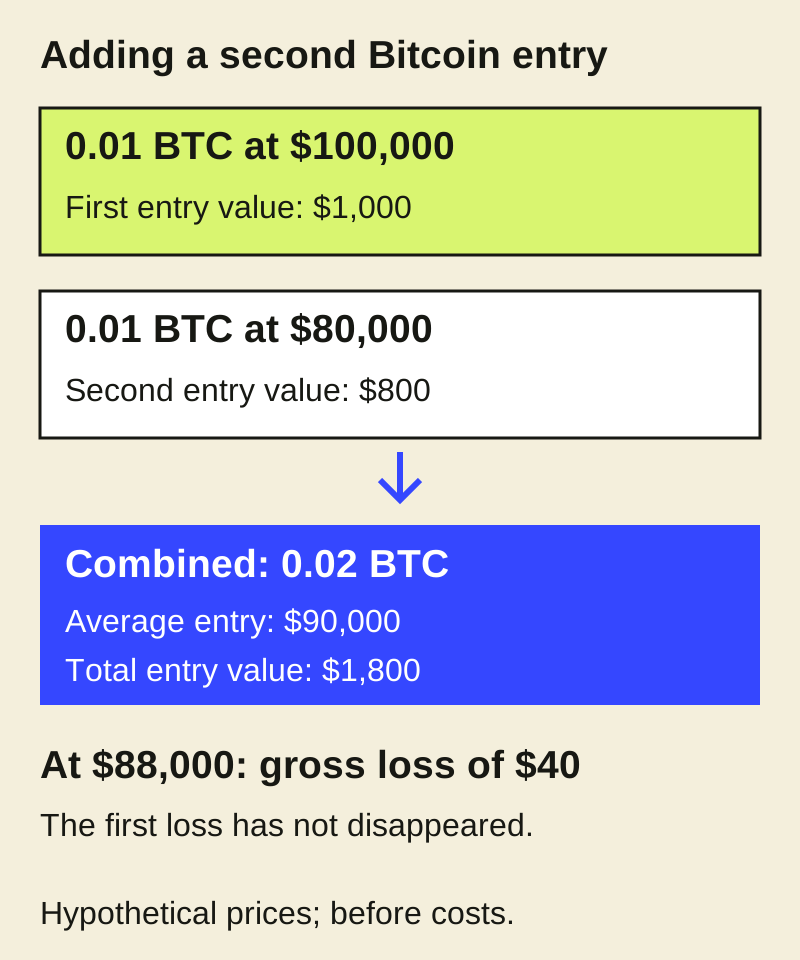
With separately managed trades, the first would show a $120 gross loss and the second an $80 gross gain at that price. Together they still equal minus $40. The difference is control over the individual exits, not a mathematical advantage or a way to avoid loss.
Our choice is Perpetual for a reader who wants one exposure and a broader set of order controls. Standard deserves consideration when separate trade tickets genuinely suit the plan. Do not choose it merely because the word “standard” sounds safer or because a screenshot shows a smaller fee.
Is Standard Futures cheaper than Perpetual Futures?
The published comparison gives Perpetual base fees of 0.02% for maker orders and 0.05% for taker orders, charged on opening and closing. Standard lists a 0.045% trading fee collected at closing. Standard also has spread and holding-cost considerations, so those percentages alone cannot establish the cheaper product.
| Execution pattern | Trading charge only | What remains outside the number |
|---|---|---|
| Perpetual: both orders take liquidity | $1.00 | Spread, funding and money transfers |
| Perpetual: both orders qualify as makers | $0.40 | Non-fill risk, funding and money transfers |
| Standard: 0.045% on the illustrated $1,000 trade | $0.45 | Product spread, holding costs and money transfers |
In this example Standard saves $0.55 against two immediate Perpetual fills before the other costs. A Standard spread or extra holding cost greater than that saving would reverse the result. Against two actual maker fills, Perpetual’s displayed trading charge is already five cents lower. These are break-even calculations, not promises of executable prices.
A limit order only earns the maker rate when it actually adds liquidity. If you need an exit now, waiting indefinitely for a lower fee is a different decision from choosing the cheapest available product. Price the order you are likely to use, including an urgent close, rather than assuming every entry and exit will qualify for the lowest rate.
Read the result after costs
A green unrealised-profit number is not necessarily a net return. BingX’s app guide distinguishes the displayed position result from trading and funding charges. After closing, use the settled transaction record to work out what the trade actually earned. Do not convert a before-cost screen into a claim that a shilling-funded trade was profitable.
When is Kraken the more sensible choice?
If you already have an approved Kraken derivatives account and funds legitimately held there, the case for switching to BingX solely for ordinary execution fees is weak. Kraken’s starting derivatives rates are also 0.02% maker and 0.05% taker. Neither platform wins that particular comparison at the quoted base tier.
A transfer can add a withdrawal charge, a period in transit and an extra account review. Even when those costs are small, they buy no fee advantage in the equal-rate example. We would keep the functioning account unless a feature such as BingX’s particular trade organisation solves a real problem.
For a new customer, check the account and product eligibility before comparing a promotional rate. Kraken’s geographic policy and BingX’s country policy are independent. Approval at one company does not predict approval at the other, and neither provider’s offshore availability overrides the Tanzanian funding rules discussed below.
There is also no established direct M-Pesa-to-Kraken derivatives deposit in the sources used for this article. A local mobile-money balance and an exchange’s accepted trading collateral are different balances. If moving between them is the expensive part of your plan, that cost deserves more attention than choosing between identical base execution percentages.
Is crypto trading banned in Tanzania?
“Everything is banned” is too broad, but “the app accepts Tanzania, so everything is allowed” is wrong too. BoT’s 2019 notice warned about cryptocurrency operations. Its National Payment System Annual Report 2024 later states that cryptocurrencies are not legally prohibited while explaining restrictions on payment providers issuing, distributing or settling virtual assets.
That later distinction matters. It prevents us from deleting every offshore platform from the country catalogue. It also prevents us from presenting a domestic wallet or bank as an approved crypto-funding partner simply because a seller lists it in a payment advertisement.
The July 2026 change includes futures
The Foreign Exchange Amendment published on 17 July 2026 adds a securities definition expressly covering derivatives, options and futures. It amends the 2022 framework rather than replacing it. The type of investment and the origin of the money therefore matter, not just whether a transfer is labelled “USD”.
The principal rules distinguish EAC/SADC prescribed territories from outside investments funded exclusively with externally acquired money. They require relevant securities payments through a bank or financial institution. The externally funded provision remains after the 2026 renumbering; it is not a blanket permission to buy offshore crypto derivatives using any domestic wallet.
For live trading, present the actual exchange, contract and source of money to the bank or qualified local adviser handling the transfer. Ask whether that specific transaction fits the permitted category and what records are required. If the answer is no, an intermediary or a different transfer label does not solve it. The demo recommendation remains usable without pretending that local payment approval has been established.
Does Zanzibar have different exchange or currency rules?
Zanzibar has its own institutions in several areas, but that does not make it a separate country selection for this exchange comparison. The Tanzanian shilling is the currency used on both the mainland and the islands. We have not established a separate Zanzibar exception in the reviewed BingX or Kraken country policies.
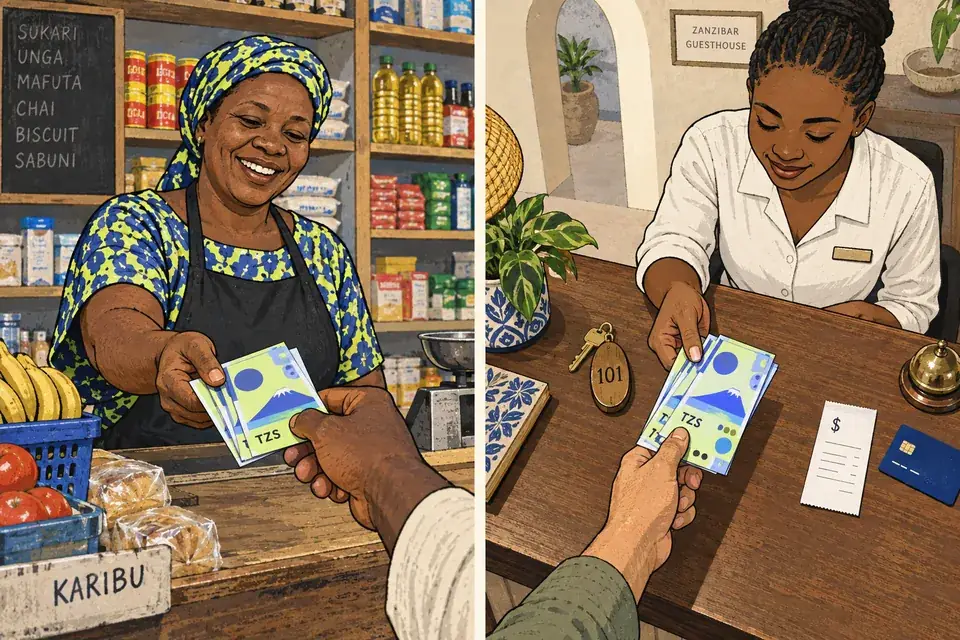
BoT’s tourism clarification allows foreign-currency payments in specified resident/non-resident tourism situations, while payments between residents must be in shillings. A Zanzibar guesthouse accepting a tourist’s dollars is therefore not evidence that a local resident can settle every obligation in dollars—or that USDT is treated as the same thing.
This affects the way you judge your return. If everyday spending is in TZS, calculate the shillings you would actually receive. If the money belongs to a tourism business, do not treat customer receipts or a foreign-currency business account as a personal derivatives budget. The permission to receive a payment for accommodation is about that payment.
Use the real residential address and the document type the exchange requests. Selecting another jurisdiction to make a dropdown look more favourable creates a verification mismatch. Equally, an address on Zanzibar should not be replaced with a mainland address just because a generic online guide ignores the islands.
Can a USDT profit still leave you with fewer shillings?
Yes. The buy and sell quotes can absorb a small trading gain, even before the underlying dollar/shilling rate changes. The following example is deliberately hypothetical; the numbers are not advertised local offers or a recommended payment route.
| Step | Calculation | Result |
|---|---|---|
| Starting amount | TZS 260,000 ÷ 2,600 TZS per USDT | 100 USDT |
| Balance after trading, already net of trading charges | 100 + 2 | 102 USDT |
| Convert back at an illustrative 2,540 TZS per USDT | 102 × 2,540 | TZS 259,080 |
| Change against the original TZS amount | 259,080 − 260,000 | Loss of TZS 920 before any separate payout fee |
The account gained 2%, but the spendable shilling result is negative in this example. The exit quote is not a secondary detail: it determines whether a small stablecoin gain survives conversion. For the return to reach TZS 260,000 at that sell quote, the balance would need to exceed approximately 102.3622 USDT before any separate payout cost.
Compare like with like. A bank’s dollar reference rate, a card conversion and a particular USDT offer are not interchangeable quotes. Record the net amount for the permitted method you will actually use, including any minimum, fee and receiving-account restriction. That gives you a meaningful target without pretending an indicative exchange rate can be executed.
Do not increase leverage to “earn back” a conversion disadvantage. The conversion cost is largely known before entry, while the trading result is uncertain. If that known cost makes the intended small trade uneconomic, using the demo or retaining an existing suitable account is the better decision.
What should you check on the phone before leaving a trade?
Check the total position size after every additional entry. The averaging example above shows why: two taps can create one larger exposure with a new average price. Your original exit amount may no longer match the whole position. Decide whether you intend to close all of it or a specified part.
Next distinguish an order waiting to open from a position already opened. An unused entry order can survive after you close the trade you were watching. Cancelling it may be part of finishing the session, especially if you will be away from the phone. A blank position panel alone does not establish that there are no live instructions left.
Use the demo for the mistakes that are costly to discover live
Rehearse partial closing and check the remaining quantity. Then practise a full close and check both the position panel and outstanding orders. Keep the simulated balance close to the amount you could genuinely afford to lose; a huge virtual balance conceals the effect of fees and oversizing.
BingX says its VST demo funds and live funds are separate systems. VST cannot pay a Tanzanian bill or be withdrawn as USDT. Successful practice also does not test a bank’s funding approval, real liquidity during stress or an exchange’s withdrawal review. Those are separate parts of using a live account.