

















Which futures platform is worth assessing from Rwanda?
Kraken: build the exit into the entry
Useful for a planned position with linked profit and loss orders, including partial entry fills.
Read the verdictKuCoin: an alternative USDT workflow
Worth assessing for an existing verified account, with careful attention to trigger price and order status.
Read the verdictKuCoin also supports exits attached to an entry. Kraken does not get credit for inventing stop losses, and neither platform can promise a fill simply because an order was accepted. The distinction below is about how the complete workflow behaves and which details a reader must inspect, rather than a list of interchangeable “advanced tools”.
Why Kraken comes first for a planned futures trade
Kraken Pro lets a derivatives trader attach a take-profit order and a stop-loss order to the main entry. When either exit is triggered, the other is cancelled. Its guide also says the exit quantity follows partial or full entry fills. That is useful when the market fills only part of the position you originally requested.
Imagine placing an entry for ten units while only four fill. An exit for all ten would not describe the position you actually hold. The linked workflow is designed to track the filled quantity. You still need to check the order state, but there is less dependence on remembering to type the new size into a separate exit ticket.
Choose the trigger deliberately
The interface offers mark, index and last price as trigger references. A last-price chart shows the most recent trade on that venue. An index represents prices collected from underlying markets. A mark price is the platform’s reference for valuing the position and assessing liquidation. They can be close without being identical.
For a reader whose concern is liquidation, a stop keyed to the relevant mark reference is often easier to reason about than watching a different chart. It still needs room to execute before the position reaches the liquidation condition. Matching the reference removes one possible mismatch; it does not guarantee the exit price or eliminate a fast-market gap.
Protect this order or the whole position?
Kraken’s advanced bracket settings distinguish the current order from the entire open position. The entire-position option uses the open quantity when it triggers. That matters if you add a second entry: protecting only the new order can leave the earlier holding outside the intended exit.
For example, an existing four-unit position plus a new two-unit entry is six units in total. A stop covering only the new two units does not close all six. Decide which holding you mean to exit before selecting the scope. This is a concrete reason to inspect the bracket controls, rather than treating every button marked “stop loss” as equivalent.
Why can the chart cross my stop without an exit?
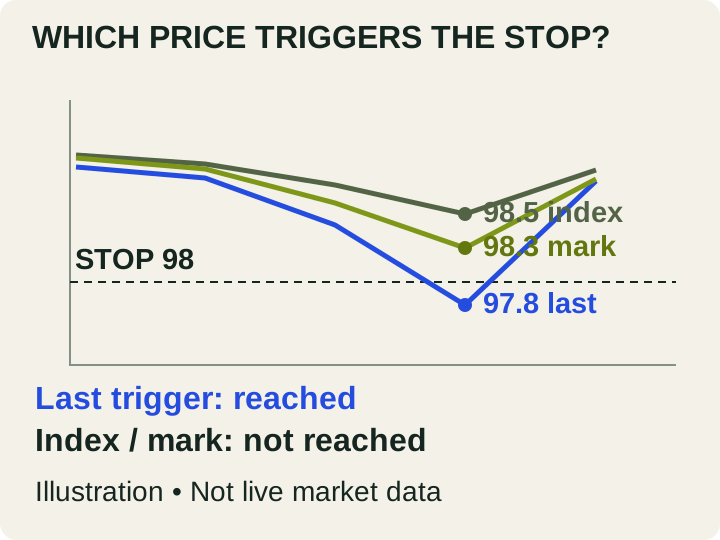
Consider a hypothetical sell stop at 98. The latest trade briefly reaches 97.8, while the index is 98.5 and the mark is 98.3. A last-price trigger has reached its condition; an index-price or mark-price trigger has not. The fact that the visible candle crossed 98 cannot settle the question without knowing which signal the order uses.
Now reverse the mismatch: the mark approaches the liquidation level before the chart you are watching reaches your last-price stop. The account can be at risk even though the selected chart appears to leave room. Kraken’s liquidation guidance treats the displayed liquidation price as an estimate tied to the mark, not a guaranteed price where your order will be executed.
The useful adjustment is small: display the same reference that matters to the decision and record the trigger selected on the order. Do not respond by moving every stop closer to liquidation. A closer stop may look less likely to fire during noise, but it also leaves less margin for an orderly exit.
When does KuCoin make more sense?
KuCoin is a reasonable alternative when you already have an eligible, verified USDT futures account and the contract you need. Its published workflow allows a profit target and stop to be entered with the opening order, with protection taking effect as the entry fills. These controls should be inspected in the live interface; older tutorials can show a different menu layout.
The platform uses a mark price for unrealised profit and loss and liquidation calculations. Therefore, switching from Kraken to KuCoin does not remove the three-price distinction. A stop is defined by its trigger, direction, quantity and execution type. Knowing those four fields is more valuable than memorising where a button sat in an old screenshot.
A triggered order can still remain unfilled
KuCoin’s current cancellation guide identifies price protection, insufficient required margin and position-size changes among the reasons orders can fail or be cancelled. Its separate price-limit guide explains that thresholds can change with market conditions. Do not treat one example percentage in a help article as an unchanging rule for every contract.
A stop-limit order prioritises your minimum acceptable selling price, but can remain open if buyers disappear below it. A stop-market order prioritises finding available liquidity, subject to venue protections. These are different trade-offs. A stop-limit is not automatically a safer stop just because it contains the word “limit”.
There is no reason to move a working KuCoin account just to obtain a stop-loss feature that both venues provide. Kraken is our featured choice for its integrated bracket controls; KuCoin remains a practical alternative when its contract and existing setup suit you. The winner for a particular trade must also have the required contract and lawful account access.
What changed in Rwanda’s crypto rules in 2026?
Law 023/2026 was published on 28 May 2026. It regulates virtual-asset service providers and issuers, while instruments already regulated under capital-market law are excluded from its virtual-asset definition. That exclusion does not make an overseas crypto derivative automatically approved.
Article 15 restricts virtual-asset business by natural persons, recognises no crypto legal tender and limits direct crypto payments without central-bank authorisation. It also restricts marketing to licensed providers or approved issuers. Personal account access, running a dealing business and promoting a service are consequently different questions.
A platform being reachable is not a substitute for the relevant authorisation. We have not established a Rwandan retail-futures licence for either shortlisted exchange. This comparison must not be read as a locally licensed offer; verify the current scope with the CMA and the contracting provider before acting. The recommendation concerns product fit only where the service is lawful and the account is eligible.
Does appearing in a government report mean an exchange is licensed?
No. Rwanda’s 2024 national risk assessment names several services that people could access, including Kraken and KuCoin. It is a study of exposure and market activity. A name appearing in that document is not a licence certificate, and it cannot establish approval under a law enacted two years later.
For a claim of local approval, look for the legal company, licence category, permitted activity and current status. A stockbroker licence, payment-service licence and virtual-asset permission do different jobs. Even an authentic company registration does not, by itself, establish a right to offer leveraged trading.
An unfamiliar website displaying a CMA logo deserves the same examination as a famous international name. Match the website and contracting company to the actual record. A copied certificate or a statement that an application is “in progress” is not equivalent to a permission already granted. This check is especially important when someone offers to trade on your behalf.
Can eKash or MoMo pay directly into a futures account?

eKash connects domestic payment participants through Rwanda’s instant-payment system. The National Bank of Rwanda’s published message states a maximum RWF 20 transaction fee for the relevant transfers. That is useful for local bank-to-wallet or wallet-to-bank movement; it is not a fee quote for buying USDT or funding an international derivative.
RSwitch describes its role as the operator of the interoperable system. BNR’s 2024–25 report records twenty institutions onboarded for person-to-person services by June 2025. These are payment-system facts, not a claim that twenty exchanges accept eKash. The receiver’s identity and the service being purchased still matter.
| Receipt detail | What it tells you | What it does not tell you |
|---|---|---|
| RWF transferred successfully | The named local recipient received money | That an offshore exchange credited a trading account |
| A small eKash charge | The domestic transfer component | The complete conversion spread or crypto withdrawal charge |
| A payment reference | A way to trace that payment | Permission to trade futures or run a crypto business |
If an exchange presents a payment option, read its receiver, settlement amount and account requirements before sending. Do not pay a stranger who says they will “activate futures” after a local transfer. An exchange’s identity check or product approval cannot legitimately be purchased from an unofficial social-media contact.
How much money would you get back in Rwandan francs?
A positive USDT trading result does not tell you the amount you can spend in Rwanda. The conversion quote and payment costs still matter. RWF and FRW are commonly used labels for the same Rwandan franc; neither is the settlement asset of a USDT futures contract.
For an illustration, suppose 150,000 RWF buys a net 100 USDT and, after trading charges, the account has 103 USDT. If the return quote pays 1,430 RWF per USDT, the gross local result is 147,290 RWF. That is 2,710 RWF below the initial outlay before any separate withdrawal charge, despite a 3% increase in the USDT balance.
The example uses invented quotes to show a possible round-trip effect, not current Rwanda prices. It is not a forecast of currency depreciation. The two quotes include the commercial terms you are actually offered, which may differ from a central-bank reference rate or an exchange-rate widget.
Compare two funding options by asking how many net trading units the same RWF budget buys and how much a later withdrawal would deliver. Do not compare only the transfer fee: a service with a low visible charge can recover more through its conversion price. Conversely, a larger fixed fee may be less important than a poor rate on a larger conversion.
Keep the original local payment, the crypto credit and the final withdrawal as separate records. A crypto network transfer is not a new trading profit, and moving money between your own accounts does not create another successful trade. The evidence needed for a local adviser is the actual sequence of transactions, rather than a single percentage from the exchange dashboard.
What should you check after changing a position?
After adding to a position, verify the exit quantity. After reducing it, verify that an old order cannot accidentally open an opposite position. After a full close, inspect any remaining orders. These checks address real state changes; there is no need to redesign the whole strategy every time you open the app.
If an exit did not behave as expected, save the order ID, trigger reference, requested quantity, filled quantity and cancellation reason. A candle screenshot alone cannot show whether the trigger was reached, whether the order passed the venue’s checks or whether liquidity was available within its limits.