


















Which exchange is the better fit in Uganda?
OKX: lower base taker cost
Our first choice for an eligible existing crypto holder comparing ordinary USDT futures execution.
Read the verdictBybit: keep a setup that already works
A small fee difference alone does not justify moving an approved account and paying another transfer charge.
Read the verdict| Starting point | Decision | What makes it useful |
|---|---|---|
| Existing crypto, approved futures access, frequent market orders | Start by comparing OKX | Its published entry-level taker rate is below Bybit’s base rate. |
| An established Bybit account and occasional trades | Do not switch for a tiny fee saving alone | A transfer cost can outweigh many small execution savings. |
| Only UGX in a bank or mobile wallet | Resolve the permitted funding route first | An advertised payment option cannot override the provider’s restrictions. |
| Trying to buy Bitcoin for long-term ownership | Use a spot-investment comparison | A futures balance is not the same as buying Bitcoin to hold. |
Why choose OKX for USDT futures?
The attraction is a relatively straightforward way to keep a futures result in the token used for collateral. On a USDT-margined contract, the profit or loss is accounted for in USDT; a crypto-margined contract uses the underlying coin. That difference matters when you intend to compare the result with a shilling budget later.
For example, a 5 USDT trading gain is easy to separate from the UGX conversion used in your records. A Bitcoin-settled gain adds another moving part because its shilling value depends on Bitcoin’s price as well. Neither structure freezes your UGX purchasing power, but the USDT version avoids adding coin-price exposure to the collateral merely by choosing the wrong contract family.
Our recommendation assumes that the account accepts your genuine residence and enables the relevant futures product. Uganda is not named in the published exclusion record reviewed. This is a provider-policy assessment, not approval from the Bank of Uganda or a promise that every resident can use every OKX service.
Read the amount as exposure, not just the deposit
If you allocate 40 USDT of margin to 200 USDT of exposure, a 1% price move produces roughly 2 USDT of gross gain or loss for a linear position. It does not produce only 1% of the 40 USDT deposit. Fees and funding are additional, and liquidation rules can end a position before your planned exit.
The useful setting is the position size you intended, not the highest multiple offered. A trader with a shilling-denominated spending obligation should know what a normal adverse move would cost before committing the token balance. Start with the exposure in dollars and translate that possible loss into your own budget.
Is OKX cheaper than Bybit for the same trade?
At the ordinary published levels used here, OKX lists 0.02% maker and 0.05% taker fees. Bybit lists 0.02% and 0.055%. Those are execution rates, not a complete cost of investing from Uganda. VIP status, promotions and the particular product can change the account’s actual rate.
| Execution | OKX | Bybit |
|---|---|---|
| Both sides take liquidity | 2.00 USDT | 2.20 USDT |
| Both sides qualify as makers | 0.80 USDT | 0.80 USDT |
| One maker side and one taker side | 1.40 USDT | 1.50 USDT |
The completed answer is narrow: OKX wins this base taker comparison by 0.20 USDT per unchanged-size round trip, while maker-only execution is tied. We do not claim that the difference proves better withdrawals, better local access or better final fills.
Suppose changing exchanges adds a 3 USDT transfer cost. At a 0.20 USDT saving per round trip, fifteen such round trips only recover that cost; the sixteenth begins to leave a saving, assuming everything else stays equal. An occasional trader with a suitable Bybit account has little reason to move solely for this gap.
Bybit also supports separate long and short USDT Perpetual positions through Hedge mode. Keep it if that established workflow is useful to you; do not create opposite trades just to use a feature. Two gross positions can incur more fees than a smaller position expressing the same net view.
For either platform, a limit price does not automatically earn the maker rate. A limit order that crosses the market can execute immediately as a taker. Compare actual filled orders in the history instead of assuming every trade submitted with a typed price was the cheaper type.
Is crypto trading legal—and can I use mobile money?
The FIA assessment released in 2026 states that Uganda has no law explicitly banning personal ownership or trading of virtual assets. It also says they are not legal tender. That does not make bank, card and mobile-money funding freely available.
Section 7.1.12 describes the Bank of Uganda restriction on its supervised institutions facilitating virtual-asset transactions, directly or indirectly. The distinction is crucial: a personal holding is one question; using a regulated payment company to settle a crypto purchase is another.
For a reader starting with UGX, the immediate decision is to establish a permitted payment arrangement, not choose a merchant who promises to hide the purpose. A futures account cannot fix a payment that your provider is not allowed to facilitate. The assessment also does not establish a local derivatives licence for the offshore exchanges in this shortlist.
Why does a UGX listing still appear online?
An exchange can display a currency or a merchant advertisement without guaranteeing that the payment provider will accept that specific transfer. Escrow concerns the exchange-side asset release; it does not change the rules of the bank or wallet involved. These are separate services even when a single order screen presents them together.
Binance’s official zero-fee campaign for UGX/USDT ran from 1 to 30 June 2026. That offer ended on 30 June; it did not remove local payment restrictions.
What does UGX 500,000 actually cost to withdraw?
Separate a mobile-money service charge from the withdrawal tax. MTN’s published table lists an agent withdrawal fee of UGX 7,000 for the 250,001–500,000 band, plus the tax column. Parliament’s April 2026 discussion describes the cash-withdrawal levy as 0.5%; the current tariff’s upper-band tax of UGX 2,500 is consistent with that rate at 500,000.
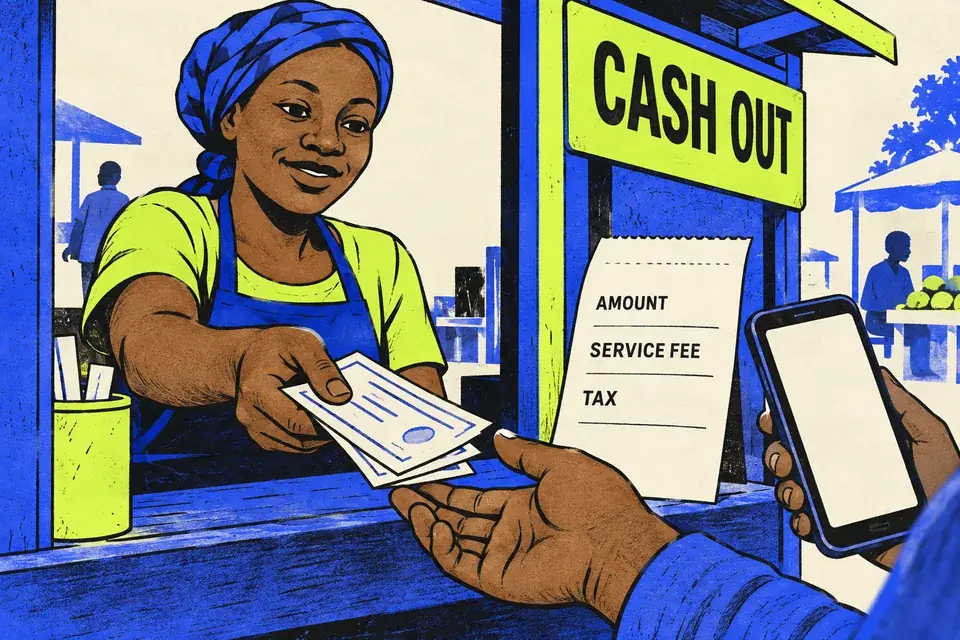
| Item | Amount |
|---|---|
| Cash requested | UGX 500,000 |
| Published agent withdrawal fee | UGX 7,000 |
| Cash-withdrawal levy: 0.5% × 500,000 | UGX 2,500 |
| Balance required for the cash and these charges | UGX 509,500 |
| Combined charges relative to cash received | 1.9% |
A 500,000 wallet balance therefore does not cover 500,000 in cash plus those charges. This is a spending-budget example, not a suggested crypto cash-out channel. It helps explain why money displayed in an app and money available for a cash expense can differ.
Do not apply that fee to every other action in the tariff. Sending to a bank, paying a bill and withdrawing through an agent have different columns. Adding an agent fee to a transaction that does not involve an agent would overstate the cost; leaving out an applicable levy would understate it.
The local cash cost and the exchange commission belong to different decisions. A lower trading rate cannot make an unusable payment route workable. Solve the lawful payment and spending plan first, then compare the exchange costs that you can actually influence.
How do I close a position without opening another one?
Use the platform’s close controls and understand reduce-only. On OKX, a reduce-only order can decrease an existing position but cannot create or increase an opposite one. In one-way mode it can be selected explicitly; in Hedge mode, closing orders are reduce-only by default.
Imagine you hold 80 contracts and manually close 50. Only 30 remain. An older ordinary sell order for 80 could do more than the remaining close if it later executes. A reduce-only instruction is intended to prevent that leftover order from creating a new reverse position; the exchange may resize or cancel it.
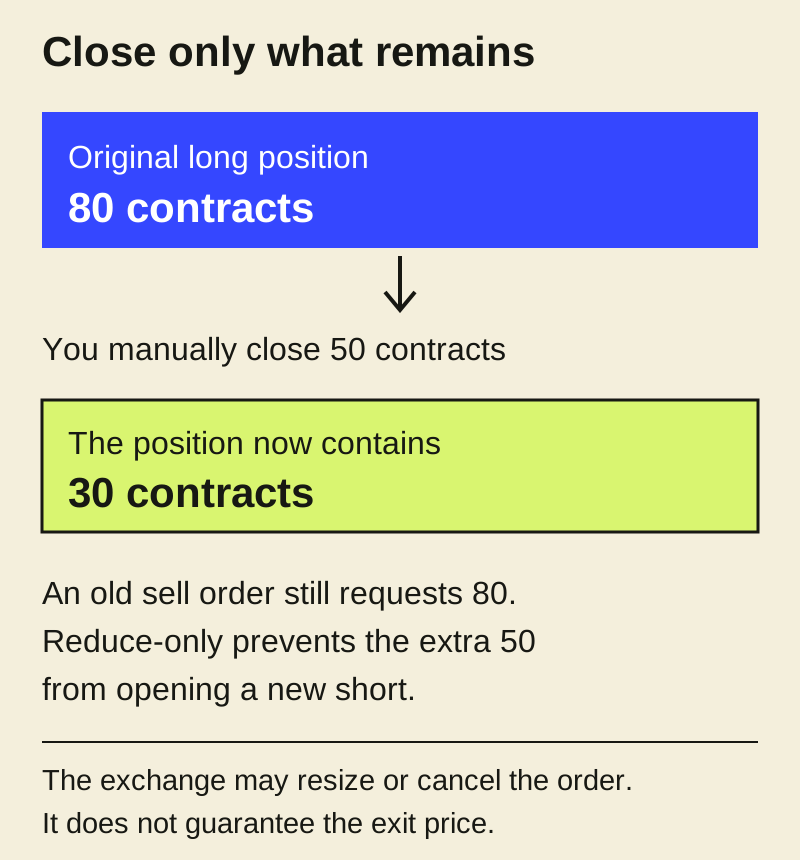
This matters on a phone because changing the order amount and seeing the completed fill are not the same event. Read the remaining position and the order history after a partial close. Do not repeatedly press sell because the chart still appears to show the old position size.
Reduce-only does not promise an execution price or an immediate fill. A limit exit can still wait. Its value is preventing a closing instruction from becoming fresh exposure—not protecting the position from every market or connection problem.
Which ID should Ugandans and foreign residents use?
There is no single “Uganda document” that works for every service. MTN’s SIM-registration page distinguishes an original national ID for Ugandans, a valid passport for foreigners and a Refugee ID for refugees. That establishes the mobile operator’s categories, not an offshore exchange’s acceptance list.
An exchange may require a document type, issuer or address evidence that differs from the SIM requirement. A refugee living in Uganda should state the genuine nationality and residence; being able to register a local SIM does not demonstrate acceptance of the same card for a futures account. Obtain the provider’s document decision before transferring capital.
Renewal is different from having a number
NIRA has a specific guide for renewing, replacing and updating national IDs. An application reference or a remembered NIN is not automatically a substitute for the document the exchange requests. If the card is being renewed, ask which current document the provider accepts instead of uploading altered dates or borrowing somebody else’s account.
How should I measure the result in shillings?
Keep three amounts distinct: the initial UGX cost, the net token result after settled charges, and the value actually available through the permitted return arrangement. A percentage displayed beside a futures position normally answers only the trading part.
For a simple bookkeeping example, suppose your starting cost was UGX 400,000 and the final lawful payout, after all applicable conversion and transfer costs, was UGX 392,000. The investment lost UGX 8,000 even if the exchange displayed a small token gain. If the money remains in tokens, record a valuation separately from a realised shilling payout.
Save the execution and funding history rather than only a screenshot of the final balance. Deposits are not trading profits, and moving an asset between your own accounts is not evidence that a trade earned money. Keeping those lines separate makes the result understandable and gives you usable records for any applicable tax treatment.
The FIA report discusses gaps in crypto-specific tax guidance; that is not a promised zero tax rate. A reader operating commercially, earning other income or disposing of assets may have obligations under existing rules. Use the actual records when seeking a tax determination, rather than assigning the same tax treatment to every wallet credit.