
















Which crypto futures exchange should a Kenyan trader choose?
OKX for USDT futures and a documented KES exit
The exchange publishes Kenya-specific M-PESA instructions for both buying and selling.
Read the verdictBybit for an alternative KES marketplace
Compare executable payment offers as well as the futures fee on your account.
Read the verdictFor USDT perpetuals followed by an M-PESA cash-out, OKX documents the relevant Kenyan payment workflow. Its Kenya-specific instructions cover both directions of the payment. That makes the complete account workflow clearer than a generic claim that an exchange “supports Africa”.
The complete Kenya catalogue still contains 12 available and seven limited platforms. This editorial selection is narrower. It explains the strongest relevant choices rather than turning every wallet, spot service or additional exchange into a supposedly equivalent futures recommendation.
Why OKX leads for a Kenyan USDT futures account
The useful advantage is the connection between the trading product and the local exit. OKX’s guides explain buying USDT through P2P using M-PESA and selling it back to an M-PESA buyer. The buy guide was available in this review, and the sell guide was updated on 15 September 2026. This is documentation of the service, not a withdrawal we personally performed.
For Bitcoin exposure settled in USDT, choose a USDT-margined perpetual instead of a coin-margined contract or spot margin loan. An eligible account can use isolated margin to assign collateral to an individual position. The account still needs futures access; a completed P2P purchase does not automatically establish that every derivatives product is enabled.
A practical advantage: close part of the trade
A trader who needs to reduce exposure does not always need to exit everything. OKX documents partial position closing and reduce-only orders. In one-way mode, a reduce-only instruction is intended to decrease the position, not turn an oversized sell into a new short. This matters when a phone-sized ticket makes it easy to enter the full balance by mistake.
For example, a 0.03-BTC long can be reduced by 0.01 BTC, leaving 0.02 BTC exposed. A plain sell order larger than the long can behave differently from an instruction to close only. Check the remaining quantity after execution, rather than assuming the button label alone tells you the result.
When could Bybit beat OKX for the same Kenyan trade?
Bybit’s KES P2P market displays M-Pesa Kenya as a payment method, and Kenya is absent from its reviewed excluded-country list. It is therefore a relevant alternative to price, subject to verification and product access. A marketplace listing is not a fixed rate or a guarantee that the displayed advertiser accepts every order amount.
Its published non-VIP derivatives fees are 0.02% maker and 0.055% taker. OKX’s fee-calculation guide uses 0.02% and 0.05% for its level-one example. Use your logged-in fee on either venue before deciding; these published figures support a comparison, not a promise about every Kenyan account.
| Fill pattern | OKX at the example rates | Bybit at published non-VIP rates |
|---|---|---|
| Maker entry, taker exit | $2.80 | $3.00 |
| Taker entry, taker exit | $4.00 | $4.40 |
The taker-to-taker difference is $0.40. At an assumed 130 KES per dollar, that is KES 52. If one provider’s usable payment quote delivers more than KES 52 of additional value on that complete transaction, the small trading-fee lead can be reversed. Funding, spread and slippage must still be included.
Choose the better complete transaction
Bybit can win for an individual Kenyan order when its executable KES quote or the account’s actual pricing outweighs that difference. OKX leads our general recommendation because the Kenya-specific deposit and exit guidance is clearer in the reviewed material. This is a narrower and more defensible conclusion than saying one exchange is always cheaper.
Avoid moving an already funded account just to chase forty cents. An on-chain transfer fee, another conversion or a missed limit fill can exceed that amount. Compare the cost of the next trade from where your funds are now, not only the cost of a hypothetical new account.
Can you fund crypto futures directly with M-PESA?
The documented OKX route is P2P: M-PESA pays another user, who supplies USDT through the platform’s order process. Safaricom is not supplying the futures contract, and your mobile-money balance is not the exchange’s margin balance. This answers the common “does it accept M-PESA?” question more precisely than a yes-or-no logo list.
The order should specify KES, the accepted M-PESA method and an amount inside the advertiser’s range. The payer’s details need to match the verified account. A payment requested to a different person or outside the platform changes the transaction you agreed to, so do not treat it as an ordinary continuation of the same order.
Compare enough information to finish the purchase
For an illustrative KES 26,000 purchase, a rate of 130 KES per USDT supplies 200 USDT before payment costs. At 132, it supplies about 196.97. That difference is already greater than several of the small execution-fee differences in the platform comparison. The useful quoted number is the USDT actually released, not a global USD/KES reference rate.
A merchant’s order minimum can also matter more than the quoted rate. An attractive offer that starts at KES 50,000 is not usable for the 26,000 budget. Filter by your intended amount first. This is not a reason to double the deposit merely to unlock the advertisement.
Once the asset has arrived, check where it sits in the exchange. A funding wallet is used for transfers and P2P; a trading balance supports the derivatives order. Moving money between them does not create a profit or a fresh deposit bonus. Keep the amount intended for trading separate from the amount you plan to sell back.
How do M-PESA limits affect a larger withdrawal?
Safaricom’s published limits are KES 250,000 per transaction and KES 500,000 for the daily transaction limit and wallet balance, introduced in 2023. Those are separate constraints. A payment can be below the per-transaction cap yet still be too large for the receiving wallet’s remaining room.
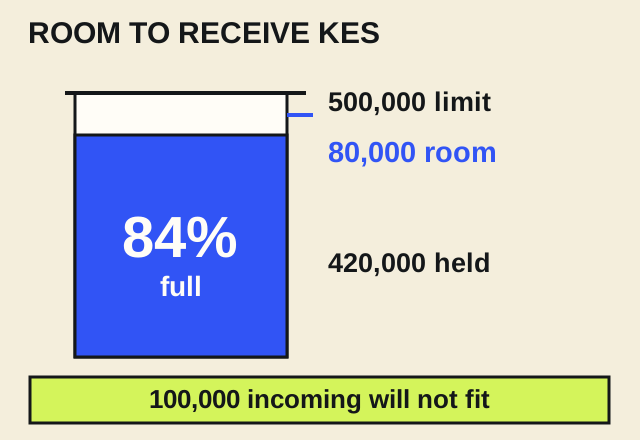
If the wallet already contains KES 420,000, the remaining balance capacity is KES 80,000. A planned KES 100,000 incoming payment would exceed that capacity even though it is well below KES 250,000. The buyer’s order limit does not change the capacity of your own wallet.
For a planned KES 300,000 sale, do not accept an improvised split payment after the order starts. Use a supported arrangement whose amount, payment method and settlement instructions are agreed inside the platform, or select another permitted withdrawal method. Splitting to conceal activity or bypass controls is not a solution.
The cash-out is complete when the correct payment arrives
OKX’s sell instructions call for checking the actual M-PESA account, the full amount and the sender before releasing the escrowed USDT. A buyer pressing Paid is not your confirmation. For a shortage or mismatched payer, use the order’s appeal process rather than releasing early and hoping to recover the difference later.
Capacity matters particularly when the wallet is also used for ordinary receipts. Arrange the trading withdrawal around the balance that actually exists at the time, not a screenshot from yesterday. The platform can hold the crypto in escrow; it cannot increase your personal M-PESA limit.
What eats into a short crypto trade?
For a short trade, compare the actual entry and exit prices, the two trading fees and any funding payment crossed while the position stays open. The KES-to-USDT purchase is a separate cost. Mixing it into every later trade makes it harder to see whether the strategy or the funding method is expensive.
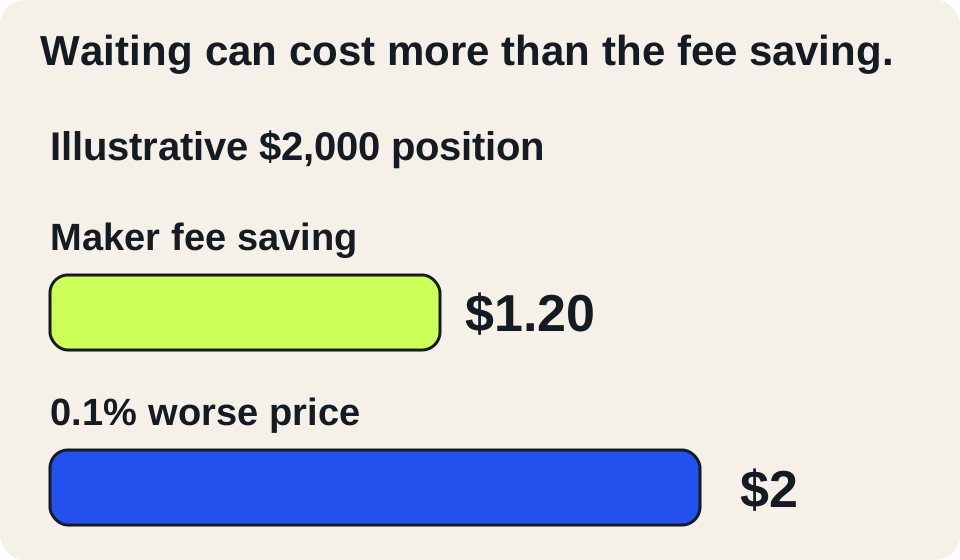
Suppose a $2,000 position opens and closes unchanged using market orders at an illustrative 0.05% per side. The two fees total $2. A limit order that waits and qualifies for an assumed 0.02% maker rate on both sides would cost $0.80. The $1.20 saving only exists if both orders qualify and fill; a limit order that immediately matches an existing offer can still pay the taker rate.
Waiting for a cheaper fill can cost more
At an illustrative 130 KES per USDT, that $1.20 is about KES 156 before conversion. If the market moves unfavourably by 0.1% on the same $2,000 exposure while you wait, the $2 price difference is larger than the fee saving. Maker pricing can be useful, but a lower fee is not automatically the better trade.
Holding through three hypothetical 0.01% funding charges adds $0.60 at unchanged exposure. Funding changes by contract and event, and can run in either direction. A position kept for several days needs a different comparison from a trade closed within minutes. The app’s fee tier and the chosen contract’s countdown should supply the live inputs.
The practical choice is to use the fee mode that fits the order you need. Forcing every exit into a passive limit order solely to save a small fee can leave the position open. Conversely, repeatedly using immediate orders when the price is not urgent can make execution charges a noticeable part of a small KES-funded balance.
How much of a futures win can you cash out to M-PESA?
Use the settled, transferable balance rather than the largest green profit number. An open position’s gain can change before you close it. A closed position can also leave funds supporting another trade or waiting in the trading account before an internal transfer to the funding wallet.
For example, suppose you begin with 200 USDT, close all positions and have 216 USDT after trading charges. Selling the full 216 at an illustrative 130 KES produces KES 28,080 before payment costs. The trading gain was 16 USDT, not 216. Keeping capital and profit separate avoids treating the entire mobile-money receipt as trading income.
If you sell only that 16 USDT gain, a buyer’s minimum order can make the small sale impractical or offer a worse quote. Compare offers for the amount you actually intend to sell. It can make sense to retain funds you deliberately want for trading, but not to open extra positions merely to reach somebody’s P2P minimum.
Cashing out while another position is open
Moving funds out of a shared margin balance can reduce the buffer for the remaining position. A successful withdrawal preview means the platform currently permits the transfer; it does not mean the remaining trade has the same room for a price move. Check the surviving exposure before treating all available funds as surplus.
The M-PESA capacity and release checks in the previous section still apply. What changes here is the amount you send to that process: actual transferable USDT after the trade, not an unrealised result or the whole wallet total. That is the number to use when comparing the final KES quote.
Is crypto leverage trading regulated in Kenya in 2026?
Kenya’s VASP framework has moved beyond the March consultation. The CMA now publishes the final Virtual Asset Service Providers Regulations, Legal Notice 134, in the Kenya Gazette Supplement dated 22 July 2026. A page presenting the March draft as the latest stage is out of date.
A framework is not an individual provider licence. Our reviewed sources do not establish a Kenyan VASP licence for OKX or Bybit, so the exchange recommendations are not labelled CMA-approved. The checked licence 199 belongs to IC Markets (KE), under the broker register. Keep the legal entity and the product together when comparing those claims.

Do you pay 10% tax on the whole trade?
KRA’s 2025 implementation notice identifies 10% excise on fees charged for virtual-asset transactions. That is a fee base, not 10% of every deposit or the position’s total exposure. If a taxable service fee were KES 100, a 10% charge on that fee would be KES 10; applying it to a KES 100,000 position instead would give an unrelated and incorrect KES 10,000.
The 2026 KRA summary also flags an information-return requirement for VASPs. It does not provide a simple personal crypto-profit rate for every trader. Keep the transaction statements and the service’s invoice, and distinguish a provider’s fee tax from any tax applying to your own income. We do not automatically apply the VASP fee treatment to a broker CFD without its correct classification.
Should you choose a USDT perpetual or buy the coin?
Should you choose a USDT perpetual or buy the coin?
A USDT perpetual fits a trader who wants to go long or short without receiving the coin in a personal wallet. Profit and loss settle in the contract’s stated asset. A spot purchase fits someone who wants to keep or transfer the coin itself. For a Kenyan reader planning to sell USDT for M-PESA later, the perpetual keeps the trading result in the asset used by that cash-out process.
Do not choose a BTC contract simply because the original deposit was made to buy Bitcoin. After a supported conversion, a USDT balance can back the eligible USDT markets offered to your account. Each market still has its own minimum size, leverage allowance, funding rate and depth. A large altcoin menu is useful only if the pair you actually want has a workable order and exit.
The local CFD option has a different purpose
IC Markets (KE) appears in the CMA broker register as licence 199 and advertises crypto CFDs. That is relevant if a Kenyan-regulated broker relationship is your priority, but it does not provide withdrawable crypto. Its reviewed page also contains inconsistent headline leverage figures. We do not use the larger figure to elevate it over the crypto-exchange choices.
For the USDT-to-M-PESA workflow covered here, compare OKX and Bybit first. The broker licence is not evidence that either international exchange has the same Kenyan authorisation, and the broker’s CFD should not occupy the space needed to explain those exchange products.
Why can a stop loss fail to close at the expected price?
Why can a stop loss fail to close at the expected price?
A stop is an instruction triggered by a price condition, not a guaranteed sale at that price. OKX’s liquidation FAQ identifies several reasons a position can liquidate despite a stop, including different trigger prices, a stop covering only part of the position and an order that does not fill during volatility.
For a partial-exit example, imagine buying 0.03 BTC and attaching a stop to only 0.01 BTC. Even if that stop works, 0.02 BTC remains open. On a mobile screen, checking the size covered by the stop can be more valuable than changing the leverage slider by one step.
After modifying the position, inspect both the remaining trade and the remaining exit instructions. A stop sized for yesterday’s smaller trade may not cover today’s added quantity. Practise those changes in a demo environment before relying on them with a live balance; the mechanics matter more than an attractive screenshot of a profit percentage.