















Best crypto futures exchanges in Madagascar
BingX leads our shortlist for a Malagasy reader who wants to compare manual futures trading with copying another trader. Its product documentation makes the choices visible, but the right starting point is the ordinary Perpetual Futures interface—not assuming that “Standard”, “Copy” and “Perpetual” are three names for the same account.
BingX: manual or copied positions
Useful when the central choice is how the trades will be managed.
Read the verdictBybit: an alternative to compare
A second documented futures and copy-trading system, not a guaranteed return.
Read the verdictMadagascar is not named in the general excluded-country lists checked for these two providers. Their acceptance of an individual customer and availability of a particular feature still need confirmation. The full country directory retains thirteen available and four limited platforms; these two are the editorial shortlist, not the entire market.
| What you want | A suitable starting point | What you are taking on |
|---|---|---|
| Make your own BTC or ETH decisions | Manual perpetuals | Your own entries, exits and ongoing position management. |
| Follow a named trader’s strategy | A separately budgeted copy allocation | Their trading decisions plus the copying system’s execution differences. |
| Buy crypto and keep it without leverage | Spot rather than futures | Ownership of the asset, without a leveraged position to maintain. |
The useful question is not which button produces the most exciting return chart. It is whether you want to make the trading decisions yourself, delegate part of them, or simply own crypto. These are different jobs. A leverage ranking should help you recognise the difference before money moves.
BingX Standard vs Perpetual Futures
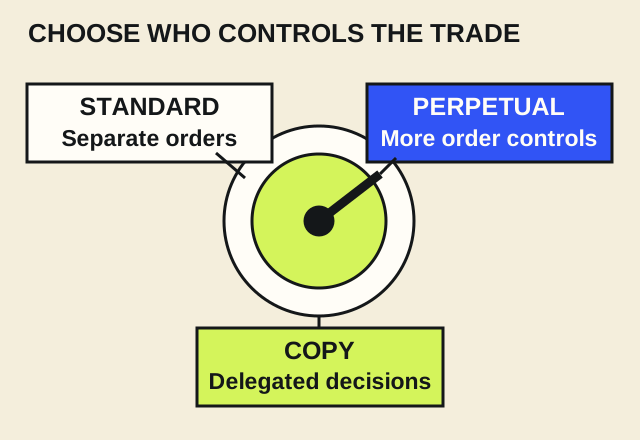
BingX’s comparison page distinguishes the products by fees, order types and position management. The Perpetual interface supports more order types and combines multiple orders into a position. Standard manages orders separately. That affects what you see when adding to a trade or trying to close part of it.
| Feature | Perpetual Futures | Standard Futures |
|---|---|---|
| Published base commission | 0.02% maker / 0.05% taker, opening and closing | 0.045%, charged on closing |
| Orders | Includes limit, market, trailing, post-only and TWAP | Market and trigger orders |
| Position display | Orders combined into a position | Orders managed individually |
| Demo in the product comparison | Supported | Not listed as supported |
For a reader learning to manage a position deliberately, our preference is the Perpetual interface and its practice environment. That recommendation is about controls and learning the workflow. A simpler-looking Standard screen may still be suitable for another user, but the lower displayed commission alone does not settle the choice.
Compare a complete trade, not one fee number
Using unchanged exposure of 1,000 USDT, the published base rates imply 1 USDT for a market entry and exit in Perpetual, versus 0.45 USDT for Standard’s closing commission. This arithmetic excludes spread, funding, execution differences and any other applicable charge. It is a commission comparison, not proof that Standard always has a lower total cost.
If you need a limit order to control the entry price, or want to rehearse the workflow without real money, those requirements can be worth more than 0.55 USDT on this example. Conversely, paying for capabilities you never use does not create value. Select the product that matches the intended order, then compare its complete cost.
BingX or Bybit for a Malagasy trader?
Bybit is a credible alternative rather than a platform to dismiss just because BingX leads this page. It offers its own futures copy-trading product. Its published profit-sharing levels range from 10% to 15% depending on the trader’s level. Compare the actual strategy terms, not a supposed universal advantage of one exchange’s name.
For manual perpetual trading, Bybit’s published non-VIP rates are 0.02% maker and 0.055% taker. Compared with BingX’s 0.05% base taker rate, the difference is 0.10 USDT on an unchanged 1,000 USDT position entered and exited at market. Maker rates in this comparison tie. That small gap is a reason to calculate, not to exaggerate superiority.
| Use case | Verdict | Why |
|---|---|---|
| Learning manual orders from scratch | Start by assessing BingX Perpetual | The documented practice workflow and order choices suit that task. |
| You already understand Bybit and have a suitable balance there | Staying may be more sensible | A tiny commission difference may not repay transfers or relearning. |
| Choosing a copy trader | Compare the person and settings on either platform | Profit share, allocation and open losses matter more than the exchange ranking. |
| Wanting a fixed return in MGA | Neither futures product fits | Both introduce variable trading results and conversion risk. |
A profit-share example makes the distinction tangible. If a strategy earns 20 USDT of eligible net profit before the trader’s share, a hypothetical 10% share leaves 18; a 15% share leaves 17. The one-USDT difference is already ten times the manual fee gap in the earlier example. The calculation does not assume the strategies would earn the same profit.
Our finished verdict: BingX is a useful first account to assess for the choice between manual and copied futures, while Bybit remains reasonable for an existing user or a specifically preferred strategy. We have not established that one produces better trader returns. Provider features can be compared; future performance cannot be awarded in advance.
Can MVola fund a crypto futures account?
MVola, Orange Money and Airtel Money are local payment services; a person accepting one of them in exchange for crypto is not the same as a direct exchange integration. SAMIFIN’s April 2026 virtual-asset assessment describes mobile money as an indirect bridge through customers and intermediaries, rather than an exchange or custody service offered by the wallet operators themselves.
That difference tells you where a failed payment belongs. If you send ariary to a seller and receive no USDT, the missing step is the seller’s delivery. The futures exchange may have received nothing. A local wallet transaction number alone cannot identify an on-chain transfer that never took place.
The MVola Visa card has its own limitations
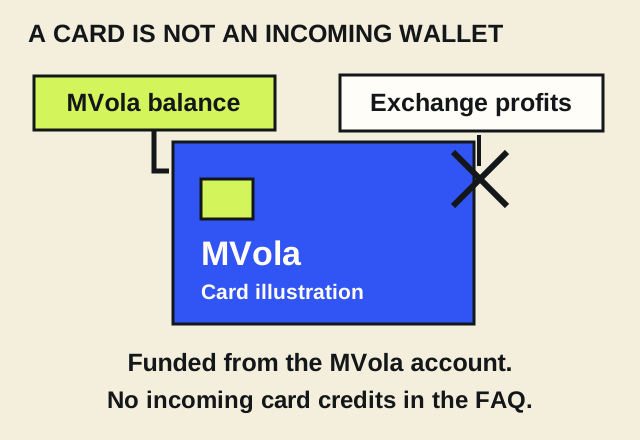
MVola’s card page says the card is funded from the MVola account and cannot receive incoming credit transactions. It should therefore not be presented as an automatic return destination for exchange profits. A Visa logo also does not prove that a particular crypto purchase will be accepted by the issuer and the merchant.
For a bank-and-wallet route, use the actual bank-link instructions for your own accounts. MVola documents bank linking separately from its card. First establish the permitted payment purpose and beneficiary, then price the transfer. Do not assume a local bank link proves a relationship between that bank and BingX or Bybit.
If the only offered route involves sending money to an unrelated personal account on the promise of a later token delivery, the extra person is part of the risk. You need to know which service is responsible, what amount will arrive and how a dispute is handled. An attractive futures fee says nothing about those promises.
What local withdrawals can cost in ariary
MVola’s published tariff, dated 17 February 2025, lists cash-point withdrawals of Ar100,001–250,000 at Ar3,400 and Ar250,001–500,000 at Ar4,700. The next band, Ar500,001–1,000,000, is Ar8,800. These are local cash withdrawal charges, not BingX or Bybit fees, and the amount shown for a current transaction should be checked before confirming.
For a hypothetical Ar480,000 withdrawal, the listed cash-point fee is Ar4,700, about 0.98% of the amount. Splitting it into two Ar240,000 withdrawals would incur Ar3,400 twice, or Ar6,800. On this tariff, splitting costs Ar2,100 more. A smaller individual transaction is not automatically a cheaper cash exit.
Calculate profit after the full local journey
Imagine spending Ar480,000 to obtain 100 usable USDT. After trading and all exchange charges, 105 USDT remains. At an assumed exit price of Ar4,600 each, that produces Ar483,000. If you then withdraw that entire amount at the listed Ar4,700 cash-point charge, the spendable result is Ar478,300: Ar1,700 less than the original outlay.
That is a deliberately constructed example, not a current purchase offer. Its value is that it explains how a 5% token gain can disappear without the futures calculation being wrong. The acquisition quotation, return quotation and need for physical cash all affect the local result.
If you intend to spend from the wallet instead of taking cash, do not subtract a cash-point fee that you will not pay. Likewise, a bank transfer is priced under its own schedule. Choose the actual ending form of the money before comparing alternatives, and keep enough wallet balance for any fee charged separately.
Is crypto regulated in Madagascar?
Malagasy law 2023-026 brought virtual-asset definitions into the anti-money-laundering framework. SAMIFIN’s April 2026 assessment nevertheless describes the absence of a dedicated operational framework and licensing supervision for virtual-asset providers. Those are compatible findings: defining an activity in a financial-crime law is not the same as approving a retail futures exchange.
We therefore describe BingX and Bybit as offshore platform candidates, not as exchanges licensed by SAMIFIN for Malagasy derivatives. The report also records the central bank’s earlier statement that cryptocurrencies are not legal tender. That does not justify rewriting every provider’s country list as a ban, but it does rule out equating USDT with ariary issued under the local monetary system.
For a practical transaction, ask the bank or payment provider about the intended investment transfer and keep an accurate record of its purpose. Crypto should not be used to disguise an outward payment or avoid exchange-control requirements. If a transaction needs permission, another payment channel does not remove that requirement.
What records will make your result understandable?
Keep the MGA paid to acquire collateral, the amount of crypto delivered, trading charges and the proceeds of any sale back into local money. A token-only balance history will not explain the local acquisition cost. This also gives a tax adviser something concrete to work with rather than a screenshot of an estimated dollar profit.
We do not infer a special crypto tax exemption from the absence of a bespoke exchange-licensing system. Tax treatment depends on the relevant rules and your activity. For someone trading repeatedly or for a business, obtain local advice before relying on an assumption that an offshore account is outside all reporting obligations.
Copy allocation, performance and vouchers
What exactly are you copying?
BingX Copy Trading 2.0 offers position-ratio and per-order modes. Ratio mode follows the trader’s allocation proportion; per-order mode uses the margin amount you choose for each copied order. Leverage and margin mode match the trader’s by default. Those settings deserve attention before choosing a profile from a leaderboard.
Consider an illustrative 200 USDT copy budget. If the trader allocates 25% of available margin, proportional copying starts from 50 USDT of your margin, before the platform’s sizing rules. Setting 10 USDT per order produces a different exposure pattern. Copying the same person with different settings does not mean copying the same risk.
Translate the allocation into ariary before accepting it
At an assumed acquisition cost of Ar4,800 per USDT, that 200 USDT budget represents Ar960,000. The example uses a made-up rate, not a current Malagasy quotation. Seeing the local amount can change the decision: an allocation that looks small next to a trader’s balance may be substantial relative to your own spending needs.
Do not multiply the copy budget by the number of attractive traders without checking the combined commitment. Four separate 200 USDT allocations would commit Ar3,840,000 at the same assumed rate. They may also hold similar Bitcoin positions, so four names do not necessarily mean four independent sources of risk.
Stopping a copy relationship is a trading action
BingX says Stop Copying closes copied positions at the market price and returns the funds to the perpetual account. It is not merely an unsubscribe button that leaves the trades untouched. If you want to leave a strategy, inspect the open positions and expected exit before confirming.
This is where manual trading can be the better fit: you keep responsibility for each entry and exit instead of coordinating your own budget with another person’s strategy. Copy trading is useful only if you understand what is being delegated. It should not be described as a bank-like passive income product.
How to read a copy trader’s results
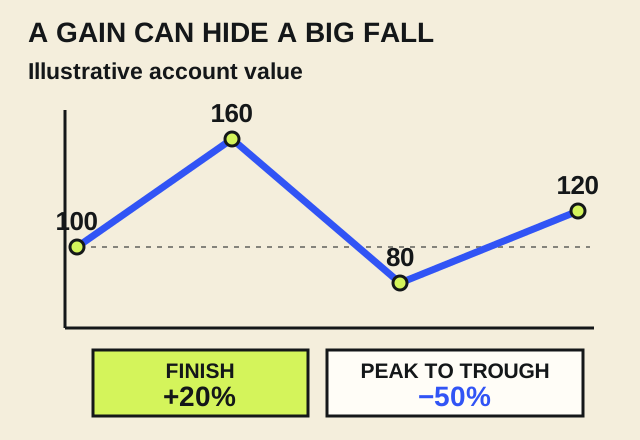
A large return percentage can hide the part of the experience you would find hardest to tolerate. Look at the time period, the largest fall from an earlier peak, open positions and how much of the result comes from a few exceptional trades. A week of gains and a year of results are different evidence.
Suppose one illustrative strategy rises from 100 to 160, drops to 80 and ends at 120. The final return is positive 20%, but the fall from 160 to 80 is 50%. A second strategy ends at 115 without such a large decline. The first has the higher endpoint; that does not make it the better match for someone unable to tolerate halving the account along the way.
Winning often is not the same as making money
Nine gains of 2 USDT and one loss of 30 USDT produce a 12 USDT loss before costs, despite a 90% win rate. This simple calculation is more informative than calling a trader “accurate”. Look for the scale of losing positions, not just the number of green entries.
Also distinguish realised results from the account’s current value. Closing many small winners while leaving a large losing trade open can make the closed-trade history look comfortable. The open loss still belongs to the economic result. A screenshot that crops out the open positions is not enough to evaluate the strategy.
Research presented at CHI 2024 examines how copy-trading platform metrics and social signals influence investors. That reinforces a useful reading habit: separate popularity from the measurements that describe your possible experience. We are not using follower counts as a substitute for a risk comparison or as evidence that any named trader will perform well.
Finally, choose a budget you can leave alone without needing to rescue the strategy with repeated deposits. Increasing your allocation after every loss changes the experiment and makes it difficult to tell whether the strategy itself has improved. A pre-agreed spending limit is easier to evaluate than a moving target.
Does a copy-trading voucher protect your whole budget?
A genuine subsidy can be useful, but it has a boundary. BingX’s voucher rules assess the overall profit or loss from copying the selected trader and cap compensation at the voucher’s face value. A losing order inside an otherwise profitable copy relationship does not automatically produce a payment.
For example, take a hypothetical 20-USDT voucher and an eligible 35-USDT net loss. Compensation capped at 20 leaves 15 USDT of that loss with you. At the illustrative Ar4,800 acquisition cost used earlier, that remaining loss represents Ar72,000, before any local transfer costs. The voucher has helped; it has not made the entire experiment free.
Check the product and the qualifying allocation
The voucher can carry a minimum allocation and a restriction to a particular copy-trading type. A Standard-only voucher is not automatically usable for a Perpetual copy. Guaranteed-price fees for zero-slippage copying are excluded from compensation under the published FAQ.
Before increasing a deposit to meet a reward threshold, compare the extra money committed with the maximum potential subsidy. If an offer requires funds you would not otherwise allocate, the promotion is changing the size of the investment. That is a separate decision from whether the chosen trader suits you.
We do not promise a voucher to every Malagasy account or treat an advertised reward as already earned. Check the reward actually issued to your account, its expiry and its eligible product. Record any paid compensation separately from trading profit so that the strategy’s results remain understandable.