











Is there a recommended crypto futures exchange for Fiji?
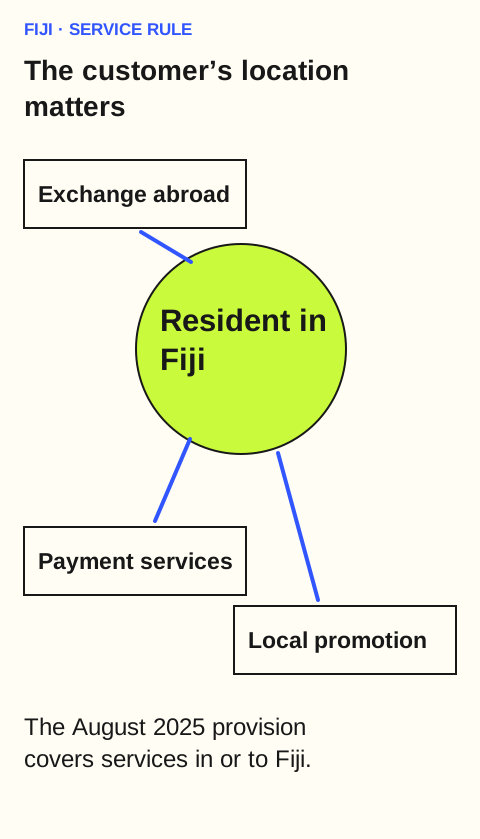
The 2025 prohibition concerns services provided in or to Fiji. Earlier controls also restrict crypto investment using locally held funds. These cover different parts of the proposed transaction, so a working overseas signup screen does not resolve either one.
A useful comparison therefore needs to answer a different question: is the proposed account for someone currently resident in Fiji, or for a Fijian citizen genuinely living elsewhere? Those readers do not necessarily have the same options. The overseas-resident cases appear later; they are not a way to route a Fiji resident around the local rule.
The catalogue below retains the international providers previously researched for the country, with restricted qualifications. It is not a ranking of approved local perpetual accounts. We have withheld commercial signup recommendations for Fiji because naming a “best” exchange under these conditions would imply an access conclusion the evidence does not support.
What changed in August 2025?
The Reserve Bank of Fiji (Budget Amendment) Act 2025 added provisions concerning virtual assets and service providers. The operative date identified by the RBF is 30 August 2025. The rule reaches persons inside or outside Fiji carrying on the relevant business in Fiji, and services or related activities directed to Fiji residents.
Its scope is broader than operating a physical exchange office in Suva. The listed activities include exchanges between virtual assets and money, exchanges between virtual assets, transfers, custody or administration, and specified services relating to an issuer's offer or sale. The accompanying RBF notice also addresses marketing, payment, settlement and technical support related to a virtual-asset provider's business.
For a reader shopping for leveraged crypto, that makes an overseas headquarters an inadequate answer. A platform does not become a locally authorised service simply because the company is incorporated abroad. Nor does a referral group's ability to demonstrate a successful deposit establish that the business may serve residents.
How to read Kraken, OKX and other names in the database
A country record can answer whether a provider names Fiji in its own restrictions. That is different from proving that the provider has permission to supply a crypto derivative to a Fiji resident. Both pieces of information matter; neither should be silently substituted for the other.
| Signal | What it establishes | What it does not establish |
|---|---|---|
| Fiji appears in a registration form | The form recognises the country or identity category | Local permission to trade perpetuals |
| A futures market is visible | The platform has that market somewhere in its service | Eligibility for a verified Fiji-resident account |
| A card payment succeeds | That particular payment was processed | Approval under Fiji's funding and service rules |
| The company holds a foreign licence | Permission under that licence's scope | A Fiji exemption |
This is why a directory may contain several limited provider records while the Short Answer recommends none. Deleting every provider name would conceal useful research, but activating a signup button next to each one would overstate the practical conclusion. The country guide and its tools should give the same answer.
If a provider later establishes a documented legal basis to serve Fiji residents, that would be a material change worth updating. A new token listing, promotion or maximum leverage figure would not by itself resolve the current issue.
Can FJD, a foreign-currency account or USDT fund the trade?
The RBF's April 2024 notice expressly addresses purchases or investment in cryptocurrencies using funds held in Fiji, including locally issued debit and credit cards. Quoting a deposit in USD does not make its source cease to be Fiji. The same notice distinguishes overseas investment approval from an unrestricted ability to send money abroad.
For example, a resident who earns FJD, exchanges it into another currency and sends it towards a crypto account has changed the denomination of the payment. That sequence does not, by itself, establish approval for the investment. The currency conversion is not the missing permission.
A different situation is someone who already has a foreign account. The existence of that balance still does not answer whether the proposed service may be supplied to a Fiji resident. The 2025 service rule needs to be considered in addition to the earlier funding notice; reducing the whole issue to “do not use a local card” misses that distinction.
Remittance allowances are purpose-specific
The January 2026 exchange-control guidelines organise foreign payments by purpose and supporting documentation. A permitted family, education or other payment is not a general crypto-investment allowance. An ordinary transfer category should not be relabelled to disguise a trading deposit.
That distinction also matters for relatives abroad. Money sent for a genuine family purpose should not be described as a locally approved futures top-up merely because the recipient lives in another country. Keep the real purpose and account ownership clear; the recipient's exchange eligibility is a separate matter.
Does a DEX or cash-settled contract change the answer?
A wallet connection removes some exchange-account steps, but it does not supply a legal exemption. A decentralised perpetual still involves a specific product, interface and set of services. The reviewed Fiji material provides no blanket permission to replace an exchange deposit with a wallet-based derivative.
Cash settlement also needs care. A contract paying a difference in value is not identical to owning Bitcoin, and a fiat-settled financial product may require a different legal analysis from a virtual-asset service. However, that distinction does not establish that any offshore crypto CFD is authorised for a Fiji resident or that its funding has been approved.
Our conclusion is limited and practical: this review has not established a lawful resident-facing leveraged crypto product to recommend. It does not claim that the virtual-asset notice settles every possible financial derivative. Anyone offering a supposed exception would need to identify the actual issuer, instrument and permission, rather than rely on the word “CFD” or “decentralised.”
For comparison shoppers, this prevents a common category mistake. An apparently convenient replacement should be assessed as its own product, not treated as a loophole because the interface looks different from a centralised exchange.
What if you already have a trading balance?
An existing balance creates different questions from opening a new leveraged position. It may involve a provider's account review, closing an exposure, withdrawing supported assets or documenting a past transaction. We have not assumed that a successful historic registration gives permanent permission to add funds or increase leverage.
Before changing the account, retain the trade history, deposit receipts, open-position details and communications about any restriction. Those records let the provider distinguish an account-closure request from a request to start a new service. They also help a bank understand a proposed return of funds, which should not be described as an ordinary remittance if its real source is investment activity.
If the account is restricted, use the provider's official account-resolution channel and identify the actual residence. A third party claiming it can release the balance after an extra crypto payment is not evidence of an authorised withdrawal procedure. Do not share wallet recovery phrases or let an intermediary impersonate the account holder.
A bank's acceptance of a withdrawal must not be promised from the fact that it previously processed a deposit. Supply an accurate source-of-funds explanation and obtain the applicable instructions before arranging a return. This guide cannot identify an approved universal crypto-to-FJD cash-out service from the public documents reviewed.
Trading classes and referral groups: what the local warning says
The Consumer Council of Fiji's January 2026 warning describes virtual-asset training promoted through social media, including claims that money-exchange businesses can be used when banks cannot process transactions. Its concern is not simply that trading can lose money; it addresses the promotion and facilitation of services under the local prohibition.
For a potential customer, a course certificate, group administrator or screenshot of earnings cannot substitute for the provider's legal basis. A lesson can demonstrate an order without proving that the student may open the demonstrated account from Fiji. Claims of a guaranteed income from leverage are especially unhelpful when the underlying access issue is not answered.
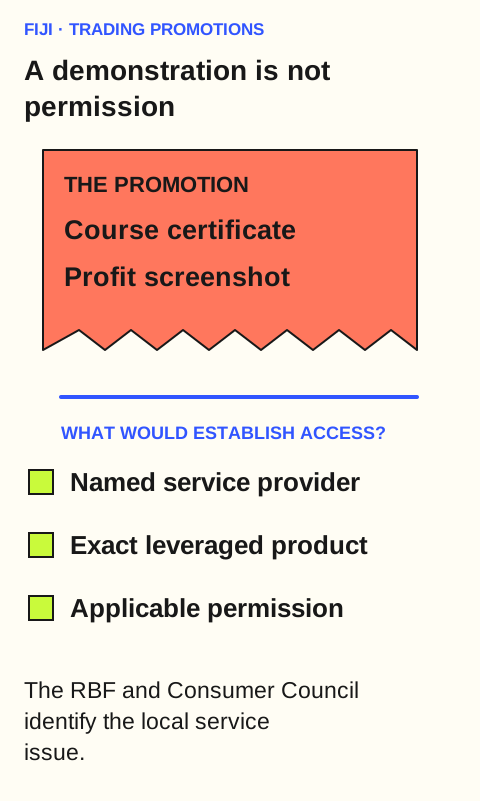
The RBF introduced a confidential disclosure channel in April 2026 for suspected unlicensed financial activity, including virtual-asset services and their marketing. That is an official place to report a questionable local offer. It is not an account-opening portal or a mechanism that grants a trader approval after submitting a report.
Fijian citizens living in Australia or another country
Fijian citizenship should not be presented as a worldwide ban on every trading account. Someone genuinely resident abroad needs the rules for that residence, the provider's accepted documents and the relevant funding arrangements. An Australian resident with a Fijian passport should examine Australian products, rather than a supposed “Fiji offshore” futures account.
In Australia, the meaningful comparison is between eligible local retail perpetuals, spot-margin products and separately approved wholesale derivatives. New Zealand needs its own assessment; sharing close links with Fiji does not make the Australian offering transferable. The country guides linked from this site help resolve those destination-specific product questions.
A temporary trip is not automatically a change of residence. Likewise, a foreign passport held by someone living in Fiji does not itself remove the resident-facing service restriction. These distinctions are worth making once because they prevent both an excessive nationality ban and an unsupported claim of access.
The remaining financial questions concern genuine transfers, actual tax residence and accurate records of the money's source. There is no need to turn this into a broad tax-rate catalogue: for the reader seeking crypto leverage, the decisive first step is establishing which country's account the person can legitimately use.