

















Which crypto futures exchanges make sense in New Zealand?
MEXC and Bitget deserve the first comparison if you want a crypto-funded perpetual account from New Zealand. Both publish international futures products, and neither names New Zealand in the general country exclusions reviewed for this article. MEXC also has a fee announcement specifically addressing New Zealand users. That is useful evidence of a local customer offering, although it is not an FMA derivatives licence or a guarantee that every account gets every contract.
The choice is narrower if you require a New Zealand-licensed provider. A locally offered crypto CFD can give leveraged Bitcoin exposure, but it is a different product from a USDT perpetual.
| Option | Where it earns a place | What changes the decision |
|---|---|---|
| MEXC | Crypto-funded USDT perpetuals; published NZ-specific futures pricing history | Use the current account and pair fee, not an old zero-fee advertisement. No FMA derivatives licence was verified. |
| Bitget | An alternative futures account with published position tiers and a clear base commission schedule | Its offshore exchange is not covered by Mana Remittance Limited’s New Zealand registration or complaints membership. |
| CMC Markets NZ | A locally offered crypto-CFD comparison when the NZ legal entity matters most | Cash-settled CFDs, spreads and holding charges differ from an exchange perpetual account. |
| Swyftx | Documented NZD bank funding for buying and selling crypto | The NZD deposit service is not evidence that a crypto futures product is approved for that same customer. |
MEXC: the useful advantage is the product range
For a trader seeking BTC or ETH perpetuals, MEXC provides a directly relevant product rather than simply a way to purchase coins. Its published high-leverage announcement names BTCUSDT and ETHUSDT at up to 500x, with separate country exclusions and no support for that tier in copy trading. New Zealand is not among the exclusions named in that announcement. These are ceilings for eligible contracts and positions, not a sensible default setting or an entitlement attached to a New Zealand passport.
MEXC is the stronger starting candidate here when the goal is a conventional USDT futures account and the user accepts an offshore relationship. It is a weaker fit if the deciding requirement is local dispute protection or keeping the entire account in NZD. Those are different priorities from having a larger leverage slider.
Bitget: compare the actual BTC order, not its registration headlines
Bitget’s published BTCUSDT tier example starts at 125x and reduces leverage as the position gets larger. That gives a more useful comparison than treating 125x as the limit for every coin or trade size. A trader using much lower leverage can still compare the same perpetual on fees, execution and collateral handling; there is no need to use the advertised maximum to benefit from a futures platform.
A September 2026 notice makes the New Zealand qualification particularly clear. Mana Remittance Limited’s FSPR registration and IFSO membership belong to that company, not Bitget’s global exchange. MRL does not provide crypto exchange services and does not take NZ regulatory responsibility for Bitget trading. The correct reason to consider Bitget is its futures offering—not a claim that the offshore account has acquired local FMA protection.

Kraken, Binance, OKX and Bybit: what can the NZ account actually trade?
Kraken’s international derivatives eligibility page explicitly excludes New Zealand residents. Its familiar brand and availability of other services do not make Kraken Futures an alternative for someone living in Auckland. This is a product restriction, not a statement that every Kraken service is unavailable. An existing spot customer should not send money expecting the international derivatives tab to become usable after a deposit.
Bybit has a separate New Zealand addendum naming Kono Group Limited and limiting users to the services supported for that market. Importantly, the addendum covers residents, nationals and people with a relevant New Zealand connection. A generic global product page therefore does not establish which futures services a particular NZ-linked account receives. We have not treated the addendum as blanket approval for all Bybit derivatives.
Binance’s New Zealand registration also needs to be read by service. The licence information reviewed concerns its local virtual-asset offering; it does not establish an NZ retail futures authorisation. Likewise, OKX’s general exclusions alone did not resolve the current NZ-specific derivatives entitlement. Neither is promoted in this article as a verified substitute for Kraken’s unavailable international futures product.
How much does a New Zealand futures account cost?
Compare the account’s rate and the pair you intend to trade
Bitget’s published standard futures commissions are 0.02% for a maker fill and 0.06% for a taker fill before applicable discounts. A maker order rests on the book; a taker order executes against an existing offer. On an unchanged 10,000 USDT position, two taker fills would cost 12 USDT in trading commission. One maker entry and one taker exit would cost 8 USDT. Funding and withdrawal costs are additional.
Those numbers concern the position value, not the amount you transferred from your NZ bank. Posting 1,000 USDT to support a 10,000 USDT trade does not reduce the fee calculation to 1,000. That is the part worth comparing when an exchange advertises cheap leverage: a smaller margin deposit does not make the same trade cheaper to execute.
MEXC requires more care with public price claims. Its March 2025 NZ-specific announcement quoted 0% maker and 0.02% taker on the covered futures pairs, but expressly excluded several Bitcoin contracts and linked to the live fee schedule. It is evidence of a regional offer, not a current universal quote. The fee page says rates can vary by region and promotion. API trading has also had its own announcements, so a bot should not be costed using a web-trading banner.
| Taker rate per fill | Entry plus exit | Meaning |
|---|---|---|
| 0.02% | 4 USDT | Illustrative lower-rate scenario; not a guaranteed MEXC NZ quote |
| 0.04% | 8 USDT | Illustrative intermediate scenario |
| 0.06% | 12 USDT | Bitget’s published standard taker rate before discounts |
Funding can outweigh a small commission saving
A 0.01% funding payment on 10,000 USDT is 1 USDT for that event. If the position pays at three such events, the total is 3 USDT; the actual direction and interval depend on the contract. This example is not a prediction of funding or a claim that every venue uses three payments daily.
For a New Zealand reader choosing between MEXC and Bitget, compare the same BTC or ETH market over the period you expect to hold it. A low advertised entry fee can be outweighed by funding, a wider execution spread or the conversion needed to get back to NZD. There is no permanent cheapest exchange for every holding period.
How do you fund crypto futures with New Zealand dollars?
NZD is your bank currency, but it usually is not the collateral in the international perpetual contract you are comparing. A BTCUSDT position uses a dollar-linked cryptoasset in its account setup. Changing an app’s display currency to NZD does not create an NZD futures market or a local bank account for deposits.
Swyftx documents an NZD bank-transfer route. Deposits must come from an account in the customer’s name, including qualifying joint accounts, and each transfer uses a newly generated single-use reference. Reusing the old reference can require support intervention. That is a practical reason to open the current deposit instructions rather than reuse last month’s saved payee details unchanged.
The published NZD bank-deposit fee is zero on Swyftx’s side; a bank may charge separately. Buying the cryptoasset, withdrawing it and trading futures are separate costs. Swyftx also describes possible bank security holds. A transfer marked pending at the bank is not margin available to protect an exchange position.
Easy Crypto is no longer the old purchase route
Easy Crypto stopped buying and selling at 10am NZDT on 30 March 2026, according to the customer migration FAQ. Its remaining account access and migration functions should not be mistaken for a working new-order service. References that still tell a Kiwi trader to place a fresh Easy Crypto buy order are out of date.
Swyftx’s migration documentation provides a current place to start for former customers. Even then, moving a profile or historical records does not approve a separate leveraged product. Use the service for the function actually documented—NZD funding and crypto purchases—before deciding where an eligible futures account belongs.
Direct card purchase or a separate NZD purchase?
Compare the amount of usable collateral delivered, not just whether a button says “zero deposit fee.” For illustration, NZ$1,000 at NZ$1.70 per dollar buys about 588.24 dollar-equivalent units before costs. If conversion and purchase costs total NZ$15, only NZ$985 is being converted, or about 579.41 units. A further 2-unit network withdrawal leaves about 577.41. These are assumed figures, not a live NZD quote or a claim about a particular service.
That example explains why paying a higher card or conversion cost can erase a trading-fee saving. Someone who already owns eligible collateral faces a different decision from someone funding every session from an NZ bank. The exchange can be the same while the total cost is very different.
Taking profits back to an NZ bank account
Closing a USDT perpetual leaves an exchange balance; it does not automatically send NZD to your bank. The cash-out service must support the asset and network you send, accept your verified account and provide an NZD withdrawal route. Check the receive side first, particularly if a network with a cheap withdrawal fee is not supported by the service where you plan to sell.
Swyftx publishes a separate NZD withdrawal process. Its instructions include converting the relevant account balance before requesting NZD and using the supported bank details. Do not read a “withdraw USD” option on another exchange as an equivalent New Zealand bank transfer: correspondent charges and currency conversion can produce a different result.
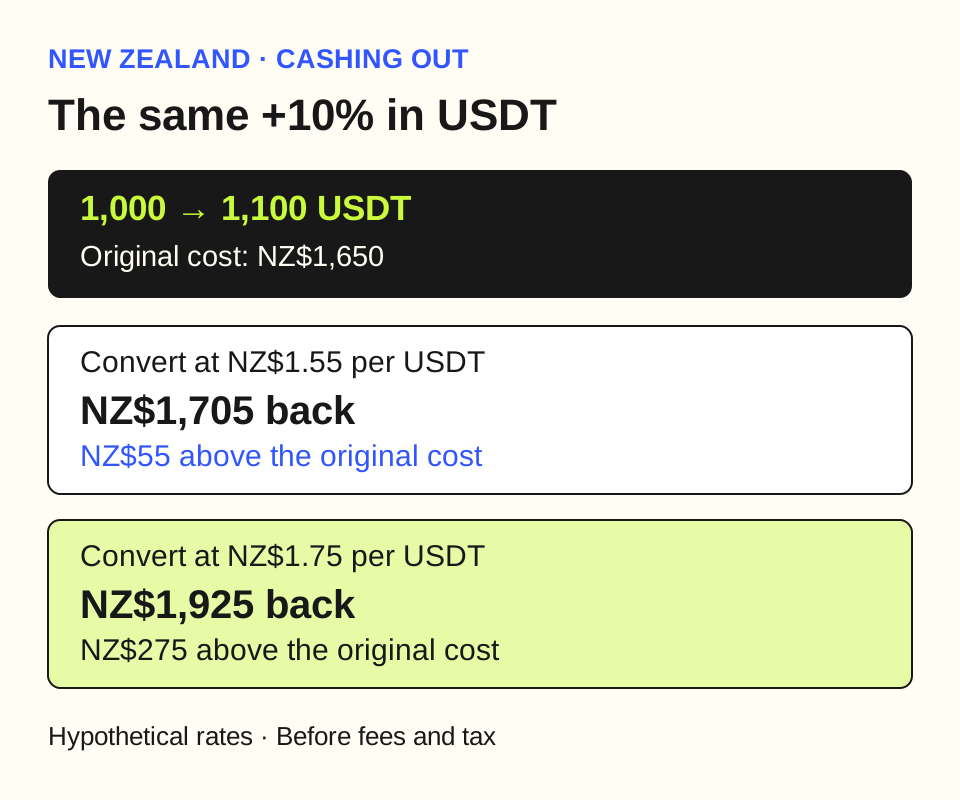
An NZD return can also differ from the profit percentage displayed in USDT. Assume 1,000 USDT initially cost NZ$1,650 and later become 1,100 USDT. At a closing conversion of NZ$1.55 per unit, the balance is worth NZ$1,705, a NZ$55 gain before costs. At NZ$1.75, it is worth NZ$1,925, a NZ$275 gain. The same 10% USDT increase produces different spending power in New Zealand.
Is leveraged crypto trading legal in New Zealand?
New Zealand does not treat buying Bitcoin and offering a Bitcoin derivative as the same regulatory activity. The FMA states that businesses offering derivatives to retail investors in New Zealand generally need a derivatives-issuer licence. The relevant question is the provider and product serving the account—not whether a company name appears somewhere on a financial register.
Neither offshore MEXC nor Bitget was verified here as an FMA-licensed derivatives issuer. The first comparison is their documented futures offering; readers requiring the NZ licensing framework need the locally licensed alternative described below.
Is there a national 2x limit for every New Zealander?
The reviewed FMA standard conditions do not establish the blanket 2x crypto limit sometimes copied into international country guides. A platform can impose its own lower limit, and different countries can have different product-intervention rules. Those facts should not be combined into a single invented New Zealand cap.
CMC Markets’ New Zealand crypto page, for example, currently advertises up to 100:1 on its platform. That is a provider-level maximum, not a promise for every customer or coin. It also illustrates why the precise NZ-serving product matters: a cap from a provider’s Australian or European retail account may describe a different offer.
When does a local crypto CFD deserve consideration?
It deserves consideration when you want leveraged crypto exposure with a documented NZ product disclosure and local provider relationship. It is less suitable if your main requirement is a USDT-native perpetual wallet, transferring collateral between exchanges, or trading the long tail of crypto pairs. The comparison should stay about those concrete differences, rather than drifting into stock-market investing.
For a CFD quote, inspect the crypto spread and ongoing holding charge alongside the margin requirement. For an exchange perpetual, inspect commission and funding. A maximum-leverage headline cannot settle that comparison, and a cash-settled CFD does not deliver Bitcoin to your wallet when you close it.
Can New Zealand traders use a perpetual DEX?
A wallet connection does not remove the need to check the platform’s location rules. dYdX’s published frontend guidance lists restricted jurisdictions and explains a close-only mode that prevents new positions or deposits while allowing reductions and withdrawals. New Zealand is not named in the headline examples reviewed, but the list is expressly non-exhaustive and the complete terms still govern access.
A perpetual DEX requires supported on-chain collateral rather than an NZD bank deposit. It therefore addresses wallet-based execution, not the local bank-funding need.
How are crypto futures and their collateral taxed in NZ?
Separate the contract result from the coins around it
New Zealand’s lack of a broad capital-gains tax does not make crypto trading profit tax-free. Inland Revenue explains that cryptoasset disposals can produce taxable income, including exchanges for another cryptoasset. Moving coins between wallets you own is different from selling or swapping them.
A futures account adds another layer. The derivative is not simply the BTC or ETH it references, and the tax classification of its income can differ from owning those coins directly. Inland Revenue’s technical material explicitly distinguishes a cash-settled crypto futures contract from the underlying token in its GST analysis. That is not an instruction to apply one spot-crypto calculation to every perpetual, or a universal ruling that all derivatives share one income-tax treatment.
Record realised contract results, funding payments and commissions separately from purchases and disposals of the collateral. Otherwise software may treat an internal transfer as a sale, omit funding receipts or count a return of your own margin as new income. A tax calculation based only on bank deposits and withdrawals misses the activity between those two endpoints.
What rate applies to a profitable trader?
For an individual, taxable income fits into the ordinary progressive bands rather than a special universal “crypto rate.” From 1 April 2025, the bands run from 10.5% on the first NZ$15,600 to 39% above NZ$180,000. Intermediate bands are 17.5%, 30% and 33%. Your other income affects where additional taxable trading income falls.
For example, if NZ$70,000 of other taxable income is followed by NZ$5,000 of additional taxable trading income, that extra amount falls within the 30% band, producing NZ$1,500 of income tax before other adjustments. This assumes the NZ$5,000 has already been correctly calculated and classified; it is not a formula for the gross value of the contracts traded.
Keep NZD values even when the exchange reports only USDT
Inland Revenue requires supporting crypto records, including NZD transaction values, exchange records, wallet details and bank statements. Keep them for at least seven years. The useful export is the full transaction history, not just a screenshot of the dashboard’s annual percentage return.
For a futures trader, retain the contract identifier, settlement asset, funding history, commission and collateral movements. These records let you explain how an exchange balance became an NZD amount without assuming USDT was always worth exactly one US dollar or that the exchange’s display conversion is suitable for every tax entry.
What changed with reporting in 2026?
New Zealand’s Crypto-Asset Reporting Framework started on 1 April 2026. The first reporting period ends on 31 March 2027, with provider reporting due by 30 June 2027. Users do not register as reporting providers merely because they trade; they do need to supply accurate residence and taxpayer details when requested.
Derivatives should not automatically be treated as the same CARF report as a token purchase. Inland Revenue also describes CRS changes covering indirect exposure to cryptoassets. Reporting by a platform and your own obligation to calculate taxable income are separate. An exchange reporting a transaction does not mean it has calculated your final New Zealand tax bill.
Auckland, the South Island and New Zealanders abroad
No different exchange leverage cap was established for Auckland, Wellington, Christchurch or another New Zealand city in the provider policies reviewed. Moving between the North and South Islands is therefore not an opportunity to unlock a different international derivatives account. The Chatham Islands should not be treated as an offshore exchange jurisdiction merely because they are geographically separate.
A genuine move abroad can be different. Kraken’s international derivatives restriction is expressed by residence, while Bybit’s NZ addendum uses a broader connection test. This is why “I have a New Zealand passport” does not answer every provider’s eligibility question in the same way. The precise provider wording matters for a Kiwi who moves overseas as well as for a foreign national moving to New Zealand.
Tax residence is another test again. Inland Revenue’s crypto guidance explains the consequences for NZ tax residents and non-residents; holding the balance on a foreign exchange does not itself move it outside New Zealand’s tax system. Someone who has left the country should establish their residence position rather than use the exchange account’s country dropdown as a tax conclusion.
Niue: which exchanges can residents assess?
Niue is a self-governing state in free association with New Zealand, and Niueans hold New Zealand citizenship. It uses the New Zealand dollar. Those connections explain why residents can encounter NZ-linked identity and payment questions, but they do not justify recording an Alofi home address as Auckland or automatically applying every NZ mainland product restriction.
For Niue and the Cook Islands, Kraken and MEXC are candidates under the published exclusions reviewed: neither island jurisdiction is named. This is a narrower finding than a tested local account or a licence. The same qualification applies to both island sections below, while Tokelau has an additional classification uncertainty.
The important difference between those candidates and Bybit is the latter’s NZ addendum, which can also apply through nationality or another relevant connection. A New Zealand passport plus Niue residence should therefore be disclosed accurately; selecting Niue does not automatically settle the Bybit product classification.
Neither shared citizenship nor shared currency establishes a domestic NZ bank-payment route. The source bank, residence and exchange deposit method must match the transaction. Niue’s Ministry of Finance administers its own revenue matters, and no Niue-specific crypto-perpetual tax ruling or local derivatives licence for these candidates was verified in this research. That limit should remain visible rather than being replaced with a claim of tax-free or government-approved trading.
Cook Islands: a separate exchange decision from mainland NZ
The Cook Islands comparison starts with the two candidates above, but a reader funding from Rarotonga faces a different payment question from an NZ-based reader. An international derivatives account and a supported NZ domestic bank transfer are not the same service.
The Cook Islands conducts its own affairs in free association with New Zealand. Its Financial Supervisory Commission has a separate supervisory remit. A locally incorporated company or a Cook Islands address on a crypto website is not, by itself, evidence that the company is authorised to offer the leveraged product being advertised.
The practical comparison is whether an accepted crypto-funded account fits your funding arrangements. Kraken’s derivatives are distinct from its cash-transfer methods; international bank funding has its own country and provider conditions. MEXC’s USDT contract does not create a Cook Islands dollar deposit account. Evaluate those services separately before assuming that a familiar NZD amount can be wired directly into margin.
Before choosing between the candidates, identify what you will transfer. An existing supported crypto balance makes the contract and collateral comparison central. A Cook Islands bank balance first requires a permitted purchase or cash-deposit method; neither shared citizenship nor an NZD price quote supplies that missing service.
Tokelau: what is documented, and what remains unconfirmed?
Tokelau has a different constitutional position from Niue and the Cook Islands. MFAT describes it as a non-self-governing territory with its own political institutions and administration. It should not be silently folded into either of those two self-governing states when comparing exchange terms.
Kraken and MEXC do not separately name Tokelau in the exclusions reviewed. The unresolved point is whether the provider groups an address in Atafu, Nukunonu or Fakaofo under New Zealand for the particular product. Unlike the clearer mainland restriction, the published documents did not settle that treatment. We therefore cannot give Tokelau a confirmed futures shortlist or import Niue’s constitutional position to reach one.
For a reader already holding an account, the useful evidence is the verified country assigned to that account and the enabled derivatives service. A spot balance alone supplies neither answer. This limitation is specific to the thin Tokelau documentation; it does not erase the researched choices for mainland New Zealand or the two self-governing island states.