















Which crypto futures account makes sense from Samoa?
For a Samoan resident who has permission for the proposed offshore investment, Bybit offers a straightforward USDT-perpetual starting point. Samoa is not named in its reviewed service exclusions. The headline non-VIP commission is 0.02% for a maker order and 0.055% for a taker order, with account and regional conditions applying.
Bitget is the closest comparison for the same USDT-based trading style. It publishes a standard 0.02% maker and 0.06% taker fee. For an existing Bitget customer, keeping an eligible USDT account can be more convenient than opening a second account for a small commission saving.
Kraken deserves consideration when returning proceeds through a supported international cash method is central to the plan. Its derivatives account values profit and loss in USD, and its standard taker fee is lower at 0.05%. This is a different account design from simply leaving the trading result in USDT. No direct WST futures wallet was verified for any of the three.
| Account | Where it fits | What prevents an unconditional recommendation |
|---|---|---|
| Bybit | A permitted USDT-funded crypto-perpetual account; lower headline taker fee than Bitget | The Samoan investment approval and usable funding/withdrawal arrangement must exist |
| Bitget | An alternative USDT futures account, especially for an existing eligible customer | Higher standard taker rate; American Samoa is expressly excluded |
| Kraken | USD-valued derivatives and a documented international cash withdrawal option to investigate | Receiving-bank and account conditions; not a direct tālā deposit promise |
Bybit leads the USDT comparison, but there is no reason to transfer an established account solely for a 0.005-percentage-point commission difference. If an approved withdrawal arrangement works only with another provider, that practical advantage can be decisive. The provider conditions reviewed here are public evidence, not a completed Samoan onboarding or bank-transfer test.
BTC/USDT, leverage and the balance you get back
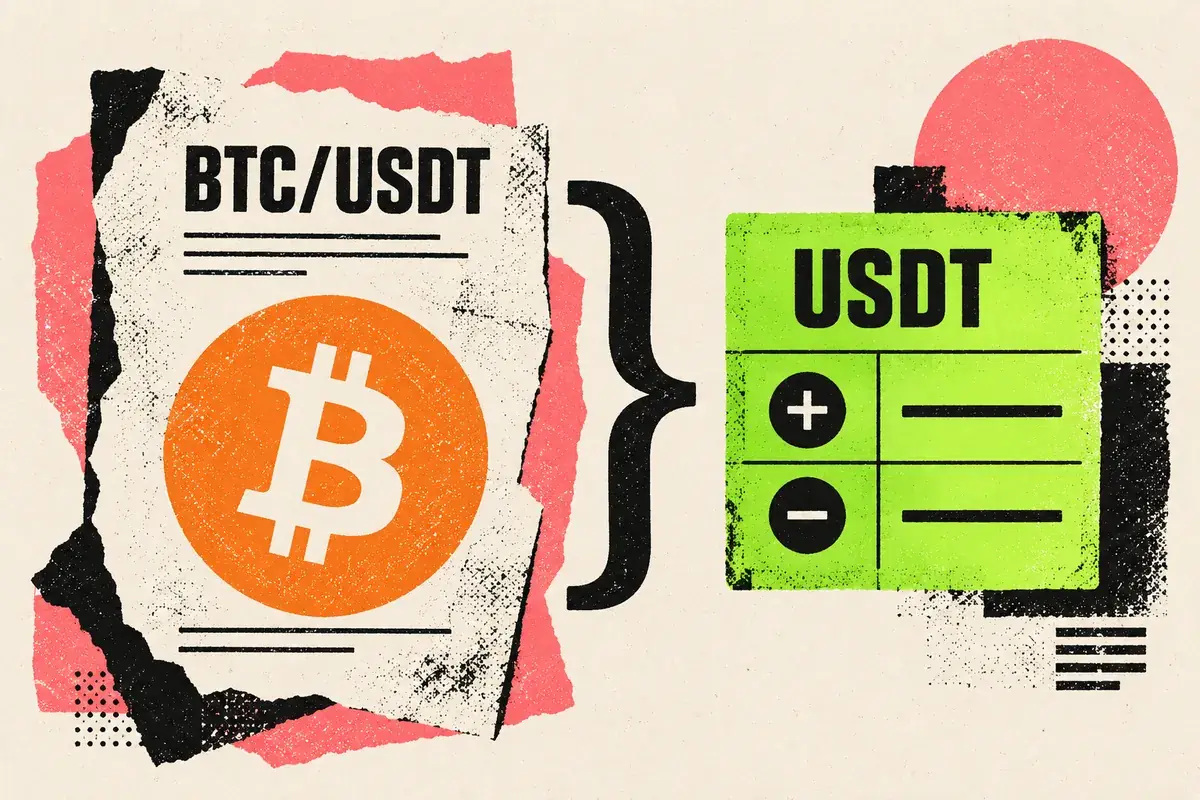
For a Samoa-funded account, choose the settlement asset before comparing the maximum leverage. A BTC/USDT perpetual gives exposure to Bitcoin’s price while keeping the result in USDT. Closing a winning position does not deliver the full Bitcoin amount represented by the contract; the realised change is credited according to the contract’s settlement rules.
This matters when the investment plan includes returning proceeds to Samoa. A 300 USDT result still needs a conversion or payment route that brings usable money home. It is neither WST 300 nor a promise that your bank will receive USD 300 without charges.
What leverage is documented?
Bitget’s BTCUSDT tier example starts at 125x for its smallest standard position tier, with lower limits for larger positions. Kraken’s BTC and ETH international perpetual specifications include a 100x class. These are published product references, not a special Samoan statutory allowance or a guarantee for a newly verified account.
For Bybit, inspect the maximum for the selected contract and account rather than importing a number from an advertisement for another pair. BTC, an altcoin perpetual and an inverse contract can have different risk settings. Samoa’s exchange-control permission does not set the exchange’s liquidation threshold.
We found no official Samoan retail multiplier that can be stated as a universal “crypto leverage limit.” The useful answer is the combination of a permitted investment and the actual market limit the provider applies, not a made-up national 100x or 125x rule.
What does CBS need for an offshore futures investment?
The Central Bank of Samoa’s Exchange Control Information Booklet, updated in July 2026, requires CBS approval for offshore investments. Its published application requirements include the proposed investment, the source of the money and the expected return of overseas investment proceeds to Samoa. Assessment is individual.
For crypto futures, a useful application identifies the exchange and its contracting business, the contract family, the amount to be invested and how the account will be funded. Explain that it is a leveraged crypto position if that is the purpose. Calling it a routine online purchase does not help CBS assess the investment actually planned.
There is an important difference between the amount deposited and the position controlled. If you propose to send the equivalent of USD 500 and use it against a USD 5,000 position, describe both. The investment’s possible exposure is not adequately explained by naming only the smaller transfer.
CBS publishes a dedicated exchange-control email, exchange.ctrl@cbs.gov.ws. The relevant request is a decision on that specific overseas investment, not a general question about whether the internet permits crypto. This guide supplies the published rule; only the authority can issue an approval for your individual application.
A local USD account is not the approval
CBS also publishes conditions for foreign-currency deposit accounts. Having foreign currency available can affect the conversion needed, but it does not replace the offshore-investment process. The funding plan should match the purpose under which the account operates and the transaction CBS approves.
No bank in Samoa is represented here as an automatic sponsor of the shortlisted exchanges. A bank’s ability to make international transfers and its willingness to process a particular investment payment are separate findings.
How many tālā does a USDT futures balance really cost?
Samoan currency appears as WST internationally and often as SAT or tala in local material. None of those labels means Australian or New Zealand dollars. A platform displaying a converted BTC price in SAT has not thereby created a locally settled futures market.
For an illustrative permitted purchase, suppose WST 1,500 ultimately produces 530 USDT after the payment provider’s quote and charges. The effective cost is about WST 2.83 per USDT. If another quote supplies 545 USDT for the same WST 1,500, its effective cost is about WST 2.75. Neither example is a live exchange rate.
The difference is visible before leverage enters the calculation: the second quote supplies 15 additional USDT. It may outweigh a modest difference in futures commission. Compare executable quotes for the same payment amount, rather than the central-bank reference rate with a retail provider’s all-in amount.
Trading fees versus the cash-out quote
A 3,000 USDT position opened and closed as a taker at unchanged size produces 3.30 USDT in Bybit commission at the headline 0.055% rate. Bitget’s standard 0.06% rate produces 3.60 USDT. These examples leave out funding, slippage and withdrawal costs and assume the quoted fee tier applies.
If the account later has 700 USDT available to withdraw, a hypothetical cash-out quote of WST 2.65 per USDT produces WST 1,855 before any additional fixed charge. A quote of WST 2.75 produces WST 1,925. That WST 70 difference is a conversion outcome, not a change in the futures trade itself.
The numbers help frame a real comparison without pretending that Samoa has a universal USDT price. Local marketplace liquidity, payment method and provider availability can differ. An advertised tālā quote should not be treated as guaranteed until its conditions and the recipient are known.
Samoans working in New Zealand or Australia
A seasonal work placement creates a more specific question than “does this exchange accept Samoans?” The CBS booklet includes Samoan citizens temporarily overseas for seasonal work, without an intention to obtain permanent residence there, within its resident definition for exchange-control purposes.
At the same time, an exchange assesses the actual residential and legal circumstances of its customer. A current address in New Zealand or Australia can trigger a different product offering even when the person retains Samoan exchange-control obligations. These two assessments do not necessarily change on the same date.

An existing account also needs attention when the work arrangement changes. Kraken, for example, excludes New Zealand residents from its international derivatives product. Keeping an old Samoan address on the account would not establish continuing eligibility after a real move.
For a permanent emigrant, the facts differ from a temporary seasonal placement. Use the destination country’s guide for product access, and document the change in residence when dealing with Samoan accounts. Neither ancestry nor the passport’s issuing country is a reliable substitute for the current customer assessment.
Does this guide cover American Samoa or Savai’i?
This article concerns the independent country of Samoa, including Upolu and Savai’i. American Samoa is a separate jurisdiction. Bitget explicitly includes American Samoa among prohibited US territories in its current terms, even though Samoa itself is absent from that list.
An exchange’s templated buying page can conflict with its operative terms. During this review, search results returned Bitget-branded purchase material for American Samoa. That marketing result is not stronger evidence than the prohibited-country provision. The consequence for a reader is concrete: do not register under “Samoa” when the actual address is in American Samoa.
Within independent Samoa, we found no documented Upolu-versus-Savai’i difference in the shortlisted exchanges’ derivatives limits. A customer on Savai’i may use a different bank access channel, but that does not create a separate national crypto licence or a higher leverage ceiling. There is no need to travel to Apia simply to claim a different exchange jurisdiction.
If a person moves between the two Samoas, the account assessment needs to follow the new facts. A shared language, family connection or existing login does not merge the two country classifications.
Is a Samoa-branded crypto exchange locally approved?
In June 2023, the Government of Samoa expressly said it had not endorsed or approved the proposed Samoa Stock Exchange, Samoa Digital Asset Exchange and Oceania Special Economic Zone initiatives then being promoted. That dated announcement does not establish the status of every later business, but it prevents treating those launch claims as a licence.
No later authorisation for those proposed crypto-exchange initiatives was established in the sources reviewed for this article. A reader offered one of them as a locally approved leveraged-trading venue should therefore expect an identifiable current approval and the product it covers, rather than a recycled launch announcement.
There is a newer, different development: CBS authorised controlled testing of PacWallex and TickTap from May 2026 to February 2027. These are electronic-money payment products in a sandbox. The approval describes payment testing, not Bitcoin futures trading or a licence for the international exchanges in our comparison.
Samoan tax: why the tālā record matters
Samoa’s Income Tax Act addresses ordinary income, business income and capital gains. It does not justify assigning every crypto perpetual the same tax category merely because it is displayed beside spot coins in an app. Classification depends on the actual activity and instrument.
Section 76 requires amounts taken into account under the Act to be expressed in tālā, generally using the CBS mid-rate at the relevant date. A bank’s retail conversion quote can therefore differ from the rate used for the statutory calculation. Retain both records rather than replacing one with the other.
A particularly local detail appears in section 75: recognition of a foreign-currency exchange loss has a prior-CBS-approval condition. That should not be stretched into a claim that every loss on a USDT perpetual is legally a foreign-currency loss. It does mean the investment approval, instrument classification and currency record can matter when determining the treatment of a loss.
Download the exchange history with each contract’s realised result, funding payments and fees. Preserve the acquisition and disposal record for the settlement asset as well. The Ministry of Revenue’s ordinary guidance is the starting point for the filing obligations; no separate official one-rate crypto-futures tax rule was established in this review.