












Bybit, Binance or OKX for a Tajik futures account?
Bybit combines a documented TJS marketplace with USDT perpetuals, so it is the most straightforward product to investigate when your budget starts in somoni. Its payment selector names Alif Bank, Bank Eskhata, DCBank, Humo and other local methods. That is useful local evidence, although it does not prove that a particular bank endorses the trade or that an advertiser can fill your order today.
Binance deserves a close look alongside it. A September 2026 announcement introduced a temporary zero maker-and-taker fee promotion for selected TJS P2P pairs, including USDT. It runs from 16 September through 16 October 2026 under the published terms. This gives Tajik users a current reason to compare an executable quote, rather than choosing solely from an exchange's global reputation.
OKX is relevant to a trader who will place repeated futures orders: its published regular-tier taker reference is slightly below Bybit's. It has also documented TJS P2P support since 2023. Which option wins depends on whether acquiring the collateral or repeatedly trading it accounts for more of the cost.
| Your situation | Starting point | Reason to switch |
|---|---|---|
| Starting in TJS and wanting USDT futures | Bybit | Another eligible offer delivers more usable USDT for the same permitted payment |
| Comparing local acquisition costs during the stated promotion | Binance | Its actual quote or payment conditions are worse despite the fee promotion |
| Already holding crypto and using frequent taker executions | OKX | Account-specific fees, execution or product eligibility erase the published fee advantage |
None of these is presented as an NBT-licensed Tajik futures exchange. They are offshore services with different strengths. We reviewed their published material, not funded Tajik accounts; a promise of “the fastest local withdrawal” would go beyond what this investigation establishes.
Which kind of crypto future should you choose?
For a first futures comparison, focus on the BTCUSDT or ETHUSDT contract you intend to trade, not the exchange's total number of coins. A venue can list hundreds of spot assets while the specific perpetual you want has different position limits, funding costs or much less trading activity.
Bybit's USDT product guide distinguishes perpetual and expiry contracts. A perpetual has no scheduled final expiry; an expiry contract ends on a stated date. For someone planning a short Bitcoin trade and wanting to close it manually, a perpetual is the simpler product to compare. Someone targeting a particular future date may prefer the dated contract and its quoted price.
The currency in the market name matters too. TJS is your local payment currency. USDT is the settlement asset for the USDT contract. A bank debit of TJS 5,000 does not create a TJS 5,000 margin balance, and a 50 USDT loss is not a 50-somoni loss. Keep the trading size in the contract's currency and translate the result afterwards.
What should you inspect on a small altcoin market?
Look beyond the largest leverage number. The price available for a tiny order may not be available for your entire position. A thin book can make the entry or exit much worse than expected, while a maximum multiplier says nothing about whether another trader will take the other side at your price.
The useful comparison is between the same token, position size and intended order type at each eligible exchange. If one exchange quotes lower commission but the actual average fill is worse by more than that saving, it is not the cheaper trade. We do not invent a live liquidity winner because this requires current order-book observations at the size being considered.
Why an order can cost more than the first price you see
Here is a simplified futures order book. Suppose the first 20 units are offered at 10.00 USDT and the next 30 at 10.10. A market order buying 50 units would pay 200 USDT for the first part and 303 for the rest: 503 USDT in total, or 10.06 per unit on average, before commission. It would not buy all 50 at 10.00.
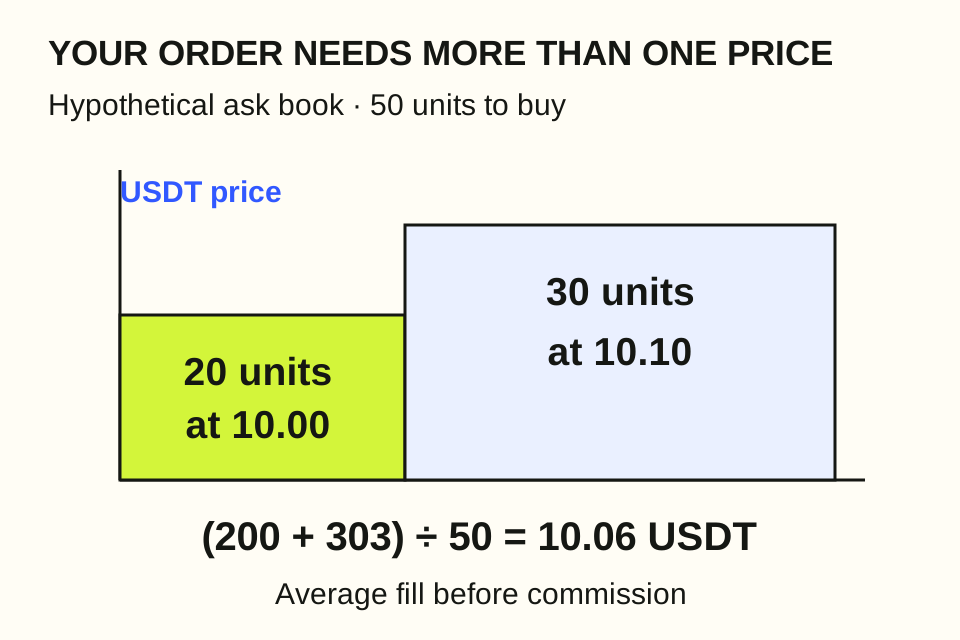
This is a useful distinction for a small account funded through a relatively expensive local conversion. The 3 USDT difference from the best visible price is money that no longer supports the position. Leverage does not erase it; commission and any subsequent funding payments still come on top.
A limit order at 10.00 caps the acceptable purchase price, but in this snapshot only 20 units are immediately available there. The rest may wait or never fill. You have exchanged certainty about the price for uncertainty about obtaining the full position. There is no order type that guarantees both in every market.
Does a limit order always receive the maker fee?
No. A limit order that matches existing liquidity immediately can be charged as taker. The label on the order form is not enough; the way it executes determines the fee category. Bybit's maker/taker explanation explicitly includes immediately executable limit orders in the taker group.
For a trader entering and exiting frequently, save the actual fills and commissions rather than assuming every planned limit order was cheaper. This gives you a real basis for deciding whether OKX's or Bybit's pricing suits your behaviour. The comparison becomes about completed trades, not the smallest number in a fee table.
How much do futures fees take from a modest account?
The published reference rates reviewed here are Bybit non-VIP futures maker 0.02% and taker 0.055%, versus OKX regular level-1 maker 0.02% and taker 0.05%. Actual account tiers, regional arrangements and special markets can differ. Use these figures as a like-for-like reference, then confirm the rate shown for the account and contract.
Apply those rates to the 503 USDT purchase above. The entry commission would be approximately 0.277 USDT on Bybit and 0.252 USDT on OKX: a difference of about 0.025 USDT. In that example, the 3 USDT paid above the first visible price is more than 100 times that commission difference. A cheaper fee schedule would not compensate for a worse fill of that size.
For someone keeping a small account and trading infrequently, the local buy/sell quote can matter more. For a frequent trader already holding collateral, the accumulated execution difference can justify a closer comparison. This is why Bybit leads the practical TJS shortlist while OKX remains a serious alternative, rather than being given the same generic “low fees” justification.
Funding is a different charge
A perpetual may involve funding payments between traders. The rate and interval shown for the selected market can change. A positive payment on one side is not a fixed tax on every trade, and closing before or after the relevant timestamp can affect whether a payment applies.
If you plan to hold a position for several days, inspect that market's funding history and current schedule alongside commission. A platform with slightly cheaper entry and exit fees can still cost more over your holding period. Do not assume every perpetual uses the same eight-hour schedule or that today's rate will stay unchanged.
What Binance's TJS promotion does—and does not—change
The announced September–October 2026 promotion concerns eligible P2P trades in selected TJS pairs. It does not make a Binance futures order commission-free. It also does not force every marketplace advertiser to quote the same exchange rate or accept the same bank method.
An offer with zero platform commission can still deliver fewer tokens because its price is worse. Compare the final USDT received for your actual somoni budget, including the advertiser's limits and any payment cost, rather than declaring the promotion the winner before looking at the quote.
For example, two hypothetical offers for a TJS 5,000 budget might deliver 500 USDT and 496 USDT after all stated charges. The difference is 4 USDT. The fee promotion would not rescue the second offer if its final price still left you four tokens behind. The numbers are illustrative; the comparison to make is how much collateral actually reaches your trading account.

After 16 October, the appropriate comparison is the then-current tariff and quote. The expiry does not remove Binance from the shortlist; it removes one time-limited reason for preferring its P2P offer. For an account you expect to use for months, compare ordinary pricing as well as the temporary offer.
What does the National Bank say about crypto?
The National Bank's January 2026 publication describes a virtual-asset risk assessment with OSCE support. It records work on risks, regulatory approaches and supervision. It does not announce a retail futures licence for Bybit, Binance or OKX. A project being studied should not be reported as a completed local approval.
This is a gap in local protection, not a reason to invent a complete country-wide ban. The provider-access shortlist comes from the exchanges' own material. The local assessment tells a different part of the story: do not assume that an offshore derivatives dispute has the same local remedy as a regulated Tajik banking service.
Tajikistan is not Uzbekistan or Kyrgyzstan
Country lists and currency codes are easy to mix up in regional reviews. Bybit's excluded-jurisdiction page names Uzbekistan; it does not name Tajikistan. That is a provider-policy distinction, not a judgement about the entire region. The Tajik somoni is TJS, while neighbouring markets use other currencies and their own rules.
The same care applies to a person who works abroad. A Tajik national actually resident in another country must use the provider conditions for that residence. A remittance home does not turn the sender's account into a Tajik-resident account, and a Tajik bank card alone does not prove which exchange entity can serve the person.
No region-specific exception for Dushanbe, Khujand or Gorno-Badakhshan was established in the cited product material. There may be practical differences in banking access, but we do not invent a special crypto-futures permission based on the customer's city. The relevant local evidence here is the actual payment method and applicable account conditions.
Using somoni without confusing a payment logo with a guarantee
The Bybit TJS selector is useful because it names banks and methods a local reader recognises. It is not a list of banks guaranteeing the exchange or the seller. An advertiser choosing Alif Bank or Bank Eskhata does not establish that the bank has assessed that person's crypto trade.
Filter a potential offer by the amount you can actually pay and the method allowed for your own account. A cheap price attached to a minimum above your budget is not your available price. Nor is an offer with insufficient remaining tokens enough to fill the purchase you planned.
For permitted P2P transactions, keep the payment identity consistent with the verified user and the platform's rules. A request to use a relative's account or pay an unrelated beneficiary introduces a different party into the transaction. Do not accept it merely because the advertiser has a familiar bank logo.
A remittance limit is not a trading-deposit limit
Alif's published Western Union service information contains limits for that remittance product. Those figures cannot be lifted into a crypto guide and described as the limit for every Alif transfer. The method, recipient and purpose must match the actual service being used.
This also affects support questions. Ask about the specific own-name transfer you intend, not whether the bank “supports crypto” in every possible form. An international remittance, a local transfer to another customer and a card transaction can have different terms and charges.
Why the futures ticket may show less money than your account
On Bybit, the Funding Account holds assets used for several payment functions, while the Unified Trading Account supports the relevant trading activity. Tokens appearing in Funding are not necessarily already in the balance used by the futures ticket. That distinction can explain a missing balance without any loss of funds.
There is another reason an order can require more than the simple margin figure. Bybit's order-cost guide includes initial margin and estimated opening and closing fees. Putting the entire account into a position based only on “balance multiplied by leverage” can leave too little to cover the complete order cost.
For example, allocating 100 USDT as initial margin for a 1,000 USDT position does not make all execution charges vanish. Leave the account's order preview to show the complete requirement, rather than repeatedly raising leverage until the order appears to fit. The latter changes the margin cushion; it does not make the trade free.
Does a wallet-based perpetual offer a useful alternative?
Hyperliquid changes the account model: its documentation describes wallet or email connection and a USDC collateral route for core perpetuals. It can appeal to someone already using compatible on-chain assets who wants that workflow. It does not provide a Tajik bank balance or replace the local-currency funding decision.
The comparison with a custodial USDT exchange is therefore concrete. Bybit combines the documented TJS marketplace with its trading account; a Hyperliquid user must manage the supported deposit asset, network and wallet interaction. The extra steps may be acceptable to an experienced on-chain trader and unnecessary for a beginner starting with somoni.
Hyperliquid supports cross and isolated margin, with cross described as the default in its margin documentation. In cross mode, collateral can support multiple positions. In isolated mode, collateral is assigned to the particular position. Do not assume that connecting a personal wallet automatically isolates every trade or keeps deposited trading collateral outside protocol risk.
Our preference is to keep the TJS-funded beginner on the simpler exchange comparison, while treating the wallet service as a distinct option for someone who understands the added responsibilities. No local Tajik licence or guaranteed wallet recovery is implied. The product's current access conditions still need to fit the actual user.
Measure a completed trade in the currency you spend
The futures statement alone cannot reconstruct the full somoni result. You need the original TJS payment and the eventual proceeds as well as the token trading history. Bybit's export guide specifically excludes P2P Order History from that general export process, so save those orders separately.
This matters if a successful trade coincides with a worse USDT sale quote. The futures result measures performance in the settlement asset; the cash-out records show what the money can buy locally. There is no reason to describe the difference as an exchange trading error when it arose in a separate conversion.
For an actual withdrawal, distinguish free funds from collateral still supporting an open position. A positive unrealised profit is not always money available to transfer out immediately. Resolve the position and account state before selling or promising a particular amount to someone else.
Keep tax questions tied to those actual records and your residence. We do not assign an invented flat Tajik crypto-futures tax rate from a general foreign guide. The useful evidence is the sequence of dated payments, executions, charges and proceeds, not a percentage copied from another country.