
BingX Perpetuals or Standard Futures: which should you open?
Choose Perpetual Futures when you want to place your own limit orders, distinguish maker from taker fills and manage a combined position with more advanced controls. That is the default product we would inspect for regular BTC or altcoin futures trading. You can use it without following a trader, subscribing to signals or allowing anyone else to decide your entries.
Standard Futures has a separate interface and a simpler per-order structure. That may appeal to someone who prefers to keep individual entries distinct, but it is not merely a renamed version of the perpetual order book. Its estimated fill price includes a spread mechanism and its trading commission is recorded and collected differently. A comparison that quotes one BingX fee for both products conceals the decision that matters first.
| Task | Perpetual Futures | Standard Futures |
|---|---|---|
| Price an active manual strategy | Maker/taker commission on each side | One-time trading fee plus spread model |
| Choose order behavior | Limit, market and advanced order choices | Simpler market and trigger workflow |
| Organize entries | Combined positions; one-way or hedge modes | Separate positions per order |
| Use multi-asset or USDC futures features | Supported product options, subject to eligibility | Not interchangeable with these Perpetual features |
BingX’s menu also includes coin-margined and USDC-settled perpetuals. Those labels change the asset supporting or settling the position, so a USDT example should not silently become a quote for every contract. The calculations here concern the named USDT products unless a section explicitly says otherwise.
BingX perpetual futures fees for manual trading
The public BTC-USDT and ETH-USDT contract records returned a 0.02% maker fee and a 0.05% taker fee in our 6 October 2026 capture. Those are reference rates for the sampled perpetual contracts. VIP status, product-specific conditions and eligible promotions can alter an account quote; they are not assumptions we automatically apply to every reader.
At those rates, opening a 10,000 USDT position costs 2 USDT as maker or 5 USDT as taker. An exit of the same value incurs another commission. If you enter passively but close immediately at market, the illustrative total is 7 USDT. If both sides consume liquidity it is 10 USDT, before funding and execution differences.
| Entry / exit | Commission | What still sits outside it |
|---|---|---|
| Maker / maker | 4 USDT | Funding and any execution cost |
| Maker / taker | 7 USDT | Funding, spread and exit slippage |
| Taker / taker | 10 USDT | Funding and both executions |
The fee is based on the filled position value. A 500 USDT margin allocation at 20x can support 10,000 USDT of exposure, but it does not turn a 0.05% taker charge into 0.25 USDT. The illustrative charge is 5 USDT on that side. This is why a small-margin strategy can still spend a meaningful share of its balance on frequent entries and exits.
An immediately executable limit order can be taker. A Post Only instruction is useful when you want to avoid that outcome, with the trade-off that the order may not enter or fill when it would cross the book. For an urgent reduction, it may be rational to accept taker commission rather than keep waiting for a passive fill. The right execution role follows the task; “always maker” is not a complete exit strategy.
The fee selector on this site applies to BingX perpetuals. It should not be used to estimate Standard Futures or a leader’s profit share. Keeping those costs separate also makes the ledger easier to understand when a copied position and a manual position trade the same underlying coin.
Why Standard Futures’ 0.045% is not an all-in quote
BingX’s Standard fee guide describes a discounted 0.045% one-time trading fee, recorded on opening and deducted on closing. The same guide labels 0.075% as the undiscounted rate. We use the published discounted reference when illustrating Standard, rather than treating it as a permanent promise or incorrectly charging it twice.
For 10,000 USDT of opening volume, 0.045% gives a 4.50 USDT trading fee. That looks lower than the 10 USDT two-taker perpetual example, but the comparison is incomplete. Standard also has a spread mechanism reflected in the estimated filled price. BingX describes that spread as dependent on market conditions and long/short demand, with large positions and copied orders potentially affecting it.
Follow the cost model of the product you opened
Commission on both fills
Maker or taker pricing when entering and exiting. Funding is separate.
Reference: 0.02% / 0.05%One commission, plus spread
Commission is calculated at opening and charged on closing. The spread changes the fill.
Documented discounted rate: 0.045%A hypothetical 0.08% disadvantage on a 10,000 USDT entry is another 8 USDT before considering the exit. Combined with 4.50 USDT of commission, it exceeds the perpetual commission-only example. This is not a measured Standard spread or a claim that Standard always costs more. It shows why a lower posted fee cannot settle the product choice without looking at the actual fill estimate.
The Standard chart can also fail to show the exact price used for your fill because the spread is part of that execution calculation. If the price on the entry confirmation differs from the recent candle, compare it with the estimated filled price and order record before assuming a display error. A market chart and the complete charge for opening a leveraged position are not identical measurements.
For someone choosing Standard because entries are managed separately, that additional pricing work is the cost of the preference. For someone who mainly wants to work a limit price against visible offers, Perpetuals is the more direct fit. We would not encourage switching merely to capture a lower-looking percentage without comparing both sides of an otherwise similar trade.

Using BingX for manual crypto futures and partial exits
In the signed-out Perpetual interface, BingX displayed separate Open and Close choices, an isolated-margin label, leverage settings, and Limit, Market and Trigger instructions. That separation is useful for a manual trader: closing existing exposure is a different task from opening the opposite direction. We inspected the public form without submitting an order or changing a funded position.
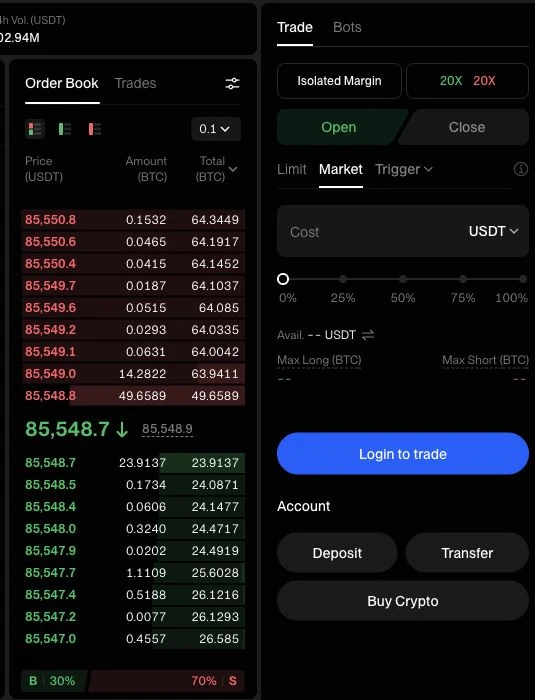
Standard keeps entries as individual orders, whereas Perpetuals normally aggregates exposure for the same pair and direction. That changes what you select when reducing a trade. A Standard user may be closing a particular entry; a Perpetual user may be reducing the combined position. Choose the intended position or order record first, especially after several entries at different prices. An opposite opening order is not a substitute for selecting the relevant Close control.
Keep a trigger and an execution price separate
A trigger tells the platform when to activate an order. The resulting execution still follows the chosen order type and market conditions. A triggered limit can remain waiting if its price is no longer available. A market-style instruction can fill away from the last visible quote. The stop’s reference price should be read on the actual ticket rather than assumed to match the candle source.
BingX documents trailing-stop and advanced order options for Perpetuals, while Standard has a narrower set of execution choices. The difference matters if you need to stage several reductions or avoid immediate taker execution. It matters less if your entire workflow consists of a single entry and a single market close, in which case the full cost comparison may dominate.
On a phone, the useful product check is the amount label: Standard emphasizes margin, while the Perpetual ticket offers its own cost or quantity controls. Moving between those screens can therefore change what the same typed number represents. These captures document the desktop forms; they do not establish the behavior of a logged-in native-app position.
BingX leverage, margin tiers and liquidation
A leverage label on a blank ticket is not proof of the highest permitted setting. Our public Perpetual screen showed 20x as its current default. The contract metadata supplies size increments and fee fields, but not a universal leverage ceiling for every market and account. We therefore do not turn that observed 20x into a maximum or promote an unsupported platform-wide multiplier.
BingX’s dedicated forced-liquidation rules calculate risk using required maintenance margin and the estimated closing fee against the collateral supporting the position. The trigger occurs when that risk reaches or exceeds 100%. Maintenance rates vary with position tiers. A single fixed percentage copied from a general fee page is not a reliable description of all positions.
In isolated mode, the margin assigned to the individual position is central to that calculation. In cross mode, other positions, reserved funds and available balance enter the account picture. The cross liquidation process can cancel pending orders and offset opposite positions before reducing remaining exposure. That means the displayed estimate can change as the account changes even if you do not edit the original entry.
Adding margin is different from closing size
Adding permitted collateral can create a larger buffer, but leaves the market exposure in place. Closing part of a position reduces exposure and can also affect its risk band. Which action is useful depends on what you intend to keep holding. A smaller margin percentage on the interface is not itself a trading objective if the market position has become larger than you wanted.
For the sampled BTC contract, the public minimum quantity was 0.0001 BTC alongside a separate minimum USDT value field. Both constraints matter; meeting the coin increment alone does not automatically satisfy every order rule. ETH used a different minimum quantity. These are another reason to confirm the exact contract before applying the sizing habit from a previous market.
We rely on the dedicated liquidation rules for this account-level discussion. A short feature comparison elsewhere on the site is not enough to establish every trigger-price safeguard or execution detail. The useful operating habit is to monitor the position’s current risk and available exit, rather than treating a simplified liquidation-price calculation as a guarantee of how the engine will act.
Is BingX Guaranteed Stop Loss available for your trade?
BingX documents a Guaranteed Stop Loss feature for eligible perpetual markets, intended to deal with adverse slippage under its terms. It is a distinct optional mechanism, not a property of every ordinary stop. The historical announcement and current contract fields support discussing the feature, but they do not justify promising it for every pair or account.
The documented feature is conditional on the supported position and stop settings, and charges can apply when the mechanism is used. The launch material’s original pair counts and temporary promotional rates are not dependable present-day quotes. We do not label the feature universally free or turn an old zero-fee BTC promotion into a continuing benefit.
For a concrete decision, compare the currently quoted guarantee cost with the protection actually described for the intended contract. If an ordinary stop is the only available option on the ticket, it should be evaluated as an ordinary stop. If the guaranteed option is offered, read the applicable conditions before assuming a precise worst-case exit.
Our public BTC and ETH contract records enabled the guaranteed-stop field, which is evidence of a supported feature flag rather than a completed guarantee. The signed-in ticket must still offer an eligible configuration. We did not trigger the feature or measure its settlement performance, so the review does not score an untested promise as proven execution quality.
Why a copied BingX trade can produce a different result
Copying adds a second execution process to the trader’s original decision. BingX Copy Trading 2.0 uses a dedicated subaccount for the relationship and documents copying the trader’s leverage and margin mode. That improves the link between the two strategies, but it cannot make two orders fill at the same price or make every follower’s balance identical.
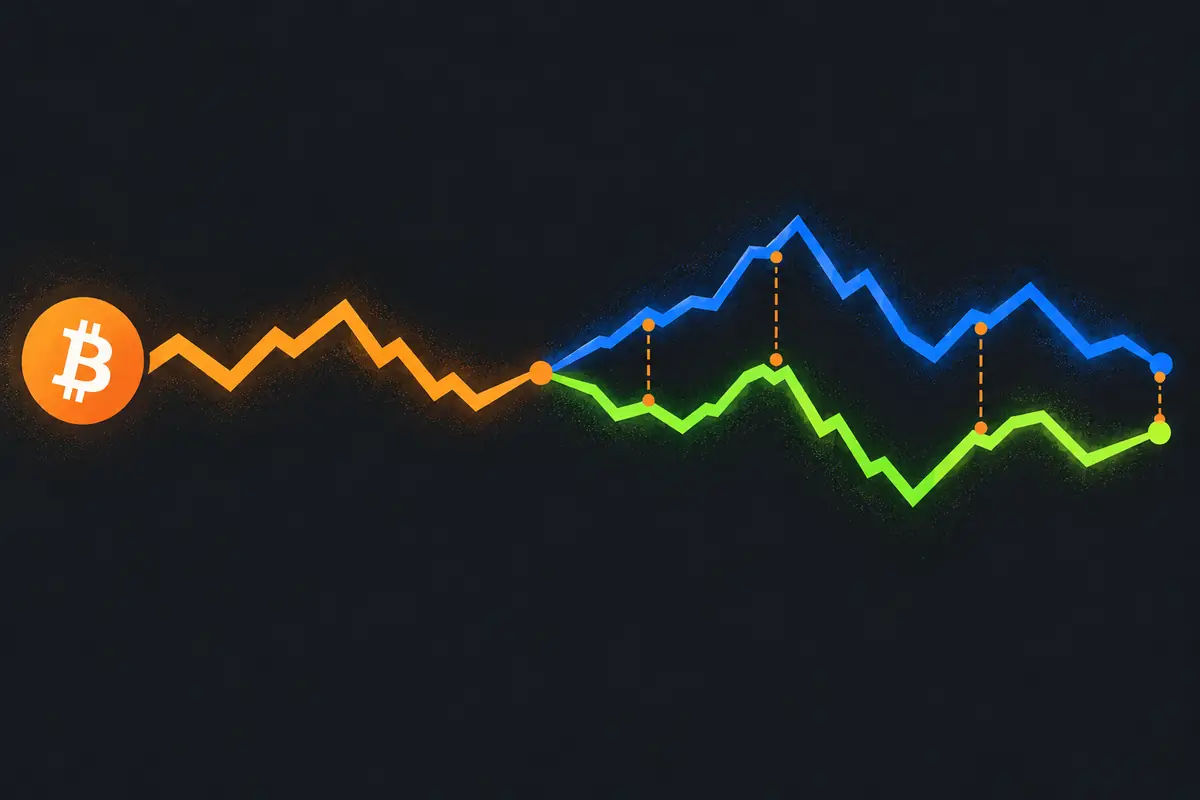
Suppose a leader buys 0.1 BTC at 80,000 USDT and a follower’s otherwise equivalent order fills at 80,080. If both later close at 80,200, their gross trading PnL is 20 USDT and 12 USDT respectively. The follower is 8 USDT behind before commission, funding or profit share. These are hypothetical prices, not observed BingX performance, but the difference shows why matching direction does not guarantee matching return.
The same exit can leave the follower with less profit
Illustrative 0.1 BTC long · both close at 80,200 USDT
Position-ratio copying and fixed-per-order margin also behave differently. In the first, the copied allocation depends on the relationship between the leader’s intended margin and available margin. In the second, the follower specifies an amount per trade. Minimum order sizes, caps and insufficient available funds can prevent a mathematically exact copy. BingX’s guide documents these constraints rather than guaranteeing every signal will become a position.
Slippage settings introduce a further trade-off. A tighter allowable difference can avoid an unattractive entry, but can also leave the follower without a trade the leader holds. Later outcomes then diverge for a reason unrelated to the leader’s headline win rate. Check failed-copy reasons and actual position records rather than judging the relationship solely from the leader’s displayed ROI.
The 2.0 workflow also avoids automatically realigning open positions merely because the leader or copier adds or removes funds. Actual trading signals drive the copy actions. Adding funds is therefore not necessarily a way to enlarge every existing copied position. That detail is useful when deciding whether the product matches the exposure you intend to hold.
A small copier can receive a larger-than-proportional order
The minimum-order rule differs between copying methods. In the documented position-ratio workflow, a calculated opening quantity below the contract minimum is raised to that minimum. The resulting exposure can exceed a perfectly proportional copy. In the fixed-margin-per-order workflow, a below-minimum opening amount is canceled instead. A smaller follower account can therefore end up with either a relatively larger trade or no trade, depending on its selected method.
This matters when the leader spreads capital across many small altcoin positions. A follower cannot assume that transferring one tenth as much money will reproduce every position at one tenth the size. Several minimum-sized orders can consume more of the follower’s balance than the intended ratios suggest; canceled orders can leave a different mix of assets. Compare the resulting allocations, including failed entries, before concluding that two accounts are following the same diversified strategy.
Funding, balances and withdrawals on BingX futures
For a manual perpetual position, funding is a separate transfer between sides of the market. The observed BTC Perpetual screen displayed an eight-hour interval and a next-settlement countdown. That observation does not guarantee every BingX contract uses the same interval. Read the named market’s current schedule when comparing a holding strategy with another exchange.
Standard’s guide distinguishes when funding is calculated from when it appears as a settled charge: its isolated workflow describes settlement on position closure, while cross can settle at the funding event. A trader comparing the two products can therefore see different timing in the account record without one product having eliminated funding. The reported PnL and the full cash result should be reconciled after costs.
For a copied strategy, the dedicated subaccount is another relevant balance boundary. Money allocated there is not simply idle cash available for unrelated manual orders. When a relationship ends and positions close, the transfer back to the Perpetual balance is distinct from an on-chain withdrawal. Neither step proves the timing or availability of a later network transfer.
The account deposit and withdrawal route should use a supported asset and matching network. BingX’s current network selector, withdrawal fee and minimum determine the usable route. A low trading commission says nothing about a token-specific withdrawal suspension or the cost of sending a small remaining balance. We did not move funds or verify a particular account’s withdrawal limits.
Product availability also depends on the user’s location, entity and verification status. A signed-out futures interface can be visible where opening that product is restricted. Complete the relevant account checks before allocating collateral, and use our country research for the jurisdiction-specific layer. The public BTC screen in this review establishes the visible workflow, not permission for every visitor to trade.
BingX versus Bitget and Bybit: the useful comparison
Compared with Bitget, the useful copy-trading questions are the allocation method, eligible markets, profit-share terms and what happens when you stop following. Those are more informative than comparing leader counts. Our Bitget review also contains the operational context relevant to moving funds; use current service notices rather than assuming that two similar interfaces imply identical account conditions.
Bybit is a relevant alternative when you expect to use broader account and order workflows. For a straightforward BTC entry and exit, however, a long feature list may add little. Compare the same position size and execution role before attributing value to tools you will not use. The Bybit review separates its account modes and trade-offs.
BingX futures: your questions
Does BingX charge the Standard 0.045% fee on both sides?
The published Standard guide describes a one-time fee recorded on opening and deducted on closing. That differs from Perpetual maker/taker commission on each fill. Standard also has a spread model and funding, so the one-time percentage is not the whole cost.
Why can my Standard entry differ from the candle price?
BingX describes a spread adjustment in Standard’s estimated filled price. Market activity, size and available depth can affect execution. Compare the order confirmation and estimated fill with the actual trade record; a candle alone is not the complete pricing reference for that product.
Does a BingX private leader keep the same profit share forever?
No. Under the May 2026 private-perpetual rules, a changed ratio can apply to existing copiers from the next settlement cycle, with notifications. The current cycle keeps its old ratio. This specific update does not establish the same change policy for Standard Futures relationships.
Will Stop Copying leave my current copied trades open?
The Copy Trading 2.0 guide says ending the relationship closes remaining positions at market and returns funds to the Perpetual account. That can realize PnL and execution costs. Read the confirmation rather than treating the action as a pause that only prevents new signals.
Is the 20x shown on BingX’s public ticket its maximum leverage?
No. It was the selected default in our interface observation. Contract and account restrictions determine what can actually be chosen. The screenshot is evidence of the displayed workflow, not evidence of a universal ceiling or permission for a particular user.
Does Guaranteed Stop Loss mean every BingX stop has a fixed fill?
No. It is a separate feature subject to supported markets, current conditions and possible charges. Ordinary trigger and stop orders do not automatically acquire those terms. Historical launch discounts or pair counts should not be used as today’s quote.
Evidence behind this reviewSources and research
Sources and research
Official BingX product, fee, liquidation and copy-trading material was checked on 6 October 2026, alongside public BTC and ETH contract metadata and signed-out Standard and Perpetual interfaces. The May 2026 private-copy change takes precedence over older change-of-share wording for that scope. Examples are labeled calculations; no live orders, copied positions or withdrawals were performed.
- Standard versus Perpetual products
- Standard fee and spread rules
- Perpetual fee schedule
- Contract metadata
- Dedicated liquidation rules
- Guaranteed Stop Loss terms
- Copy Trading 2.0 user guide
- Copy Trading 2.0 settlement and formulas
- Profit-share tier programme
- Private-copy share changes, May 2026
- Standard BTC interface
- Perpetual BTC interface