Is dYdX still a good perpetual exchange?
The useful reason to choose dYdX is a particular perpetual market and the way you can control its collateral. The present product combines an order book, USDC settlement and a choice of cross or isolated trading. You can separate an experimental altcoin position from the rest of the account instead of treating every market as part of one undifferentiated balance.
The current catalogue also requires a more careful reading than many broad reviews give it. Our 6 October collection contained 296 market records, but only 73 were marked ACTIVE; 223 were in FINAL_SETTLEMENT. An old symbol remaining in an API response does not mean a new position can be opened. We use the active flag when discussing choice, and do not advertise the total database count as the number of available opportunities.
Which dYdX markets and leverage limits are available now?
BTC-USD was active with a 2% initial margin fraction in the collected market data, consistent with the 50x maximum shown on the public trading screen. SOL-USD showed 5%, equivalent to 20x before any applicable scaling. LINK-USD showed 10%, equivalent to 10x. These are different contracts, not three ways to display a universal dYdX leverage limit.
The catalogue describes the market; it does not guarantee that your wallet, region or current account equity qualifies for its maximum. Open orders can use capacity too. A useful first comparison is whether the contract is active and supports the intended exposure, followed by the size available in its book. A high maximum is irrelevant if the symbol has entered final settlement or the book cannot absorb your order near the displayed price.
| Market | Initial fraction | Maintenance fraction | Basic maximum |
|---|---|---|---|
| BTC-USD | 2% | 1.2% | 50x |
| SOL-USD | 5% | 3% | 20x |
| LINK-USD | 10% | 5% | 10x |
A database entry is not a live trading opportunity
WBTC-USD is a good example of why filtering matters. It appeared in the response with FINAL_SETTLEMENT status, while BTC-USD remained active. A reader seeking Bitcoin exposure should not interpret both as interchangeable live markets. Likewise, a statement that the protocol can support hundreds of potential isolated markets describes capability, not the current list of tradable contracts.
For a shortlist, start with the active market you actually intend to use and its own parameters. The public market record gives the status, margin fractions, quantity increments and open interest. In our review the figures are dated evidence, not a promise that the same limits will still apply when you return next month.
Why can dYdX require more margin without a larger position?
Some dYdX markets increase their initial margin requirement as the value of all open positions in that market grows. The relevant input is market-wide open interest multiplied by the oracle price. Your own position can remain unchanged while other traders add exposure, or while a price rise increases the dollar value of the market's existing exposure.
This mechanism is intended to limit how much leveraged risk builds up around a market. Below its lower threshold, the base initial fraction applies. Between the lower and upper thresholds, the required fraction rises. At the upper threshold it reaches full collateralization. The liquidity-tier documentation describes the rule; the current market fields determine where it applies.

A SOL example with your position held constant
The captured SOL parameters set a 40 million USDC lower threshold and a 100 million upper threshold, with a 5% base fraction. Imagine market-wide open notional rises from below 40 million to 43 million while your own 12,000 USDC exposure and equity are held constant for comparison. The initial fraction becomes 9.75%, making the basic requirement 1,170 USDC instead of 600. The extra 570 is caused by the market condition, not a larger personal order.
An account with 1,000 USDC equity would no longer meet that new initial requirement for the unchanged illustrative exposure. This is not the same as saying it must immediately be liquidated. Initial margin governs adding risk; maintenance margin governs whether an existing position remains sufficiently supported. In this simplified example the 3% maintenance amount is 360 USDC, with prices, funding and other positions deliberately held out of the calculation.
The captured dYdX BTC row had zero lower and upper cap fields, so it cannot support the same open-interest threshold calculation as SOL. Use the selected market’s parameters; the SOL example is not a BTC margin rule.
Same 12,000 USDC position, a different opening requirement
The captured base fraction applies.
Other exposure in the market can change your initial requirement.
A margin restriction is not the liquidation bill
If equity does fall below maintenance, the liquidation process is a different event from the market-wide initial-margin adjustment. The current help page describes a default maximum liquidation penalty of 1.5%, subject to the protocol settings. It should not be substituted for the ordinary maker/taker fee in a planned entry calculation, or treated as the only possible loss on the position.
The contract-loss mechanism also describes insurance and deleveraging of offsetting exposure when necessary. That makes the market’s backstop relevant to someone holding a profitable position as well as someone approaching liquidation. It is a reason to understand the chosen isolated market’s structure, rather than assuming that a winning trade has no dependency on losses elsewhere in that market.
Isolated margin: why available USDC can move before a fill
An isolated market and an isolated position are related but different choices. A market designated ISOLATED has separate collateral and insurance arrangements at protocol level. Selecting isolated margin for a trade is an account-management choice that confines its collateral to that position. A cross-capable market can still be traded using isolated margin through the documented interface.
A particularly useful detail is what happens to a resting entry. If you have no position in the market and submit an isolated limit order, collateral is allocated before the order fills. Your main available balance can therefore fall even though the position list is still empty. That is an unopened isolated position, not necessarily a missing deposit or an unexplained trading loss.
The official guide says collateral returns to the cross account when all orders for that unopened isolated position are cancelled. Cancelling just one of several pending orders does not trigger the same full return. This matters if you abandon a trade and then wonder why the next market has less buying power than expected.
Changing target leverage is not an immediate collateral transfer
Target leverage determines the collateral allocation on the next order. Moving the target alone does not move funds into an existing position. If your aim is to add collateral to a position already open, use the position's margin adjustment rather than assuming a changed target has already protected it.
For long-term orders opening an isolated position, the help centre specifies a 20 USDC backing requirement for equity-tier checks. That is a practical explanation for some rejected small orders even when their notional quantity looks valid. These details make isolated trading useful when planned in advance; they also explain why a generic instruction to increase the leverage slider may solve the wrong problem.
How do you fund dYdX with USDC from your wallet?
The perpetual account reviewed here is on dYdX Chain. The deposit source can be another supported network, but the trading balance is USDC on the destination account. A wallet connection, a source-network balance and usable perpetual collateral are three separate stages. Seeing USDC in a browser wallet does not mean it is already available to the trading engine.
The supported route depends on the wallet used to establish the account. The current onboarding guide describes EVM and Solana wallet routes through Skip, Cosmos connections, and Coinbase or direct Noble USDC deposits. An email/social account follows the direct or Coinbase route described in that guide. The interface's offered network and asset combination is the relevant route, rather than a generic instruction to send any stablecoin to an address beginning with a familiar prefix.
Choose the account identity, then follow its deposit route
- EVM or Solana wallet
- Supported Skip route
The source network differs from the destination trading balance.
- Cosmos / direct route
- Supported wallet or Noble USDC
Use the destination specified by the current deposit flow.
- Trading destination
- USDC on your dYdX Chain account
A different connected wallet creates a different trading identity.
Choose the wallet identity before sending funds
The wallet documentation says a dYdX Chain address is tied to one wallet. Connecting a different wallet produces a different trading address; it does not automatically reveal the positions created through the first wallet. Open positions cannot simply be transferred between those wallet identities.
This is especially relevant when alternating between desktop and mobile. Use the same supported wallet identity rather than creating a fresh social account because it looks easier on the phone. Otherwise the empty portfolio may belong to a different account. The current wallet list also distinguishes Phantom on Solana from the retired Phantom EVM onboarding route and distinguishes Ledger through MetaMask from unsupported Keplr-plus-Ledger signing.
For a delayed deposit, keep the original transaction reference and inspect the route rather than making a second transfer to compensate. dYdX's troubleshooting guide separates Standard and Instant deposit flows and points to the bridge tracker. That provides a concrete way to locate the delay between networks without confusing it with a trading loss inside the perpetual account.
dYdX trading fees: compare the charged rate before rewards
The documented base tier below one million dollars of rolling 30-day volume is 0.01% maker and 0.05% taker. Those rates make the entry method meaningful: a 16,000 USDC fill costs 1.60 USDC as maker or 8 USDC as taker before any qualifying reduction. A round trip with a maker entry and taker exit at the same notional would cost 9.60 USDC in commission.
Those are fee-only calculations. They do not assume that a patient limit order will fill or that the exit will have the same notional after the price moves. They are useful for comparing the schedule, not for claiming a complete trading cost or a guaranteed saving. The current fee table is available under Portfolio → Fees, and the account's applicable tier takes precedence over a base-tier example.
A post-only limit order is the appropriate instruction when maker treatment matters. If it would immediately cross the book, it is cancelled instead of silently becoming an immediate taker fill. An ordinary limit order does not automatically provide that protection. Cancellation of an unfilled order is not itself a filled-trade commission under the documented default schedule.
Staking discounts and rebates are separate calculations
The current rewards documentation distinguishes the fee ladder, bonded-token staking discounts and trading rebates. It also states that the earlier trading-reward C factor is zero. An old tutorial that calculates a stream of token rewards from every trade may therefore describe the wrong programme.
We show gross commission before conditional rebates or staking benefits. That keeps the comparison reproducible for a new account and avoids treating a token balance as compulsory trading collateral. A reader considering staking solely for cheaper transactions should compare the qualifying fee saving with the amount and commitment required, rather than count the largest advertised discount as an automatic feature of every trade.
Where does dYdX funding appear in your trading result?
dYdX funding settles hourly. The market screen can show one-hour, eight-hour and annualized views, so the displayed percentage needs its period attached. An annualized number is a way to express the current rate, not a fixed annual contract or a prediction of the amount you will pay over the next year.
The practical record is the series of funding payments applied while the position exists. These affect realized P&L and are accessible through Portfolio → History; the trade screen also has a Funding view for the selected market. If a trade has moved in the expected direction but the total result seems smaller, reconcile fills, commissions and these payments separately.
For example, imagine a 9,000 USDC long stays open for three hourly settlements, with illustrative rates of +0.002%, -0.001% and +0.003%. Holding notional constant only to make the arithmetic transparent, it pays 0.18, receives 0.09 and pays 0.27 USDC: a net cost of 0.36. Multiplying the final rate by the entire holding period would give the wrong history.
dYdX funding combines a premium with a market-specific interest component. Its historical BTC help example uses a different initial-margin fraction from the captured BTC market. Current contract fields determine leverage; completed funding history determines payments.
Reduce-only, stops and exits on the current dYdX interface
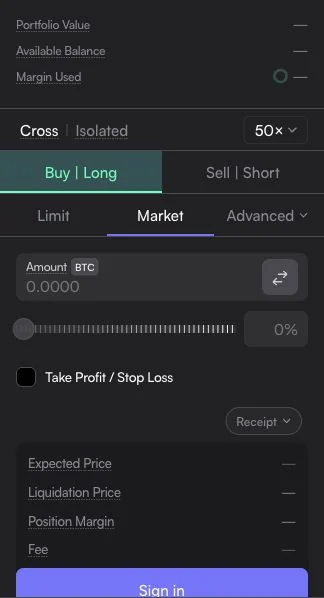
The unsigned BTC interface shows cross/isolated choices, an amount in BTC, a leverage control and an optional take-profit/stop-loss control. The receipt separates expected price, liquidation price, position margin and commission. These are useful checks before submission because a valid quantity and a visible market do not establish the final collateral or cost of the order.
The dYdX help centre gives reduce-only an important time-in-force qualification: it is supported for immediate-or-cancel execution, not for an order left resting as good-til-time. That means a trader should not assume every standing limit exit can combine the same options available on another exchange. The applicable ticket and published order rules need to agree.
The Close Position action has a different default
The documented market Close Position flow uses reduce-only automatically. A manually created market or limit order does not enable it by default. For stops and take-profits, the guide describes resizing an oversized reduce-only trigger to the remaining position when triggered. By contrast, an oversized immediate reduce-only sale can be rejected. Those are two different outcomes, even though both instructions aim to avoid flipping the position.
A stop trigger is also not the final fill price. A triggered market order seeks available liquidity; a triggered limit order can remain unfilled if its price condition cannot be met. Instead of reproducing a long order-type glossary, the useful dYdX distinction is which action closes immediately, which instruction waits for a trigger, and which can rest on the book.
The accompanying capture records the public ticket without an authenticated balance. It demonstrates the labels and units inspected, while the account-specific receipt remains unavailable until the user is connected. We did not submit an order or test the behavior of a live stop.
Withdrawing from dYdX: available balance and destination matter
Withdrawal starts from the trading interface, but it ends on the chosen destination network. The amount released from the perpetual account is not necessarily the amount received after routing costs. The withdrawal preview gives the destination, asset and expected net amount; match those details to the receiving wallet or exchange's supported deposit network.
A Coinbase route using Noble USDC is different from sending to an arbitrary exchange address that also accepts a token called USDC. Network support is part of the asset identification. The current help guide specifically discusses Coinbase for that route and also supports withdrawals to compatible chains through the wallet flow. We do not extend that statement to every exchange.
The protocol can rate-limit or temporarily gate withdrawals. The general withdrawal guide describes aggregate Noble USDC limits, while the isolated-market guide narrows some negative-collateral gating to affected isolated markets. Consequently, a delayed request should not automatically be interpreted as a universal account freeze; nor should a self-custody label be read as a guarantee of immediate withdrawal in all chain conditions.
Diagnose the missing balance before another transfer
First distinguish collateral committed to positions or isolated orders from funds already in transit. If the money has left the trading subaccount, the bridge transaction and destination status are the useful evidence. If it remains allocated to an unopened isolated position, the pending orders are the relevant issue. These are different remedies, not reasons to keep retrying the same withdrawal amount.
Withdrawal routes and limits are documented, but no withdrawal was performed. The current confirmation quote is needed for a destination-specific fee and timing estimate.
Can your location interrupt access to dYdX perps?
dYdX's public frontend restrictions include the United States, Canada and the United Kingdom, among other excluded jurisdictions. The access guide applies to the operated website and mobile interfaces. A wallet connection is not an exemption from those terms.
There is a concrete account-management consequence. The guide describes a close-only stage in which existing orders can be cancelled, positions reduced and funds withdrawn, while new exposure and deposits are disabled. After seven consecutive days in that state, it describes a blocked frontend status with more limited access. A notice therefore needs attention while the permitted offboarding actions remain available.
This matters for a trader who changes residence or travels while holding positions. Plan the account around permitted access; do not assume that a previous successful login means the same location remains eligible. The guide says location is checked during browsing as well as on page load, and the mobile application follows the same policy.
The appropriate alternative depends on where the account holder actually lives and the derivative product available there. Our country access pages distinguish that question from a general exchange score. This review does not recommend bypassing an interface restriction or claim that an active global market makes the product authorized everywhere.
dYdX versus Hyperliquid or Paradex: which difference matters?
A trader already using Hyperliquid should compare the exact market and order workflow before moving collateral. dYdX may be useful when its isolated arrangement or selected contract meets a specific need. It is not automatically an upgrade merely because both venues describe themselves as onchain order books. Compare the resulting trade, not the category label.
Paradex presents a more distinct reason to switch: its current retail classification can provide zero trading commission, and its account-privacy model limits public position visibility. Those features come with their own order-classification rules and dependencies. A trader who values them should read the dYdX versus Paradex comparison, rather than assume that dYdX supplies the same privacy or retail fee treatment.
dYdX futures: your questions
Does dYdX still offer more than 200 active perpetual markets?
Not in the 6 October 2026 collection used here: 73 records were ACTIVE and 223 were in FINAL_SETTLEMENT. The total response contained 296 records, which is not the same as 296 markets accepting new trades. Counts can change after this review.
Why can a SOL order need more margin even when I keep the same size?
SOL has documented market-wide open-interest thresholds. When total open notional passes the lower threshold, its initial fraction can rise. Your own order does not have to grow for that to happen. Current BTC fields should not be forced into the same calculation when their thresholds are zero.
Does changing target leverage add USDC to my existing isolated position?
No immediate transfer follows from changing the target alone. The documented target affects collateral allocation on the next order. Adjust an existing position through its margin controls if that is the action you intend.
Why is collateral reserved when my isolated limit entry has not filled?
An unopened isolated position can reserve collateral for its outstanding entry orders. The guide says the interface returns it to the cross account when all such orders for that market are cancelled; cancelling only one may not release it.
Can I use another wallet to see the same dYdX positions?
A different wallet creates a different dYdX Chain identity. The official wallet guide does not support transferring open positions between those identities. Use the wallet associated with the original account rather than interpreting an empty new portfolio as missing funds.
Is every dYdX stop automatically reduce-only?
No. The help centre says reduce-only is not the general default for manually created stops and take-profits. The market Close Position flow has its own reduce-only default. Check the selected order instructions and their time-in-force compatibility.
Where can I check funding already paid on dYdX?
Portfolio → History contains funding payment records. The market Funding tab provides rate views, including different time periods. Use the actual hourly payment history to reconcile a completed holding period rather than multiply the latest displayed rate by the entire trade duration.
Evidence behind this reviewSources and research
Sources and research
Official documentation, dated public market data and the unsigned trading interface were reviewed on 6 October 2026. No funded trades, wallet signatures or withdrawals were performed. Market conditions and account-specific permissions can change.
- Current perpetual market catalogue
- Market-wide margin scaling
- Isolated positions and target leverage
- Fee schedule, staking and reward changes
- Trading commissions and post-only instructions
- Current wallet onboarding and deposits
- Supported wallets and account identity
- Hourly funding and payment history
- Reduce-only compatibility and defaults
- Order types and trigger behavior
- Withdrawal routes and protocol limits
- Frontend geographic restrictions
- Deposit tracking and troubleshooting
- Maintenance and liquidation treatment
- Contract loss and insurance mechanisms