
What leverage can a new HTX account actually use?
HTX's 200x headline describes a maximum offered on eligible products. It does not describe the first trade every newly registered person can make. The relevant starting point is the exchange's notice effective 30 March 2026: new users who have not completed level 2 identity verification are limited to 5x for futures order placement.
The same notice withholds ordinary futures API order placement from accounts with no verification or only level 1. Level 2 or higher is the stated condition for that functionality. Completing verification removes that particular gate; it does not bypass regional restrictions, contract risk limits or the exchange's account assessment.
Closing remains different from opening
Three gates before the advertised maximum
- Residence
- Product must be permitted
A global website does not establish local derivatives access.
- New-user verification
- Below level 2: up to 5x
Level 2 also gates ordinary new futures API orders.
- Selected contract and size
- Contract ceiling and risk tier
Verification alone does not authorize every size at 200x.
The notice preserves existing holdings, order cancellation and qualifying position-reduction actions. In hedge mode, new closing orders remain supported; in one-way mode, reduce-only orders are permitted under the described restrictions. Opening, adding to or reversing a position is treated differently and can produce a verification prompt.
That distinction matters if a trading tool suddenly rejects an order. A reverse instruction is not merely a close: it is also a request for new exposure. For a trader trying to reduce risk, using the appropriate closing control is more relevant than increasing leverage or retrying a normal entry order in the other direction.
Sub-accounts inherit their main account's verification level, so creating another sub-account does not create a separate route around these limits. The notice also covers ordinary futures and Futures Copy Trading. It says trading bots follow their existing rules, which should not be interpreted as an exemption from local eligibility requirements.
Copy settings can diverge from the lead trader
For a follower capped at 5x, a lead trader's higher multiplier may be reduced to the follower's permitted maximum or may prevent that trade from being copied, depending on the settings described in the notice. Copying a trader therefore does not guarantee an identical position. The resulting exposure, margin usage and accepted orders matter more than a matching strategy name.
Which HTX futures products are still listed?
We checked the public contract catalogues rather than treating the old Huobi menu as current evidence. The USDT catalogue returned 374 records, 370 with active status, on 6 October 2026. That pool includes non-crypto exposures as well, so it should not be advertised as 370 different cryptocurrencies. This review concentrates on the crypto contracts.
BTC-USDT, ETH-USDT and SOL-USDT were active perpetual entries. Their symbols and contract specifications identify the exact instruments used below. A stablecoin account is the practical starting point when the intended result is a USDT balance and you want to compare commission and funding in the same currency.
Coin-margined perpetuals remain a distinct option
The inverse catalogue returned active BTC-USD, ETH-USD, XRP-USD, TRX-USD and DOGE-USD contracts. BTC's face value was 100 USD per contract; the other sampled entries used 10 USD. The contract amount is therefore not interchangeable with the coin quantity entered on a linear ticket.
A coin-margined product can suit a trader who deliberately wants to retain and settle in the underlying coin. It complicates the dollar picture because the collateral value changes as the coin moves. Switching to this family simply to obtain a different quoted commission can introduce an exposure the trader did not want.
Dated crypto futures are not just an old menu label
The delivery catalogue included active BTC and ETH contracts expiring on 9 October, 16 October and 25 December 2026. The dates make the product difference tangible: a perpetual position has continuing funding settlements, whereas a delivery contract has a maturity and its own settlement rules. An expiring contract is not an indefinitely running trade with funding turned off.
For a planned hedge ending around a particular date, that maturity can be useful. Compare the futures entry price with the underlying market, the cost of exiting or settling, and whether a later contract will be needed. A premium paid at entry can outweigh the funding that would otherwise have been paid on a perpetual.
The public catalogue proves that the named records were present with active status. It does not prove that your account can open them, or that a large order will achieve the visible quote. Availability by jurisdiction and actual order-book capacity remain separate from the existence of the contract.

HTX Prime fees: compare the correct contract group
HTX's current fee page divides futures rates by product and group. On the Group 1 table, Prime0 USDT-margined futures were 0.0200% maker and 0.0600% taker. The corresponding coin-margined columns were 0.0200% maker and 0.0500% taker. A review using one taker number for every HTX derivative hides that distinction.
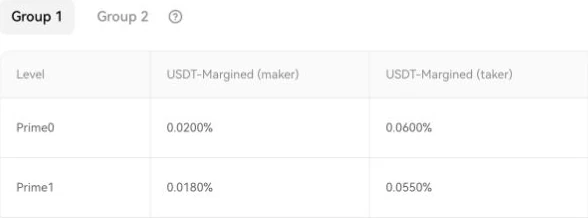
Prime1 Group 1 USDT rates were 0.0180% maker and 0.0550% taker. The same row's coin-margined rates were 0.0150% and 0.0450%. These are examples from the captured public table, not an account-specific offer or a claim that every contract belongs to Group 1.
| Account / product | Maker | Taker |
|---|---|---|
| Prime0 USDT-M | 0.0200% | 0.0600% |
| Prime0 coin-margined | 0.0200% | 0.0500% |
| Prime0 USDT-M with HTX deduction | 0.01900% | 0.05700% |
| Prime1 USDT-M | 0.0180% | 0.0550% |
What a discount saves on an actual-sized trade
With 5,000 USDT executed on entry and the same value on exit, two Prime0 USDT taker fills cost 6 USDT combined. A maker entry and taker exit cost 1 plus 3, or 4 USDT. If both fills qualify for the displayed Prime0 HTX-token deduction, the taker rate is 0.05700%, making the taker round trip 5.70 USDT.
The resulting saving is 0.30 USDT for that example, before any cost or price movement in the token used for deduction. This is why the large spot discount displayed elsewhere on the page must not be imported into the futures calculation. The public futures table supplies its own discounted columns.
How Prime qualification differs from a leverage allowance
The displayed Prime1 qualification row offered alternatives: at least 30,000 USDT of 30-day spot volume, 300,000 USDT of futures volume, 5,000 USDT in previous-day total assets, or 1,000 USDT in the separate HTX-asset column. Higher tiers have different thresholds, and the detailed rules explain asset valuation and aggregation.
Main and sub-account turnover contributes to the tier calculation. HTX also weights its token in the stated asset methodology. This does not mean buying exactly the headline amount guarantees the desired tier instantly: the snapshot process and current account display determine when the rate becomes effective.
Prime is a pricing programme. The new-user KYC limit is a permissions rule. Neither substitutes for the other. An account can qualify for a fee tier while still being restricted from a particular futures product or multiplier. Check the fee on the chosen contract rather than assuming a higher Prime badge unlocks every trading feature.
For occasional trades, existing qualification is valuable; generating unwanted turnover solely to reach a discount is not. The extra fills incur fees and market exposure before any future saving is realised. The useful calculation compares your normal monthly turnover with the rate difference, not with the exchange's highest advertised VIP benefit.
Funding schedules differ even within HTX USDT perpetuals
The HTX funding guide supports one-, four- and eight-hour intervals and allows changes as conditions require. Our contract snapshot showed BTC-USDT, ETH-USDT and SOL-USDT on eight-hour schedules, while TRUMP-USDT used four hours. These named examples are more informative than calling the whole exchange an eight-hour venue.
Funding applies to a position held at the settlement event. Closing before an event can avoid that event's payment, but exiting and reopening introduces spread and commission. It is not automatically cheaper to make two additional trades than to keep the position through one funding charge.
One exchange, different settlement frequencies
Every 8 hours
Three events per complete 24-hour period if the schedule remains unchanged.
Every 4 hours
Six events over the same period; each event has its own rate.
At an illustrative 10,000 USDT constant exposure and a 0.01% payable rate, one settlement is 1 USDT. Three such events in a day cost 3 USDT; six cost 6 USDT. The shorter schedule doubles the number of events in that simplified case, not necessarily the actual daily cost, because each rate can change.
The displayed estimate is not the settled result
The funding rate can move before the deadline. HTX's public explanation also warns that processing around the exact settlement moment can be delayed by seconds. An exit placed at the last instant is therefore a weak basis for assuming a funding charge cannot occur.
The guide calculates the payment from net positions, contract face value, settlement price and the applicable rate. For the reader, the useful unit is the value of the position at settlement. A 10x multiplier should not be applied again to a notional that already represents the full position.
Funding is a transfer between opposing traders rather than the maker/taker commission charged for an execution. The HTX-token commission deduction does not turn a payable funding event into a discounted taker fill. Keeping those entries separate makes a multi-day trade's cost easier to reconcile.
For dated contracts, the comparison changes. Assess their entry premium or discount and maturity terms instead of assigning the perpetual's next funding rate to them. This is where HTX's product range can be useful: the alternative exists for a specific holding period, but the comparison must account for the price of that alternative.
What the 2026 trading-system change means for your orders
HTX began a phased USDT futures system migration in April 2026 and later set a 19 September 2026 deadline. The September notice identifies API users, futures app users below version 11.13 and grid or copy-trading app users below 11.20 as relevant groups. Accounts already upgraded to Multi-Assets Collateral mode were described as unaffected by that migration requirement.
This is now a past deadline, not an upcoming optional enhancement. If an older app or integration displays market prices but cannot perform certain account or order functions, a functioning chart does not establish that its trading connection migrated. The notice specifically leaves market-data interfaces outside the broad reintegration requirement.
Pending orders can consume more capacity than their headline margin
The new system accounts for potential loss on a cross-margin order whose expected fill is worse than the mark price. For example, a buy priced above the mark can consume capacity for that difference as well as the normal opening requirement. The purpose is relevant without reproducing the entire engine formula: an aggressive pending entry can affect the room left for existing positions.
The migration document also describes risk-control cancellation of non-reducing orders when the account's initial-margin ratio reaches its limit. The account can then be restricted to reductions until the ratio improves. An order disappearing under that mechanism is different from a trade filling, and different again from the position itself being liquidated.
Liquidation checks changed too
The documented updated model uses mark-price-based maintenance requirements and tiered maintenance rates. Old screenshots or formulas referring to the previous adjustment-factor system should not be carried into a current liquidation estimate without checking the migrated account.
For manual trading, the practical controls are the current margin ratio, the amount tied up in outstanding orders and whether the ticket permits a new opening. For automated trading, the API migration matters as well. This review does not recommend copying legacy request formats merely because a historical endpoint still returns public prices.
The system changes do not justify claiming a particular order will always be cancelled before a loss becomes larger. Fast moves, execution costs and account exposure still matter. They do explain why two otherwise similar accounts, one using an old workflow and one fully migrated, may present different errors or calculations.
Can you withdraw an HTX futures profit before closing?
HTX changed the transferable-profit rule on 27 July 2026. Under the published update, positive unrealized PNL in cross margin is no longer included in the amount transferable out of USDT futures. The rule applies to both Single-Asset and Multi-Assets Collateral modes, including API, grid and copy-trading users.
The important distinction is that the same unrealized PNL can still support opening new positions under the stated rules. A balance that increases trading capacity is therefore not necessarily money available to transfer to another account or withdraw to a wallet.
A simple account example
Suppose an open cross position shows a floating gain of 300 USDT. That gain is not itself a 300 USDT transfer allowance under the July update. Closing the relevant exposure turns its result into realized PNL, but the actual transferable amount still depends on other commitments, account balance and applicable restrictions.
If another position or pending order uses the released capacity, the account may not let the entire visible gain leave. This is a useful reason to review all outstanding entries before planning a payout, rather than looking only at the profitable position's green number.
Partial closure does not realize the whole position
When only part of an exposure is closed, only that part's trading result becomes realized. The remainder still moves with the market. A trader scaling out needs to distinguish the realised slice, the margin still backing the remainder and the available transfer figure shown by the account.
This rule is also relevant to comparisons with older HTX reviews. A screenshot or tutorial written before July can show behaviour that was correct then but no longer describes the present account. The update did not claim to change existing liquidation prices merely by altering transfer eligibility.
Once funds can leave the futures compartment, the external withdrawal is another step. Select the supported asset and network and use the quoted withdrawal amount and fee. This review verified the published transfer rule, not a funded account's payout speed, so it does not promise that realizing a profit produces an immediate blockchain transaction.
HTX contract size: make the quantity match the trade you intended
A contract count can hide a meaningful difference between HTX products. In the captured linear catalogue, BTC-USDT used 0.001 BTC per contract, ETH-USDT used 0.01 ETH and DOGE-USDT used 100 DOGE. Reading the face value resolves what a raw contract quantity represents.
For instance, 30 BTC-USDT contracts correspond to 0.03 BTC. At an illustrative 90,000 USDT bitcoin price, the position is 2,700 USDT. The same count of BTC-USD inverse contracts, at 100 USD face value each, represents 3,000 USD face value instead. A strategy specifying a contract count must therefore name the contract family as well.
Compare cost in the instrument's settlement currency
The linear example's commission and result are assessed in USDT. The inverse product uses its coin settlement mechanics. A dollar-equivalent fee comparison can help budgeting, but it should not imply that the resulting balances are interchangeable without conversion.
The leverage chosen within either product controls the required backing subject to account and tier rules. It does not rewrite the face value of a contract. If you copy the count from one product to another, recompute the exposure before assessing the multiplier.
The detailed quantity controls and the new system make HTX more flexible, but also less suitable for someone who wants to select a multiplier without checking the instrument. The useful advantage is having several products for different collateral and holding-period needs, provided the user actually chooses among them.
Where HTX is a poor match, despite the product range
Start with residence and product eligibility, not just whether the global website loads. HTX's terms distinguish access to the service from restrictions on derivatives and may apply additional controls to particular jurisdictions or accounts. A global registration link does not establish local authorization to trade leveraged products.
For readers in a restricted market, the relevant alternative is the permitted product for that location. Moving to another offshore brand without checking its own policy simply repeats the same problem. Our country directory is intended to narrow that comparison by residence and product type.
HTX is also less compelling when the only attraction is its highest advertised multiplier. A new unqualified account may receive 5x, and an eligible verified account still faces the selected contract's size limits. A trader seeking a particular altcoin should establish that contract's actual limit rather than borrowing BTC's headline.
Which alternatives deserve a direct comparison?
Compare OKX when the deciding factor is how several positions and collateral assets are managed together. Compare the account mode you would actually use; a sophisticated portfolio mode available to another customer may not be the product offered to you.
Compare Bybit for an alternative conventional perpetuals workflow, particularly when order handling and your own verification status are more important than having dated HTX contracts. The relevant costs are your contract's maker/taker rate and expected funding, not a website-wide VIP minimum.
HTX's advantage is strongest when its retained coin-margined or dated contracts solve a real need. For a single short-lived BTCUSDT trade, that broader menu may add little. Pricing, current book conditions and familiar closing controls can become more important than total product variety.
Our HTX futures verdict
Its weaknesses are the layers a returning or newly registered user must distinguish: KYC permission, Prime pricing, contract group, margin mode and system version. The July profit-transfer change and September migration deadline make an undated tutorial particularly unreliable here.
For a new manual trader, settle the account permissions first, then choose the contract family and calculate its actual fee. For an existing user, the more urgent question may be whether their app or integration is current and whether planned withdrawals rely on floating gains that can no longer be transferred.
HTX futures: your questions
Why does a new HTX futures account show only 5x?
The notice effective 30 March 2026 caps new users below level 2 KYC at 5x. Higher verification addresses this gate, but contract limits and residence restrictions can still apply.
Does a higher HTX Prime level unlock 200x?
Prime determines pricing and benefits. The 200x maximum is subject to product, position and account permissions. A Prime badge is not a substitute for the required verification or contract eligibility.
Can I transfer floating HTX cross-margin profits out?
The July 2026 update excludes positive unrealized PNL from the transferable amount for USDT cross margin in both Single-Asset and Multi-Assets Collateral modes. Realize the relevant profit by closing exposure; other commitments still affect the amount available.
Are HTX coin-margined fees the same as USDT futures fees?
Not in the captured Group 1 Prime0 schedule: both maker columns were 0.02%, but the coin-margined taker rate was 0.05% versus 0.06% for USDT-margined futures. Other groups and tiers need their own rate.
Does HTX still list dated bitcoin futures?
Yes. The 6 October catalogue included active BTC maturities for 9 October, 16 October and 25 December 2026. These are dated records, not a permanent promise that a particular expiry remains open after its maturity.
Why can my HTX API still read prices but reject trading functions?
The September migration notice excluded market-data interfaces while requiring account, order and position integrations to migrate. Verification permissions can also affect new orders. A working price feed alone does not confirm trading readiness.
Is TRUMP funding on the same schedule as BTC on HTX?
The reviewed catalogue showed TRUMP-USDT on a four-hour period and BTC-USDT on eight hours. HTX can change intervals, so these dated examples should not replace the current contract countdown.
Does closing mode matter when HTX restricts an account?
Yes. The new-user notice preserves certain closing or reduce-only actions while restricting opening, adding and reversing. Use the exit instruction appropriate to hedge or one-way mode rather than treating every opposite-direction order as a close.
Evidence behind this reviewSources and research
Sources and research
Official documentation, dated public market data and the unsigned trading interface were reviewed on 6 October 2026. No funded trades, wallet signatures or withdrawals were performed. Market conditions and account-specific permissions can change.
- New-user KYC leverage and API rules
- Advertised BTC/ETH maximum
- Prime qualification and futures fees
- USDT contract catalogue
- Coin-margined perpetual catalogue
- Dated contract catalogue
- Funding mechanism
- New margin and order model
- September migration deadline
- July unrealized-profit transfer change
- User agreement and eligibility