
Is KiloEX a good choice for your perpetual trade?
KiloEX changes the question you ask before placing an order. On a conventional exchange you examine bids, asks and the amount resting at each price. Here the useful checks are the oracle price, the estimated execution price and the remaining capacity for your direction. There is no resting public order book to interpret as if this were Binance or an onchain matching exchange.
For a position intended to run beyond a few minutes, compare KiloEX's quoted opening spread, current funding and expected closing conditions with a pool alternative such as GMX. For repeated quick take-profits, start with the closing rule in the next section: it is a concrete reason to prefer an order-book venue when the strategy depends on capturing a tiny price movement.
Why a profitable exit under ten minutes can cost more
KiloEX applies a closing-spread protection factor when a profitable position is closed within ten minutes. The checked BNB configuration also shows 600 seconds. The adjustment affects the exit price; it is not a flat percentage charged on every trade.
Consider two otherwise comparable ETH trades. One is closed at a profit after six minutes, while the other is closed after fourteen. The first meets the documented time-and-profit condition. The second falls outside that particular short-duration window, but still has ordinary closing spread and commission. It would be wrong to describe the later trade as a free exit, or to claim the first is automatically unprofitable.
Two conditions for the extra close-spread protection
Under 10 minutes + positive PnL
The documented protection factor applies to closing spread. No universal flat surcharge is published.
Outside that specific rule
Ordinary closing spread and commission still apply. Waiting does not remove market risk.
A stop trigger does not lock the final proceeds
A trigger can be reached and the resulting fill can still incorporate closing spread. This matters when a take-profit is only a small distance from entry: the gross move shown on a chart may not leave much after the two commissions and the price adjustment. Use the position's close estimate to assess the net result, rather than multiplying chart movement by the leverage setting.
The practical consequence is about strategy selection, not waiting for a clock to run out. Keeping an unwanted position open to avoid a conditional spread exposes it to another price move. If a system requires immediate exits whenever a signal changes, that requirement deserves more weight than a potential discount for staying in the market longer.
KiloEX trading fees: what 0.05% actually covers
The published crypto commission is 0.05% when a position opens and 0.05% when it closes, before applicable discounts. KiloEX's worked example calculates the closing commission from the original position amount even after the displayed position value rises. That convention is worth identifying because simply multiplying the latest marked value by the rate would produce a different estimate.
Take an illustrative 4,000 USDT position backed by 200 USDT at 20x. At the base rate, the opening commission is 2 USDT and the corresponding full closing commission is another 2 USDT. Those commissions alone consume 2% of the initial 200 USDT margin. The 0.10% round trip looks small against the whole position but is much more noticeable against the money allocated to it.
This calculation is deliberately limited. It does not estimate a spread, predict a funding payment, or turn a network charge into a fixed USDT number. Those require the actual pair, direction, timing and selected network. A calculator that silently enters zero for every missing component gives a misleading impression of precision.
Discounts should improve a trade, not create a reason to trade
KiloEX publishes a VIP schedule and a separate referral programme. Read the discount actually assigned to the connected wallet before reducing the base commission in your budget. We preserve this site's registered KiloEX referral link, but do not promise a fixed reader rebate: the programme permits configurable rebate sharing, so the existence of a code alone does not establish the final percentage.
A smaller commission does not remove the profitable-close rule or increase directional capacity. Likewise, building extra volume only to reach a tier can cost more than the later savings. For an occasional trader, the defensible starting comparison is the ordinary rate and the native quote; a wallet-specific discount is an improvement on that baseline.
Holding costs after the borrowing fee was removed
The former borrowing fee was cancelled after 25 April 2024. It should not appear as an ongoing charge in a present-day KiloEX trading budget. Funding remains, and it should be evaluated in the direction relevant to the position rather than copied from a generic description of a pool DEX.
KiloEX links funding to an external-rate reference and a risk premium, while determining who pays from its own exposure imbalance. BTC and ETH use the platform-wide net direction; the other tokens use their own market's net direction. This makes it possible for the reasoning behind the rate on a major pair to differ from the reasoning for an altcoin, even when both trades are on the same network.
Suppose you are comparing a BTC long with a SOL long. The fact that both are longs does not justify assuming the same funding sign or amount. Examine each pair's displayed rate and the applicable time basis. A short is not automatically a funding receiver either; if the imbalance points the other way, it can be the paying side.
KiloEX’s documented risk premium does not establish one fixed daily or annual holding rate. Rates can change while the position is open. Use completed funding payments when calculating the cost of a longer trade.
That distinction also prevents a common comparison error with other pool products. Jupiter's borrowing model and KiloEX's current funding model are not the same cost under different names. Compare the actual charge accumulated for the intended exposure and duration, rather than assigning every pool-based venue a generic borrowing expense.
Which crypto markets and leverage limits are available?
We matched KiloEX's BNB product configuration to its separate symbol catalogue. The production response contained eleven active crypto products with opening enabled: BTC, ETH, BNB, SOL, LTC, XRP, DOGE, LINK, AVAX, SUI and OP. BTC and ETH had a 125x ceiling; the other nine had a 100x ceiling. This is a dated BNB snapshot, not a count of every market on every KiloEX deployment.
| Markets | Maximum leverage | What still limits entry |
|---|---|---|
| BTC and ETH | 125x | User size, pair exposure and available direction |
| BNB, SOL, LTC, XRP, DOGE, LINK, AVAX, SUI, OP | 100x | Each active product has its own remaining capacity |
The distinction between the symbol catalogue and active products is important. A name can remain in a catalogue without an active opening configuration. Counting every symbol as tradeable would give the reader more apparent choice than the evidence supports. Historical announcements about additional listings on Base or opBNB do not establish that those products are enabled on BNB today.
A listed market can still refuse the requested direction
The configuration also separates the per-user size ceiling from remaining long and short capacity. An opening request has to fit the relevant constraints together. If the long side has little room, the presence of available short capacity does not help a trader whose thesis requires a long. Switching direction simply to use the capacity would change the trade itself.
For the same reason, 125x is a ceiling rather than a promise that any BTC order can be opened at that multiplier. The trade must fit size limits and the capacity available when it is submitted. The native ticket is the place to see how much can currently be opened from the wallet; our market table is useful for narrowing the candidates before that check.
KiloEX also documents non-crypto products. They are not the reason to choose it for a crypto futures position, and their trading schedules should not be imported into this review's crypto comparison. The useful question is whether the crypto market you need is active on the deployment where you plan to fund the trade.
BNB collateral, execution charges and the trading ticket
The ordinary BNB trading guide specifies USDT for margin and BNB for network costs. The BTC/USD label on the chart describes the price being referenced; it does not mean that your margin must be Bitcoin or that a bank-dollar balance is accepted. Matching those units before moving funds avoids arriving with an asset the chosen ticket cannot use.
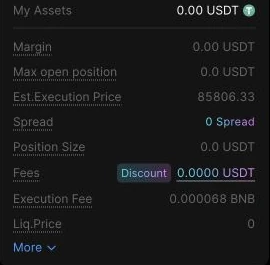
Opening and closing are described as a request followed by execution through keepers. The interface separates the execution fee from commission because it pays for the execution transaction. In our unsigned BNB view, the execution fee field displayed 0.000068 BNB. That is a captured interface value, not a permanent tariff or a completed transaction cost.
The public ticket also showed estimated execution price, spread and position size. With no connected, funded wallet, its zero amount and zero commission fields do not constitute a zero-fee quote. We could inspect the controls and the live market display, but did not establish the price at which a funded order would execute.
Fast Trading changes the wallet interaction
KiloEX's Fast Trading guide describes an authorization that removes repeated wallet confirmations and pays gas using the collateral token. The convenience is real at the workflow level: it is a different experience from approving each transaction separately. It does not mean that network execution becomes economically free.
The guide says the authorization can be revoked and distinguishes the feature from sending funds to a designated custodial wallet. Treat enabling it as a separate permission decision, not as a necessary first step just to inspect prices. Existing users of the older one-click arrangement are given a gas-withdrawal route in the same guide. We did not enable either mode or sign wallet messages during this review.
Limit orders, breakout entries and the exit you intend
The KiloEX ticket distinguishes Market, Limit and Conditional orders. Its guide associates a limit entry with waiting for a more favourable price, while the conditional route can be used for a breakout in the other direction. That distinction is more useful than describing all three as interchangeable ways to buy or sell.
For example, an ETH buyer waiting below the current price and an ETH buyer waiting above it are asking for different behaviour. A lower-price entry and a breakout entry should not be placed through the same control merely because both use a target number. The guide also incorporates spread in execution, so the trigger is not a substitute for reviewing how the resulting order is priced.
Once a trade is open, the documented position controls allow additional margin and take-profit/stop-loss settings. Adding margin changes the backing behind the existing position; it does not by itself make the market thesis stronger. The useful reason to use that control is a deliberate change to the amount supporting an exposure you still intend to hold.
There are some old instructions mixed into the documentation. The opening guide still mentions a 20-dollar minimum, while the dated announcement says minimum margin was reduced to one dollar in August 2024. We use the later announcement as historical evidence of that change and leave the current pair's minimum to the live ticket. Repeating the older tutorial number as today's universal requirement would be misleading.
The same care applies to automated exits. The guide describes an automatic take-profit at a 900% PnL threshold. This is a product rule in that guide, not a promised return or a strategy target. Confirm the exit conditions shown for the actual position rather than assuming it can remain open indefinitely because a perpetual contract has no expiry date.
KiloEX after the 2025 incident: what is verified now?
The official post-mortem dated 21 April 2025 attributes the incident to a trusted-forwarder authorization failure that allowed improperly authorized position execution. In plain language, the attack involved access to the process that executed trades, rather than an ordinary trader guessing the market correctly. That is relevant to a product whose execution depends on keepers and oracle-linked prices.
KiloEX reported recovery of assets after agreeing to a 10% bounty retention. A published recovery account is useful historical evidence, but it is not a current withdrawal test. Nor does a list of audits establish that every later code deployment or permission change is covered by those reviews. The audit register is linked for readers who want to examine the scope of the reports.
On 6 October 2026, the public trading screen loaded BTC prices, exposure figures, funding and the order controls, and the BNB configuration endpoint responded with opening-enabled products. That establishes observable availability of those public surfaces. We did not connect a wallet, deposit, open a trade, close a position or withdraw funds, so we cannot describe the complete money-in/money-out cycle as independently tested.
This leaves a specific boundary around the recommendation. KiloEX can be evaluated as a functioning public trading interface with published rules, while an assertion that all withdrawals are currently normal would require stronger evidence. If a service notice or an account error appears during funding or settlement, use that specific status rather than the fact that the chart continues updating.
A historical incident does not make every later trade impossible, and a responsive website does not erase that history. The sensible comparison with alternatives includes both the current product controls and the remaining dependence on contract permissions, execution infrastructure and network availability.
Who can use KiloEX, and when is another DEX a better fit?
KiloEX's terms contain an explicit prohibited-jurisdiction list. It includes the United States and its listed territories, the United Kingdom, China including Hong Kong and Macau, Russia, Singapore, Malaysia, Bangladesh, Bolivia, Ecuador and Kyrgyzstan, among other named jurisdictions. The definition also covers citizens or residents of prohibited jurisdictions; it is not limited to the IP address from which a webpage opens.
That wording matters when choosing a wallet-based route. The lack of a conventional exchange login should not be presented as approval for everyone who can connect a wallet. A trader affected by a listed restriction needs a product permitted for their circumstances, not an alternative way to make the same prohibited frontend load.
Among eligible readers, KiloEX is most persuasive when the required pair is active, directional capacity fits the order and the quoted execution cost is acceptable for the planned hold. GMX deserves comparison when market-specific pools and collateral choice are central. Jupiter Perps is a more direct comparison for a reader already operating on Solana, but its borrowing and available-market model need their own budget.
An order-book DEX is the more natural comparison for someone who needs resting liquidity, maker placement and an execution process without this particular ten-minute profitable-close condition. That is not a claim that another venue has no slippage or fees. It is a reason to choose a mechanism that fits the trade, rather than forcing the trade to fit an attractive commission number.
KiloEX futures: your questions
Does KiloEX still charge a borrowing fee?
No. Its fee page dates cancellation to April 2024. Funding remains applicable, along with commission, spread and network execution. The discontinued charge should not be carried into a new KiloEX cost estimate.
Does every exit before ten minutes receive a penalty?
The documented protection factor applies when the position is both under ten minutes old and in positive PnL. It affects closing spread; the source does not provide one fixed surcharge for every eligible exit. Ordinary exit costs still apply outside that condition.
Is KiloEX’s 125x limit available for every coin?
No. The checked BNB configuration gives BTC and ETH up to 125x and nine other active crypto products up to 100x. User size limits and directional capacity can reduce the order you can actually open.
Do I need BTC to trade BTC/USD on the BNB deployment?
The reviewed BNB guide uses USDT margin and BNB for ordinary wallet transaction costs. BTC/USD is the referenced market. Fast Trading has a separate arrangement for paying gas with collateral tokens.
Why can a take-profit trigger and still return less than expected?
The fill incorporates closing spread and charges. The trigger level alone therefore does not establish the final net result. This is particularly relevant for small take-profits and the short-duration profitable-close rule.
Evidence behind this reviewSources and research
Sources and research
Official documentation, dated public market data and the unsigned trading interface were reviewed on 6 October 2026. No funded trades, wallet signatures or withdrawals were performed. Market conditions and account-specific permissions can change.
- Crypto commission, funding and closing spread
- BNB production product configuration
- Product IDs and symbol catalogue
- Dated leverage and minimum-margin announcements
- VIP discounts
- Referral rebate settings
- BNB opening, margin and closing controls
- Fast Trading permissions and gas payment
- Frontend eligibility terms
- Audit register
- Official incident post-mortem · 21 April 2025