Where do you actually trade Orderly-powered perpetuals?
Orderly supplies trading infrastructure to other products. A frontend, sometimes called a builder or broker in its documentation, supplies the site where you connect, fund the account and place an order. That is why an Orderly review cannot give one exchange-wide retail commission, one customer-support experience or one list of accepted countries.
The useful starting point is the official Live DEX Board. It identifies the trading interfaces built on the network. Inclusion there establishes an ecosystem relationship, not a recommendation that every interface is equally suitable for a funded trading account. The two routes examined here are WOOFi Pro, an established trading frontend, and Orderly Demo DEX, the network's own feature showcase.
For ordinary manual crypto perpetual trading, WOOFi Pro is the stronger starting comparison on published commission: its public lowest-volume tier is cheaper than Demo's announced flat rates. It also publishes its own volume and WOO-staking progression. That is a price comparison, not a claim that we measured faster execution or completed a withdrawal there.
Demo has a different purpose. Orderly's 28 September 2026 launch announcement describes a live environment for exposing new capabilities as they arrive, before every independent builder integrates them. It can therefore be useful for investigating a specific feature. The word Demo must not be read as a promise of free paper trading: the announcement describes production trading with fees.

Current transfer notice: read before funding
The notice displayed 5 October 2026 at 18:30:42 without a timezone. It appeared on both inspected frontends; the observation does not establish that every Orderly-powered interface had the same disruption.
Both screens also displayed an Operational label. These signals can coexist: the order interface can load while the transfer path is delayed. For someone needing to add collateral quickly or withdraw after closing a position, the specific transfer notice is more useful than the generic status label. An updating chart is not evidence that a deposit will arrive promptly.
The notice states that funds are safe, but this review does not independently establish that claim. We did not fund either account or submit a withdrawal. Until a later update resolves the delay, do not base a time-sensitive trading plan on immediate arrival or departure of collateral. Switching between these two frontends is not demonstrated to remove the shared messaging dependency.
WOOFi Pro versus Orderly Demo DEX: actual fee differences
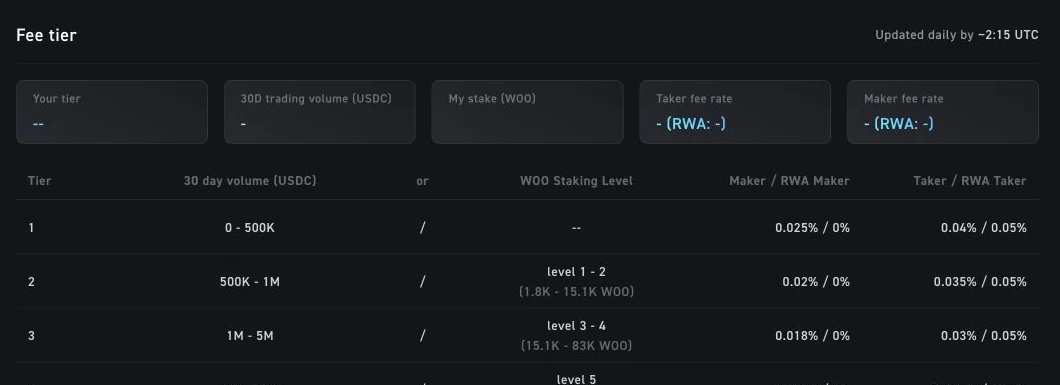
The WOOFi Pro fee screen showed a starting crypto rate of 0.025% maker and 0.04% taker for the zero-to-500,000-USDC thirty-day volume band. Its adjacent RWA columns showed different numbers, so using the wrong column would distort a crypto comparison. This review uses the crypto columns and no assumed token-staking benefit.
Demo's launch announcement specifies 0.03% maker and 0.06% taker, with no volume tiers. The unsigned Demo trading screen left the personal fee fields blank and its fee-tier page returned no rows. We therefore attribute the Demo rates to the official announcement, not to a personalized account quote we did not obtain.
| Frontend | Maker / taker | Basis |
|---|---|---|
| WOOFi Pro | 0.025% / 0.04% | Public starting volume tier; no assumed stake |
| Orderly Demo DEX | 0.03% / 0.06% | 28 September launch announcement; no volume tiers |
For a hypothetical 12,000-USDC position opened and closed as taker at unchanged notional, commission would be 9.60 USDC at WOOFi's starting tier and 14.40 USDC at Demo's announced rate. The difference is 4.80 USDC for that round trip. Funding, slippage, transfer expenses and any collateral conversion are excluded from both sides, rather than being silently assumed free on one.
A recurring trader has a different calculation
WOOFi's public tier table reduces crypto commission at higher qualifying volume or staking levels. The important comparison is the tier actually reached by the account, not the smallest number anywhere on the table. Staking introduces exposure to the token used for qualification, and trading more just to cross a threshold introduces additional costs.
A maker-heavy trader should also compare the maker column rather than reusing the taker example. But a lower maker tariff only helps the portion that actually qualifies for it. The current Orderly fee documentation has a specific exception for fills against hidden quantities, so simplistic statements that every resting limit always earns the same treatment are unsafe.
This is enough evidence to prefer WOOFi on the illustrated ordinary-user commission. It is not enough to crown it the cheapest Orderly frontend overall. The directory contains other builders, and their account terms, promotions and product coverage need separate checks. We have deliberately compared named products rather than inventing a network-wide lowest fee.
Do you pay Orderly’s base fee on top of the frontend fee?
Usually the user-facing commission already includes the network component. Orderly's official example describes a builder charging the trader 0.05%, retaining a margin over a 0.03% network base. The trader pays 0.05% in that example, not 0.08%. Adding both numbers would double-count the base cost.
A single user fee, divided behind the interface
The trader pays 0.05%, not 0.08%. The example explains the split; it is not WOOFi’s or Demo’s tariff.
The network's base pricing is a commercial relationship with the builder. It is not a retail tier that every wallet can select. A builder may qualify for better underlying terms without passing every improvement to every customer. Conversely, a customer can have a frontend discount whose conditions are not visible in the general network table.
This separation explains why two interfaces connected to shared liquidity can show different commissions without contradicting each other. The question is not which table is universally true, but whose transaction it prices. The rate deducted for the reader's execution belongs to the chosen frontend and account.
Funding is a separate item associated with the perpetual position. It should not be renamed as a builder markup or included in a one-time commission comparison. Look at the selected contract's current rate and settlement timing; a positive or negative payment can change the result of holding the position even when both opening commissions are known.
There is also an important boundary around shared liquidity. The ordinary network markets and builder-managed Perp Anything markets are not interchangeable. Orderly's newer market-operations documentation assigns the latter their own market management and liquidity responsibilities. Do not assume a newly listed specialist contract automatically has the depth of the shared BTC book simply because it uses the same infrastructure.
Will the same wallet show the same balance on another frontend?
No automatic shared balance should be assumed. Orderly's account documentation says a wallet owner can register a separate account for each builder, and those accounts are not interlinked by default. Connecting the identical wallet address to a second site therefore does not establish that an existing position, collateral balance or trading history will appear there.
Imagine using WOOFi Pro for BTC and later opening Demo to inspect a newly released control. A zero balance in the new interface is not, by itself, evidence that the first account lost funds. The two sites can be pointing to different builder accounts. Before moving money or reporting a missing balance, identify which frontend originally received the deposit and where the position was opened.
The same wallet does not merge two builder accounts
Its account and positions
The deposit and trading history belong to the account associated with this builder.
A separate account
Connecting the same wallet does not automatically reveal A’s funds or manage A’s stops.
The chain and the frontend are different choices
Orderly supports deposits from multiple networks, but selecting a different chain is not the same action as selecting a different builder. One concerns the route by which collateral enters the system; the other concerns the trading account associated with the interface. Confusing the two is an avoidable source of failed troubleshooting.
For a manual trader, the practical way to keep this clear is to retain the frontend name, wallet and deposit transaction alongside the account history. There is no need to learn an account-ID hashing formula to choose an exchange. The technical documentation matters here because it supports a simple conclusion: shared market infrastructure does not mean one portable account everywhere.
Moving an active strategy between frontends is consequently more involved than changing browser tabs. Confirm the supported transfer or withdrawal path and how the old position will be managed. Do not assume a second interface can cancel the first account's orders or inherit its stops merely because both display the same market.
USDC settlement, multi-collateral and cross-chain deposits
The simplest route to understand is a supported USDC deposit into the selected frontend's trading account. WOOFi's guide distinguishes networks with native vaults from routes that use its cross-chain swap process. A native vault path and a swap-assisted path can involve different steps and costs even when both finish with trading collateral visible in the same interface.
The network also supports eligible non-USDC collateral. That does not mean every asset on every connected chain is accepted, or that every builder has exposed the same deposit options. Orderly publishes both per-user limits and chain-wide collateral caps. If a particular collateral route is full, the fact that the wallet contains that token is not enough to make another deposit valid.
Keeping ETH as collateral is a different decision from depositing USDC
Orderly assigns supported collateral a recognized value for margin purposes. Its current table gives ETH, SOL, BNB and WBTC a base weight of 80%, with further size-sensitive adjustments possible. A hypothetical 1,000-dollar ETH balance therefore should not be treated as 1,000 dollars of stable, fully recognized margin. Both the coin price and the recognized percentage matter.
The trade is also accounted for in USDC. Losses or other account activity can create a negative USDC balance while the account still holds another token. Under documented conditions, collateral can be converted to USDC automatically. That is a real economic difference from simply holding the coin untouched in a wallet and paying a small trading commission.
The documentation contains separate thresholds for general collateral management and projected borrowing when opening isolated positions. We do not collapse these into one universal trigger. A reader using non-USDC backing should examine the actual account's borrowing and conversion information before relying on the amount displayed as total asset value.
For someone who merely wants a USDC-settled BTC or ETH trade, extra collateral complexity may provide little benefit. For a trader intentionally retaining a supported asset while using it as backing, it can be useful—but only when the frontend makes its accepted assets, conversion terms and account margin visible. That is the relevant comparison, rather than the number of blockchain logos in a dropdown.
Leverage and margin controls: network support is only the first step
The documented base margin ratios for BTC, ETH and SOL can imply up to 100x before size-sensitive requirements. Larger exposures require more backing, and the frontend can impose further constraints. A number in a network table is therefore a starting parameter, not a promise that an arbitrary wallet can open any size at that multiplier.
WOOFi's introductory guide illustrates why dated text needs care: its opening description mentions up to 50x while a later step describes account settings from 1x to 100x. We do not choose whichever sentence sounds more attractive. Use the current pair and account controls, with the network's market parameters as supporting context.
Orderly now documents both cross and isolated margin. Cross shares available account backing, while isolated allocates margin to a position. The standard market set can support both at once; Perp Anything markets are described as isolated-only. A builder still has to implement the controls, so support in the protocol documentation is not proof that every retail screen offers an identical switch.
Choose the interface that exposes the controls your trade needs
For a trader managing a single speculative position separately from an existing book, visible isolated controls can matter more than a branding preference. For a trader intentionally sharing collateral among positions, the account-wide margin information is more relevant. Neither choice should be made from a screenshot of a different frontend.
Orderly documents market, limit, immediate-or-cancel, fill-or-kill, post-only and reduce-only behaviours. Those names are useful only if the chosen screen lets you apply them to the intended order. In the public Demo view we could see several advanced controls, but margin and leverage actions were disabled without a connected account. We did not infer usable account permissions from their presence alone.

Frontend eligibility: WOOFi’s rules are not the whole network’s rules
WOOFi's terms identify AstroLink Technology LLC and contain their own restricted-territory and restricted-person provisions. The named list includes Canada, China, the United States and its territories, Seychelles and other specified locations. It also addresses citizenship and residence, so evaluating access only from the location of a browser session would be incomplete.
Orderly's terms separately exclude US persons and specified sanctioned persons or jurisdictions, and require integrators to respect those restrictions. These are overlapping layers, not competing promises from which a reader can select whichever is more permissive. Local derivatives rules can impose additional conditions beyond what the frontend lists.
The result is that shared liquidity does not imply identical country access. A permitted WOOFi user and a permitted Demo user can be reaching related infrastructure under different interface conditions. A restriction on one route also does not, by itself, prove that every other builder permits the same reader.
This review links the relevant terms rather than presenting a wallet connection as evidence of approval. It does not recommend location masking or a frontend switch to evade a restriction. The useful task is finding a product that is genuinely available for the reader's situation, then comparing its trading terms.
Who handles a delayed withdrawal or an inaccessible frontend?
Start with the interface through which the account was created. The frontend can identify its account mapping, requested chain, displayed status and any interface-specific failure. Send a concise record of the transaction or withdrawal reference, amount and approximate time through its official support route; a public social reply asking for a seed phrase is not that route.
Orderly's troubleshooting documentation then distinguishes an incorrectly selected destination chain from a cross-chain message still in flight. Its published workflow uses the withdrawal record and LayerZero message status to determine where the transfer is waiting. This is more actionable than repeatedly clicking withdraw because the trading screen still looks operational.
Offboarding closes positions; it does not merely change the website
Orderly also documents an emergency offboarding tool. Its sequence closes open perpetual positions at market, cancels orders, settles PnL and transfers assets out. That can be useful when discontinuing a frontend, but it is not a neutral button that preserves a trading strategy while moving the interface around it.
Closing at market has its own execution result, and the transfer stage still depends on the relevant infrastructure. We do not present offboarding as a proven cure for the current LayerZero delay. It is a documented exit route with consequential actions, not an independently tested withdrawal guarantee.
The practical division of responsibility is clear enough for a reader to act on: the frontend handles the account experience and its support channel; shared trading and settlement components can require protocol-level investigation. Keeping those roles distinct avoids sending a missing frontend balance to a token community, or interpreting a working order book as confirmation that every settlement stage has completed.
| Problem | Useful first route | Evidence to retain |
|---|---|---|
| Wrong or missing frontend balance | Original frontend account support | Builder name, wallet, deposit transaction |
| Withdrawal waiting between chains | Frontend support and Orderly message investigation | Destination chain, amount, request time |
| Leaving a frontend permanently | Documented Orderly offboarding route | Open positions and orders that would be closed or cancelled |
When Orderly helps—and when a direct exchange account is simpler
A direct venue such as Hyperliquid or dYdX is a useful alternative to investigate when a reader would rather assess one named trading product than compare several builders. Their collateral, risk and access models remain different; the advantage in this context is a more direct product comparison, not an automatic promise of cheaper or safer trading.
For now, the observed transfer notice is a material constraint on urgent funding or withdrawal plans. Once that is resolved, the durable decision remains: choose the interface whose documented economics and actual controls fit the trade, while recognizing that the underlying order book and the customer-facing account are different layers.
Orderly futures: your questions
Is Orderly Network itself a retail exchange?
It mainly supplies infrastructure to independent frontends. Its Demo DEX is a separate live showcase with its own published rates. The official directory is the appropriate starting point for choosing a trading interface.
Do I add the 0.03% network base to WOOFi’s displayed commission?
No. The user-facing fee generally incorporates the underlying base. Orderly’s own example charges the trader 0.05% in total when the builder’s base cost is 0.03%; it does not charge 0.08%.
Is Orderly Demo DEX a free testnet?
The launch announcement describes a live production showcase charging 0.03% maker and 0.06% taker. Do not infer paper trading or free transactions from the name Demo.
Can I see a WOOFi position by connecting the same wallet to Demo?
Not automatically. Orderly accounts are associated with the builder as well as the wallet. A different frontend can show a separate balance and history; shared liquidity does not merge those accounts.
Why does WOOFi show different RWA and crypto fees?
Its public fee table separates those product categories. For crypto futures, use the crypto columns. The lowest-volume crypto tier observed was 0.025% maker and 0.04% taker, without a staking assumption.
Does Orderly support isolated margin now?
The current documentation supports isolated and cross margin, including supported non-USDC collateral. Frontend implementation still matters, and Perp Anything markets are described as isolated-only. The account screen must offer the required mode for your contract.
Can I withdraw immediately while the page says Operational?
That label alone is insufficient. Both inspected frontends displayed a separate deposit-and-withdrawal delay notice during this review. Its status needs a later service update; we did not perform a withdrawal test.
Does Orderly’s offboarding tool preserve my open trades?
No. Its documented process market-closes positions, cancels orders, settles PnL and transfers funds. It is an exit process, not a way to move the same active positions unchanged to another frontend.
Evidence behind this reviewSources and research
Sources and research
Official documentation, dated public market data and the unsigned trading interface were reviewed on 6 October 2026. No funded trades, wallet signatures or withdrawals were performed. Market conditions and account-specific permissions can change.
- Official trader FAQ and frontend directory
- Demo DEX launch, purpose and flat fee schedule
- WOOFi Pro account, deposits and trading workflow
- WOOFi fee qualification and link to the live tier table
- WOOFi operator and eligibility terms
- Network base fees versus user fees
- Separate accounts for separate builders
- Supported collateral, weighting and conversion rules
- Base margin and size-sensitive leverage
- Cross and isolated margin availability
- Supported networks
- Orderly terms and integrator restrictions
- Withdrawal-delay investigation
- Offboarding sequence and its consequences
- WOOFi live crypto/RWA tier table and service notice
- Demo DEX public interface and service notice
- Builder-managed Perp Anything market operations