Initial vs Maintenance Margin in Crypto Futures
Jump to sectionsShort answer
Initial margin determines whether you can open or enlarge a position. Maintenance margin is the minimum support required while it remains open. They are not two fees added together. A 6,000 USDT position at 10x needs 600 USDT of simple initial margin, but the order may reserve more for fees. Being above maintenance can keep an existing position open without leaving enough available margin to add another trade.
Bybit exposes order cost and available balance separately. This is useful when an order seems affordable from the wallet total but fees or pending orders have already reserved part of it.
Why can a position stay open when there is not enough margin to add to it?
Opening and maintaining a trade are separate checks. The opening requirement asks whether the account has enough eligible support for the proposed exposure. The maintenance requirement asks whether the exposure already held can remain open. An account can pass the second check and fail the first without any contradiction in the screen.
Consider a simplified isolated position with 6,000 USDT of current value. At 10x, its simple initial requirement is 600. Assume a maintenance requirement of 60 and ignore fees for this first comparison. If its supporting equity later sits at 450, it remains above the 60 maintenance amount. That does not mean the account has 450 of unused buying power or can open a second identical position.
| Amount | What it measures | Example |
|---|---|---|
| Position value | Exposure to the underlying price | 6,000 USDT |
| Initial margin | Opening requirement before extra reserves | 600 USDT at 10x |
| Maintenance requirement | Support that must remain while holding | 60 USDT at an assumed 1% |
| Supporting equity | Collateral plus relevant gains or losses | Changes as the position and account change |
The 60 is not an additional payment on top of the 600. It is a threshold against which the remaining support is assessed. Nor is 600 minus 60 automatically a guaranteed 540 loss allowance: the position value, maintenance requirement and costs can change while the trade is open. The comparison is useful only when the figures refer to the same moment.
On a real exchange, crossing the maintenance boundary can initiate automatic risk reduction rather than produce a polite request to pay later. The detailed process depends on the product and account mode. Waiting for a traditional margin-call grace period is therefore a poor assumption for a perpetual-futures position.
Why does the order ticket ask for more than initial margin?
Bybit USDT order cost includes initial margin plus estimated opening and closing fees. The closing component reserves funds before the eventual exit price is known; it is charged according to the actual execution later.
A 2 ETH order with a 6.27 USDT difference
Use an illustrative 2 ETH long at 3,000 USDT, with 10x leverage. Assume a 0.055% opening taker rate and the same non-VIP rate for the closing reserve. Position value is 6,000 and simple initial margin is 600. Applying the documented long-order reserve method gives the following breakdown. These rates and prices are declared inputs, not a current account quote.
Initial margin: 2 × 3,000 ÷ 10 = 600.00 USDT
Opening-fee estimate: 6,000 × 0.00055 = 3.30 USDT
Closing reserve: 6,000 × (1 − 1/10) × 0.00055 = 2.97 USDT
Order cost: 600 + 3.30 + 2.97 = 606.27 USDT
This is a long-order reserve example. The venue uses a different closing-reserve adjustment for shorts; the eventual fees depend on actual execution.With exactly 600 available, the trader can cover the simple initial margin but not this 606.27 order cost. The 6.27 shortfall is not unexplained extra leverage or a missing deposit. It comes from the two fee components. Increasing the available balance by one dollar would still leave the modeled order underfunded.
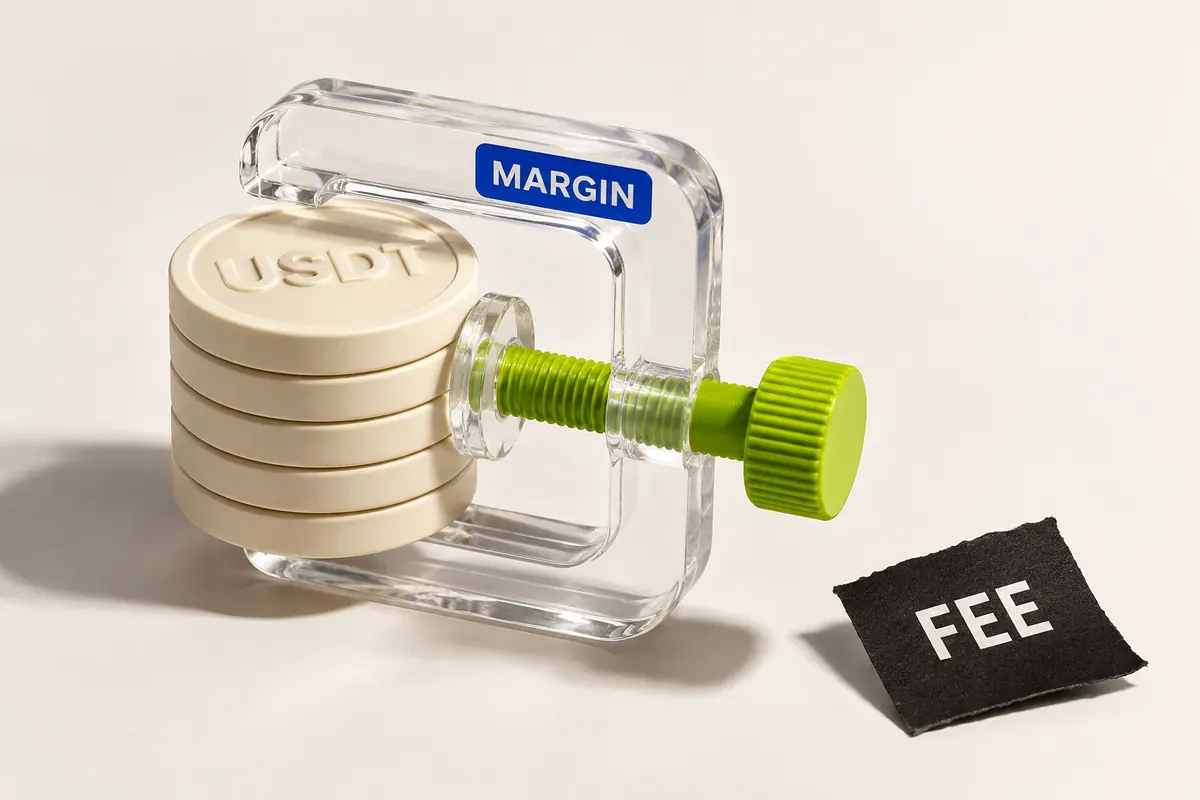
After a fill, reconcile the opening fee as a charged expense and the remaining support as collateral. On closing, released collateral is not a second profit. The account receives the result of its price movement and cash flows, while funds no longer required as margin become available subject to other positions and orders.
Order margin and position margin need not use the same price
The submitted order has a price or an execution estimate. An open position has a current valuation. Bybit’s initial-margin explanation uses mark price for position value and notes that its position-tab amount includes an estimated closing fee. A calculation based only on the original entry can therefore differ from the displayed amount without implying an error.
For example, valuing the same 2 ETH at 3,050 rather than 3,000 produces 6,100 of position value and 610 of simple initial requirement at 10x. No additional ETH was bought by that revaluation. To compare the ticket with the position panel, align quantity, valuation price and included reserves first.
Wallet balance vs available margin: what is tying up the money?
A wallet total answers how much is recorded in the account, not how much can fund another order. Existing positions, active orders and other obligations can reserve part of that support. In multi-asset accounts, not every dollar of displayed asset value necessarily counts as a dollar of usable collateral. A deposit into a separate funding wallet can also remain outside the trading account until transferred.
Use a deliberately simple allocation example with 1,000 USDT in cash, no unrealized P&L, no borrowing and no collateral discount. An existing position occupies 500 including its reserves. A still-unfilled opening order occupies another 300. Only 200 is available for new commitments. The 300 has not bought anything yet; it is reserved so the order can be supported if it fills.
- Existing position and reserves
- 500 USDT
- Unfilled opening order
- 300 USDT reserved
- Available for a new commitment
- 200 USDT
- Wallet cash
- 1,000 USDT · unchanged
A new order requiring 400 USDT does not fit.
Canceling the unfilled order releases its 300 in this example, raising availability to 500. Wallet cash stays at 1,000, the existing position stays open, and there is no 300 profit. A new order needing 400 can now fit, while one needing 606.27 still cannot. Canceling an order solves the reservation problem only to the extent of funds actually released.
A partially filled order is different. Canceling its remainder removes the unfilled commitment but leaves the filled position and its margin requirement. If a 300 reserve has partly become live exposure, do not expect the full 300 to reappear as available funds. Read the remaining order quantity and open position together.
Three balance restrictions that look similar but are not
- Reserved for an opening order: canceling or reducing the unfilled commitment may release support.
- Supporting an open position: reducing exposure or changing eligible collateral affects the requirement; merely canceling unrelated orders does not close the position.
- Not eligible or not transferable: the asset, account location, borrowing obligations or withdrawal rules may prevent the displayed value from becoming spendable USDT.
Bybit’s UTA FAQ distinguishes margin balance from the amount available for order placement. Its glossary also warns that an indicative account balance in cross or portfolio mode need not equal the final amount usable for a particular order. That distinction is especially relevant when an order itself changes collateral value or creates an immediate marked loss.
For example, a proposed purchase far above the current mark can start with an unfavorable valuation if it executes at that price. A platform may account for that order loss before accepting the commitment. The problem is not always an invisible fee. Compare the submitted price with the reference valuation before concluding that the account balance is wrong.
Can maintenance margin rise without opening another trade?
Yes. Maintenance is often calculated from the current value of a position. For 2 ETH at 3,000 and an assumed flat 1% requirement, it is 60 USDT. If the relevant valuation rises to 3,300, the same quantity is worth 6,600 and the requirement becomes 66. The rate stayed at 1%; the amount increased because its base increased.
A price rise increases maintenance for both directions, but also changes equity. It creates a loss for the short and a gain for the long. Compare the resulting maintenance requirement with eligible equity at that same price.
A tier change is not always a cliff on the whole position
Larger positions may enter higher maintenance tiers. Some schedules apply a deduction so that the higher rate does not abruptly reprice every dollar of exposure. Bybit documents a rate-and-deduction method. In a purely illustrative schedule, the first 10,000 requires 1% and the next portion requires 2%. A 12,000 position needs 100 plus 40, or 140—not 240.
Check the tier arithmetic
For the illustrative second tier, 12,000 × 2% − 100 = 140 USDT. The 100 deduction preserves the lower charge on the first 10,000. This is equivalent to 10,000 × 1% + 2,000 × 2%. These are invented teaching tiers, not current ETH or BTC parameters.
At a boundary of 10,000, both expressions produce 100. Just above it, the requirement increases on the additional portion. The applicable exchange table can also impose a maximum leverage or position value, so reproducing the maintenance amount does not prove the proposed order is allowed.
Active orders can also count toward risk limits, depending on how the platform aggregates exposure. A position close to a tier boundary may have less capacity for an additional opening order than its current filled value suggests. Include the orders that could add exposure when checking a proposed increase.
The exchange can revise its margin parameters as well. A saved screenshot of a tier schedule does not lock those terms for the life of a perpetual. If the displayed requirement changes while quantity and price appear unchanged, compare the effective product parameters and notices before altering a strategy to fit an obsolete rate.
Explore position tiers and maximum leverage togetherIs a higher maintenance margin ratio safer or more dangerous?
The percentage’s definition decides. A contract maintenance rate might mean required margin divided by position value. An account risk ratio might mean required support divided by available support. Another platform can display the reverse. All may use similar words, but increasing values tell different stories.
| Display convention | Illustrative reading | Movement toward the boundary |
|---|---|---|
| Requirement ÷ support, as in Bybit account MMR | 200 ÷ 1,000 = 20% | Rises toward 100% as support shrinks |
| Support ÷ requirement, as in OKX margin level | 1,000 ÷ 200 = 500% | Falls toward 100% as support shrinks |
| Contract maintenance rate on notional | A separate product parameter, such as 1% | Not an account health percentage |
If eligible support drops to 250 while the required amount remains 200, the first convention reads 80% and the second 125%. Both describe 50 of remaining support above that simplified requirement. It would be a mistake to prefer the 80% screen merely because its number is lower, or to think 125% guarantees more protection because it is higher.
Bybit’s UTA account MMR rises toward its risk threshold; OKX documents a maintenance margin ratio reaching 100% or lower as the trigger for its liquidation process. Their precise denominators, fee allowances and account modes differ. They are not numerically interchangeable dashboards; the illustration explains direction, not an exact conversion between live accounts.
Initial-margin ratios need the same care. A platform can restrict additional exposure when initial requirements consume the available support even though maintenance requirements remain covered. “Cannot open” and “must liquidate” refer to different tests. Copying a threshold from one ratio to the other turns a useful risk display into a false alarm—or misses a real one.
What should you change when a futures order says insufficient margin?
For an opening rejection, compare the required order cost with available balance after reservations. For a position already open, compare eligible equity with maintenance instead. They are different tests and can fail at different times.
| Message | Start here |
|---|---|
| Insufficient balance to open | Initial margin + fees/reserves versus available balance |
| Maintenance warning | Eligible equity versus current maintenance requirement |
| Margin ratio changed | The product’s numerator, denominator and direction of risk |
Margin questions behind rejected orders and changing balances
Do I pay maintenance margin in addition to initial margin?
Maintenance is a required level of remaining support, not a second trading fee. An order may separately reserve execution costs. Distinguish required collateral, reserved fees and fees actually charged in the transaction record.
Why is my available balance lower than my USDT wallet balance?
Positions and active orders may already occupy funds. Borrowing, asset eligibility and account mode can create further differences. Start with the order-specific available amount; canceling an unfilled order only releases the commitment that remains unfilled.
Does canceling an order recover a trading loss?
No. It can release funds reserved for an unfilled commitment. A filled portion remains a live position until reduced, and a realized loss remains an expense. Availability can increase without account equity increasing.
Can I lower maintenance margin just by choosing higher leverage?
Not as a general rule. The simple initial requirement falls as leverage rises, but maintenance follows the product’s value, tier and account rules. Treat the two requirements separately when comparing the resulting display.
Can unrealized profit fund a new order?
Only where that account mode treats it as eligible available equity, after maintenance and order reservations. A positive P&L display alone does not identify the amount that can support another order.
Sources and research 7 source references
Reviewed current official order-cost, initial-margin, UTA and maintenance documentation on 7 October 2026. The ETH order applies a published reserve relationship to invented prices and fee inputs. Allocation, tier and ratio examples isolate one mechanism and are not account simulators. No account balance was accessed and no order was submitted. Ratios are compared by direction, not presented as interchangeable live measurements.
Evidence by section
- Why can a position stay open when there is not enough margin to add to it?
- Why does the order ticket ask for more than initial margin?
- Wallet balance vs available margin: what is tying up the money?
- Can maintenance margin rise without opening another trade?
- Is a higher maintenance margin ratio safer or more dangerous?
Source register and access
- Bybit: Order cost: margin, opening fee and closing reserveLink checked · Reviewed 7 Oct 2026 · Product rule · next editorial check due 2027-01-05
- Bybit: Initial margin for USDT perpetual and expiry contractsLink checked · Reviewed 7 Oct 2026 · Product rule · next editorial check due 2027-01-05
- Bybit: Trading terms and formulas in the Unified Trading AccountLink checked · Reviewed 7 Oct 2026 · Product rule · next editorial check due 2027-01-05
- Bybit: Unified Trading Account FAQ: margin and available balancesLink checked · Reviewed 8 Oct 2026 · Product rule · next editorial check due 2027-01-06
- Bybit: USDT maintenance tiers, deductions and closing reserveLink checked · Reviewed 7 Oct 2026 · Product rule · next editorial check due 2027-01-05
- OKX: Tiered maintenance margin ratio rulesLink checked · Reviewed 7 Oct 2026 · Product rule · next editorial check due 2027-01-05
- OKX: Futures PnL and margin-level calculation rulesLink checked · Reviewed 7 Oct 2026 · Product rule · next editorial check due 2027-01-05