










Which exchange is best for crypto futures in Denmark?
For Danish traders who already use OKX, its European X-Perps account is a practical place to start: it combines a documented derivatives product with position-history and snapshot tools. Kraken is the stronger alternative to examine when you want a choice between perpetual and dated crypto contracts.
The deciding question is what you need from the futures account after the first trade. A Danish resident has to think about open positions at year-end, not just withdrawals to a bank. An exchange that executes your preferred market but leaves you unable to reconstruct its results can be an inconvenient choice even when the advertised commission is attractive.
| Product | Useful strength | Condition to resolve |
|---|---|---|
| OKX X-Perps | European crypto markets and downloadable position records | Activate the product and confirm the required report fields for your account |
| Kraken EEA derivatives | Perpetuals plus fixed-maturity futures | Compare the exact contract, its collateral rules and the account’s approved limit |
| Robinhood Europe perps | Another European crypto product with a published all-in commission formula | Confirm personal eligibility and compare the achieved price, not commission alone |
That puts OKX first for the documented workflow discussed here, rather than claiming it wins every price comparison. Its public history guide includes funding fees in position records and offers dated position snapshots. The same guide says an annual summarised profit-and-loss figure is not currently provided automatically. Those exports are ingredients for Danish reporting, not a completed Danish tax return.
Kraken is particularly relevant if your strategy requires a contract with a specific expiry. A reader holding one BTC trade for several weeks has different needs from someone frequently entering and closing smaller positions. The best choice can change with those needs even when both readers live in Copenhagen.
Robinhood’s published fee structure provides a useful competitive check. It combines a 0.02% platform commission with a zero maker or 0.02% taker venue fee, giving 0.02% or 0.04% before funding and execution differences. That can beat a starting 0.05% taker commission, but it is not enough on its own to establish the lowest complete trading cost.
The shortlist therefore gives you a practical starting point and a reason to challenge it. Use OKX if its approved markets and reporting fit your activity; compare Kraken for contract flexibility. Another eligible product earns consideration when it demonstrably delivers the market and execution you need at a better total cost.
How much crypto leverage is available to a Danish resident?
Danish retail crypto CFDs require 50% initial margin under the Danish Financial Supervisory Authority’s product intervention, equivalent to a 2x opening leverage limit. This is a product-specific rule. It does not establish that all cryptocurrency activity is banned or that every global exchange advertisement describes a product legally distributed in Denmark.
The distinction matters because European exchanges also publish derivatives offerings with different product descriptions and advertised limits. OKX describes X-Perps as European expiry futures with a funding mechanism and advertises up to 10x. Kraken’s European specifications distinguish market limits and professional maximums. A retail account must use its own approved conditions, not copy a number from another client category.
In February 2026, ESMA reminded providers that calling a product a perpetual future does not remove CFD protections when the contract meets the CFD definition. The practical response is to verify the European product offered to your Danish account. A 10x promotional page and a 2x CFD rule answer different questions until the instrument and its distribution are identified.
Is the futures screen actually active?
An accessible homepage or a funded spot balance is not the final test. Look for the named European derivatives product, completion of its assessment and the actual order limits. Kraken’s EEA eligibility requirements include verification, a derivatives questionnaire and tax information. OKX says all thirty EEA countries are supported, but activation and rollout conditions can vary.
Someone moving from a global account may recognise the exchange logo while receiving a different product menu. This can affect the available collateral, contract codes and markets. Save the old account records before a migration and build the new comparison around the replacement product, rather than assuming that every previous position type remains available.
A Danish-language interface is helpful if you prefer local explanations, but it is not a separate licence or a promise of Danish-speaking derivatives support. Choose the product first; treat language as an additional service preference. Otherwise a comfortable onboarding screen can distract from a missing contract or an unsuitable account limit.
For the same reason, we do not rank a DEX here as a regulated substitute when a centralised account refuses a product. A wallet connection would not resolve the product’s legal distribution, your Danish tax treatment or the platform’s own terms. The documented European exchange accounts remain the relevant starting comparison.
Can Denmark tax a futures gain before you close the trade?
Yes. Danish guidance treats covered crypto financial contracts under the annual mark-to-market approach: a position crossing the end of the income year can produce a taxable annual gain or loss while still open. Waiting to withdraw money to a Danish bank does not postpone that calculation.
The Danish legal guidance explicitly discusses crypto perpetual and quarterly futures as financial contracts. This is more specific than applying a general article about buying and selling Bitcoin to every activity in an exchange account. The contract result belongs in the financial-contract analysis; the coins held beside it can have their own treatment.

One trade, two tax years
Consider a deliberately simplified example already expressed in DKK. A contract opened during the year has an unrealised gain of DKK 12,000 at 31 December. It closes the following February with a total gain of DKK 8,000. Ignoring fees and currency effects for this illustration, the first year has a DKK 12,000 increase and the next year a DKK 4,000 decrease from the year-end value.
The trade has not earned DKK 20,000. Nor does its February closing result erase the earlier year automatically. The point is the division of the result between years. The exact tax calculation must incorporate the applicable contract valuation, costs, currency conversion and loss rules.
For someone keeping profits fully committed as trading margin, this creates a cash-planning issue. An annual taxable gain can exist without a matching bank withdrawal. Keeping the full balance tied up in positions because “I have not cashed out” can leave less accessible money for a later tax payment.
Does closing on 30 December solve everything?
Closing fixes the trading result at that moment but is not a universal tax shortcut. It can create commissions and execution costs, and reopening introduces a new entry price. Whether it is sensible depends on the strategy and the tax facts, not a rule that every Danish trader should liquidate their account before New Year.
A better operational habit is to retain a position snapshot and the records needed to value it. This is why the opening comparison gives weight to the ability to reconstruct open positions. The record is useful whether you decide to close, continue holding or reduce only part of the exposure.
Can a futures loss be deducted against your salary?
Do not budget on a futures loss reducing your salary tax in the same way as an ordinary expense. Danish financial-contract losses have restrictions. SKAT’s guidance describes deduction against qualifying declared net gains and the handling of losses carried forward. A losing year does not automatically produce a cash refund equal to the loss multiplied by your preferred tax percentage.
The official guidance identifies box 346 for gains and eligible losses, and box 85 for losses to carry forward. More important than memorising a box number is retaining enough history to establish the relevant gains and losses. A new tax-software import may not contain older years needed to assess that position.
Why the exchange’s net-profit number is not the answer
An account could show DKK 20,000 gained on one set of trades and DKK 18,000 lost on another. The simple economic difference is DKK 2,000. Whether the tax return uses exactly that net result depends on the instruments and applicable rules. Mixing coin disposals, financial contracts and unrelated income under one app total can conceal the distinctions.
That is not a reason to prefer a platform with fewer visible records. It is a reason to export the underlying transactions. Two products marketed as “crypto trading” can create different tax records, while two differently named futures products may belong to the same financial-contract analysis.
Keep a separate reserve for tax outside the amount you intend to expose to margin losses. There is no universal percentage we can assign to every Danish reader because capital-income tax depends on the person’s circumstances. The useful planning figure is your estimated liability based on the actual records, updated when the year’s result changes materially.
Would opening a company automatically make this easier?
An ApS is a different taxpayer and account owner, not a settings change inside a personal exchange account. The Danish guidance discusses company investment in these contracts, but that does not establish that incorporation is worthwhile for a particular trader. Accounting costs, distributions and the company’s own tax treatment belong in the calculation.
For a personal account trading occasionally, adding a company can create more work than it solves. For a genuine existing business, the comparison may be different. Decide who owns the capital before funding, so that the exchange, bank and accounting records describe the same owner.
Does settlement in BTC or stablecoins change the paperwork?
The asset paid out by the contract matters in Denmark. SKAT distinguishes the financial-contract result from cryptocurrency received or spent on settlement. Coins received as a gain can start a separate speculative holding; coins used to meet a loss can also create a disposal for the coin-tax analysis.
This makes cash settlement and coin settlement different administrative choices even when the two screens show the same percentage return. One can leave you with a cash balance; the other can leave you with newly acquired crypto whose later sale requires its own record. Neither label proves a lower tax bill by itself.
A gain paid in coins
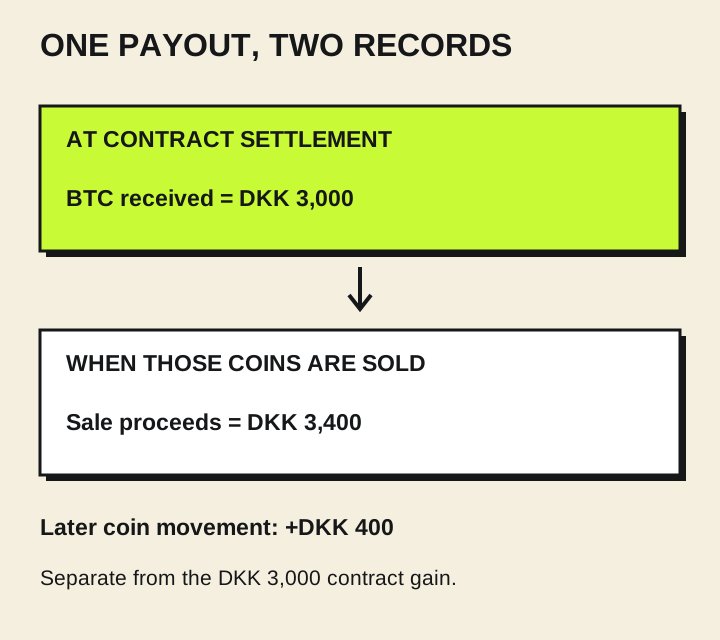
Suppose a contract pays an amount of BTC worth DKK 3,000 at settlement. The financial-contract gain has that value for this simplified example. If those coins are later sold for DKK 3,400, the extra DKK 400 is a later movement in the coins, not another DKK 3,400 futures profit. Fees and the precise classification still need to be included in the real calculation.
The original settlement value is therefore valuable information. If an export records only the number of coins and the final sale, it may leave you reconstructing the earlier DKK value. Keeping the date, amount, market value and relevant exchange record together is considerably easier than recovering them months later.
A loss paid with existing coins
The reverse deserves the same care. Paying a contract loss with coins you already own does not make the old acquisition record irrelevant. There can be a financial-contract loss and a separate movement between the coins’ acquisition value and their value when spent.
For a Danish reader comparing collateral options, simpler records can have a real practical value. It may be worth using a supported cash balance rather than adding coin movements solely to avoid a small conversion charge. If keeping coin exposure is intentional, retain that structure and record it correctly; the point is to choose knowingly.
Stablecoins also need their own classification. The Danish guidance includes decisions treating specific stablecoin arrangements as financial contracts. Do not assume that every token with a stable price is ordinary untaxed cash, or that holding a dollar token removes the DKK exchange-rate calculation.
How do you fund crypto futures from a Danish kroner account?
Denmark’s krone is closely managed against the euro, with a central rate of DKK 7.46038 per EUR. That does not make DKK and EUR interchangeable inside a deposit form. It also does not mean a Danish bank converts them at the central rate without a charge.
For an account whose accepted bank-deposit currency is EUR, obtain a DKK-to-EUR quote and compare the euros actually credited. Kraken and OKX publish European euro-transfer arrangements. Their account instructions, rather than the currency selected for displaying the website, determine what should be sent.
The krone’s euro link does not stabilise dollar profit
Many crypto contracts are quoted or settled using dollars. The DKK/EUR relationship therefore does not fix their value in kroner. If a contract produces $500, its DKK value still depends on the relevant dollar exchange rate. A stable-looking EUR/DKK chart is not a guarantee about a USD-settled account.
For illustration, $500 at DKK 6.70 per dollar equals DKK 3,350; at DKK 6.40 it equals DKK 3,200. The difference is DKK 150 before conversion charges. This is not an exchange fee and should not be added to a fee table as though the provider charged it.
Read Danish exchange-rate tables in the right units
Nationalbanken publishes exchange rates as DKK per one hundred units of foreign currency. A displayed value of 750 for EUR in a hypothetical example therefore means DKK 7.50 per euro, not DKK 750. Misreading that unit can make a tax spreadsheet wrong by a factor of one hundred while every individual trade import looks plausible.
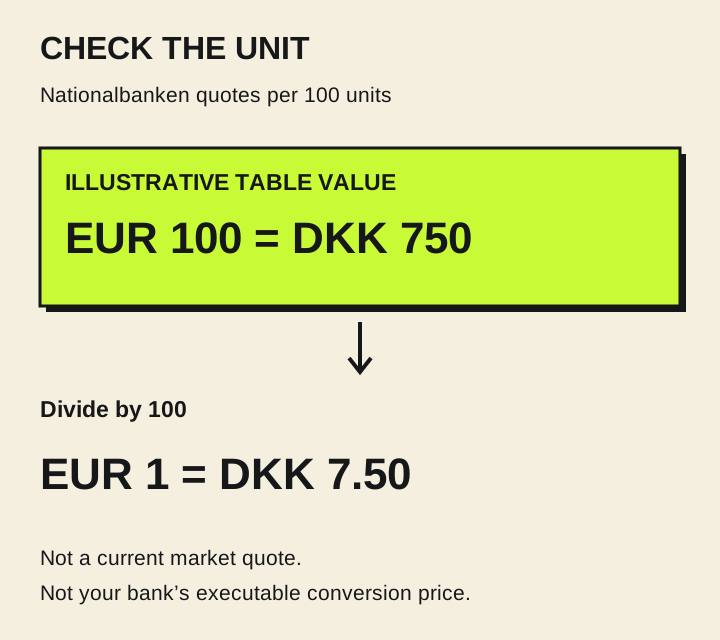
Use the valuation method appropriate to the transaction and tax calculation; a central-bank reference rate is not the same as the executable retail conversion quote. Save which rate and date you used. The aim is a reproducible calculation, not finding whichever historical rate makes a particular result look better.
A Danish trader with income already paid in euros may avoid an initial DKK conversion by funding from their own supported euro account. Someone paid only in kroner should price that conversion explicitly. Use the funding route that matches the currency you actually hold; converting DKK to EUR and immediately back again adds no trading benefit.
Is a Danish crypto app a useful bridge to futures?
Firi’s Danish service is relevant when you already hold coins there or want a domestic DKK bank connection. Its published Danish pricing includes free bank deposits, a 0.7% trading fee and a DKK 45 bank withdrawal fee. Those features describe local coin trading and payments; they do not establish an equivalent leveraged futures market.
Card funding adds another cost. Firi’s schedule lists 3.9% for card and Apple Pay deposits, with trading charges additional where applicable. It also describes price additions for some direct purchases. Compare the final quote for the asset and method, rather than assuming the headline trading commission is the entire acquisition cost.
For a DKK 10,000 amount, a 0.7% trading commission is DKK 70. A hypothetical purchase and later sale at the same DKK value would incur DKK 140 in those commissions, before any spread, network fee or bank withdrawal. Adding the DKK 45 withdrawal brings those specified components to DKK 185. A card-funded route would add a further DKK 390 on that deposit assumption.
This does not make the local service a bad choice for its intended purpose. It shows why buying coins there solely to move them into a separate futures account should be compared with direct euro funding. The local route may be familiar, but it contains additional transactions that a direct transfer can avoid.
Existing coins change the calculation
If your balance is already in supported crypto, a fresh purchase fee is not part of the onward-transfer decision. Count the costs you would actually incur from today’s starting balance. Including a historic fee on one route but excluding it from another would produce a misleading comparison.
The receiving asset and network must match the destination account’s current instructions. In particular, Kraken’s current EEA restrictions differ from old advice suggesting USDT could simply be deposited after trading support ended. Confirm the present restriction before choosing a transfer asset; do not rely on an old tutorial.
A small test transfer can establish that the route works, but it does not prove that every larger payment will be processed without review. For a larger withdrawal to a Danish bank, keep the trading and transfer records available so that the source of the incoming amount can be explained without improvising a transaction history.
What does a Danish futures trader actually pay per trade?
Use the same exposure, order style and holding period when comparing exchanges. The amount you deposit is not the value on which the futures trading commission is normally calculated. A DKK 5,000-equivalent account supporting a DKK 20,000-equivalent position should compare commission on the position, not on the smaller account balance.
At 0.05% per execution, opening and closing that position at an unchanged value costs DKK 20 equivalent in total. At 0.02%, the corresponding commission is DKK 8. At 0.04%, it is DKK 16. These are simplified commission-only examples; the exchange charges in its applicable currency, and different entry and exit values change the calculation.
Kraken and OKX publish starting maker/taker rates of 0.02% and 0.05% for the European products discussed here. Robinhood’s published combined rate produces the third example. None of those rates establishes the spread, market impact or funding that a real position will incur.
A cheaper market order can still cost more overall
If a platform saves DKK 4 in commission on that round trip but delivers an average execution DKK 12 worse, the total is DKK 8 worse. This is particularly relevant when trading smaller altcoin markets. The count of assets listed across an exchange is less useful than the available size at the price of your chosen European contract.
Check a price quote at your normal order size. A tiny test fill can be useful for learning the interface but says little about what a much larger order would receive. If your strategy usually scales out in several pieces, compare that pattern instead of assuming one entry and one exit.
Funding belongs to the holding period
A funding quote is a periodic payment between the two sides, not a guaranteed annual yield. On DKK 20,000-equivalent exposure, a hypothetical 0.01% payment is DKK 2. Three such payments a day would be DKK 6 at a constant position value and unchanged rate. Over ten days that becomes DKK 60, already greater than the commission difference in the opening example.
The rate can move or reverse sign. A strategy based on collecting funding therefore needs to account for price movement, fees and changing payments rather than treating the current rate as income locked in. If holding cost drives the decision, compare a dated contract’s price and expiry as well as a perpetual’s current funding.
Which records should an active Danish trader keep?
Keep the futures records separate from the general coin-purchase history. An export labelled “trades” can look complete while omitting a different product’s funding entries or open-position values. Check the report against an actual position you recognise before importing a year of activity into software.
Kraken documents a derivatives log containing events such as futures trades, funding changes and transfers. Its general account-document tools are separate. OKX’s position-history documentation describes funding fields and a position-snapshot export. Availability of a public guide does not prove that your account has exported every necessary field: inspect the file itself.
A useful file set lets you answer four concrete questions: what was traded, what fees and funding changed the balance, what remained open at the relevant valuation date, and which deposits or withdrawals were simply movements of your own capital. Those questions prevent a deposit from looking like a trading gain or a transfer between wallets from looking like a sale.
Do not count the same loss twice
An exchange may show realised profit already net of some costs while also listing those costs in another report. Subtracting every displayed fee a second time understates the result. Reconcile one completed trade manually first: opening amount, closing amount, commission and funding should lead to the expected balance change.
If the account has multiple subaccounts, retain their identities in the export. A transfer from one subaccount to another is not new income for the owner, but it can appear as an outgoing entry in one file and an incoming entry in another. The combined records explain that movement.
This is not an invitation to build a complex trading journal before you can use a platform. It is a way to test whether a few essential records exist. An account that makes them easy to retain can save a Danish trader more time than a flashy dashboard with a single unexplained annual percentage.
What changes if you move into or out of Denmark?
Moving while positions remain open can create a valuation date that matters independently of the ordinary year-end. SKAT has separate guidance for financial contracts when a person enters Danish taxation and for potential exit-tax rules when leaving. The outcome depends on the person’s circumstances; changing an exchange address alone does not settle it.
Before a genuine move, save a dated position snapshot, acquisition and transaction records, and the relevant exchange-rate evidence. Those records let an adviser identify what value existed before and after the change. Reconstructing the account later from a final withdrawal is much harder.
For a Danish citizen living abroad, the passport does not by itself mean the Denmark product menu or tax analysis remains correct. Likewise, a foreign citizen genuinely living and taxable in Denmark should not assume that an exchange’s original home-country settings remain appropriate. Update the provider with the real circumstances and check the offered replacement product.
If that update requires closing or transferring a position, compare the execution cost and tax timing before acting. A country change can create practical decisions that a static “available in Denmark” badge cannot answer. Get the provider’s proposed account treatment in writing where possible, particularly for an open position that cannot simply be moved intact.
The final choice remains a crypto-trading decision: suitable European contracts, competitive execution and records you can use. Danish local requirements sharpen that comparison. They do not justify burying the futures shortlist below a general lesson about Bitcoin or replacing it with a catalogue of traditional investment products.
Which crypto futures exchanges can Greenland residents use?
Kraken’s international derivatives service is the best-documented starting candidate for a resident of Greenland. Its current geographic exclusion list does not name Greenland, and its earlier December 2025 futures campaign explicitly included the territory. That campaign has ended; we use it only as supporting evidence of territorial recognition, not as a current bonus offer. Full verification and product approval still determine access to a particular account.
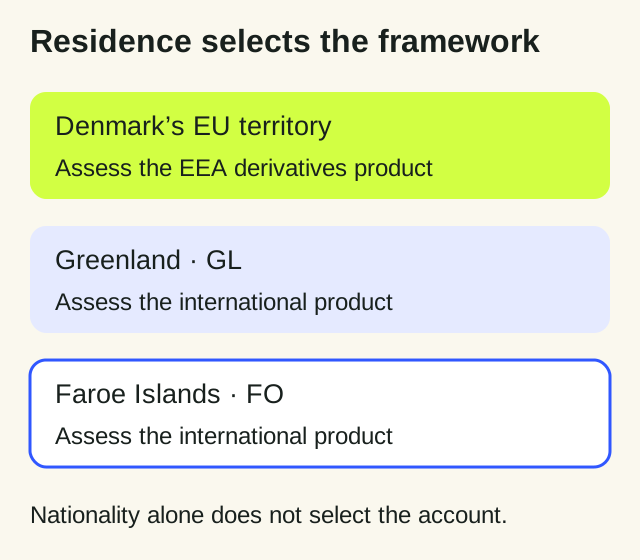
Greenland is outside the EU even though Greenlanders who are Danish nationals are EU citizens. For exchange access, a home in Nuuk is not equivalent to a residential address in Copenhagen. The mainland Danish comparison above concerns European products. Do not carry its X-Perps availability, European contract limits or account entity into Greenland merely because the passport says Denmark.
| Exchange | What the research establishes | What it does not establish |
|---|---|---|
| Kraken international derivatives | No Greenland exclusion in the current derivatives list; earlier futures documentation names Greenland | Automatic account approval or the same contract limits as Kraken EEA |
| KuCoin | The live public KYC region response includes GL; global terms do not name Greenland as restricted | Approval of every document or every futures product |
| Bybit international | Greenland is absent from the published excluded-jurisdiction list | An individually verified account or unrestricted local bank funding |
The funding difference is easy to miss. Kraken’s SEPA table specifically excludes Greenland, and the payment-provider coverage reviewed makes the same distinction. A balance denominated in Danish kroner is therefore not proof that a local bank transfer can use the Danish-resident EUR deposit route. Use an international transfer method actually offered to the verified account, or an accepted crypto deposit, with both the currency and network confirmed before sending.
For somebody who already owns supported crypto, that may make a direct transfer more practical than converting into EUR solely to follow a mainland funding example. Somebody starting with a Greenlandic bank balance instead needs the bank’s actual outgoing-transfer quote and the exchange’s receiving instructions. Neither situation requires inventing a Greenland-specific maximum leverage: the international contract’s current risk tier and the approved account determine the usable amount.
The Danish year-end tax discussion earlier in the article also should not be copied automatically to a Greenland-resident tax return. This section’s conclusion concerns exchange access: Kraken is a supported candidate for assessment, with KuCoin and Bybit as conditional alternatives, rather than an assertion that Greenland uses mainland Denmark’s full financial and tax framework.
Crypto leverage from the Faroe Islands: accounts and funding
For a Faroese resident, Kraken international derivatives remains a sensible first candidate; the territorial evidence above covers the Faroe Islands separately as well as Greenland. KuCoin is another concrete option to assess, rather than assuming that a small territory will be missing from every exchange’s registration system. Its public KYC response contains an FO entry for the Faroe Islands. Bybit’s international restrictions also do not name the territory.
The distinction that matters at registration is between the document’s issuing jurisdiction and the home address. A Danish-issued passport does not require a Faroese resident to invent a Copenhagen address. Where the provider asks for residence, give the actual Faroese location; where it asks who issued the identity document, supply the document’s real details. A recognised region entry helps resolve the first question but cannot guarantee acceptance of an individual document.
Do Danish banking links make the account European?
No. The Faroese government describes the islands’ banking links with Denmark and the króna’s equal value with the Danish krone, while also explaining that the Faroes remain outside the EU. These banking arrangements do not put a Tórshavn resident inside the exchange’s EEA derivatives programme. The government’s own distinction is more informative than grouping every Danish-currency account into one European customer category.
For funding, compare a quote into the currency the exchange actually accepts. If the sending balance is in kroner and the receiving method takes EUR, the conversion still matters even when the original balance looks identical in value to Danish kroner. Kraken’s published SEPA territory table excludes the Faroe Islands. A transfer marketed as an ordinary domestic Danish payment should not be assumed to satisfy the receiving exchange’s international or SEPA instructions.
A Faroese trader with an existing approved international futures account should therefore compare contracts within that account before opening a second European-branded service. For instance, an existing Kraken or KuCoin crypto balance may already provide the desired collateral; the mainland Danish OKX recommendation is not a reason to migrate it into an unverified EEA product. Bybit can be considered as an alternative on its international terms, with its separate payment-provider rules still applying.
Moving permanently between the Faroes and mainland Denmark changes this assessment. Before migrating an account, establish whether the destination entity supports the open contract and collateral. Preserve the old account’s history rather than expecting a change of residence to convert the product automatically. The practical choice follows where you live and which account is approved, not which of the two currencies happens to appear on a bank statement.